Alaska Window Tint Law

Contents
- 1 Key Takeaways
- 2 📑 Table of Contents
- 3 Introduction: Why Alaska’s Window Tint Law Matters
- 4 Understanding the Core Rule: Visible Light Transmission (VLT)
- 5 Alaska’s Specific VLT Requirements: Front vs. Rear
- 6 Other Critical Alaska Tint Restrictions: Beyond Darkness
- 7 Penalties for Non-Compliance: What Happens If You Get Caught
- 8 Special Considerations: Medical Exemptions and Factory Tint
- 9 Comparing Alaska to Neighboring States and Popular Tint Destinations
- 10 Practical Tips for Alaska Drivers Before You Tint
- 11 Conclusion: Enjoy Your Tint, Within the Law
- 12 Frequently Asked Questions

Parking Sensor Kit
Car Emergency Roadside Kit

Digital Tire Pressure Gauge

Car Seat Cover (Universal Fit)
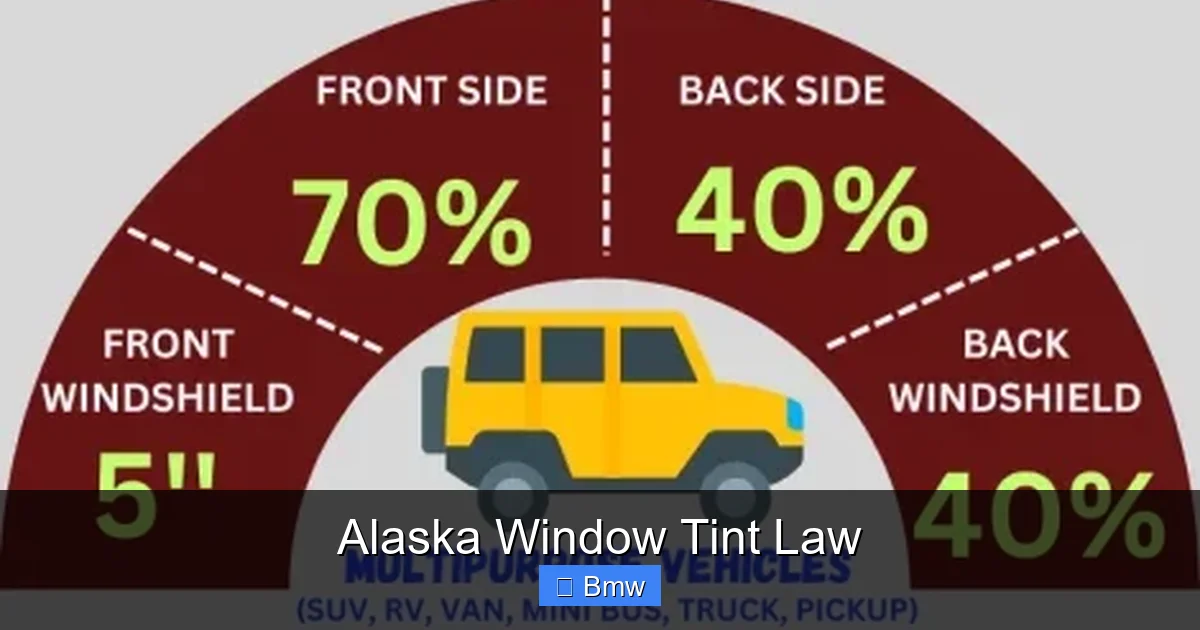
Alaska’s window tint law is straightforward but strict. It mandates a minimum 70% Visible Light Transmission (VLT) for the front windshield and front side windows of all passenger vehicles. There are no specific darkness restrictions on the rear windows of sedans, but SUVs and vans must allow more than 70% VLT on the rear side and back windows. Violations can lead to fines and a requirement to remove the tint. Always verify your tint’s compliance before installation, especially given Alaska’s unique climate considerations.
Key Takeaways
- Front Windows Must Be Very Light: Alaska law requires front windshield and front side windows to let in at least 70% of light (70% VLT), meaning only very light tint is legal.
- Rear Window Rules Differ by Vehicle Type: For sedans, rear windows can be darker. For SUVs, vans, and trucks, rear side and back windows must also allow over 70% VLT.
- Reflective & Colored Tint is Generally Banned: Metallic, mirrored, or any tint that gives a colored appearance (red, blue, yellow, etc.) is illegal on all windows.
- No Formal Medical Exemptions: Unlike some states, Alaska does not have a statewide medical exemption process for darker front-side tint.
- Installers & Drivers Are Both Responsible: Both the person who applies the illegal tint and the vehicle owner can be cited for violations.
- Penalties Involve Fines & Removal: A first-time tint violation is typically a non-criminal traffic infraction with a fine, and you will be ordered to remove or replace the non-compliant tint.
- Factory Tint is Usually Compliant: Most vehicles from the factory meet Alaska’s standards. Aftermarket tint is the primary source of violations.
📑 Table of Contents
- Introduction: Why Alaska’s Window Tint Law Matters
- Understanding the Core Rule: Visible Light Transmission (VLT)
- Alaska’s Specific VLT Requirements: Front vs. Rear
- Other Critical Alaska Tint Restrictions: Beyond Darkness
- Penalties for Non-Compliance: What Happens If You Get Caught
- Special Considerations: Medical Exemptions and Factory Tint
- Comparing Alaska to Neighboring States and Popular Tint Destinations
- Practical Tips for Alaska Drivers Before You Tint
- Conclusion: Enjoy Your Tint, Within the Law
Introduction: Why Alaska’s Window Tint Law Matters
So, you’re thinking about tinting your car windows in Alaska. Maybe you want to beat the summer glare from that midnight sun, add a touch of privacy, or simply give your BMW a sleeker look. Before you book that appointment, there’s one critical step you absolutely cannot skip: understanding the Alaska window tint law. It’s not just about style; it’s about staying on the right side of the law and avoiding a costly, inconvenient ticket.
Window tint laws can feel like a confusing patchwork from state to state. What’s perfectly legal in Arizona might land you in hot water in Alaska. This guide cuts through the confusion. We’ll break down the exact Visible Light Transmission (VLT) percentages, explain the special rules for different vehicle types, cover what’s banned (spoiler: reflective tint is a no-go), and walk you through the real-world consequences of non-compliance. Whether you drive a compact sedan, a rugged SUV, or a luxury vehicle like a BMW, this is your definitive resource for navigating tinting in the Last Frontier.
Understanding the Core Rule: Visible Light Transmission (VLT)
At the heart of every window tint law, including Alaska’s, is a term called VLT. It stands for Visible Light Transmission. In simple terms, it’s the percentage of visible light that a window allows to pass through. A 70% VLT tint allows 70% of outside light in and blocks 30%. A 5% “limo” tint only allows 5% of light in. Alaska’s law sets the minimum VLT for various windows, meaning the tint cannot be darker than that percentage.
Visual guide about Alaska Window Tint Law
Image source: carglassadvisor.com
How is VLT Measured and Enforced?
Law enforcement officers use a device called a tint meter. It’s a handheld tool that clamps onto your rolled-down window and gives a direct VLT reading. It’s not a guess; it’s a measurement. If your meter reads 69% on a front window that requires 70%, that’s a violation. It’s that precise. This is why getting your tint from a reputable shop that guarantees compliance is so important. They should test the tint with a meter before installing it.
Alaska’s Specific VLT Requirements: Front vs. Rear
Alaska divides its rules primarily by window location and vehicle classification. Let’s make it crystal clear.
Visual guide about Alaska Window Tint Law
Image source: taxihack.com
Front Windshield and Front Side Windows: The 70% Rule
This is Alaska’s most consistent and strict rule. For all passenger vehicles—whether it’s a BMW 3 Series, a Toyota Camry, or a Ford F-150—the following must allow more than 70% of light to pass through:
- Front Windshield: Tint is allowed, but it must be non-reflective and cannot be darker than 70% VLT. Often, a clear UV-blocking film is used here.
- Front Side Windows: The two doors immediately next to the driver and front passenger. These must also be over 70% VLT.
In practice, this means the tint on your front windows will look very light, almost like factory glass. It won’t provide the deep, dark privacy you might see on cars in other states. For a BMW owner, this rule applies regardless of the model. The large front windshield of an X5 or the front doors of a 5 Series must both comply.
Rear Windows: The Big Divide Between Sedans and SUVs
This is where vehicle type becomes crucial. Alaska law distinguishes between “passenger vehicles” and “multi-purpose vehicles” (MPVs).
- For Sedans & Standard Passenger Cars: The rear side windows (behind the front doors) and the rear back window have no specific VLT restriction. You can legally install a very dark tint, like 5% or 15%, on all rear windows of a sedan. This is a major point of difference from many other states that have rear window limits for all vehicles.
- For SUVs, Vans, & Trucks (MPVs): Alaska law treats these differently. For these vehicles, all windows that are intended for viewing must allow more than 70% VLT. This includes the rear side windows and the rear back window. So, if you drive a BMW X3, X5, or X7 (classified as an SUV/MPV), your rear windows must also be very light, matching the front. The same goes for a Honda CR-V or a Chevrolet Suburban.
How do you know your vehicle’s classification? It’s typically based on the manufacturer’s body style designation. If your vehicle is marketed and built as an SUV, van, or pickup truck, it’s almost certainly an MPV under Alaska law. When in doubt, check your vehicle’s title or ask your tint shop. They deal with this daily.
Other Critical Alaska Tint Restrictions: Beyond Darkness
VLT isn’t the only rule. Alaska has several other important regulations that can trip you up.
Visual guide about Alaska Window Tint Law
Image source: tintinghub.com
The Ban on Reflective and Colored Tint
Alaska explicitly prohibits any window tinting material that is:
- Reflective or Metallic: This includes tints with a mirrored appearance or those that use metallic particles to reflect light. The goal is to prevent excessive glare that could blind other drivers.
- Opaque or Colored: Tint that is red, blue, yellow, or any other color besides a neutral grey/brown is illegal on any window required for driving visibility. This means no “smoked” looks or colored tints on front or rear windows.
These rules apply to all windows on all vehicles. You cannot put a reflective strip at the top of your windshield, and you cannot use a blue-tinted film on your rear window of a sedan.
Sticker and Certification Requirements
Alaska law requires that the installer affix a sticker to the inside of the driver’s side window (or another conspicuous location) that identifies:
- The name of the tinting company.
- The VLT percentage of the film.
- That the film complies with Alaska state law.
This sticker serves as proof of compliance. If you don’t have it, an officer has reasonable suspicion to stop you and test the windows. Always ensure your installer provides this sticker. It’s a key piece of evidence if you are ever pulled over.
Penalties for Non-Compliance: What Happens If You Get Caught
Getting a window tint ticket in Alaska is more than just a slap on the wrist. It’s a traffic infraction with specific consequences.
The Citation and Fix-It Ticket Process
If an officer’s tint meter shows your windows are darker than allowed, you will receive a citation. For a first offense, it is typically considered a “non-criminal traffic infraction.” The fine can vary by municipality but often ranges from $100 to $250. More importantly, the citation will order you to “correct the violation.” This means you must:
- Have the illegal tint removed by a professional, OR
- Replace it with a compliant tint.
You will then need to provide proof of correction to the court, usually in the form of an inspection receipt from a law enforcement agency or a signed statement from a licensed tint shop. Failure to correct the violation can lead to increased fines and potential suspension of your vehicle registration.
Who is Liable? The Owner and the Installer
Alaska law holds both the vehicle owner/driver and the person who applied the illegal tint responsible. This means:
- As the vehicle owner: You are ultimately responsible for ensuring your vehicle complies with the law. You can be cited even if you didn’t install the tint yourself.
- As the installer: A tint shop that knowingly applies non-compliant tint can also face penalties, including fines and potential loss of business licenses. Reputable shops will refuse to install illegal tint.
This shared liability is why you must choose a tint installer who is knowledgeable about and committed to Alaska state law. Don’t assume a national chain or a shop from another state knows Alaska’s specific rules. Always ask: “Is this tint legal for my BMW X5 in Alaska?” and get it in writing.
Special Considerations: Medical Exemptions and Factory Tint
There are a couple of nuances worth understanding separately.
Is There a Medical Exemption for Darker Front Tint?
This is a critical point. Alaska does not have a statewide statutory medical exemption for window tint laws. Unlike some states that allow a physician’s note for darker front-side tint due to conditions like lupus, photosensitivity, or melanoma, Alaska’s law does not include this provision. This means even with a doctor’s recommendation, you cannot legally have darker than 70% VLT on your front windshield or front side windows. Local jurisdictions (like large municipalities) might have their own ordinances, but state law is the baseline and it contains no exemption. Always check with local law enforcement for any city-specific rules, but assume the state rule applies.
Factory Tint: Is It Automatically Legal?
Most new vehicles come with a very light tint on the rear windows, often around 15-20% VLT, and a clear or very light UV film on the front. This “factory tint” is almost always compliant with Alaska’s laws for sedans (where rear darkness is unregulated) and for SUVs (where the factory typically meets the 70%+ standard for all windows). However, you should never assume. If you buy a used vehicle with tint, especially from a warmer climate, it may be aftermarket and non-compliant. The safest move is to have the tint professionally tested with a meter to know exactly what you’re dealing with.
Comparing Alaska to Neighboring States and Popular Tint Destinations
Context helps. If you’re planning a road trip from Alaska to the Lower 48, or if you’re curious why your friend in Arizona can have such dark windows, here’s a quick comparison.
- Washington: Very similar to Alaska. Front side windows must allow at least 70% light. For SUVs/vans, rear windows must also allow more than 70%. No red/yellow/blue tint. Reflective tint banned.
- Oregon: Also a 70% front-side rule. For MPVs (SUVs/vans), rear side and back windows must allow more than 35% VLT (darker than Alaska). Sedans have no rear limit.
- California: Infamous for strict laws. Front side windows must allow at least 70%. Rear windows on ANY vehicle can be any darkness. However, California has very strict rules on reflective tint and medical exemptions are possible.
- Arizona: Famous for allowing very dark rear tint on all vehicles (often 5% or “limo” tint). Front side windows must be 33% VLT or lighter. This is the polar opposite of Alaska’s front-side rule.
If you’re a BMW owner who spends winters in Arizona or California, you might be tempted to get a darker all-around tint there. But if you drive that vehicle back to Alaska for the summer, you must remove the illegal front-side tint. You cannot have it both ways. For a deep dive into how Alaska stacks up against every other state, you can explore our comprehensive Window Tint Laws By State Updated 2026 guide.
Practical Tips for Alaska Drivers Before You Tint
Knowledge is power, but action is everything. Here’s your pre-tint checklist.
1. Confirm Your Vehicle Classification.
Is your BMW an X5 (SUV) or a 5 Series (sedan)? This single fact determines whether your rear windows can be dark or must stay light. Look at your vehicle’s registration or do a VIN decode online to confirm its body style.
2. Get a Guaranteed Legal Quote.
When you call a tint shop, say this: “I need a quote for a [Your Vehicle Model/Year] that is 100% compliant with Alaska state law. What VLT film will you use on the front doors and windshield?” A professional will answer immediately with “70% or higher for the front” or explain the specific film they use that meets the standard. If they hesitate or say “we can do whatever you want,” run.
3. Understand the Cost of Compliance.
High-quality, guaranteed legal film from reputable brands like 3M, Llumar, or SunTek costs more. You’re paying for the material, the warranty, and the shop’s legal expertise. Skipping this to save $50 could cost you $200 in fines and the hassle of removal. For a detailed breakdown of what you should expect to pay for a legal, professional installation on a vehicle like a BMW, check out our article on How Much Does Auto Window Tint Cost.
4. Keep All Documentation.
Save your receipt from the tint shop. It should list the film type, VLT percentage, and vehicle information. Keep the compliance sticker on your window as long as the tint is on. This is your primary defense if you are stopped.
5. Know What to Do If Pulled Over.
Be polite. If the officer questions your tint, you can show them your sticker and receipt. If they still use a meter and it shows non-compliance, you will likely get a citation. Do not argue on the side of the road. Correct the issue promptly and bring proof to court. Most judges will dismiss the fine once you show proof of correction.
Conclusion: Enjoy Your Tint, Within the Law
Alaska’s window tint law is designed with a clear priority: driver and officer visibility. The 70% front-side rule is non-negotiable and applies to everyone. The distinction between sedans and SUVs for rear windows is the main variable you need to master. By understanding these rules, asking the right questions of your installer, and keeping your paperwork in order, you can legally enjoy the benefits of window tint—reduced glare, added UV protection, and a cooler cabin—without the stress of a ticket.
For BMW owners, this means your sleek vehicle can still look sharp with a light, legal front tint and, if you have a sedan model, the option for a much darker rear. If you drive an X-series SUV, your entire vehicle will have a uniformly light, elegant appearance that complies with state law. The key is informed decision-making. Do your research, choose a reputable, law-abiding installer, and drive with confidence on Alaska’s roads, knowing your tint is as legal as your registration.
Frequently Asked Questions
What is the legal tint percentage for front windows in Alaska?
For all passenger vehicles in Alaska, the front windshield and front side windows must allow more than 70% of visible light to pass through (70% VLT or lighter). This means only very light tint is legal on these windows.
Can I have dark tint on the rear windows of my SUV in Alaska?
No. Alaska classifies SUVs, vans, and trucks as “multi-purpose vehicles.” For these vehicles, the rear side windows and rear back window must also allow more than 70% VLT, the same as the front. Dark rear tint is only legal on sedans and standard passenger cars.
Are reflective or colored window tints legal in Alaska?
No. Alaska law explicitly bans any window tint that is reflective, metallic, mirrored, or that gives a colored appearance (such as red, blue, or yellow) on any window required for driving visibility.
Is there a medical exemption for darker window tint in Alaska?
No. Unlike some states, Alaska does not have a statewide statutory medical exemption that would allow for darker than 70% VLT tint on the front side windows, even with a doctor’s recommendation.
What are the penalties for having illegal window tint in Alaska?
A first-time violation is a non-criminal traffic infraction, typically resulting in a fine (often $100-$250). More importantly, you will receive a citation ordering you to remove or replace the non-compliant tint. You must provide proof of correction to the court.
Do I need a sticker for my window tint in Alaska?
Yes. The installer is required to affix a sticker to the inside of the driver’s side window that identifies the tinting company, the VLT percentage, and states that the film complies with Alaska law. You must keep this sticker in place.