
Can a Ford F150 Tow 8000 Lbs

The short answer is yes, a properly configured Ford F150 can tow 8,000 pounds. However, this maximum capacity is only achievable with specific engine choices, the Max Trailer Tow Package, and often a 4×2 (two-wheel drive) configuration. Towing near this limit requires careful attention to payload, tongue weight, and the use of proper towing equipment. Always consult your specific truck’s door jamb label for its certified ratings.
Key Takeaways
- Configuration is Everything: Not all F150s can tow 8,000 lbs. You need a powerful engine (like the 3.5L EcoBoost or 5.0L V8), the Max Trailer Tow Package, and often a 4×2 model to hit the highest ratings.
- Know Your Numbers: Understand the difference between GVWR (Gross Vehicle Weight Rating) and GCWR (Gross Combined Weight Rating). Your truck’s actual tow rating is determined by GCWR minus the loaded weight of the truck itself.
- Payload is the Silent Killer: Even if your truck’s tow rating is high, exceeding its payload capacity (the weight it can carry in the cab and bed) will prevent you from safely hitting that 8,000 lb target.
- Equipment is Non-Negotiable: Towing 8,000 lbs requires a proper weight-distributing hitch, integrated trailer brake controller, and often a trailer brake system itself. Factory packages bundle these essentials.
- Real-World vs. Sticker: The maximum tow rating is a best-case scenario with a minimal-weight truck and a single occupant. Adding passengers, cargo, and a heavier truck drastically reduces your available capacity.
- Driving Dynamics Change Significantly: An 8,000 lb trailer demands longer stopping distances, more cautious acceleration, and heightened awareness of crosswinds and sway. It is not casual driving.
- Always Verify Your Specific Truck: Ford’s ratings change yearly and by configuration. The only authoritative source is the yellow tire information label on your truck’s driver’s side door jamb.
[FEATURED_IMAGE_PLACEHOLDER]
📑 Table of Contents
- So, Can a Ford F150 Really Tow 8000 Pounds?
- Decoding the Jargon: GVWR, GCWR, and Payload
- Finding the 8,000-Pound Capable F150: Engines and Packages
- Real-World Scenarios: What Does 8,000 Pounds Look Like?
- The Competition: How Does the F150 Stack Up?
- Safety and Best Practices: It’s Not Just About Can You, But Should You?
- Conclusion: Yes, But With Great Responsibility
So, Can a Ford F150 Really Tow 8000 Pounds?
This is one of the most common—and most important—questions for F150 owners and shoppers. The promise of America’s best-selling truck is raw utility, and towing capacity sits at the heart of that promise. The simple, direct answer is: Yes, a Ford F150 can tow 8,000 pounds, but only under the right conditions. It’s not a blanket statement that applies to every single F150 on the road. That “but” is a critical detail because misunderstanding it can lead to unsafe, illegal, and damaging towing situations.
Think of your F150’s towing capacity not as a single number, but as a spectrum. The base model XL with a standard V6 engine might have a maximum tow rating closer to 5,000 lbs. Meanwhile, a top-tier Limited or Platinum with the potent 3.5L EcoBoost V6, the Max Trailer Tow Package, and a regular cab, long bed, 4×2 configuration can be rated to tow well over 13,000 lbs. An 8,000-pound trailer sits comfortably within the capability range of many mid-to-high configured F150s. The key is knowing exactly which configuration gets you there and, more importantly, understanding the real-world factors that can shrink that number quickly.
Decoding the Jargon: GVWR, GCWR, and Payload
Before we dive into engine choices, we need a quick lesson in truck speak. These three acronyms are the foundation of everything towing-related. If you skip this, you’ll miss why your truck might not be able to tow what the brochure says.
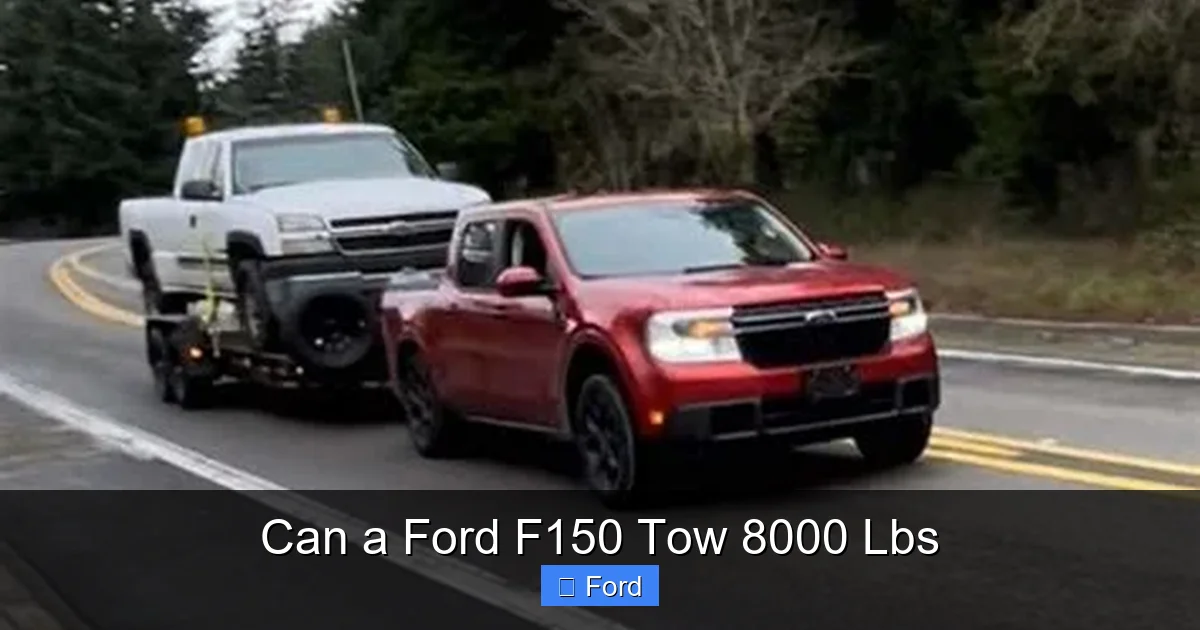
Visual guide about Can a Ford F150 Tow 8000 Lbs
Image source: autozonic.com
Gross Vehicle Weight Rating (GVWR)
This is the maximum safe total weight of your truck itself, including passengers, cargo in the bed and cab, fuel, and the tongue weight of the trailer. It’s the truck’s own weight limit. Exceeding it is illegal and puts dangerous stress on your tires, suspension, and brakes. You’ll find your specific truck’s GVWR on the door jamb sticker.
Gross Combined Weight Rating (GCWR)
This is the magic number for towing. It’s the maximum safe total weight of your combined system: the loaded truck plus the loaded trailer. Your truck’s maximum tow rating is calculated as: GCWR – (Actual Weight of Loaded Truck) = Maximum Trailer Weight. This formula is why a heavier truck (with more options, a crew cab, etc.) will often have a lower maximum tow rating than an identical model with a lighter configuration, even with the same engine.
Payload Capacity
Payload is the difference between your truck’s curb weight (its weight as built) and its GVWR. It’s everything you can put in the truck. A common mistake is towing a heavy trailer and then loading the truck bed with gear. That gear eats into your payload, and since the truck’s weight is part of the GCWR equation, it directly reduces how much you can legally and safely hitch behind you. Towing 8,000 lbs often requires a healthy payload margin for the tongue weight (the downward force on the hitch) and any gear you carry.
Finding the 8,000-Pound Capable F150: Engines and Packages
Now for the fun part: picking the right tools for the job. For the 2021-2023 model years (the current generation), achieving an 8,000+ lb tow rating consistently requires stepping up to one of Ford’s two主力 engines and adding the right package.
Visual guide about Can a Ford F150 Tow 8000 Lbs
Image source: autozonic.com
The EcoBoost Powerhouse: 3.5L V6
The twin-turbocharged 3.5L EcoBoost V6 is the towing workhorse of the F150 lineup. It delivers massive torque (up to 470 lb-ft) low in the RPM range, which is exactly what you need to get a heavy trailer moving without straining the engine. When paired with the Max Trailer Tow Package, this engine in a 4×2 configuration can tow up to 14,000 lbs, making an 8,000 lb trailer well within its comfort zone. The EcoBoost’s power band is ideal for towing, providing strong, quiet pulling power.
The Legend Continues: 5.0L V8
The Coyote 5.0L V8 offers a more traditional, rumbling V8 experience. It also produces substantial power (up to 400 hp and 410 lb-ft) and, with the Max Trailer Tow Package, can achieve similar maximum tow ratings to the EcoBoost in many configurations. The choice between EcoBoost and V8 often comes down to personal preference for power delivery and sound, as their towing capabilities are very closely matched in modern F150s.
The Essential Max Trailer Tow Package
You cannot skip this. The Max Trailer Tow Package is not just a fancy badge. It’s a collection of critical hardware that transforms your truck from a hauler to a dedicated tow vehicle. It typically includes:
- A higher-capacity radiator and cooling system.
- An upgraded rear axle (often 3.73 or 4.10 gears).
- A trailer brake controller (wired and integrated into the dash).
- Pro Trailer Backup Assist (makes backing up much easier).
- Heavy-duty front stabilizer bar.
- Specific wiring harnesses and connectors.
Without this package, your truck’s tow rating will be significantly lower, often by several thousand pounds. For an 8,000 lb goal, it’s almost always a requirement on anything but the most base models.
Real-World Scenarios: What Does 8,000 Pounds Look Like?
Numbers are one thing, but visualizing the load is another. An 8,000-pound trailer is substantial. Here are common examples that fall into this range:
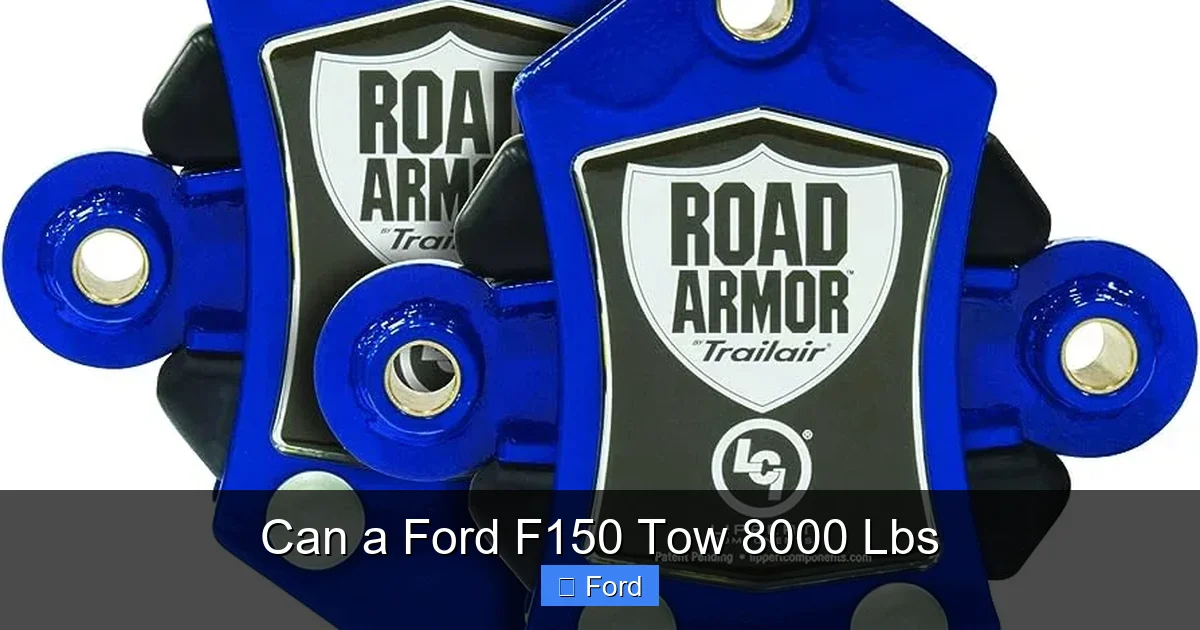
Visual guide about Can a Ford F150 Tow 8000 Lbs
Image source: towpedia.com
- Large Travel Trailer or “Toy Hauler”: A 30-35 foot travel trailer with amenities (beds, kitchen, bathroom) easily weighs 7,000-10,000 lbs dry. Add your gear, water, and propane, and you’re solidly in the 8,000+ lb range.
- Boat and Trailer: A 26-28 foot center console boat on a heavy galvanized trailer can push 8,000 lbs. The weight is concentrated high and sometimes uneven, making sway control even more critical.
- Large Car Hauler/Enclosed Trailer: A 24-28 foot enclosed trailer carrying a car, ATVs, or a lot of gear can very quickly reach this weight.
- Heavy-Duty Utility Trailer: A large flatbed or gooseneck trailer loaded with construction equipment, a tractor, or a large amount of materials.
When considering such a trailer, you must factor in its dry weight (the trailer’s weight empty) and then add your cargo. That total loaded weight is what you must compare against your truck’s calculated available capacity.
Practical Tip: Before you buy a trailer, get it weighed at a public scale (truck stops often have them) with your intended cargo. This is the only way to know your true loaded weight. Guessing leads to overloading.
The Competition: How Does the F150 Stack Up?
Context is key. The F150 isn’t the only game in town for 8,000 lb towing. Looking at competitors helps you understand if it’s the right tool. Its primary rivals are the Chevrolet Silverado 1500 and Ram 1500. All three, in their max-tow configurations, can surpass 12,000 lbs, making an 8,000 lb trailer a relatively light load for their top engines. However, the F150 often holds a slight edge in maximum published numbers due to the EcoBoost’s torque curve and widespread availability of the high-capacity packages.
For those comparing to heavier-duty options, a base-model GMC Sierra 2500 or Dodge Ram 2500 with a diesel engine will tow 15,000+ lbs with ease, offering a huge safety margin for 8,000 lbs but at a cost of higher price, weight, and fuel consumption. For some, that overkill is desirable for peace of mind and headroom. Conversely, if you’re looking at a large SUV like the GMC Yukon, you’ll find its maximum towing capacity (around 8,000 lbs in its best configuration) is right at your target. This makes the Yukon a viable, more passenger-focused alternative to a truck for this specific towing task, though with less bed cargo space.
Safety and Best Practices: It’s Not Just About Can You, But Should You?
This is the most important section. Just because your truck’s number says 8,500 lbs doesn’t mean you should casually hitch up an 8,000 lb trailer and hit the highway. Safety must be the priority.
Weight Distribution and Sway Control
For trailers over a few thousand pounds, a simple ball hitch is insufficient. You need a weight-distributing hitch. This system uses spring bars to distribute the trailer’s tongue weight across both the truck’s front and rear axles. This prevents the rear of the truck from sagging, which can cause poor steering, braking, and headlight aim. More importantly, it significantly reduces trailer sway. Many states require WD hitches for trailers over a certain weight (often 3,500-5,000 lbs). For 8,000 lbs, it’s not optional.
Braking: Your Truck’s Stopping Power is Not Enough
The trailer must have its own braking system—electric brakes or surge brakes—and your truck must have a trailer brake controller to activate them. The Max Trailer Tow Package includes this. You must properly tune the controller so the trailer brakes assist the truck’s brakes from the moment you press the pedal. Stopping an 8,000 lb load is a physics lesson in momentum. Your stopping distance will increase dramatically.
Driving Technique
Allow for **much** more following distance. Accelerate slowly and steadily to avoid lugging the engine. Be hyper-aware of crosswinds, especially on bridges and open highways. When descending long grades, use a lower gear (manual mode on your transmission) to control speed without overheating the truck’s brakes. Practice backing up in an empty parking lot. It’s a learned skill.
Pre-Trip Checklist
Every time, without fail:
- Check tire pressures on truck and trailer (inflate to max cold pressure on sidewall).
- Inspect trailer lights (brake, turn, running).
- Verify the hitch and safety chains are properly connected and secured.
- Check the trailer’s loaded weight and balance. 10-15% of the total trailer weight should be on the tongue.
- Ensure your load is balanced side-to-side and secured from shifting.
Conclusion: Yes, But With Great Responsibility
So, can a Ford F150 tow 8,000 pounds? The definitive answer is yes. With the right engine—almost certainly the 3.5L EcoBoost or 5.0L V8—the Max Trailer Tow Package, and a lighter cab/bed configuration, the F150 is engineered and rated to handle this task. It’s a core part of its identity as a versatile, full-size pickup.
However, that capability comes with a non-negotiable checklist. You must understand the difference between GVWR and GCWR, respect your payload limits, and invest in the proper towing hardware (weight-distributing hitch, brake controller). You must acknowledge that the real-world, “what’s in my truck right now” towing capacity is almost always lower than the glossy brochure maximum. And you must adapt your driving to the immense mass you’re controlling.
If you do your homework, weigh your actual combined load, equip your truck correctly, and drive with heightened caution, your Ford F150 will be a confident and competent partner for moving 8,000 pounds. It’s not just about the raw number; it’s about the responsible execution of that capability. Your safety, the safety of others on the road, and the longevity of your truck depend on it.
Frequently Asked Questions
Can any Ford F150 tow 8000 lbs?
No. Base models with smaller engines and without the Max Trailer Tow Package often have much lower ratings, sometimes as low as 5,000 lbs. You need a specific high-output engine and the proper towing package to reach 8,000 lbs or more.
What is the most important factor for reaching an 8000 lb tow rating?
The single most important factor is the combination of the Max Trailer Tow Package with a powerful engine like the 3.5L EcoBoost V6 or 5.0L V8. The package provides essential cooling, gearing, and hardware that the standard truck lacks.
Does 4×2 or 4×4 affect towing capacity?
Yes. 4×2 (two-wheel drive) models are typically lighter than 4×4 models because they lack the transfer case and front differential. This lower curb weight means the 4×2 version can often tow several hundred pounds more than an otherwise identical 4×4 model, as the GCWR is spread over a lighter truck.
How do I find my specific F150’s towing capacity?
Look for the yellow tire information sticker on the driver’s side door jamb. It lists your truck’s GVWR and GCWR. To calculate your maximum tow weight, you must first determine your truck’s actual loaded weight (with fuel, occupants, and cargo) and subtract that from the GCWR.
Is a weight-distributing hitch necessary for 8000 lbs?
Absolutely. For a trailer of this weight, a weight-distributing hitch is essential for safety and legality in most states. It properly distributes the tongue weight across both axles of your truck, preventing rear sag and dramatically improving stability and braking.
What happens if I exceed my F150’s towing capacity?
Exceeding the certified tow rating is illegal, voids your warranty, and is extremely dangerous. It leads to severe strain on the engine and transmission, catastrophic brake failure, uncontrollable trailer sway, and poor handling that can cause accidents. It also risks damaging your truck’s frame and suspension components.
