
What Color Hyundai Coolant Is

Hyundai coolant colors aren’t just for show—they’re a critical code. Modern Hyundais primarily use pink or orange coolant, specifically Hyundai’s Long Life Coolant (LLC), formulated for their engines. Using the wrong color coolant can lead to corrosion, overheating, and costly engine damage. Always check your owner’s manual for the exact specification.
Key Takeaways
- Color is a coding system: Coolant color indicates its chemical formulation and intended use. Hyundai’s standard is typically pink (G12++) or sometimes orange (OAT technology), not green.
- Never guess or mix: Mixing different coolant types or colors can create a sludge-like precipitate that clogs coolant passages and ruins your cooling system.
- Your owner’s manual is law: The only definitive source for your Hyundai’s required coolant is the owner’s manual. It specifies the exact type, not just the color.
- “Universal” coolants are risky: While some claim to be compatible, they are often a compromise. For long-term reliability, use the OEM-specified coolant or an exact aftermarket equivalent.
- Color can fade: Over time, coolant can change color due to oxidation and contaminants. A brown or rusty color means it’s degraded and needs a flush, regardless of what it started as.
- Hyundai’s LLC is extended-life: The standard pink/orange coolant is designed to last 5 years or 150,000 miles when mixed 50/50 with distilled water and properly maintained.
- Diesel engines differ: Hyundai diesel models (like some Santa Fe and Sonata) often require a different, specific coolant formulation, usually blue or another distinct color.
📑 Table of Contents
- The Great Coolant Color Mystery: It’s Not About Pretty Colors
- A Brief History: From Green to a Rainbow of Choices
- Decoding the Reservoir: Identifying Your Coolant
- The High Cost of a Wrong Choice: What Happens If You Use the Wrong Coolant?
- Your Step-by-Step Guide: Checking and Replacing Hyundai Coolant
- Addressing Common Myths and Questions
- Conclusion: Respect the Recipe
The Great Coolant Color Mystery: It’s Not About Pretty Colors
Pop the hood of your Hyundai. Glance at the coolant reservoir. What color do you see? It’s a simple question, but the answer is a gateway to understanding one of the most vital fluids in your car. You might have heard friends say, “Just use green coolant,” or seen a bottle of bright orange antifreeze at the store and wondered if it’s right for your Elantra. The truth is, the color of coolant is the first clue in a critical diagnostic system. For Hyundai owners, getting this right isn’t about aesthetics; it’s about protecting a complex and expensive engine from silent, corrosive damage. This guide will decode everything about Hyundai coolant colors, from the factory fill to what you should buy for your top-up or flush.
Why Coolant Color Exists (And Why It’s Confusing)
Coolant, or antifreeze, isn’t just water and ethylene glycol. It’s a sophisticated chemical cocktail. It contains corrosion inhibitors, lubricants for the water pump, and agents that prevent cavitation. Different manufacturers—and even different engine designs from the same manufacturer—require different inhibitor packages. The dye added to the coolant is essentially a visual identifier for these different chemical families. It’s a quick, at-a-glance system for technicians and DIYers to avoid dangerous cross-contamination.
However, this system has become messy. There is no industry-wide standard. One company’s “orange” coolant (like that used in many GM vehicles) is chemically different from Hyundai’s “orange” or “pink” coolant. Furthermore, as coolant ages and is exposed to heat and oxygen, its dye can break down and change color, making a simple visual check unreliable for determining fluid health. This is why the color is a starting point, not the final answer.
A Brief History: From Green to a Rainbow of Choices
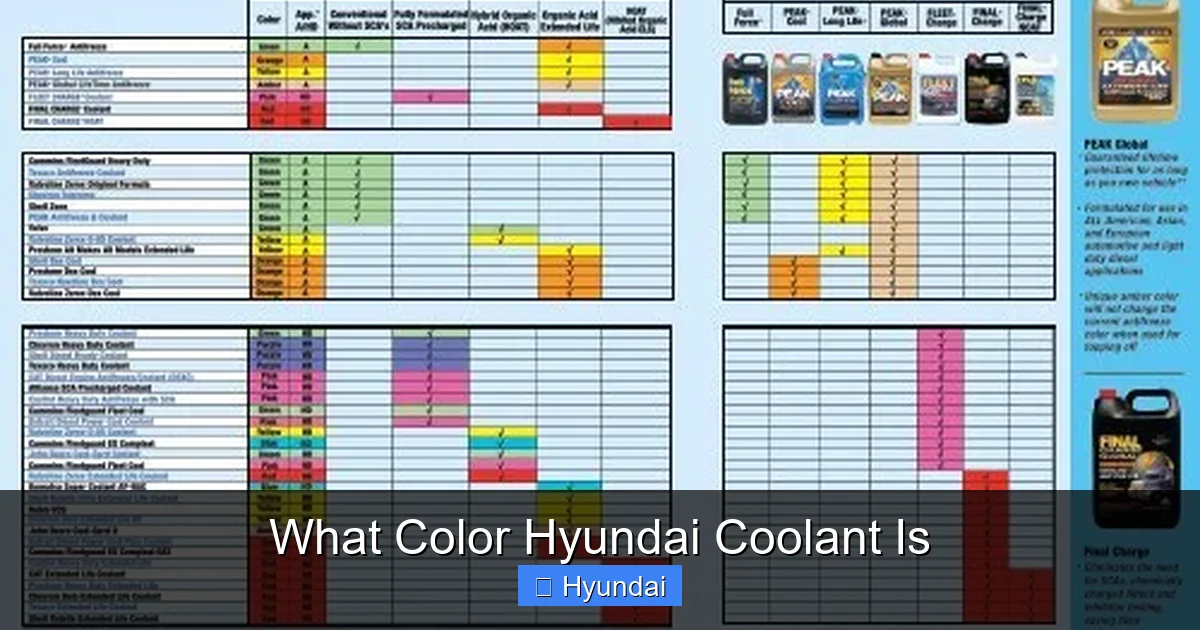
To understand Hyundai, it helps to know the landscape. The classic “green” coolant you might remember is Inorganic Acid Technology (IAT). It uses silicates and phosphates as corrosion inhibitors. It’s effective but has a short service life, typically needing replacement every 2-3 years or 30,000 miles. It’s largely obsolete for modern vehicles.
Visual guide about What Color Hyundai Coolant Is
Image source: img.yumpu.com
The industry moved to Organic Acid Technology (OAT), which is more stable and longer-lasting. OAT coolants are often orange, red, pink, or turquoise. They don’t rely on silicates. A hybrid version, Hybrid Organic Acid Technology (HOAT), often yellow or turquoise, combines some silicate benefits with OAT longevity. Hyundai’s primary coolant for the last two decades falls into the OAT/HOAT family, but with a very specific formulation unique to Hyundai/Kia. This is why you can’t just grab any “orange” coolant off the shelf.
What Color Coolant Does Hyundai Use? The Official Answer
The definitive answer for most Hyundai vehicles manufactured from the late 1990s to the present is pink. This is Hyundai’s Long Life Coolant (LLC), sometimes referred to by its part number or specification. It is an OAT-based coolant, but Hyundai’s exact recipe is proprietary. For many models, especially from the 2010s onward, the coolant may appear more of a clear pink or a translucent orange-pink when new. The key identifier is that it is NOT green, and it is NOT the same as the orange coolant used by some other brands like older GM or Chrysler vehicles.
For specific context, if you’re looking at a Hyundai Sonata from 2011-2023, it uses the pink LLC. A Hyundai Elantra from 2011 onward also uses it. The popular Hyundai Tucson and Santa Fe SUVs follow the same rule for their gasoline engines. However, there are important exceptions. Some earlier models (pre-2000s) might have used a different type. More critically, many Hyundai diesel engines (like the 2.2L CRDi in some Santa Fes and Sonatas) require a different, often blue-colored, coolant specifically formulated for diesel engine components. This is why your owner’s manual is non-negotiable.
Decoding the Reservoir: Identifying Your Coolant
So you’ve opened the hood. How do you interpret what you see?
Visual guide about What Color Hyundai Coolant Is
Image source: ph-test-11.slatic.net
- New, Factory-Fill Coolant: Should be a clear, vibrant pink or a light orange-pink. It should look almost like a soft rose wine or pink lemonade. It is translucent; you can see through it easily.
- Good, Maintained Coolant: After some service life, it may darken slightly to a deeper pink or light coral, but it should remain relatively clear and free of particles.
- Bad, Degraded Coolant: This is where color fails as a sole indicator. It may turn brown, rusty, or milky. Brown/rusty means corrosion is happening. Milky or cloudy means oil or another contaminant has entered the system (a serious issue like a head gasket leak). Any color with visible debris, sludge, or gel-like substances means a flush is desperately needed.
Practical Tip: Don’t just look at the color. Wipe the reservoir clean with a rag before checking. Look at the fluid level and clarity. If it’s low, top it up with the correct Hyundai LLC mixed 50/50 with distilled water (unless you’re adding pre-mixed). Never add straight coolant or straight water.
Orange vs. Pink: Is There a Difference for Hyundai?
This is a common point of confusion. In Hyundai’s world, “pink” and “orange” are often used interchangeably to describe the same core Long Life Coolant product. The exact hue can vary slightly between production batches or between the genuine Hyundai part and certain high-quality aftermarket equivalents (like those from Pentosin or Glyantin). The chemical specification is what matters, not the precise shade. If you buy a reputable brand’s “Hyundai/Kia Long Life Coolant” or “G12++” specification coolant, it will be correct, whether it’s labeled as pink or orange. The danger zone is using a generic “orange” coolant that meets a different manufacturer’s spec (like Dex-Cool for GM).
The High Cost of a Wrong Choice: What Happens If You Use the Wrong Coolant?
Imagine your engine’s cooling system as a network of delicate, precisely machined aluminum passages, a water pump with tight seals, and a radiator with tiny fins. The coolant’s job is to flow through this system, carrying away heat while its chemical additives form a microscopic, protective film on every metal surface it touches.
Visual guide about What Color Hyundai Coolant Is
Image source: rukminim2.flixcart.com
When you introduce the wrong coolant chemistry, that protective film breaks down. The inhibitors in the wrong coolant are not designed for Hyundai’s aluminum alloys and other metals. The result is a chemical warfare inside your engine. Corrosion begins, often silently at first. Aluminum can be eaten away, leading to leaks at the water pump, radiator, or even the engine block and cylinder head. The different chemical additives can react, forming a gelatinous sludge that clogs the narrow coolant passages in the radiator and heater core, leading to hotspots and overheating. A water pump’s seal can be degraded, causing a catastrophic leak. The repair bill for a clogged radiator, failed water pump, or a corroded engine can easily run into thousands of dollars. The few dollars saved on the wrong coolant is a terrifyingly false economy.
Mixing Coolants: A Recipe for Disaster
Even mixing your correct Hyundai pink LLC with another type (like a green IAT or a different OAT) can be harmful. The different additive packages can precipitate out of solution, forming the same damaging sludge. A one-time, small top-up with a little water in an emergency is generally acceptable (water is the universal solvent), but any significant mixing requires a complete system flush. If you’ve accidentally added the wrong coolant, do not run the engine. The system should be drained, flushed thoroughly with distilled water or a professional flushing machine, and refilled with the correct Hyundai-spec fluid.
Your Step-by-Step Guide: Checking and Replacing Hyundai Coolant
Knowledge is power, but action is maintenance. Here’s how to handle coolant correctly.
How to Check Your Coolant Level and Condition
1. Safety First: Never open a hot radiator cap or reservoir. The system is pressurized and can spray scalding coolant. Only check when the engine is completely cold.
2. Locate the Reservoir: It’s a translucent plastic tank, usually near the radiator. It has “MIN” and “MAX” or “LOW” and “FULL” marks on the side.
3. Visual Inspection: Wipe the tank clean. Look at the fluid level. It should be between the marks. Then, look at the color and clarity. Is it the expected pink/orange and clear? Or is it brown, rusty, or cloudy?
4. Check the Freeze Point (Optional but Smart): A refractometer can test the concentration of the coolant mix. A 50/50 mix of coolant to water provides optimal freeze protection (down to about -34°F / -37°C) and boil protection.
How to Perform a Coolant Flush and Refill
This is a moderate DIY task. If you’re unsure, have a professional do it.
- Gather Supplies: Correct Hyundai LLC (or exact equivalent), distilled water (for mixing and flushing), a drain pan, funnel, and new radiator cap (if your old one is old or damaged). Always use distilled water, not tap water. Tap water contains minerals that cause scale.
- Drain: With the engine cold, locate the radiator drain plug (usually at the bottom) and the lower radiator hose. Open the drain plug or carefully loosen the hose clamp and pull the hose off (have the pan ready). Let it drain completely. Also, open the coolant reservoir cap to allow air to escape.
- Flush (Crucial Step): Close the drain. Fill the system with distilled water (or a 50/50 distilled water/coolant mix for the final flush). Run the engine with the heater on high for 10-15 minutes to circulate. This agitates and dilutes any remaining old coolant and contaminants. Drain again. Repeat until the water runs completely clear.
- Refill: Close all drains. Mix your coolant 50/50 with distilled water in a clean container. Slowly pour the mixture into the reservoir until it reaches the “FULL” line. You may need to add more as air bleeds out during the first run cycle.
- Bleed Air: Start the engine, let it idle with the heater on high. As it warms up, the thermostat will open, and the level will drop. Continue adding the 50/50 mix until the level stabilizes at “FULL.” Replace the cap securely.
- Check for Leaks: After the engine cools, re-check the level and inspect for any leaks around the drain plug, hoses, and water pump.
Addressing Common Myths and Questions
The world of coolant is full of old wives’ tales and assumptions. Let’s clear them up.
- Myth: “If it’s red/pink/orange, it’s the same.” Absolutely false. The chemical composition is brand and manufacturer-specific. Hyundai’s pink LLC is not the same as Toyota’s pink (which is often a different spec), nor GM’s orange (Dex-Cool).
- Myth: “Universal coolant works in everything.” There is no true universal coolant. “Universal” products are typically a compromise formula designed to be “compatible” with many older types. They may work in a pinch or for a top-up, but they are not recommended for a complete service on a modern, sensitive engine like Hyundai’s. They lack the precise, long-term protection of the OEM spec fluid.
- Myth: “Coolant never needs changing; just top it up.” This is a dangerous belief. The corrosion inhibitors deplete over time. Once they’re gone, the coolant becomes corrosive. Low coolant level also indicates a leak that must be found and fixed. Regular, scheduled flushes are essential maintenance.
- Question: “Can I use water in an emergency?” Yes, for a very short-term emergency to get to a safe location or repair shop. But water provides no corrosion protection, freezes in winter, and boils at a lower temperature. It must be replaced with the correct 50/50 mix as soon as possible.
Conclusion: Respect the Recipe
The color of your Hyundai’s coolant is the first and easiest signal in a vital maintenance protocol. For the vast majority of Hyundai gasoline vehicles on the road today, that color is a distinctive pink, representing the Hyundai Long Life Coolant specification. This isn’t a suggestion; it’s an engineering requirement. Your engine’s longevity, performance, and reliability depend on the correct chemical environment inside its cooling passages.
When in doubt, ignore the color in the bottle and consult your owner’s manual. When purchasing coolant, look for the specification—”Hyundai Long Life Coolant,” “G12++,” or the specific Hyundai part number. From the precise coolant needed for a Hyundai Sonata to the unique formula for a diesel-powered Santa Fe, using the right product is the simplest and most cost-effective form of engine protection you can practice. Don’t gamble with a rainbow of choices. Stick to the pink, follow the service intervals, and your Hyundai’s engine will thank you with years of cool, reliable service.
Frequently Asked Questions
Can I mix Hyundai pink coolant with another brand’s pink/orange coolant?
No. Different manufacturers use different additive packages even for similarly colored coolants. Mixing them can cause sludge formation and reduce corrosion protection. Always use the specific Hyundai LLC or an exact equivalent.
My Hyundai coolant looks brown. Is it just old, or is it the wrong type?
Brown, rusty, or cloudy coolant is a sign of severe degradation and corrosion, regardless of its original color. It means the inhibitors have failed and the fluid is actively harming your cooling system. A complete flush is immediately necessary.
Is there a “universal” coolant safe for all Hyundai models?
While some “universal” or “all-makes” coolants claim compatibility, they are not the OEM-recommended fluid. For guaranteed, long-term protection matching Hyundai’s engineering standards, use the genuine Hyundai Long Life Coolant or a high-quality aftermarket brand that explicitly states it meets Hyundai’s LLC specification.
What happens if I accidentally put green coolant in my Hyundai?
Green IAT coolant is chemically incompatible with Hyundai’s aluminum engines and the pink LLC. It should not be used. If added, the system must be completely drained, flushed, and refilled with the correct pink coolant as soon as possible to prevent corrosion and sludge buildup.
Does the Hyundai Santa Fe use a different coolant than the Sonata?
For gasoline engines, both typically use the same Hyundai Long Life Coolant (pink). However, diesel engine versions of these models (like the 2.2L CRDi) often require a different, specific coolant (frequently blue). You must verify by model, year, and engine type using your owner’s manual.
Can I use 100% coolant (no water) in my Hyundai?
No. Coolant is designed to be mixed 50/50 with water (preferably distilled). Pure coolant has a much higher viscosity, reducing its ability to flow and transfer heat effectively. It also lacks the optimal boiling point provided by the 50/50 mix. Always use the pre-mixed 50/50 product or mix concentrate with distilled water yourself.
