
How to Open Jeep Trunk from Inside

Knowing how to open your Jeep trunk from the inside is a crucial skill for safety, convenience, and emergency situations. Most modern Jeeps feature a standard interior trunk release button or lever, often located on the driver’s side door panel or near the rear seats. For models with fold-down rear seats, accessing the trunk can be as simple as pulling a release handle and folding the seats forward. When standard methods fail due to a dead battery or electrical issue, manual overrides like a physical key slot or emergency pull cable become essential. Always consult your owner’s manual first, as mechanisms vary significantly between models like the Wrangler, Grand Cherokee, and Cherokee. Understanding your specific Jeep’s system ensures you’re never locked out of your cargo space when you need it most.
Hey there, fellow Jeep enthusiast! Have you ever found yourself needing to grab something from the trunk while you’re all buckled in and ready to go? Or maybe you’ve had that gut-punch moment of realizing your cargo is locked in the back with the keys? Knowing how to open a Jeep trunk from inside isn’t just a neat party trick—it’s a vital piece of vehicle knowledge that can save you from serious inconvenience and, in rare cases, a genuine emergency. Whether you’re packing for a weekend trail adventure, hauling groceries, or simply need your emergency kit, being locked out of your own cargo space is a frustration no Jeep owner should endure.
Jeep, as a brand, is synonymous with capability and adventure. But that rugged exterior houses a variety of interior trunk access systems that can differ dramatically not just between models like the iconic Wrangler and the family-friendly Grand Cherokee, but even between different model years of the same vehicle. The good news? Once you understand the core principles and locate the specific mechanisms in your rig, you’ll have that confidence boost that comes with true self-reliance. This guide will walk you through every method, standard and emergency, for how to open a Jeep trunk from inside. We’ll cover the simple button press, the fold-down seat trick, manual key overrides, and what to do when the electronics say “nope.” Let’s pop the hatch on this essential know-how.
Key Takeaways
- Standard Release is Primary: Most Jeeps have an interior trunk release button or lever, typically on the driver’s door panel or B-pillar, which is the first and easiest method to use.
- Fold-Down Seats are Common: Many Jeep SUVs allow trunk access by folding the rear seats forward using a release handle, creating a pass-through from the cabin.
- Manual Overrides Exist: For electrical failures, locate the physical key slot (often hidden under a trim piece) or an emergency pull cable inside the trunk lid itself.
- Model Variations are Key: The exact method differs between Wrangler, Grand Cherokee, Cherokee, Compass, and Renegade; your owner’s manual is the definitive guide.
- Safety First: Ensure the vehicle is in Park with the engine off before attempting access, and never force components to avoid damage.
- Prevent Lockouts: Regularly test your interior release and keep a spare key accessible to avoid being stranded with a locked trunk.
- Professional Help is Available: If all else fails, a locksmith or dealership can provide assistance, especially for complex electronic systems.
📑 Table of Contents
- Understanding Your Jeep’s Trunk Access Architecture
- Standard Interior Trunk Release Methods (The First Things to Try)
- Emergency Access: When the Standard Methods Fail
- Model-Specific Deep Dives: Popular Jeep Scenarios
- Safety, Maintenance, and Proactive Tips
- Troubleshooting Common Issues
- Conclusion: Knowledge is Power (and Access)
Understanding Your Jeep’s Trunk Access Architecture
Before we dive into the “how,” it’s smart to grasp the “why” and “what.” Jeep’s approach to trunk (or rear cargo area) access is designed around a few key philosophies: security, convenience, and safety. The system you have depends heavily on your Jeep’s model, trim level, and model year. Broadly, they fall into two camps: powered (electric) releases and manual releases. Many models use a hybrid system, where an electric solenoid does the heavy lifting but is backed by a manual override for fail-safes.
Electric vs. Manual: The Core Systems
Electric Releases are the most common in modern Jeeps (roughly 2010 and newer). You press a button—usually on the driver’s door panel, overhead console, or even the key fob—and an electric actuator pops the trunk lid. It’s seamless and convenient. The downside? It relies on the vehicle’s battery. If your battery is completely dead, that button becomes a useless piece of plastic. This is where the manual override becomes your best friend.
Manual Releases are either a traditional key slot in the trunk lid or an interior mechanical cable or lever that physically unlatches the trunk without any electrical help. These are foolproof in any power situation but are often hidden or secondary to the primary electric button. In some older Jeeps or base trims, the manual release might be the only method from inside the cabin.
Model Family Breakdown
While we’ll get into specifics later, here’s a high-level map:
- Jeep Wrangler (JK, JL, JT): Typically features a trunk release button on the driver’s door. The rear seats fold flat, but the trunk lid itself is separate. Manual access often involves a key slot under a trim panel on the trunk lid.
- Jeep Grand Cherokee: Almost universally has a door-mounted release button. Many models also feature a fold-down rear seat pass-through. The manual key slot is usually concealed on the trunk lid.
- Jeep Cherokee & Compass: Similar to the Grand Cherokee, with a door panel button and seat-folding access. Manual key slots are standard.
- Jeep Renegade: As a subcompact, it relies heavily on key fob and door button, with a manual key slot as backup.
Your first step is always to consult your owner’s manual. It has the exact diagram for your specific VIN. But if the manual’s MIA, we’ve got you covered.
Standard Interior Trunk Release Methods (The First Things to Try)
Let’s start with the simplest, most designed-into-the-car methods. These should work in 90% of normal situations where the vehicle battery has juice.
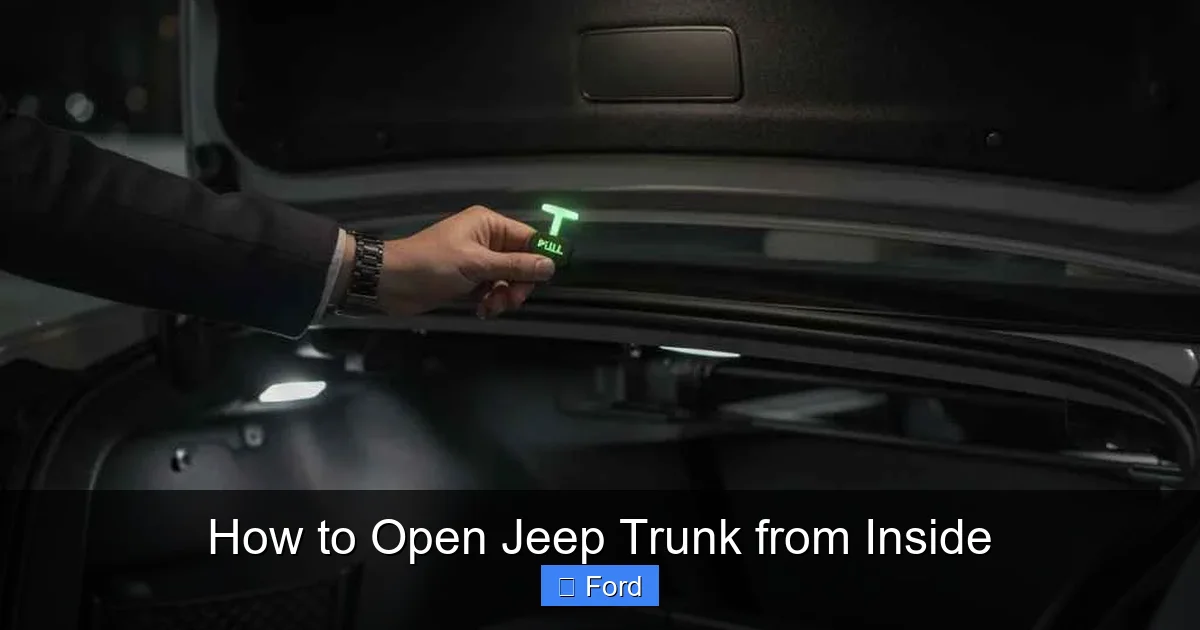
Visual guide about How to Open Jeep Trunk from Inside
Image source: thedailyautomotive.com
The Obvious Button or Lever
This is your go-to. Look for a dedicated icon that looks like a trunk or an open box with an arrow pointing up. Common locations include:
- The driver’s door panel: Often grouped with power window and door lock switches.
- The B-pillar (the post between front and rear doors): A small button at a comfortable reach.
- The overhead console: Near the map lights or sunroof controls.
- The center console: Some models place it near the shifter or infotainment system.
Pro Tip: Press and hold the button for 1-2 seconds. Some systems require a sustained press to prevent accidental opening. Listen for a distinct “thunk” or “pop” from the rear of the vehicle. That’s the latch releasing. If nothing happens, check if your vehicle is in “Park” (some models have a safety interlock) or if the trunk ajar warning light on the dash is illuminated, indicating it might already be unlatched.
Folding Down the Rear Seats (The Pass-Through Method)
This isn’t technically “opening the trunk lid,” but it’s an incredibly common and useful way to access the cargo area from inside the cabin, especially for longer items. Most Jeep SUVs have rear seats that fold down in a 60/40 split or entirely flat. The release mechanism is usually:
- A mechanical lever or strap on the top of the seatback, near the headrest.
- A button on the side of the seat cushion (sometimes requiring a key or coin to press).
Once the seats are folded, you have direct, unobstructed access to the trunk well. This method is purely mechanical and will work even with a dead battery. Important: Ensure no one or nothing (like a pet or cargo) is in the way before folding. Also, be aware that folding the seats might deactivate certain rear safety features in your vehicle.
Key Fob Activation
Don’t forget your remote! Most Jeep key fobs have a dedicated trunk release button (often a separate button from the lock/unlock ones). Simply press and hold it. The range is typically 20-50 feet. This is the ultimate convenience method when you’re approaching the vehicle from the rear. If your key fob battery is dead, you can often insert the emergency physical key (if your fob has one) into the driver’s door lock to unlock the door, and then use the interior button once inside. For more on key fob issues across brands, our guide on Honda Civic Bluetooth troubleshooting highlights how electronic systems can fail, a principle that applies to Jeep key fobs too.
Emergency Access: When the Standard Methods Fail
Okay, so you’ve pressed the button. Nothing. You’ve folded the seats. Still a solid trunk lid in your way. The battery might be completely dead, a fuse could be blown, or the electric latch solenoid might have failed. Time for plan B. These methods are your backup and are designed to get you in when the electronics are on vacation.
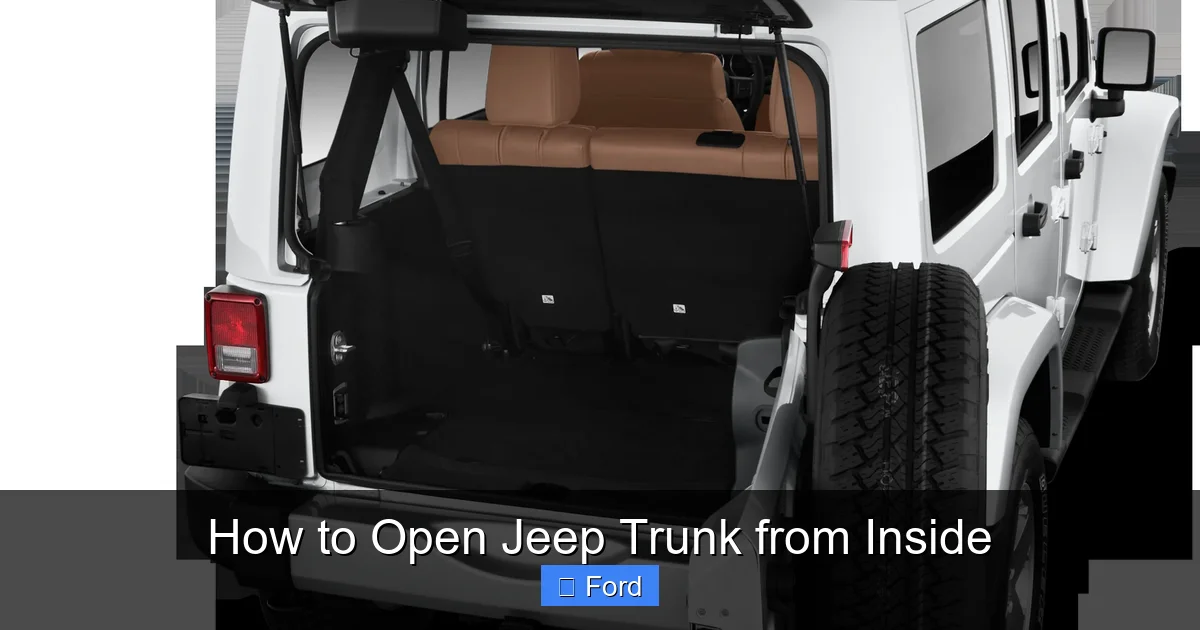
Visual guide about How to Open Jeep Trunk from Inside
Image source: st.automobilemag.com
The Physical Key Slot (The Classic Fallback)
Virtually every Jeep with a powered trunk also has a hidden physical key slot on the trunk lid itself. The trick is finding it. It’s almost always concealed by a small, decorative plastic cap or piece of trim.
- Location: Look on the trunk lid, typically centered near the Jeep badge or on the underside of the lip. Sometimes it’s on the driver’s side edge.
- How to Access: Gently pry off the cap with a flat-head screwdriver wrapped in a cloth to avoid scratches. Underneath, you’ll see a traditional key cylinder.
- Action: Insert your mechanical key (the one that pops out of your fob) and turn it clockwise. You’ll feel the latch release. You may need to lift the lid slightly as you turn.
Caution: Some newer Jeeps use a “valet key” or a slim key that fits into this slot. Ensure you’re using the correct key. If you’ve lost the physical key, a locksmith or dealer can cut one from your VIN.
Interior Manual Release Cable (The Trunk’s Emergency Cord)
This is a brilliant fail-safe. Inside the trunk itself, usually near the latch mechanism or on the underside of the lid, there is a bright-colored (often yellow or orange) cable with a T-handle. Pulling this cable mechanically releases the trunk latch from the inside, allowing you to open it.
- How to Find It: You’ll need to have some way to get into the trunk *first* to see it. This sounds like a catch-22, and it is! This cable is primarily for escaping from inside the trunk (a safety requirement) or for mechanics to open it when the power is out. It’s not typically an “inside the cabin” method unless you can reach it through a folded seat pass-through.
- Use Case: If you’re trapped inside the trunk (extremely rare), feel along the walls and lid for this handle. Pull firmly.
For everyday cabin-to-trunk access, this internal cable is usually not helpful unless you’re already in the cargo area.
Tool-Assisted Access (Last Resort)
If you have no key, a dead battery, and no visible manual slot, you might need to get creative. This is risky and can damage paint or weather stripping. Proceed with extreme caution.
- The Slim Jim or Coat Hanger Method: This works on older Jeeps with a simple mechanical latch linkage. You need to insert a thin, flexible tool between the trunk lid and the body seal, locate the latch arm, and pull it. This is very model-specific and easy to mess up. We strongly recommend watching a model-specific video tutorial first. It’s often easier to gain entry through a rear window if it’s a soft-top Wrangler.
- Calling for Help: If you’re uncomfortable, a locksmith or roadside assistance service (like AAA) has specialized tools and experience. It’s worth the fee to avoid costly damage.
Remember, forcing the trunk lid can bend hinges or break the latch, leading to a very expensive repair. Patience and the right tool are key.
Model-Specific Deep Dives: Popular Jeep Scenarios
Let’s get practical. Here are step-by-step instructions for the most common Jeep models on the road today. Always verify with your manual, but these are the standard procedures.
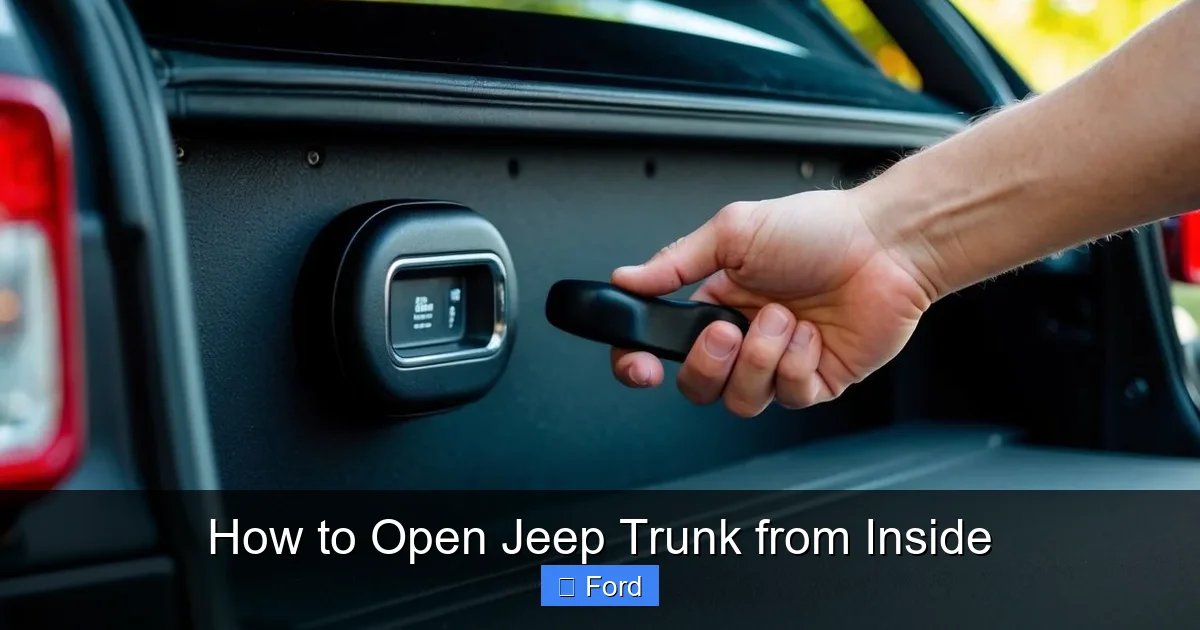
Visual guide about How to Open Jeep Trunk from Inside
Image source: koala.sh
Jeep Wrangler (JL/JT 2018-Present & JK 2007-2018)
The Wrangler’s approach is straightforward due to its removable doors and top.
Standard Method: The interior trunk release button is located on the driver’s door panel, usually near the power window controls. Press it. The trunk lid will pop open slightly. You then lift the lid manually. Note: The Wrangler’s trunk lid is relatively light.
Fold-Down Seats: The rear seats in a 4-door Wrangler Unlimited fold down. Release handles are on the top of the rear seatbacks. Folding them creates a large, flat pass-through to the trunk area. In 2-door models, the rear seats are often fixed or have a limited fold, so this method may not apply.
Emergency Manual Key: The key cylinder is on the trunk lid, often hidden under a small rectangular plastic cover near the center or the driver’s side. Pry the cover off with a flat tool, insert the key, and turn. On some models, you may need to push the key in slightly before turning.
Jeep Grand Cherokee (2011-Present)
This family SUV is packed with features, and trunk access is no exception.
Standard Method: A prominent trunk release button is almost always on the driver’s door armrest. Some higher trims also have a button on the key fob and sometimes a foot-activated sensor under the rear bumper (hands-free).
Fold-Down Seats: The Grand Cherokee has a 60/40 split-folding rear seat. Release levers are on the top corners of the seatbacks. Pull them and fold the seats forward for a continuous cargo space.
Emergency Manual Key: The key slot is on the trunk lid, typically centered under a round or oval cap that may have the Jeep logo. Pry it off carefully. On some model years, the slot might be on the driver’s side edge of the lid.
Jeep Cherokee & Compass (2014-Present)
These compact/midsize cousins share a very similar platform and access system.
Standard Method: Look for the trunk release button on the driver’s door panel. It’s often integrated with the power lock switches. A secondary button may exist on the rear overhead console.
Fold-Down Seats: Both have 60/40 folding rear seats. The release is a small plastic handle or button on the top of the seatback. On some trims, you may need to fold the headrest down first.
Emergency Manual Key: The key cylinder location is consistent with the Grand Cherokee—on the trunk lid, centrally located under a removable cap. The procedure is identical.
Note: For owners of these models who might be comparing systems, our detailed guide on how to open a Subaru Forester trunk from inside shows a similar door-mounted button and seat-folding approach, demonstrating a common industry pattern for crossover SUVs.
Safety, Maintenance, and Proactive Tips
Knowing the methods is half the battle. The other half is ensuring your system is always ready and using it safely.
Preventing Trunk Lockouts
The best lockout is the one that never happens.
- Test Regularly: Once a month, use your interior button and key fob to open the trunk. Listen and watch for smooth operation.
- Keep a Spare Key: Always have a spare mechanical key hidden somewhere outside the vehicle (a magnetic box under the bumper is classic) or with a trusted person. For Jeeps with keyless entry, a spare fob is ideal.
- Battery Health: A weak main battery can cause the electric trunk release to fail. Keep your battery terminals clean and consider a trickle charger if you don’t drive often.
- Lubricate: Once a year, spray a dry Teflon lubricant (like WD-40 Specialist Dry Lube) into the trunk latch mechanism through any accessible holes. This prevents grime buildup and sticking.
Safety Precautions While Operating
- Park Safely: Always engage the parking brake and ensure the vehicle is in Park (or Neutral for manual transmissions) before operating the trunk.
- Check for Obstructions: Look inside the trunk and behind the vehicle before opening. A stray suitcase or a child’s toy could fall out.
- Mind the Lift: The trunk lid, especially on larger models like the Grand Cherokee, can be heavy. Use the gas struts (if equipped) to hold it open. Never stand directly behind the vehicle with the lid raised—strong wind or a failed strut can cause it to drop violently.
- Secure Cargo: A sudden stop can cause unsecured items in the trunk to become projectiles. Use cargo nets or tie-downs.
Child Safety Locks
Many Jeeps have a mechanical child safety lock for the rear doors, but did you know some also have a lock for the trunk release button? This prevents kids from accidentally popping the trunk while driving. It’s usually a small switch or slider near the release button itself. If your interior button suddenly stops working, check if this lock has been engaged! It’s an often-overlooked simple fix.
Troubleshooting Common Issues
What if you’ve tried everything and the trunk still won’t budge? Let’s diagnose.
“The Button Does Nothing”
This points to an electrical issue.
- Check Fuses: Your owner’s manual will have a fuse box diagram. Look for a fuse labeled “TRNK,” “Cargo,” or “Body Control Module.” Pull it with a fuse puller and check the metal strip inside. If it’s broken, replace it with one of the same amperage.
- Dead Battery: If your vehicle battery is completely dead (<12V), the solenoid won't activate. Jump-start the vehicle or use a portable jump starter. Once the battery has some charge, the trunk should work.
- Faulty Switch or Solenoid: If the fuse is good and the battery is charged, the release button itself or the trunk latch solenoid may have failed. This requires diagnosis with a multimeter and likely a replacement part from a dealer or mechanic.
“The Trunk Won’t Stay Open”
This is almost always a gas strut (shock absorber) problem. The struts hold the lid up. If they’re weak, leaking, or disconnected, the lid will fall. Replace them in pairs. This is a common wear item.
“The Manual Key Slot is Stuck/Doesn’t Work”
Dirt, rust, or a misaligned latch can prevent the key from turning. Try:
- Spraying a penetrating lubricant (like PB Blaster) into the keyhole and working the key back and forth.
- Gently jiggling the trunk lid up and down while turning the key.
- If it’s severely stuck, you may need a locksmith to extract a broken key or force the mechanism.
For those experiencing similar stubborn mechanisms in other vehicles, our article on how to open the trunk on a Nissan Rogue covers manual key techniques that are often transferable to Jeep models.
Conclusion: Knowledge is Power (and Access)
We’ve journeyed from the simple button press to the gritty details of manual overrides and troubleshooting. Mastering how to open your Jeep trunk from inside transforms you from a potentially frustrated driver into a capable problem-solver. It connects you to the mechanical soul of your vehicle, reminding you that even in a high-tech machine, simple physics and clever engineering are at play. Remember the hierarchy: try the interior button first, then the key fob, then the fold-down seats, and finally resort to the manual key slot. Keep that spare key handy and give your latch some love with a little lubricant now and then.
Jeep owners are a community of adventurers and tinkerers. Sharing this knowledge is part of that spirit. So, take this guide, print it out, and maybe tuck it in your glove box. The next time you’re staring at a stubborn trunk lid—whether you’re loading camping gear on a Friday evening or need your jumper cables during a downpour—you’ll know exactly what to do. No panic, no helpless waiting. Just you, your Jeep, and a job done. Now, get out there and enjoy the ride, confident that your gear is always within reach.
Frequently Asked Questions
What if my Jeep has no visible interior trunk release button?
Check your owner’s manual immediately. Some base models or older Jeeps may only have a trunk release on the key fob or require folding the rear seats. The key fob button is your primary method in these cases. If the fob battery is dead, use the spare mechanical key in the door, then locate the hidden manual key slot on the trunk lid.
My Jeep’s battery is completely dead. Can I still open the trunk?
Yes, you can. A dead battery disables the electric solenoid, so the interior button won’t work. Your solution is the manual key slot on the trunk lid itself. Use the physical key that pops out of your key fob. You’ll need to pry off the small plastic cap covering the cylinder. This is a purely mechanical process and requires no battery power.
How do I disable the child safety lock on my Jeep’s trunk release?
The child safety lock for the trunk release is usually a small switch or slider located near the release button itself (on the door panel or B-pillar). Consult your owner’s manual for the exact location. It’s designed to prevent children from accidentally opening the trunk while the vehicle is moving. Simply move the switch to the “off” or unlocked position to restore button functionality.
I lost the physical key for my Jeep’s trunk. What are my options?
Your best option is to contact a Jeep dealership with your VIN. They can cut a new mechanical key that fits your trunk’s cylinder. A reputable automotive locksmith can also do this. As a temporary measure, if you can access the cargo area through folded rear seats, you might be able to reach the internal emergency release cable, but this is not a convenient long-term solution for regular access.
Can I open the trunk from inside if I’m locked out of the Jeep?
No, you cannot. The interior trunk release buttons and seat-folding mechanisms are designed to be operated from inside the passenger compartment. If you are locked out of the entire vehicle (doors locked, keys inside), you first need to gain entry to the cabin using a spare key, keyless entry code (if equipped), or by calling a locksmith. Once inside, you can then use the trunk release methods described here.
After an accident, my Jeep’s trunk won’t open. Is there a manual release?
Yes, but it may be your only option. A collision can damage the electrical wiring or solenoid. Your first step is the manual key slot on the trunk lid. If that mechanism is also damaged, you may need to access the trunk by folding the rear seats (if undamaged) or, as a last resort, carefully removing interior trim panels to access the latch cable from inside the cabin. In post-accident scenarios, it’s safest to have the vehicle towed to a body shop where professionals can safely access and assess the damage.
