
Can a Ford F-150 Power a House?

Yes, a Ford F-150 can power a house, but with clear limitations. Thanks to the Pro Power Onboard system, select F-150 models act as built-in generators, delivering up to 7.2 kW of clean inverter power—enough for essential appliances during an outage. However, runtime is tied to the truck’s fuel tank, and it’s not designed for whole-home backup. Always use proper extension cords and never connect it directly to your home’s electrical panel.
Key Takeaways
- Pro Power Onboard is the key: This integrated inverter system, available on 2021+ F-150 hybrids and some gas models, converts the truck’s engine power into usable AC electricity.
- Power output varies by model: Hybrid F-150s provide up to 7.2 kW, while Pro Power-equipped gas models typically offer 2.0 kW or 2.4 kW—enough for essentials but not heavy-draw appliances like central AC.
- Runtime is fuel-dependent: At a 50% load, a full tank can run for 24-32 hours, but fuel consumption increases significantly with heavier electrical loads.
- Ideal for emergencies and job sites: Perfect for running a refrigerator, sump pump, lights, and tools during blackouts or at remote worksites, but not for sustained whole-house power.
- Safety is non-negotiable: Operate outdoors only, use heavy-duty grounded extension cords, and never backfeed into your home wiring to avoid electrocution and fire risks.
- It’s a supplemental tool, not a replacement: While incredibly useful, it lacks the capacity, automatic transfer switch, and long-run fuel capacity of a standby generator.
- Maintenance matters: Regular truck service, especially keeping the battery in top condition, ensures the Pro Power system is reliable when you need it most.
📑 Table of Contents
- Can a Ford F-150 Power a House? The Short Answer
- What is Pro Power Onboard? How the F-150 Becomes a Generator
- Which Ford F-150 Models Have This Capability? (And How Much Power?)
- Real-World Applications: What Can You Actually Power in a House?
- Critical Limitations and Considerations
- Safety First: Non-Negotiable Rules for Using Your F-150 as a Generator
- The Verdict: Is the F-150 a Good Backup Power Solution?
- Conclusion: Power When You Need It, Within Limits
Can a Ford F-150 Power a House? The Short Answer
Imagine a severe storm knocks out power to your neighborhood for days. You’re fumbling in the dark for flashlights, worrying about food spoiling in the fridge, and the basement sump pump has already given up. Then you remember: your truck in the driveway has a big fuel tank and a powerful engine. Can a Ford F-150 power a house? The answer is a qualified yes, but with some very important details and limits.
Ford has engineered its iconic F-150 with a feature called Pro Power Onboard. This isn’t an aftermarket add-on; it’s a factory-installed inverter system that turns your truck into a mobile power station. But it’s not magic. Understanding what it can and cannot do is crucial for safe and effective use. Let’s break down exactly how it works, which models have it, what you can run, and the critical safety rules you must follow.
What is Pro Power Onboard? How the F-150 Becomes a Generator
Pro Power Onboard is an integrated power inverter system. In simple terms, it takes the mechanical energy from the F-150’s engine and converts it into stable, clean 120V AC electricity—the same type you get from your wall outlets. This electricity is delivered through a standard 240V/40A NEMA 14-50R outlet (like what an electric dryer uses) and, on higher-output models, additional 120V 20A outlets.
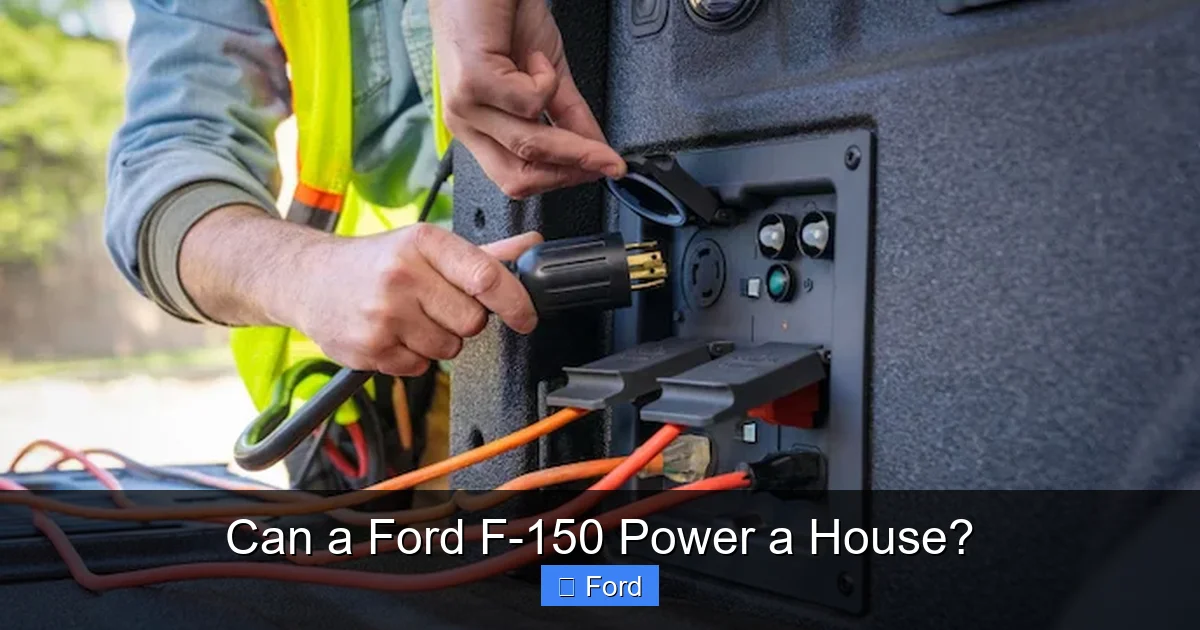
Visual guide about Can a Ford F-150 Power a House?
Image source: johnchow.com
The Technology Inside
The system is sophisticated. It uses the truck’s hybrid battery (on hybrid models) or the standard 12V electrical system (on gas models) to manage power flow, but the heavy lifting is done by the engine. When you plug in a load and turn on Pro Power, the truck’s computer automatically starts the engine and maintains its RPM to generate the required electrical output. It’s designed to be “smart,” adjusting engine speed based on demand to balance power delivery and fuel efficiency.
This means you don’t need a separate, noisy portable generator. The power source is already in your driveway. However, it does mean the truck’s engine must be running to produce electricity, which consumes fuel and produces exhaust.
Which Ford F-150 Models Have This Capability? (And How Much Power?)
Not every F-150 can power your home. Pro Power Onboard is a feature available on specific model years and powertrains. The availability and wattage output have evolved since its introduction.
Visual guide about Can a Ford F-150 Power a House?
Image source: trucksauthority.com
- 2021-Present (14th Gen) Hybrid F-150: This is the powerhouse. The hybrid system’s combined electric and gas propulsion allows for a massive 7.2 kW (9,600 watts) of inverter power. That’s enough to run multiple large appliances simultaneously.
- 2021-Present (14th Gen) Gas F-150 (select configurations): Some gas-powered F-150s with the 3.5L EcoBoost V6 offer Pro Power, but at a lower output of 2.0 kW (2,700 watts). For 2024, certain models increased to 2.4 kW (3,200 watts).
- Earlier Models: The 2021 model year was the debut. Pre-2021 F-150s do not have a built-in, Ford-engineered Pro Power Onboard system. Owners of older trucks would need to purchase and install an aftermarket power inverter, which is a different scenario with its own limitations and safety considerations.
So, if you’re shopping for a used F-150 specifically hoping to use it as a backup generator, you must target a 2021 or newer hybrid model for the highest output. For other years, you’d be looking at third-party solutions.
Real-World Applications: What Can You Actually Power in a House?
This is the most practical question. To know if the F-150 can power your house, you need to estimate your home’s electrical load during an outage. Most people don’t need to run everything—just the essentials. Let’s break down typical appliance wattages and what the F-150 can handle.
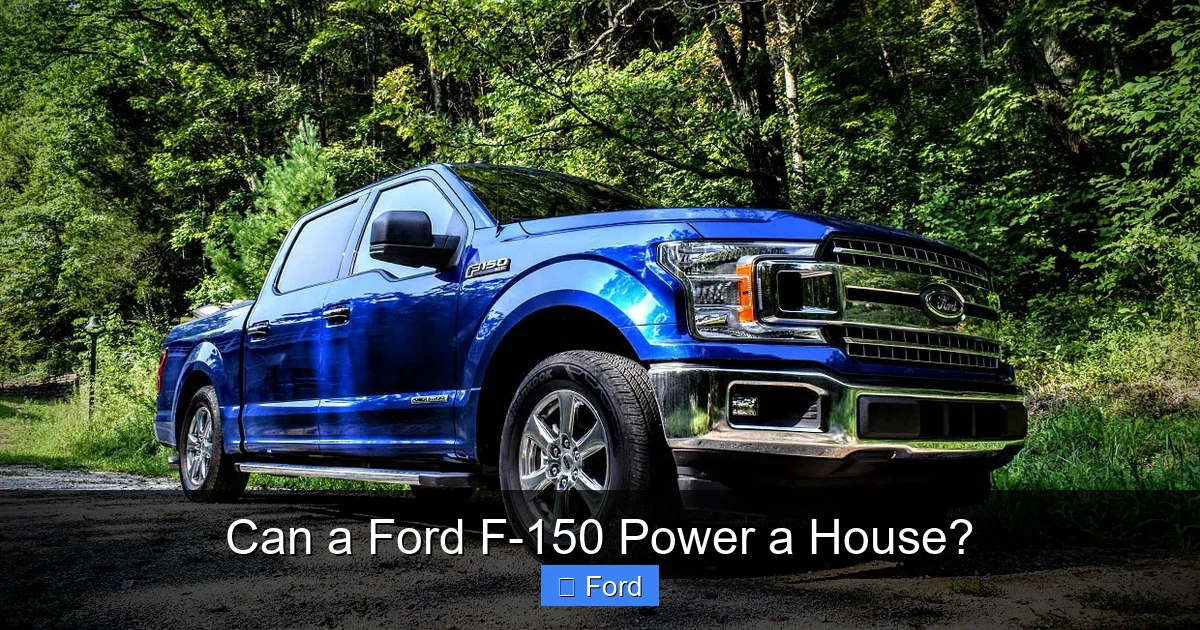
Visual guide about Can a Ford F-150 Power a House?
Image source: 95octane.com
Understanding Wattage: Running vs. Surge
Every appliance has two ratings: running watts (the continuous power needed) and surge/starting watts (the extra burst needed to start, especially for motors like in refrigerators and pumps). Your total load must not exceed the F-150’s continuous wattage rating, but you must also account for the surge of each device you start simultaneously.
Sample Load Calculation for a 7.2 kW Hybrid F-150
Let’s say you’re in a power outage. A reasonable essential load might include:
- Refrigerator/Freezer: 600 running / 1,200 surge watts
- Sump Pump (1/3 HP): 800 running / 1,300 surge watts
- LED Lights (10 bulbs): 100 watts
- TV & Entertainment System: 200 watts
- Laptop & Phone Chargers: 100 watts
- Microwave (during use): 1,000 running / 1,500 surge watts
- Deep Freezer (if needed): 500 running / 1,000 surge watts
Total Running Watts: ~3,300 watts
Peak Surge (if starting all motors at once): ~5,000 watts
This load is well within the 7,200-watt continuous capacity of the hybrid F-150. You could even add a small space heater (1,500W) or a few more lights. However, you cannot run a central air conditioning system (3,000-4,000 running, 5,000+ surge), an electric water heater (4,500W), or an electric stove/oven (3,000-5,000W) on top of other essentials. Those are whole-house loads that exceed any F-150’s capacity.
Runtime: How Long Will the Fuel Last?
This is the biggest limiting factor. The truck’s engine must run to generate power. Fuel consumption depends on the electrical load.
- At a 50% load (~3,600W on a hybrid): Ford estimates about 0.5 gallons per hour. With a full 26-gallon tank (on some configurations), that’s a theoretical 52 hours of runtime. Real-world, with conservative use, 24-32 hours is a safe estimate.
- At a 100% load (7,200W): Consumption jumps to about 1 gallon per hour, giving you roughly 26 hours on a full tank.
- At a light 25% load: Consumption can drop to ~0.3 gal/hr, extending runtime significantly.
You must monitor fuel levels and refill the tank as needed. Unlike a propane-fired standby generator that can tap into a large home tank, your F-150’s range is limited by its own gas tank. It’s a bridge solution for 1-3 days, not a week-long outage without refueling.
Critical Limitations and Considerations
Before you plan to live off your truck, you need to understand these hard limits.
It’s Not a Whole-House Backup System
Even the 7.2 kW output is insufficient for a typical modern home’s peak demand, which can easily exceed 10,000W when multiple major systems kick on (AC, fridge, well pump, etc.). Pro Power is designed for select circuits—the essentials you plug into. You cannot connect it to your home’s main electrical panel without a proper transfer switch, and even then, the load would likely overload it instantly. For true whole-house backup, you need a permanently installed standby generator (10-20kW+).
Fuel Consumption and Refueling Logistics
Running the engine continuously burns gas. In a widespread outage, gas stations may be closed or have long lines. You need a plan for safely storing and transporting fuel to refill your truck. It’s also inefficient; you’re converting gasoline to electricity with significant energy loss compared to a dedicated generator.
Exhaust and Carbon Monoxide Danger
This is the most serious safety issue. The F-150’s engine produces carbon monoxide (CO), an odorless, deadly gas. You must operate the truck exclusively outdoors, far from windows, doors, and vents. Never run it in a garage, even with the door open. Position the truck downwind of your home. CO poisoning can happen quickly and is fatal. This requirement alone makes indoor or attached-garage use impossible.
Noise and Security
A running V6 or V8 engine is louder than many modern inverters. It will disturb neighbors and could attract attention in a crisis. You’ll need to consider placement for noise mitigation and security.
Safety First: Non-Negotiable Rules for Using Your F-150 as a Generator
Improper use can lead to electrocution, fire, or carbon monoxide poisoning. Follow these rules without exception.
- Never Backfeed: Do not under any circumstances plug the truck’s power cord into a home outlet or try to feed power backward into your electrical panel. This “backfeeding” can kill utility workers repairing lines and can start fires. Power your home by running extension cords directly from the truck to individual appliances or a manual transfer switch installed by a licensed electrician.
- Use Proper Cords: Use heavy-duty, outdoor-rated extension cords with adequate gauge for the distance and load. For the 7.2 kW outlet (40A), you need a 6-gauge or thicker cord. Undersized cords overheat and cause fires.
- Grounding: The Pro Power system is grounded through the truck’s frame. Ensure the truck is parked on dry, stable ground. Do not operate on wet surfaces.
- Ventilation: Keep the truck’s exhaust area clear of debris, snow, or obstructions. Ensure ample airflow around the vehicle.
- Monitor Load: Do not exceed the continuous wattage rating. Use a plug-in watt meter to check individual appliance draws if unsure.
- Regular Truck Maintenance: A well-maintained truck is a reliable power source. Pay special attention to the battery. A failing battery can prevent the truck from starting after a long generator session. If you own an older F-150, consider upgrading to one of the best batteries for a 2018 Ford F-150 or a model specific to your year to ensure dependable starting power. Similarly, for a 2017 model, the best battery for a 2017 Ford F-150 will provide the cranking amps needed after the engine has been running the inverter for hours.
The Verdict: Is the F-150 a Good Backup Power Solution?
The Ford F-150 with Pro Power Onboard is a brilliantly useful tool, but it’s a specific tool for specific jobs. It’s excellent for:
- Powering essential appliances (fridge, freezer, sump pump, lights, phone chargers) during short-to-medium outages (1-3 days).
- Running power tools at remote job sites or during home renovations.
- Camping or tailgating, providing power for lights, a small fridge, and entertainment.
- Acting as a “first responder” power source until a more permanent solution is arranged.
It is not suitable for:
- Serving as a primary or long-term whole-house backup power solution.
- Running high-wattage, resistive loads like electric heating or central air conditioning for extended periods.
- Use in enclosed spaces or without strict attention to carbon monoxide safety.
- Scenarios where fuel availability is uncertain for more than a day or two.
For the average homeowner facing occasional outages, the F-150’s built-in generator is a game-changer that adds immense value to a vehicle you already own. It provides peace of mind and practical power without the cost, space, and maintenance of a separate standby unit. But it must be respected as a mobile, fuel-limited, exhaust-producing power source, not a replacement for a dedicated home backup system.
Conclusion: Power When You Need It, Within Limits
So, can a Ford F-150 power a house? Yes, it can power parts of a house—the critical parts you need to stay safe and comfortable during a blackout. The Pro Power Onboard system, especially in the hybrid model with its 7.2 kW output, is a standout feature that turns America’s best-selling truck into a versatile lifeline. It bridges the gap between a dead grid and full restoration with remarkable convenience.
However, its effectiveness hinges on understanding its boundaries: the finite fuel supply, the essential safety protocols for outdoor operation, and the electrical load limits. It’s a tool for resilience, not a full substitute for a home’s dedicated electrical service. If you own a qualifying F-150, take the time to learn how to use Pro Power Onboard correctly before an emergency strikes. Test it with your essential appliances, calculate your load, and establish a safe outdoor location and refueling plan. That preparation transforms your truck from a simple vehicle into a powerful, reliable member of your household’s emergency toolkit.
Frequently Asked Questions
How long can a Ford F-150 with Pro Power Onboard run continuously?
Runtime depends on the electrical load and fuel level. At a 50% load on a hybrid model with a full tank, you can expect roughly 24-32 hours of operation. Heavier loads burn fuel faster, so always monitor your gas gauge.
Can the F-150 power my entire house during an outage?
No. Even the 7.2 kW hybrid system cannot handle the peak demand of a typical whole home, which often exceeds 10,000W. It’s designed to power only essential circuits and appliances like a refrigerator, sump pump, and lights via extension cords or a manual transfer switch.
What kind of extension cord do I need to use?
For the 7.2 kW (40A) outlet on hybrid models, you need a heavy-duty, outdoor-rated cord with at least 6-gauge wire to handle the current safely over distance. For the 120V 20A outlets, a standard 12-gauge outdoor extension cord is sufficient for lighter loads.
Does cold weather affect the F-150’s ability to provide power?
Yes. Cold temperatures reduce battery performance and fuel efficiency. The engine may use more fuel to maintain operating temperature and power output. Ensure your truck’s battery is fully charged and in good health; a weak battery struggles in the cold. For older models, a premium battery like those recommended for a 2014 F-150 can make a significant difference in cold-weather reliability.
Can I refuel the F-150 while it’s running and providing power?
Yes, but it must be done with extreme caution. Turn off all electrical loads, shut off the Pro Power system, and then refuel. Always refuel outdoors, away from any ignition sources, and avoid spills. Never refuel a running engine.
Is there a difference between the hybrid and gas F-150’s Pro Power system?
Yes, a major one. The hybrid F-150 offers a much higher output (7.2 kW) compared to gas models (2.0-2.4 kW). The hybrid system’s large battery pack and electric motors allow for this significant boost, making the hybrid far more versatile for powering multiple appliances simultaneously.
