
Does a 2004 Toyota Corolla Have a Timing Belt or Chain

The 2004 Toyota Corolla is equipped with a timing chain, not a timing belt. This is a significant advantage for owners, as timing chains are designed to last the lifetime of the engine with proper maintenance. Unlike timing belts, they do not require scheduled replacement at specific mileage intervals, eliminating a costly and labor-intensive service. The primary maintenance related to the timing system is ensuring the engine oil is changed regularly with the correct oil type and capacity to keep the chain lubricated and the tensioners functioning properly. This design choice contributes to the Corolla’s reputation for reliability and low long-term ownership costs.
Key Takeaways
- The 2004 Corolla has a timing chain: All 2004 Toyota Corolla models, regardless of trim level (CE, LE, S) or transmission type (automatic or manual), use a timing chain system for the 1.8L 1ZZ-FE engine.
- No scheduled replacement needed: Unlike timing belts, which have a strict replacement interval (often 60,000-100,000 miles), the timing chain is intended to last the entire life of the engine without scheduled maintenance.
- Maintenance is oil-centric: The chain’s longevity depends almost entirely on consistent, timely oil changes using the correct oil type and oil capacity (typically 4 quarts with filter for the 1ZZ-FE). Dirty oil or low oil levels cause premature wear.
- Chain vs. Belt: Key Differences: Chains are metal, located inside the engine, and run in oil. Belts are rubber/composite, located outside the engine (often behind a cover), and require periodic replacement. A broken chain causes catastrophic engine damage, just like a broken belt.
- Listen for warning signs: While rare, a failing timing chain or its tensioner/guides can produce a distinct rattling or slapping noise from the front of the engine, especially during cold starts. This requires immediate diagnosis.
- Design promotes reliability: Toyota’s move to timing chains for the 1ZZ-FE engine (starting in 2000) was a major reliability upgrade, removing a major wear item and service cost from the maintenance schedule for Corolla owners.
📑 Table of Contents
- Unlocking the Heart of Your Corolla: Timing Belts vs. Chains
- What is a Timing System and Why Does It Matter?
- The 2004 Toyota Corolla: A Chain-Only Proposition
- Maintenance and Longevity of the Timing Chain System
- Comparing the 2004 Corolla to Its Rivals and Predecessors
- Warning Signs and Potential Issues: What to Listen For
- Owner Tips for Maximizing Your Chain’s Lifespan
- The Bottom Line: Peace of Mind in a Box
Unlocking the Heart of Your Corolla: Timing Belts vs. Chains
If you own or are considering buying a 2004 Toyota Corolla, one of the most important—and often confusing—questions about its maintenance is: “Does it have a timing belt or a timing chain?” This isn’t just automotive trivia. Knowing the answer is crucial because it dictates a major, expensive, and time-sensitive maintenance item for your car. A timing component failure usually means a destroyed engine and a bill that often exceeds the car’s value. So, let’s cut through the noise and give you a definitive, detailed answer for the 2004 model year, and explain why it matters so much for your wallet and your peace of mind.
The 2004 Toyota Corolla is a paragon of practical, reliable transportation. It’s famous for its frugal fuel economy, bulletproof reputation, and affordable upkeep. A huge part of that “affordable upkeep” story for this generation comes down to what’s inside the engine bay. The engine at the heart of nearly every 2004 Corolla is the 1.8-liter 1ZZ-FE four-cylinder. And this specific engine uses a timing chain. That’s the short answer. But let’s dive deeper into what that means, how it works, and how you should care for it.
What is a Timing System and Why Does It Matter?
The Synchronized Dance of the Engine
Before we talk chains and belts, let’s understand the “why.” Your car’s engine is a precisely orchestrated mechanical dance. The pistons move up and down in the cylinders (the “intake, compression, power, exhaust” strokes). The valves on top of the cylinders open and close to let air/fuel in and let exhaust gases out. This all has to happen at the exact right moment, thousands of times per minute. The timing system is the maestro conducting this symphony.
Visual guide about Does a 2004 Toyota Corolla Have a Timing Belt or Chain
Image source: i.ytimg.com
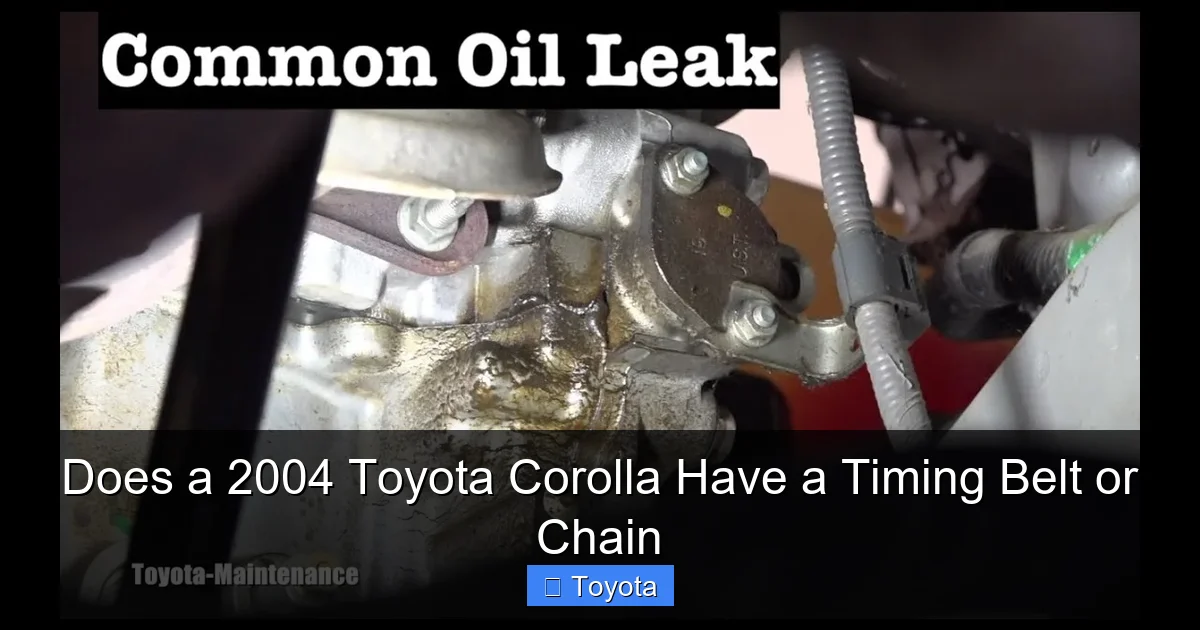
The timing system connects the crankshaft (which is driven by the pistons) to the camshaft(s) (which operate the valves). It ensures that when a piston is at the top of its compression stroke, the intake and exhaust valves are perfectly closed. If this synchronization is lost—if the timing is “off”—the pistons and valves can collide. In an “interference engine” (which the 1ZZ-FE is), this collision bends valves, punches holes in pistons, and shatters the cylinder head. The engine becomes a very heavy, useless paperweight. This is why the integrity of your timing component is non-negotiable.
Timing Belt: The Rubber Band with a Deadline
A timing belt is typically made of reinforced rubber with teeth that grip gears on the crankshaft and camshaft. It’s located outside the engine, usually under a plastic or metal cover. Because it’s made of organic materials, it degrades over time due to heat, humidity, and stress. Manufacturers therefore assign it a strict “replacement interval,” often between 60,000 and 100,000 miles. Missing this service is a gamble with catastrophic odds. The belt can jump a tooth, stretch, or, worst of all, snap completely without warning. The cost of a belt job isn’t just for the part; it’s highly labor-intensive, often requiring the removal of many engine components to access it, costing $500-$1,000 or more.
Timing Chain: The Metal Lifeline
A timing chain is, as the name suggests, a metal link chain, similar to a bicycle chain but far more robust and precise. It runs inside the engine, bathed in the same oil that lubricates all the internal moving parts. The chain is tensioned by hydraulic or spring-loaded tensioners and guided by plastic or metal rails. Because it’s metal and runs in a lubricated environment, it doesn’t dry out or crack like a belt. The design intent is for it to last the lifetime of the engine. There is no regularly scheduled “chain replacement” in the Toyota maintenance bible for the 2004 Corolla. This is a massive selling point and a key reason for the model’s low cost of ownership.
The 2004 Toyota Corolla: A Chain-Only Proposition
Engine Specifics: The 1ZZ-FE
For the 2004 model year, the North American Corolla was powered almost universally by the 1.8-liter 1ZZ-FE engine. This engine produced 130 horsepower and was paired with either a 5-speed manual or a 4-speed automatic transmission. It’s a simple, iron-block, aluminum-head, 16-valve DOHC design. And from its introduction in the 2000 model year Corolla, Toyota equipped the 1ZZ-FE with a timing chain system. There was no belt option for this engine in the Corolla.
Visual guide about Does a 2004 Toyota Corolla Have a Timing Belt or Chain
Image source: motorverso.com
This consistency is great news for used car shoppers. You don’t have to play detective or decode VIN numbers to figure out what’s inside. Every single 2004 Corolla on the road has the same timing system. This eliminates the guesswork and risk associated with buying a used car where the previous owner may have neglected a belt service or, worse, installed it incorrectly.
How to Visually Confirm (If You’re Skeptical)
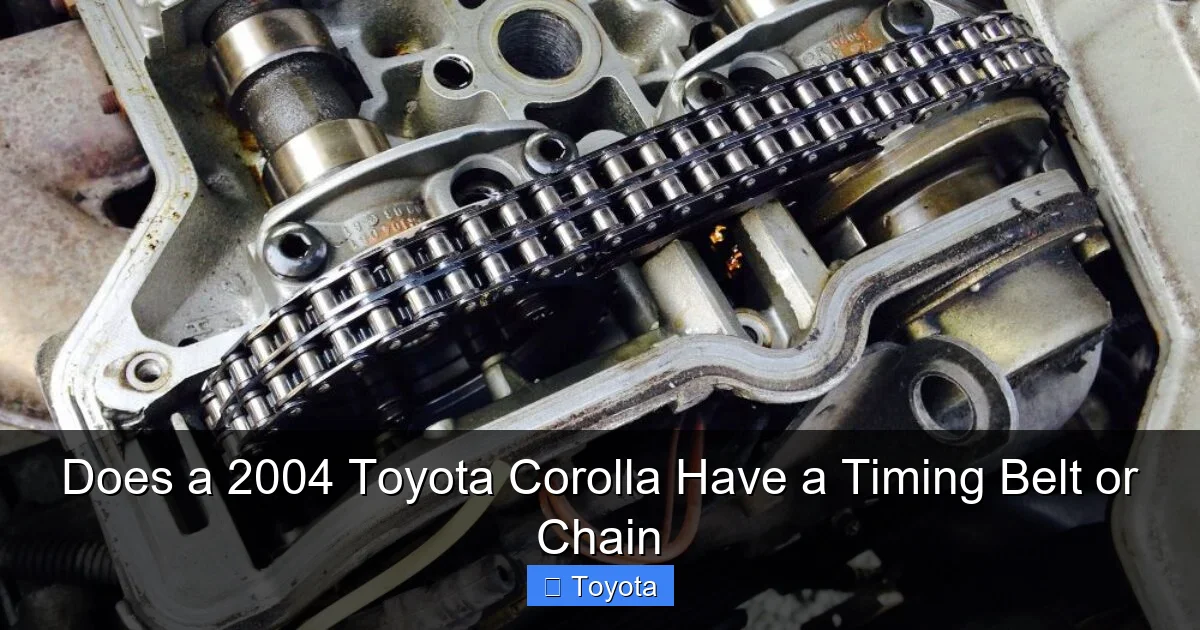
If you want to see it for yourself, you can perform a simple check. You will not find a large plastic or metal timing belt cover on the front of the engine. That’s the first clue. To actually see the chain, you’d need to remove the valve cover(s). The chain runs between the crankshaft sprocket at the bottom of the engine and the two camshaft sprockets (one for intake, one for exhaust) at the top. You’ll see a continuous metal chain, a tensioner arm, and guide rails. It’s a far more industrial-looking setup than the clean, quiet world of a rubber belt. Remember, never attempt any internal work on the timing system without extensive knowledge and the proper tools; getting the timing wrong by even one tooth will destroy the engine.
Maintenance and Longevity of the Timing Chain System
The Golden Rule: Oil Changes Are Everything
Since the chain runs in engine oil, the quality and cleanliness of that oil are the single most important factors in its longevity. Dirty oil contains abrasive particles that act like sandpaper, wearing down the chain links, sprocket teeth, and the plastic guides. Low oil levels or low oil pressure can cause the tensioner (which is often hydraulically operated) to fail, leading to chain slap and excessive wear.
Therefore, the “maintenance” for your 2004 Corolla’s timing system is synonymous with proper engine oil maintenance. This means:
- Using the correct oil: Toyota specified 5W-30 conventional oil for most climates, though 5W-20 synthetic became common later. Always check your owner’s manual. Using the wrong viscosity can affect hydraulic tensioners and lubrication.
- Changing it on schedule: The severe service interval was 3,000 miles/3 months for conventional oil, and 5,000 miles/6 months for synthetic. Even if you don’t drive much, oil degrades with time. If you’re unsure about the exact oil capacity or type, consult your manual or a trusted mechanic.
- Replacing the filter with every change: The oil filter traps contaminants. A clogged filter restricts flow, starving the chain of fresh oil.
- Monitoring oil level: Check the dipstick at least once a month. Keeping the oil between the MIN and MAX marks is critical. Running low on oil is a fast track to chain destruction.
Think of it this way: you’re paying for an oil change every few thousand miles, or you’re saving for a potential $4,000+ engine replacement down the line. The choice is clear.
Other Supporting Components
The timing chain itself is robust, but it relies on other parts:
- Tensioner: This maintains proper tightness on the chain. A hydraulic tensioner uses oil pressure. A failed tensioner allows the chain to become loose, leading to rattling and potential jumping of teeth.
- Guide Rails/Chain Guides: These plastic (sometimes later metal) parts keep the chain aligned as it spins at high speed. Old, brittle guides can crack and break, causing the chain to derail. This is a known, though not overwhelmingly common, failure point on high-mileage 1ZZ-FE engines. If you hear a cold-start rattle that goes away after a few seconds, a failing tensioner or guide is a prime suspect.
- Sprockets: The gears on the crankshaft and camshafts that the chain rides on. They have hardened teeth but can wear over extreme mileage if oil maintenance is poor.
The good news is that these supporting parts are generally very reliable in the 1ZZ-FE when oil changes are performed. Failures typically appear on engines with 200,000+ miles and a history of neglected maintenance.
Comparing the 2004 Corolla to Its Rivals and Predecessors
A Major Step Forward in Reliability
To appreciate the 2004 Corolla’s timing chain, it helps to look back. The previous generation (1998-2002) Corolla with the 1ZZ-FE also used a timing chain. So Toyota was already ahead of the curve. However, many of its direct competitors in the compact class were still using timing belts during this era.
For example:
- The Honda Civic of the same period (7th/8th gen) with the D17 and K20 engines used timing chains, so Honda was also a leader.
- The Ford Focus (first gen) and Chevrolet Cavalier used timing belts.
- The Nissan Sentra (with the QR25DE) used a timing chain, but other Nissan engines of the era often used belts.
This made the Corolla, Civic, and Sentra more attractive to savvy used car buyers who factored in long-term maintenance costs. A 2004 Corolla with 150,000 miles didn’t have a looming $800 timing belt service in its future, while a similarly priced competing sedan with a belt might have. This is a tangible, financial advantage that contributed heavily to the Corolla’s resale value dominance.
What About Other Toyota Models?
It’s interesting to note that Toyota’s adoption of timing chains wasn’t universal across all engines in the early 2000s. Their larger V6 engines, like the 3.0L 1MZ-FE found in Camrys and Avalons of that era, still used timing belts. The switch to chains for most of their lineup was a gradual process. For a broader perspective on Toyota’s evolution, you can read about when the Toyota Tundra switched to a timing chain, which happened later than the compact cars. The Corolla’s early adoption shows Toyota prioritized reliability and low ownership cost in its highest-volume, most price-sensitive model.
Warning Signs and Potential Issues: What to Listen For
While the timing chain is “lifetime” designed, “lifetime” in engineering terms often means “the expected life of the engine under normal use with proper maintenance.” On a neglected engine, nothing is lifetime. Here are the red flags, especially on a higher-mileage 2004 Corolla (150,000 miles+):
The Cold Start Rattle
This is the most common and classic symptom. When you start the engine on a cold morning, you hear a distinct metallic rattling or slapping noise from the front of the engine (behind the serpentine belt area). This noise typically lasts for 1-3 seconds and then disappears as oil pressure builds and the hydraulic tensioner takes up slack in the chain. A healthy system might have a very brief, faint tick, but a loud, prolonged rattle is a cry for help. It usually means the tensioner is weak or failing, or the plastic guide rails are worn or broken.
Check Engine Light with Timing-Related Codes
Modern engine computers (ECUs) monitor camshaft and crankshaft position. If the chain has stretched enough to cause a slight misalignment (jumping a tooth), the sensors will detect a mismatch between the crankshaft position and camshaft position. This will trigger a Check Engine Light and store codes like P0010, P0011, P0012, etc. (Camshaft Position Actuator Circuit/Performance). This is a serious, immediate issue. The engine may run poorly, have reduced power, and further operation will cause more damage.
Poor Performance and Misfires
If the timing has jumped even one tooth, the valves will open and close at the wrong time relative to the pistons. This causes poor combustion, leading to noticeable rough running, loss of power, hesitation, and misfire codes. Fuel efficiency will plummet. This is often the symptom that appears after the initial rattle has been ignored.
What to Do If You Suspect a Problem
Do not ignore these signs. The moment you hear a persistent cold-start rattle, have a trusted mechanic diagnose it. They will often need to remove the valve cover(s) to inspect the chain, tensioner, and guides directly. On the 1ZZ-FE, the front cam cover is relatively accessible. The cost to replace the timing chain set (chain, tensioner, guides, sprockets) while the engine is in the car is significant—likely $1,200 to $2,000 in parts and labor—because it’s a major job. However, it is still far less expensive than the $4,000-$6,000+ it costs to replace an engine that has suffered a catastrophic failure. Prevention through oil changes is always cheaper than repair.
Owner Tips for Maximizing Your Chain’s Lifespan
Stick to the Script: Oil Changes
I know I’m hammering this point home, but it’s the cornerstone of this engine’s longevity. Set a reminder. Use a quality oil and filter. If you do your own work, be meticulous about the oil capacity and filter torque. Underfilling starves components; overfilling can cause aeration (foamy oil) which doesn’t lubricate properly. For the 1ZZ-FE, it’s 4.0 quarts (3.8 liters) of 5W-30 with a filter change, but always verify.
Warm It Up, But Not Excessively
There’s an old myth about needing to let a car warm up for 10 minutes on a cold day. For modern fuel-injected cars like the 2004 Corolla, this is unnecessary and potentially harmful. The best practice is to start the engine, wait about 15-30 seconds for oil to circulate, and then drive gently for the first few minutes. This allows the engine and oil to reach operating temperature evenly and quickly. Prolonged, cold idle without load can lead to excessive fuel dilution of the oil, thinning it out and reducing its protective qualities.
Listen to Your Car
Get familiar with the normal sounds of your Corolla’s engine. Every few weeks, with the hood open, have someone start the car while you listen. Note the sound of the starter, the initial idle, and the smooth hum of the engine. This baseline makes it much easier to detect a new, unusual rattle or clatter. Early detection is everything.
Use Genuine or High-Quality Replacement Parts
If you ever do need a chain job, discuss the parts with your mechanic. OEM (Toyota) parts are engineered specifically for the engine and are a safe bet. There are also reputable aftermarket brands (like Aisin, which supplies many OEMs) that make excellent timing chain kits. Avoid the cheapest, no-name components. The tensioner and guides are critical to the system’s success and are worth investing in quality.
Don’t Neglect Other Engine Services
A well-running engine is a happy engine. Keep up with other services like spark plug replacement (every 120k miles for platinum/iridium OEM), air filter changes, and fuel filter service (if equipped). A misfiring cylinder or a clogged air filter can cause incomplete combustion, leading to carbon deposits and increased stress on all internal components, including the timing system. A holistic approach to maintenance protects every part of your engine.
The Bottom Line: Peace of Mind in a Box
So, does a 2004 Toyota Corolla have a timing belt or a chain? The definitive, unwavering answer is a timing chain. This single engineering decision is one of the hidden pillars of the Corolla’s legendary reliability story. It means you, as an owner, are freed from the anxiety and financial burden of a mandatory, expensive, mileage-based timing service. Your primary responsibility is simple and universal: change your oil on time, with the right oil, every time.
This design philosophy—building a car that just works with minimal fuss—is what made the 2004 Corolla such a phenomenal value when new and such a smart, durable choice today on the used market. While no machine is completely immune to failure, the 1ZZ-FE’s timing chain system, when cared for, is a “fit-and-forget” component. You can drive your Corolla with confidence, knowing that as long as you treat the engine to clean oil, that metal chain will likely keep your valves and pistons perfectly in sync for the next 200,000 miles. It’s a masterclass in practical engineering that continues to pay dividends for owners decades later.
Frequently Asked Questions
Does a 2004 Toyota Corolla have a timing belt or chain?
The 2004 Toyota Corolla has a timing chain. All models came with the 1.8L 1ZZ-FE engine, which uses a metal timing chain system designed to last the engine’s lifetime with proper oil changes.
When should I replace the timing chain on my 2004 Corolla?
There is no scheduled replacement interval. The timing chain is designed to last the life of the engine. Replacement is only necessary if it fails or shows signs of excessive wear, typically on very high-mileage engines with poor oil change history.
What are the signs of a bad timing chain on a 2004 Corolla?
The most common sign is a loud metallic rattling noise from the front of the engine during cold starts that lasts a few seconds. Other signs include a Check Engine Light with camshaft/crankshaft codes, poor running, and loss of power, indicating the chain may have jumped a tooth.
What happens if the timing chain breaks in my 2004 Corolla?
The 1ZZ-FE is an interference engine. If the chain breaks, the pistons will collide with the open valves, causing severe internal damage like bent valves, damaged pistons, and a ruined cylinder head. The engine will require a complete rebuild or replacement.
Is the 2004 Corolla timing chain expensive to replace?
Yes, it is a major labor-intensive repair. The cost typically ranges from $1,200 to over $2,000 because the engine must be partially disassembled to access the chain. This underscores the importance of strict oil change compliance.
Did any 2004 Corolla models have a timing belt?
No. Every single 2004 Toyota Corolla, regardless of trim (CE, LE, S) or transmission, used the 1ZZ-FE engine with a timing chain. There was no belt option available for this model year in the North American market.
