
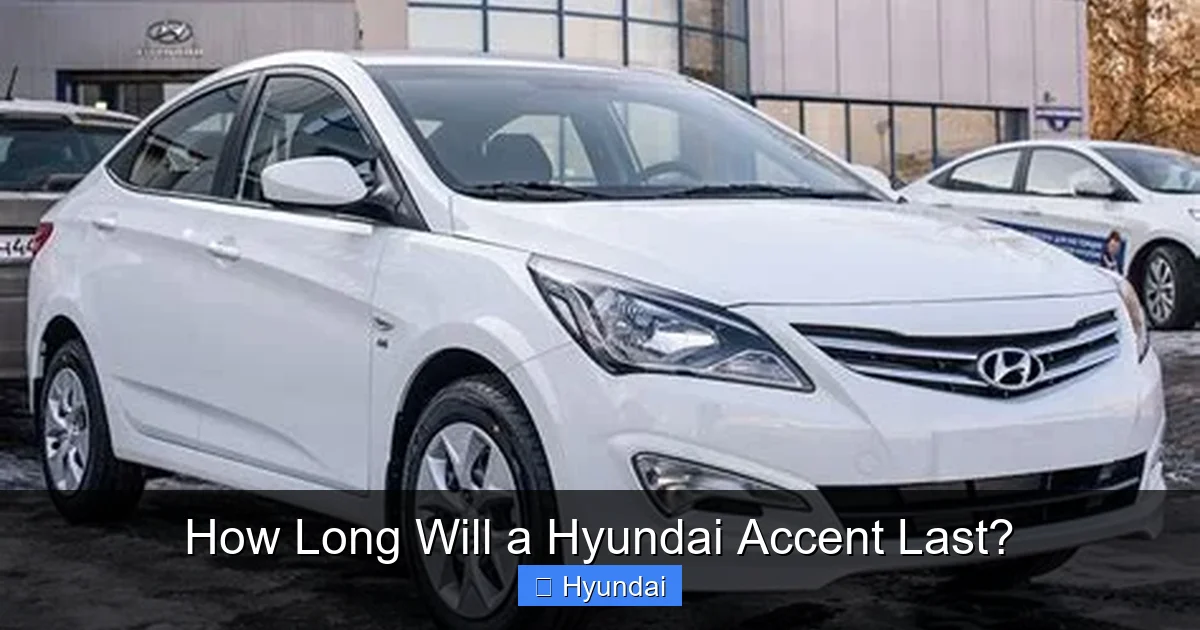
How Long Will a Hyundai Accent Last?

With meticulous care and regular maintenance, a Hyundai Accent can reliably surpass 200,000 miles. Its simple, proven powertrain design is a key strength, but long-term survival hinges entirely on the owner’s commitment to scheduled service. While not built for high-performance stress, its economical nature and robust components make it a formidable contender for longevity against rivals like the Toyota Corolla. Ultimately, the Accent’s lifespan is a direct reflection of consistent upkeep and timely repairs.
Key Takeaways
- Engine & Transmissions are Built for Longevity: The Accent’s traditional port-injected engines and conventional automatic transmissions are known for simplicity and durability when maintained, with many examples reaching 200k+ miles.
- Maintenance is Non-Negotiable: Adhering strictly to Hyundai’s severe service schedule, especially for oil changes, coolant, and transmission fluid, is the single most important factor in determining lifespan.
- Rust is the Primary Enemy for Older Models: Pre-2017 models, especially in salt-belt states, can suffer from significant frame and body corrosion, which often ends a vehicle’s life long before the engine fails.
- Cost-Effective Repairs Extend Life: Common wear items like brakes, struts, and sensors are inexpensive and easy to replace. Budgeting for these prevents small issues from causing catastrophic damage.
- Real-World Data Shows Strong Potential: Owner forums and longevity studies consistently report Accents regularly hitting 150,000-200,000 miles with original engines and transmissions, provided major services weren’t neglected.
- It’s a Different Kind of “Last”:strong> The Accent is engineered for efficient, low-stress commuting, not for towing or racing. Its longevity is measured in years and miles of trouble-free daily driving, not high-performance endurance.
- Newer Models Have Improved Rust Protection: Accents from the 2017 redesign onward feature much better corrosion resistance and warranty coverage, significantly improving their potential long-term viability in harsh climates.
[FEATURED_IMAGE_PLACEHOLDER]
📑 Table of Contents
- How Long Will a Hyundai Accent Last? Unpacking the Numbers
- The Maintenance Mileage: Your Direct Line to 200k
- Real-World Mileage: What Owners Are Actually Seeing
- The Cost of Keeping It Alive: A Practical Budget
- When It’s Time to Say Goodbye: The End of the Line
- The Verdict: A Solid, Dependable Commuter
How Long Will a Hyundai Accent Last? Unpacking the Numbers
So, you’re looking at a Hyundai Accent, or maybe you already own one, and the big question is buzzing in your head: “How long will this little car actually last?” It’s a smart question. The Accent has built a reputation as a budget-friendly, fuel-sipping commuter car. But does that mean it’s built to be a disposable appliance, or can it become a trusted, high-mileage companion? Let’s pop the hood and look under the chassis to find out.
The short answer, backed by years of owner feedback and reliability data, is surprisingly positive. A well-maintained Hyundai Accent can easily reach 200,000 miles and often more. That’s a number that was once reserved for legendary tanks like Toyota trucks or Mercedes-Benz diesels. For a modern, subcompact economy car to achieve that is a testament to Hyundai’s engineering focus on reliability over the last two decades. But that “well-maintained” part is the giant, flashing caveat. The Accent’s potential is a contract between you and the car, and you have to hold up your end.
The Heart of the Matter: Powertrain Durability
To understand longevity, you start with the engine and transmission. These are the most complex and expensive components. If they die, the car’s life is usually over. Fortunately, the Accent has historically played it safe and simple here.
For most of its modern life (1994-2020), the Accent used a family of 1.4L, 1.5L, and 1.6L four-cylinder engines. These are not high-tech, direct-injection, turbocharged units. They are traditional port-injected, overhead cam engines. This simplicity is their superpower. Fewer complex systems mean fewer things to break. They are designed for low-end torque and efficiency, not for screaming at high RPMs. This low-stress operation is ideal for longevity. The biggest threats to these engines are neglect—specifically, oil starvation from missed changes or overheating from a failed cooling system component.
The transmissions paired with these engines are equally straightforward. The long-standing 4-speed and later 5-speed and 6-speed automatic transmissions are conventional planetary gear units. They are not cutting-edge dual-clutch setups or complex CVTs (until the very latest models in some markets). This conventional design is proven, repairable, and, when serviced with fresh fluid at the recommended intervals, remarkably durable. The manual transmissions, where available, are even more bulletproof with basic care.
It’s worth noting a key point of comparison: while brands like Honda have faced widespread issues with their automatic transmissions in certain model years, Hyundai’s conventional automatics in the Accent have not been plagued by similar, widespread failure patterns. This is a significant point in the Accent’s favor for long-term ownership.
The Silent Killer: Rust and Corrosion
If the powertrain is the heart, the body and frame are the skeleton. And for many older Accents, rust is the disease that rots the skeleton away. This is the single biggest factor that will cut an Accent’s life short, especially if you live in an area that uses road salt in winter.
Early and mid-2000s Accents, and even some 2010-2016 models, are notorious for developing rot in critical areas. We’re talking about the strut towers, rocker panels, rear wheel arches, and the subframe mounting points. Once structural rust takes hold, the car becomes unsafe. Repairing this kind of damage is not cost-effective; it’s a patch on a crumbling foundation. You can have an engine with 150,000 miles that runs perfectly, but if the floorpan is gone, the car is done.
The good news is that Hyundai recognized this problem. The complete redesign for the 2017 model year brought with it vastly improved rustproofing techniques, more galvanized steel, and better drainage designs. If you are shopping for a used Accent with long-term intentions, a 2017 or newer model from a non-salt-belt state is a dramatically better bet for seeing 200,000 miles than a 2012 model from Michigan or upstate New York. Always get a pre-purchase inspection that specifically looks for rust, especially if the vehicle has spent its life in the “rust belt.”
The Maintenance Mileage: Your Direct Line to 200k
Let’s be brutally clear: an Accent that gets oil changes every 7,500 miles will not last 200,000 miles. An Accent that gets them every 3,500-5,000 miles with quality oil and a good filter has a fighting chance. The maintenance schedule isn’t a suggestion; it’s the law of the land for longevity. Hyundai’s own “Severe Service” schedule is actually the one you should follow for maximum life, even if you don’t think you drive in “severe” conditions. It’s more conservative and protective.

Visual guide about How Long Will a Hyundai Accent Last?
Image source: autozonic.com
Here’s what that really means in practice:
- Oil & Filter: This is job one. Clean oil is the lifeblood of the engine. Use the recommended viscosity (usually 5W-20 or 5W-30) and a quality filter. Don’t cheap out here. Synthetic oil can extend intervals slightly and offers better protection, especially in extreme temps. Speaking of which, understanding oil life is crucial. You might find our article on how long synthetic oil can last helpful for optimizing this critical service.
- Cooling System: The engine’s thermostat, water pump, and coolant are a team. Coolant degrades over time, losing its anti-corrosive properties and boiling/freezing point protection. A neglected cooling system leads to overheating, which is a death sentence for any engine. Replace coolant every 30,000-50,000 miles as per the severe schedule.
- Transmission Fluid: This is the #1 neglected service on automatics. “Lifetime” fluid in the owner’s manual is a manufacturer’s marketing term, not a mechanic’s recommendation. For a car aiming for 200k, you must change the transmission fluid. For the 4/5/6-speed autos, every 60,000-80,000 miles is a smart target. Fresh fluid keeps clutches and bands from slipping and wearing prematurely. If you’re curious about general fluid longevity, we have a piece on how long various fluids last in a car.
- Timing Components: This is critical. Most Accent engines from the mid-2000s onward use a timing chain, which is designed to last the life of the engine. However, the chain tensioners and guides are plastic and can wear out. Listen for a rattling on cold start—it can be a sign. Replacing these components at 150,000 miles is a wise insurance policy. Older models (pre-2003) used a timing belt, which must be replaced every 60,000 miles to avoid catastrophic engine destruction.
- Spark Plugs & Filters: Don’t ignore the simple stuff. Worn spark plugs cause misfires that can wash oil from cylinder walls. A clogged air filter chokes the engine, reducing efficiency and increasing wear. Cabin air filters affect your health, not the engine, but are easy and cheap to replace.
Real-World Mileage: What Owners Are Actually Seeing
Numbers from mechanics and owner forums tell a compelling story. On sites like Reddit and dedicated Hyundai forums, you’ll find countless threads from owners with 150,000, 180,000, and even 250,000-mile Accents. The common theme in every single one of these stories is obsessive, sometimes bordering on neurotic, maintenance.

Visual guide about How Long Will a Hyundai Accent Last?
Image source: autozonic.com
One common report is the 2010-2014 Accent with the 1.6L GDI (Gasoline Direct Injection) engine. These engines can be prone to carbon buildup on the intake valves (since fuel doesn’t wash them clean like port injection does). This can lead to rough idling and misfires after 120k miles. The fix is a costly walnut blasting service. Owners who are aware of this issue and perform induction cleaning every 60-80k miles often avoid the worst of it. This is a perfect example of a known, model-specific weakness that proactive maintenance can manage.
Transmission-wise, the 6-speed automatic in the 2012+ models is generally robust. Failures before 150,000 miles are rare and usually linked to neglected fluid changes or a faulty solenoid. The 5-speed in earlier models is even simpler. The manual transmissions are almost legendary for their durability, often outlasting the body they’re mounted to.
When comparing to other economy leaders, the Accent holds its own. A well-kept Accent can match the mileage potential of a Nissan Maxima (which is a much more complex, higher-performance car) in terms of basic reliability, though the Maxima’s V6 is a different beast entirely. The key takeaway is that the Accent’s simplicity is its ally.
The Cost of Keeping It Alive: A Practical Budget
Let’s talk money. A car lasting 200,000 miles isn’t free. You have to spend money to save money. The beauty of the Accent is that the parts are cheap and the labor is often simple. Here’s a realistic, decade-long maintenance budget to hit 200k, starting from a well-cared-for 100,000-mile example.
Visual guide about How Long Will a Hyundai Accent Last?
Image source: autozonic.com
- Years 1-2 (100k-140k miles): Major services. Transmission fluid change ($150-$250), coolant flush ($100-$150), spark plugs ($50-$80), brake fluid flush ($100), and maybe a set of brakes/rotors ($300-$500). Budget: $800-$1,200.
- Years 3-4 (140k-180k miles): Wear and tear items. Struts/shocks ($600-$1,000), possibly a new catalytic converter if the old one fails ($$$—but can be mitigated by fixing engine misfires quickly), battery ($100-$200), various belts/hoses ($200-$400), and another transmission fluid change. Budget: $1,500-$2,500+.
- Years 5+ (180k+ miles): The “major overhaul” phase. You might need a new radiator, water pump, or even a timing chain job (which can be $1,000-$1,800). Engine mounts, CV axles, and a tune-up are common. Budget: $2,000-$4,000.
Total over 10 years/100k miles: $4,300-$7,700. That averages $430-$770 per year. Compare that to a $300/month car payment on a new vehicle. You’re still winning financially, even with major repairs. The key is planning and saving for these services instead of being surprised by them.
When It’s Time to Say Goodbye: The End of the Line
Even with perfect care, every car has a finite economic life. For the Hyundai Accent, the end usually comes from one of two things: catastrophic rust or a repair bill that exceeds the car’s value.
As mentioned, a rusted-out frame is a non-starter. It’s unsafe and unfixable. For a 2010 Accent with 180,000 miles and a hole in the rocker panel, it’s a scrapyard candidate, even if the engine purrs.
The other, more common scenario is the “big repair” dilemma. At 190,000 miles, the transmission fails. The quote is $2,500 to rebuild it. The car’s value is $2,000. Do you put a $2,500 transmission in a $2,000 car? Most people say no. This is the moment the car’s “useful life” ends, even if the engine is strong. This calculus changes if you love the car, plan to drive it for another 50k miles, and have the skills or space to do the work yourself. For the average owner, the repair bill vs. value math is the ultimate decider.
The Verdict: A Solid, Dependable Commuter
So, how long will a Hyundai Accent last? The final, qualified answer is this: With a religious adherence to maintenance, a rust-free Accent from the 2017 redesign has a very strong chance of reaching 250,000 miles. A well-maintained pre-2017 model can reliably hit 150,000-200,000 miles, but its fate is heavily tied to its rust status.
It will not be a trouble-free 300,000-mile hero like some legendary pickup trucks. It will, however, be a loyal, inexpensive servant that can outlast three typical 5-year car ownership cycles. Its longevity won’t come from bulletproof engineering alone; it will come from your wallet and your willingness to be proactive. You are partnering with the car. If you hold up your end of the bargain—changing the fluids, addressing small problems before they grow, and keeping it clean and rust-free—the Hyundai Accent will almost certainly hold up its end and reward you with years of cheap, reliable transportation. It’s not the most exciting promise, but for thousands of owners, that’s exactly what they need.
Frequently Asked Questions
Is the Hyundai Accent a reliable long-term car?
Yes, the Hyundai Accent is considered a reliable long-term car, particularly the models from 2017 onward with improved rust protection. Its simple, proven powertrain components are very durable when subjected to proper, scheduled maintenance, making it a strong candidate for high mileage.
What is the biggest threat to a high-mileage Hyundai Accent?
The single biggest threat is rust and corrosion, especially on pre-2017 models in regions that use road salt. Structural rust in the frame or unibody can render a car unsafe long before the engine or transmission fail. Neglecting transmission fluid changes is the biggest threat to the powertrain itself.
How often should I change the transmission fluid in an Accent to make it last?
To maximize longevity, you should change the automatic transmission fluid every 60,000 to 80,000 miles. Hyundai’s “lifetime” fluid recommendation is not suitable for a 200,000-mile target. This simple service is the most important thing you can do for the transmission’s health.
Does the Hyundai Accent have a timing belt or chain?
Most modern Hyundai Accents (from approximately 2003 onward in the US) use a timing chain. This is a major advantage for longevity, as chains are designed to last the life of the engine. However, the tensioners and guides can wear out and may need replacement around 150,000 miles. Always verify for your specific model year and engine.
What are the most common problems on high-mileage Accents?
The most common issues on well-kept, high-mileage Accents are usually wear-and-tear items: suspension components (struts, control arm bushings), oxygen sensors, and exhaust components. For 2010-2014 models with the 1.6L GDI engine, carbon buildup on intake valves can cause rough running and may require a costly cleaning service.
How does the Hyundai Accent’s longevity compare to a Toyota Corolla?
Both are exceptional in the economy car segment. The Corolla has a slightly longer-standing reputation for bulletproof reliability and may have a marginal edge in rust resistance on older models. However, a modern, rust-free Accent with meticulous maintenance is very close in potential lifespan. The Accent often offers more features for the money, while the Corolla may have a slightly higher resale value at extreme mileage.
