
How to Add Coolant to a Hyundai Accent

Adding coolant to your Hyundai Accent is a simple yet critical maintenance task that prevents engine overheating and costly damage. Always use the correct coolant type—typically Hyundai Long Life Coolant (often pink)—and never open a hot cooling system. Regularly check levels when the engine is cold, and top up only to the “MAX” line in the translucent reservoir. If coolant is consistently low, inspect for leaks immediately.
Hey there, fellow Hyundai Accent owner! Let’s talk about something that’s easy to forget until it’s too late: your engine’s coolant. You might know it as antifreeze, but its job goes way beyond just preventing freeze-ups in winter. It’s the lifeblood of your engine’s cooling system, working tirelessly to absorb heat and keep everything at a safe operating temperature. Ignoring it is a one-way ticket to an overheating disaster, warped cylinder heads, and a repair bill that will make your eyes water. The good news? Checking and adding coolant to your Hyundai Accent is one of the simplest DIY car maintenance tasks you can master. It takes five minutes, requires almost no tools, and gives you immense peace of mind. Whether you have a 2012 base model or a 2020 sedan, this guide will walk you through it step-by-step. We’ll cover exactly what coolant to use, where to find the reservoir, how to add it safely, and what to do if your car is losing coolant too fast. Let’s get into it and keep your Accent’s engine running cool and happy.
Key Takeaways
- Use the correct coolant: Hyundai Accents require specific coolant (usually Hyundai Long Life Coolant or equivalent). Mixing types can cause sludge or corrosion.
- Never open a hot system: The cooling system is pressurized. Opening the cap when hot can cause scalding steam or coolant spray.
- Check when cold: Always check and add coolant only when the engine is completely cool to get an accurate reading.
- Locate the reservoir: The coolant overflow tank is a translucent plastic jug near the radiator with “MIN” and “MAX” marks.
- Top up, don’t overfill: Add coolant slowly until it reaches the “MAX” line. Overfilling can cause overflow and pressure issues.
- Consistent loss means a leak: If you’re adding coolant frequently, there’s likely a leak in the radiator, hoses, water pump, or thermostat housing.
- Flush periodically: Coolant degrades over time. A complete system flush every 3-5 years maintains protection and prevents corrosion.
[FEATURED_IMAGE_PLACEHOLDER]
📑 Table of Contents
- Understanding Your Hyundai Accent’s Coolant System
- Essential Tools and Safety First
- Step-by-Step: Locating the Coolant Reservoir
- The Main Event: How to Add Coolant to Your Hyundai Accent
- Topping Up vs. Full Coolant Flush: What’s the Difference?
- Diagnosing and Addressing Coolant Leaks
- Long-Term Care and Maintenance Best Practices
Understanding Your Hyundai Accent’s Coolant System
Before we pop the hood, it helps to know what we’re dealing with. Your Hyundai Accent’s cooling system is a closed loop. It’s made up of the water pump, radiator, thermostat, hoses, and the engine’s water jackets (passages inside the engine block and head). The coolant—a mixture of antifreeze and water—circulates through this loop. The water pump, driven by the engine, pushes the hot coolant from the engine to the radiator. Air flowing through the radiator fins cools the liquid down before it’s pumped back to start the process again. The thermostat acts as a gatekeeper, staying closed when the engine is cold to help it warm up quickly, then opening once operating temperature is reached to allow full coolant flow.
Why the Right Coolant is Non-Negotiable
Not all coolants are created equal. Hyundai, like most manufacturers, specifies a particular type for its engines. For most Hyundai Accents from the late 1990s through today, the manufacturer recommends Hyundai Long Life Coolant (often identified by its distinctive pink or red color) or a phosphate-free, organic acid technology (OAT) coolant that meets Hyundai’s MS 591-08 specification. Using the wrong type—like the traditional green inorganic acid technology (IAT) coolant—can be a recipe for disaster. Incompatible coolants can gunk up the system, form corrosive sludge, damage seals, and reduce heat transfer efficiency. Always consult your owner’s manual for the definitive specification for your specific model year and engine. If you don’t have the manual, a quick call to your Hyundai dealer’s parts department with your VIN will get you the right information. For a deep dive on selecting the best product, you can read our full guide on the best coolant for a Hyundai Accent.
Signs Your Accent Needs Coolant
You don’t have to wait for a warning light. Be proactive. The most obvious sign is a low coolant level in the reservoir. Other red flags include:
- The temperature gauge rising: If it’s creeping into the “H” or red zone, stop driving immediately.
- Sweet smell: A distinct, syrupy odor (like maple syrup) means coolant is leaking and burning on the hot engine or exhaust.
- Visible leaks: Look for puddles of green, orange, pink, or yellow liquid under the car after it’s been parked.
- Heater not working: Your car’s heater uses hot coolant. If it’s blowing cold air when set to hot, low coolant could be the culprit.
- White smoke from exhaust: This can indicate a more serious problem like a blown head gasket, where coolant is entering the combustion chamber.
Essential Tools and Safety First
This is a tool-light job, but preparation is key. Gather these items:
Visual guide about How to Add Coolant to a Hyundai Accent
Image source: i.ytimg.com
- The correct coolant: Have the right type on hand. You’ll likely need 1-2 quarts for a simple top-up.
- Clean distilled water: For diluting concentrated coolant (if needed) or for a emergency top-up in a pinch (though not ideal long-term). Never use tap water; its minerals can cause deposits.
- A funnel: A long-neck funnel or one with a flexible spout makes a mess-free pour much easier.
- Gloves and safety glasses: Coolant is toxic. Avoid skin contact and eye splashes.
- Rags or paper towels: For cleanup and to wipe the reservoir neck.
SAFETY IS PARAMOUNT: The golden rule: never, ever attempt to open the radiator cap or the coolant reservoir cap when the engine is warm or hot. The cooling system is pressurized. Opening it can release a geyser of scalding, pressurized coolant, causing severe burns. Always wait at least 1-2 hours after driving for the system to depressurize and cool completely. When you do open the cap, do it slowly and carefully, using a rag to protect your hand, and stand to the side to avoid the opening.
Step-by-Step: Locating the Coolant Reservoir
Finding the coolant reservoir on a Hyundai Accent is straightforward, but it’s not the radiator itself. The reservoir is a separate, translucent plastic tank, usually located in the engine bay near the front of the car. It’s often labeled with “COOLANT” or has a symbol of a thermometer or a radiator on the cap.
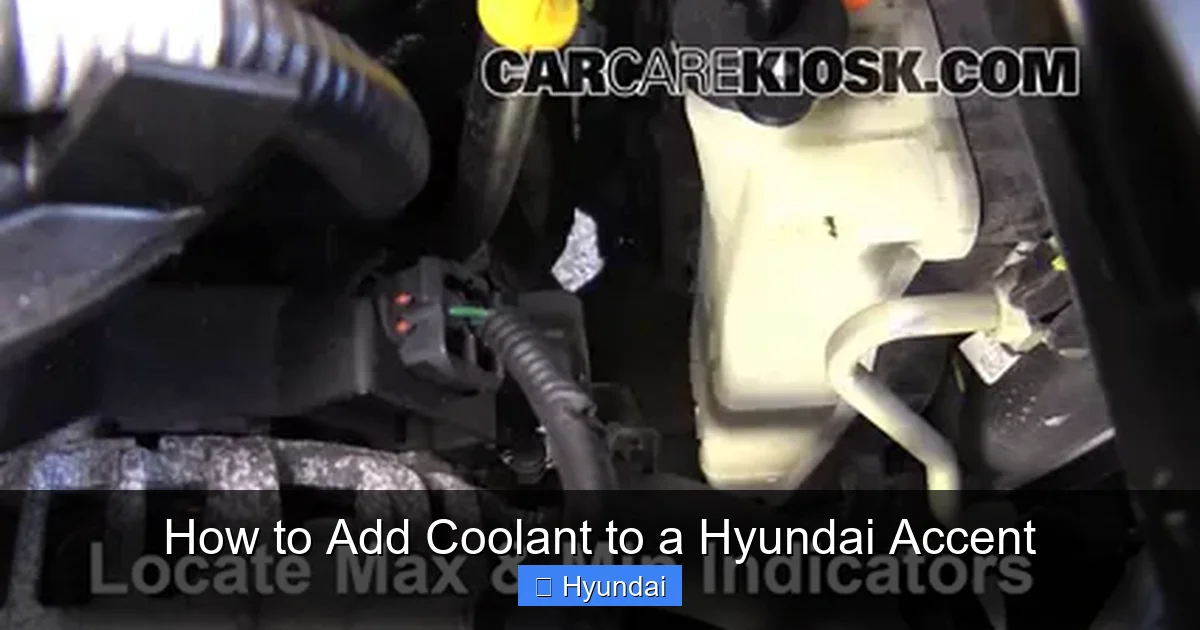
Visual guide about How to Add Coolant to a Hyundai Accent
Image source: d2n97g4vasjwsk.cloudfront.net
Identifying the Reservoir on Different Model Years
The exact placement can vary slightly:
- Most 1994-2005 Accents: The reservoir is typically on the passenger-side fender well, near the battery or the washer fluid tank.
- 2006-2020 Accents: It’s commonly found on the driver’s side, mounted on the inner fender, near the strut tower. It’s usually a black or white plastic tank with a yellow or black cap.
Your best friend here is the owner’s manual. If that’s missing, follow the largest hose from the radiator—it will lead you to the reservoir. The tank will have two clearly marked lines: “MIN” (or “LOW”) and “MAX” (or “FULL”). When the engine is cold, the coolant level should sit right on the “MIN” line. If it’s below that, you need to add some.
The Main Event: How to Add Coolant to Your Hyundai Accent
Alright, the engine is stone cold (this cannot be stressed enough). You’re wearing gloves. You have your funnel and correct coolant ready. Let’s do this.

Visual guide about How to Add Coolant to a Hyundai Accent
Image source: d2n97g4vasjwsk.cloudfront.net
1. Clean the Reservoir Cap Area
Before you unscrew anything, use a rag to wipe around the cap of the coolant reservoir. This prevents any dirt or debris from falling into the system when you open it. A clean system is a happy system.
2. Remove the Cap
Place your rag over the cap for grip and protection. Turn the cap counter-clockwise slowly. You might hear a slight hiss as any residual pressure releases. Once loose, lift it off and set it aside in a clean place where it won’t get dirty.
3. Check the Current Level and Condition
Look inside the clean reservoir. Note the level against the “MIN” and “MAX” marks. Also, take a quick look at the coolant’s color. It should be a vibrant pink, red, orange, or green depending on the type. If it looks rusty, brown, oily, or has sludge floating in it, your system needs a flush, not just a top-up. We’ll talk about that next. If it’s just low and clean, proceed.
4. Add Coolant Slowly
Insert your funnel into the reservoir neck. Slowly pour your pre-mixed coolant (or the correct ratio of concentrate to distilled water) into the tank. Watch the level rise. Stop pouring as soon as the coolant reaches the “MAX” or “FULL” line. Do not overfill. The system needs air space for expansion as it heats up. Overfilling can force coolant out of the overflow hose, creating a puddle and potentially lowering the level again.
5. Replace the Cap and Secure
Remove the funnel. Wipe any spills around the neck. Place the cap back on, aligning any tabs, and turn it clockwise until it clicks or is snug. Give it a gentle tug to ensure it’s secure. A loose cap can cause leaks and overheating.
6. Final Checks and Cleanup
Wipe up any spilled coolant immediately. It’s toxic to pets and wildlife if ingested. Start your engine and let it idle for a few minutes with the heater set to max hot and fan on high. This helps circulate the new coolant and bleed any air pockets. Watch the temperature gauge to ensure it stays normal. After the engine is warm (but not scalding hot), you can re-check the reservoir level. It may drop slightly as air works its way out. If it drops significantly below “MIN,” you may have a persistent air lock or a leak. Top it up again to “MAX” if needed. Take a final look under the car for any fresh drips.
Topping Up vs. Full Coolant Flush: What’s the Difference?
Adding a quart or two to bring the level back to “MAX” is a top-up. It’s a temporary fix for low coolant. A full coolant flush is a complete drain and refill of the entire system, replacing every last drop of old, degraded fluid with fresh coolant. Old coolant loses its anti-corrosion and anti-boil properties. Its pH becomes acidic, which can slowly eat away at your radiator, water pump, and engine passages from the inside out. A flush is a preventative service, not an emergency fix.
When is a Flush Necessary?
Follow your Hyundai’s maintenance schedule, which typically calls for a flush every 30,000 to 50,000 miles or every 3-5 years. However, you should consider a flush if:
- The coolant is dark, rusty, or has particles in it.
- The system has been contaminated with oil (sign of a bad head gasket).
- You’ve had a major component replaced (like a radiator or water pump) and want to ensure the system is clean.
- You’re experiencing persistent overheating despite a full system and no obvious leaks.
A flush is more involved, requiring draining from multiple points (radiator petcock, engine block drain plugs), flushing with water until it runs clear, and then refilling with the correct coolant and air-bleeding procedure. If you’re not comfortable with this, it’s a perfect job for a professional. For comparison, checking and maintaining coolant in a different vehicle like a Toyota Camry follows a very similar principle, though the exact reservoir location and coolant type may differ.
Diagnosing and Addressing Coolant Leaks
If you added coolant and the level is already low again a week later, you have a leak. Don’t just keep topping it up. You need to find the source. Common leak points on a Hyundai Accent include:
Common Leak Locations
- Radiator: Look for cracks, especially around the plastic end tanks, or corrosion holes.
- Coolant Hoses: Check the upper and lower radiator hoses, the small bypass hose, and the heater core hoses for cracks, bulges, or leaks at the connection clamps.
- Water Pump: Often driven by the timing belt (on some Accents), a failing water pump will leak from its weep hole. Look for coolant near the timing cover.
- Thermostat Housing: The plastic housing can crack, or the gasket can fail.
- Heater Core: Leaks here are tricky. Signs include a sweet smell inside the car, foggy windows, or wet carpet on the passenger-side footwell.
Finding a small leak can be tricky. You may need to pressure test the cooling system with a special tool. If you can’t locate it yourself, a trusted mechanic is your best bet. For context, fixing a major coolant leak on a different brand like a BMW can be significantly more expensive due to parts and labor complexity, but the diagnostic process is fundamentally the same.
Long-Term Care and Maintenance Best Practices
Making coolant maintenance a habit will save you from major headaches.
Establish a Checking Routine
Make it a part of your monthly or bi-monthly check-up. With the engine cold, simply glance at the reservoir. Is the level on the “MAX” line? Is the fluid clean? This 30-second habit is the single best way to catch a slow leak before it strands you.
Always Use Hyundai-Approved Coolant
This bears repeating. When you buy coolant, look for one that explicitly states compatibility with Hyundai/Long Life Coolant or meets MS 591-08. Major brands like Zerex, Peak, and Prestone make versions for Asian vehicles. When in doubt, take your old coolant bottle or a photo of your reservoir cap to an auto parts store; they can usually match it.
Dispose of Old Coolant Responsibly
Never pour old coolant down the drain or on the ground. It’s highly toxic. Take it to any auto parts store (most accept used automotive fluids for free recycling), a hazardous waste facility, or your mechanic. Store it in a sealed, labeled container until you can dispose of it.
Know When to Seek Professional Help
Adding coolant is DIY gold. But if your reservoir is empty and the engine is hot, do not add cold coolant to a hot engine—the thermal shock can crack the block. Call for a tow. If you find a major leak, or if the engine has already overheated and won’t start, it’s time to call a pro. Overheating can cause catastrophic internal damage that isn’t fixable with just more coolant.
Keeping your Hyundai Accent’s cooling system topped up with the right fluid is a tiny investment of time and money that pays massive dividends in reliability. You’re not just preventing a breakdown; you’re protecting one of your most valuable assets. Now you’ve got the knowledge. Go check that reservoir!
Frequently Asked Questions
How often should I check the coolant level in my Hyundai Accent?
Check the coolant reservoir at least once a month when the engine is cold. It’s also a good idea to check it before any long road trip. Frequent checks help you spot a slow leak early, before it causes overheating.
What specific type of coolant should I use in my Hyundai Accent?
Most Hyundai Accents require Hyundai Long Life Coolant (often pink/red) or an OAT-type coolant that meets Hyundai specification MS 591-08. Always verify this for your specific model year in your owner’s manual. Using the wrong coolant can damage the system.
What does it mean if my Hyundai Accent is constantly losing coolant?
Consistently low coolant levels indicate a leak somewhere in the system. Common sources include the radiator, hoses, water pump, or thermostat housing. Simply adding more coolant is a temporary fix. You must diagnose and repair the leak to prevent engine overheating and serious damage.
Can I just add water if I’m out of coolant in an emergency?
In a true emergency to get you to a safe location or repair shop, you can add clean distilled water. However, water lacks anti-freeze, anti-corrosion, and anti-boil properties. It should be replaced with the correct pre-mixed coolant as soon as possible. Never use tap water due to mineral deposits.
My engine overheated, and I added coolant. Now what?
If the engine overheated, do not start it again until the cause is found. Overheating can warp engine components. After adding coolant, monitor the level closely for days. If it drops quickly, you have a leak. Have the cooling system pressure-tested by a professional to find the source of the problem.
How do I properly dispose of old coolant from my Hyundai Accent?
Never pour coolant down drains or on soil. Store the used fluid in a sealed, labeled container. Take it to any auto parts store (like AutoZone or O’Reilly), a hazardous waste disposal facility, or your mechanic’s shop. They will recycle it properly for free or a small fee.