
How Wide Is the Bed of a Ford F150

The bed width of a Ford F150 varies by cab configuration and model year. The most common width between the wheel wells is approximately 50.5 inches, while the maximum width at the tailgate is about 62.5 inches. These measurements are crucial for fitting cargo, toolboxes, and accessories. Understanding the specific dimensions for your truck’s cab style—Regular, SuperCab, or CrewCab—and bed length—5.5-foot, 6.5-foot, or 8-foot—is essential for practical use and aftermarket planning.
Key Takeaways
- Primary Measurement: The key Ford F150 bed width measurement is the distance between the wheel wells, consistently around 50.5 inches for recent models, dictating the widest flat cargo area.
- Cab Style Dictates Bed: Your truck’s cab configuration (Regular, SuperCab, CrewCab) directly determines which bed lengths are available, which in turn affects the overall bed dimensions.
- Max Width vs. Usable Width: While the tailgate opening can be up to ~62.5 inches wide, the space between the wheel wells (~50.5 inches) is the true usable width for flat-lying items.
- Model Year Matters: Dimensions can shift slightly between generations (e.g., 13th gen 2015-2020 vs. 14th gen 2021+). Always verify specs for your specific model year.
- Bed Type Impacts Width: The standard bed, flareside bed (on older models), and the newer PowerBoost hybrid bed all have subtle differences in width and structure.
- Accessory Fit is Key: Knowing your exact bed width is non-negotiable for purchasing perfectly fitting bed mats, liners, tonneau covers, and toolboxes.
- Measure Your Own Truck: For absolute certainty, especially with wear, modifications, or older trucks, physically measure your bed’s width at the wheel wells and tailgate.
📑 Table of Contents
- Why Knowing Your F150 Bed Width Actually Matters
- The Official Ford F150 Bed Width Numbers (By Cab and Bed)
- Beyond the Numbers: Flareside vs. Standard Bed & Model Year Shifts
- How to Measure Your Own F150 Bed for Absolute Certainty
- How Does the F150 Bed Width Stack Up Against Competitors?
- Maximizing Every Inch: Practical Tips for Your F150 Bed
- Conclusion: Your Width is Your Workbench
Why Knowing Your F150 Bed Width Actually Matters
So, you’re staring at your Ford F150, maybe thinking about hauling a new dirt bike, a sheet of plywood, or a set of appliances. The first question that bubbles up isn’t about horsepower or towing capacity—it’s “will it fit?” The answer hinges on one critical, often misunderstood, number: the bed width. It’s the unsung hero of truck utility. Getting this measurement wrong means wasted trips, scratched fenders, and that sinking feeling when your 4×8 sheet of drywall won’t lie flat. It’s the difference between a versatile workhorse and a frustrating guessing game. This isn’t just trivia; it’s the foundational knowledge for every F150 owner who actually uses their truck for its intended purpose.
Think about it. That space between the rear wheels is the truck’s cargo spine. It’s where you slide in ladders, long lumber, or your buddy’s couch. The width at the tailgate is great for loading wide items at an angle, but the wheel well width is the hard limit for what can sit securely and flat. For anyone shopping for a bed liner, tonneau cover, or sliding rear window, these inches are everything. A mismatch of even an inch can mean a product that rubs, doesn’t seal, or simply won’t install. Beyond accessories, this knowledge empowers you. You’ll confidently load a 50-inch wide ATV, know exactly how many 2x4s fit side-by-side, and plan cargo for a cross-country move without the stress of “will it fit?”
The Official Ford F150 Bed Width Numbers (By Cab and Bed)
Ford doesn’t just make one F150. The magic—and the confusion—lies in the combinations. The truck’s cab style (how many doors and how much passenger space) locks you into specific bed lengths. This is the first filter. You cannot get a Regular Cab with an 8-foot bed in recent years, nor a CrewCab with a 5.5-foot bed. So, we must break it down by the available pairings. The following dimensions are for the 13th Generation (2015-2020) and 14th Generation (2021-Present) models, which cover the vast majority of trucks on the road today. Minor variations of 0.25 inches can occur between specific model years and sub-models like the Platinum versus XL, but these are the industry-standard figures.
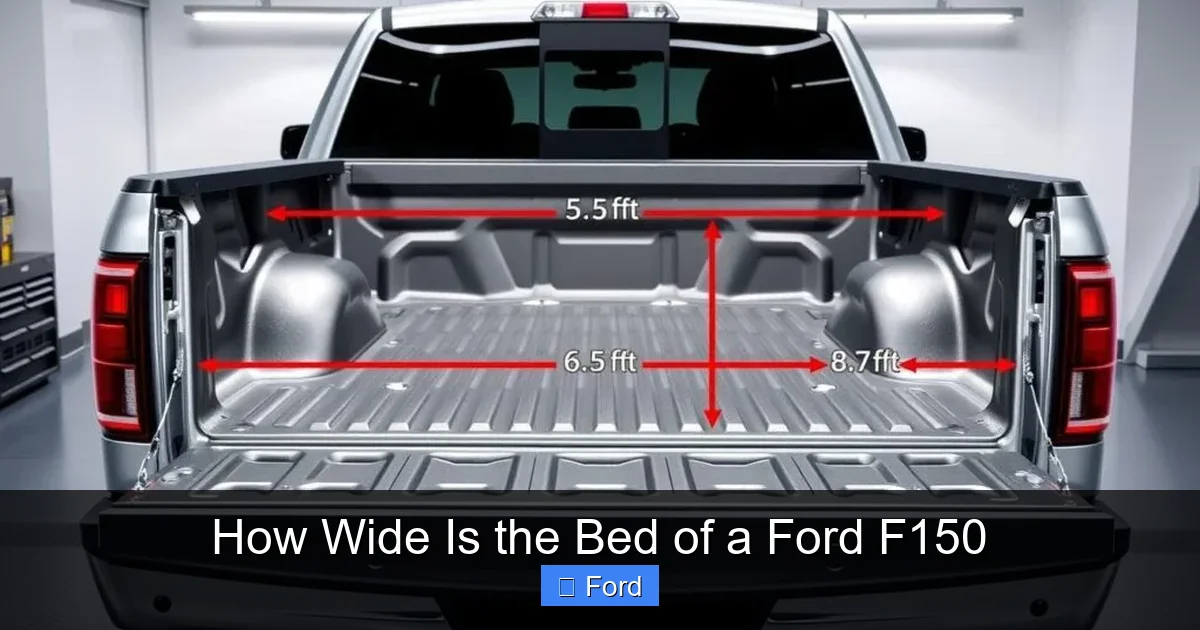
Visual guide about How Wide Is the Bed of a Ford F150
Image source: vehiclerides.com
Regular Cab Models
The two-door Regular Cab is the purist’s choice, maximizing bed space for the smallest cab. It’s the work truck staple.
- Bed Length: 8-foot (the only option for Regular Cab in recent gens)
- Width Between Wheel Wells: 50.5 inches
- Width at Tailgate Opening: 62.5 inches
- Overall Bed Width (at widest point): ~66 inches (including bed walls)
This is your maximum bed length configuration. The 8-foot bed offers immense cargo capacity, but the cab space is minimal. The width figures are consistent with other long-bed models.
SuperCab (Extended Cab) Models
The SuperCab (four doors, small rear jump seats) offers a balance. It comes in two bed lengths, each with its own width profile.
6.5-Foot Bed (Most Common SuperCab Bed):
- Width Between Wheel Wells: 50.5 inches
- Width at Tailgate Opening: 62.5 inches
This is the classic, versatile configuration. The width is identical to the 8-foot bed. The length is the sweet spot for many, fitting most standard household items and large cargo with room to spare.
5.5-Foot Bed (Short Bed):
- Width Between Wheel Wells: 50.5 inches
- Width at Tailgate Opening: 59.5 inches (Slightly narrower than longer beds due to different rear structure)
The short bed sacrifices length but retains the same critical wheel well width. The reduced tailgate opening is a subtle but important detail for loading very wide items.
CrewCab (SuperCrew) Models
The CrewCab (four full-size doors, large rear seating area) is the family and crew hauler. Its bed options are different again.
5.5-Foot Bed (Standard CrewCab Bed):
- Width Between Wheel Wells: 50.5 inches
- Width at Tailgate Opening: 59.5 inches
This is the most popular F150 configuration sold. The bed is short, but the usable width between the wheels is the same 50.5 inches. The narrower tailgate is a key identifier.
6.5-Foot Bed (Available on Higher Trims):
- Width Between Wheel Wells: 50.5 inches
- Width at Tailgate Opening: 62.5 inches
When you step up to a Lariat, King Ranch, Platinum, or Limited with a CrewCab, the 6.5-foot bed becomes available. Its width profile matches the longer beds. This is the premium “have your cake and eat it too” option: full crew cab *and* a longer, wider bed.
Important Note on the 8-Foot CrewCab Bed: For the 14th Generation (2021+), Ford reintroduced an 8-foot bed option for the CrewCab on select trims (primarily XL and XLT with the 3.5L EcoBoost). Its dimensions are:
- Width Between Wheel Wells: 50.5 inches
- Width at Tailgate Opening: 62.5 inches
This brings the ultimate in bed length to the full-size cab, a boon for contractors and serious haulers.
Beyond the Numbers: Flareside vs. Standard Bed & Model Year Shifts
If you’re looking at an older F150, specifically from the 11th Generation (2004-2008) or earlier, you might encounter the “Flareside” bed. This was the style with narrower, stylized rear fenders that *actually reduced the bed width*. For those models:
Visual guide about How Wide Is the Bed of a Ford F150
Image source: fordauthority.com
- Standard Bed Width (Between Wells): ~50.5 inches (similar)
- Flareside Bed Width (Between Wells): ~48.5 inches (about 2 inches narrower)
The Flareside’s curved rear panels ate into cargo space. It was discontinued for the 12th Generation (2009-2014) in favor of the more practical standard bed, which has remained since. So, if you’re shopping used, be sure to check if it’s a Flareside.
For the modern 13th and 14th gens, the bed structure is consistent. However, the PowerBoost Hybrid models (introduced in 2021) have a unique battery pack mounted *under* the bed, between the frame rails. This does not affect the interior bed width but does impact under-bed storage and the location of the fuel filler door. The bed itself is dimensionally identical to its non-hybrid counterparts.
How to Measure Your Own F150 Bed for Absolute Certainty
Specs are great, but trucks are real objects that live in the real world. They get dents, wear, and sometimes even non-factory modifications. Here’s how to get the definitive numbers for your specific truck.

Visual guide about How Wide Is the Bed of a Ford F150
Image source: carvibz.com
The Three Critical Measurements
Grab a tape measure and head to the back of your truck.
- Wheel Well to Wheel Well (The Golden Number): This is your most important measurement. Park on level ground. Measure straight across the bed from the inside edge of the left wheel well to the inside edge of the right wheel well. This is your maximum usable width for flat cargo. For 2015+ models, this should be very close to 50.5 inches.
- Tailgate Opening Width: With the tailgate down, measure the distance between the inside edges of the bed rails at the very rear. This tells you how wide an item you can load at an angle or with the tailgate up (if it fits). Compare this to the spec (59.5″ or 62.5″).
- Overall Bed Width: Measure from the very outside of the left bed wall to the very outside of the right bed wall. This is useful for planning full-width bed covers or racks.
Pro Tips for Accurate Measuring
- Measure Twice: Always take each measurement at least twice, at the front and rear of the bed area, to check for any warping or irregularity.
- Consider the Bed Liner: If you have a drop-in bed liner, measure both with it in (for accessory fit) and without it (for raw bed dimensions). A thick liner can reduce usable width by up to an inch.
- Check for Accessories: A permanently mounted toolbox, tonneau cover rails, or bed-mounted spare tire carrier will steal precious inches from your cargo bay. Measure around them.
- The “4×8 Sheet” Test: The ultimate real-world test. Can a standard 4×8 foot sheet of plywood or drywall lie flat between the wheel wells? With a 50.5-inch wheel well width, it will fit with about 2.5 inches of clearance on each side—perfectly.
How Does the F150 Bed Width Stack Up Against Competitors?
Numbers in a vacuum are meaningless. How does the F150’s legendary bed width compare to its arch-rivals? Let’s look at comparable configurations from the Chevrolet Silverado 1500 and Ram 1500 for the 2023-2024 model years. We’ll focus on the popular CrewCab/Short Bed (5.5-5.7 foot) and CrewCab/Long Bed (6.5-foot) setups.
- Ford F150 CrewCab 5.5′ Bed: 50.5″ between wheel wells, 59.5″ tailgate.
- Chevy Silverado 1500 CrewCab 5.5′ Bed: ~50.3″ between wheel wells, ~60.0″ tailgate. Extremely close, essentially a dead heat on usable width.
- Ram 1500 CrewCab 5.7′ Bed: ~51.8″ between wheel wells, ~61.4″ tailgate. The Ram actually has a slight edge in the crucial wheel well measurement by over an inch, a notable advantage for very wide cargo.
Moving to the longer beds:
- Ford F150 CrewCab 6.5′ Bed: 50.5″ between wheel wells, 62.5″ tailgate.
- Chevy Silverado 1500 CrewCab 6.5′ Bed: ~50.3″ between wheel wells, ~61.7″ tailgate. Again, nearly identical usable width.
- Ram 1500 CrewCab 6.5′ Bed: ~51.8″ between wheel wells, ~61.4″ tailgate. Maintains its slight width advantage.
What This Means For You: The F150 is not at a disadvantage. Its 50.5-inch wheel well width is the class standard, perfectly adequate for 99% of hauling needs. The Ram’s extra inch is nice for specialized, very wide loads, but the difference is marginal in daily use. If you’re cross-shopping, the bed width shouldn’t be a deciding factor; focus on cab space, engine choice, and feature sets. For a different perspective on truck size, you might look at how a mid-size competitor stacks up, like checking how big the bed of a Toyota Tacoma is, which has significantly different proportions.
Maximizing Every Inch: Practical Tips for Your F150 Bed
Knowing the width is step one. Using that space effectively is where true truck mastery begins.
The Art of the “Tailgate Down”
That 62.5-inch tailgate opening is your secret weapon. By lowering the tailgate, you effectively extend your cargo floor. A 10-foot piece of lumber that won’t fit with the gate up can easily be secured with the gate down, using the cab wall and the open tailgate as bookends. Always use proper tie-downs and flags for overhanging loads. This trick is invaluable for hauling long pipes, beams, or ladders.
Choosing the Right Bed Accessory
This is where your precise measurements pay off.
- Bed Mats/Linings: Must match your exact bed length and width. A mat for a 5.5-foot bed will be useless in an 8-foot bed. They are sold by specific bed configuration.
- Tonneau Covers: Folding, retractable, and snap-on covers are all engineered for specific bed widths. The side rails must align perfectly with your bed’s inner walls. The 50.5″ width is the critical spec they use.
- Toolboxes: A “cross-bed” toolbox that sits behind the cab must be less than 50.5 inches wide to fit between the wheel wells. Most popular cross-bed toolboxes are designed for this exact dimension. For side-mount toolboxes, the length of your bed (5.5′, 6.5′, 8′) is the primary spec, but they also have a depth (how far they protrude into the bed) that you must consider for cargo space.
- Bed Racks: These are typically adjustable, but the crossbar width will be limited by your bed’s overall width (~66″) or the space between the bed rails.
Loading Strategy for Wide Items
An item that is 52 inches wide won’t fit flat between the wheel wells. But all is not lost.
- Tilt It: Many wide items (like certain motorcycles or large appliances) can be tilted on their side, reducing their width footprint.
- Use the Tailgate: Place the item with one end resting on the tailgate (when down) and the other against the cab wall. This diagonal fit can accommodate surprisingly wide objects.
- Remove the Tailgate: For very large, awkward items that won’t fit even diagonally, some owners remove the tailgate entirely (it’s bolt-on). This opens up the rear completely, allowing items to extend into the space where the tailgate would be. This is a last-resort, secure-it-properly tactic.
Conclusion: Your Width is Your Workbench
The bed width of your Ford F150 is more than a spec sheet number—it’s the blueprint for your truck’s capability. That consistent 50.5-inch measurement between the wheel wells is the workbench upon which all your hauling projects are built. It’s the reliable, unchanging core dimension that allows you to confidently buy a 50-inch wide snowblower, a set of 48-inch shelves, or a standard pallet of goods. The variations in tailgate width and overall bed length simply add layers to that foundation, offering flexibility for different jobs. Whether you chose the mighty 8-bed of a Regular Cab or the compact 5.5-bed of a CrewCab, that central 50.5-inch corridor is your constant. It tells you what fits, what doesn’t, and what accessories will actually work. So, measure your truck, internalize those numbers, and unlock the true, predictable potential of your F150. When you know your space, you stop guessing and start hauling.
Frequently Asked Questions
Is the bed width the same on all Ford F150 models?
No, the bed width varies slightly depending on the cab style and bed length. However, the crucial measurement between the wheel wells is consistently 50.5 inches on most 2015 and newer models with standard beds. The width at the tailgate opening changes (59.5″ vs. 62.5″) based on bed length.
What is the narrowest point inside an F150 bed?
The narrowest point is always the distance between the inside edges of the rear wheel wells. For modern F150s (2015+), this is 50.5 inches. This measurement dictates the widest flat item you can carry, like a sheet of plywood.
Does an 8-foot bed have the same width as a 5.5-foot bed?
Yes, the width between the wheel wells is the same (50.5 inches) on both the 8-foot and 6.5-foot beds. The 5.5-foot bed has a slightly narrower tailgate opening (59.5″ vs. 62.5″), but the usable space between the wheels is identical.
How wide is the bed of a Ford F150 with a Flareside?
Older Flareside beds (pre-2009) are narrower. The width between the wheel wells is approximately 48.5 inches, about 2 inches less than the standard bed of the same era. This style was discontinued after the 2008 model year.
Can I fit a 4×8 sheet of plywood flat in the bed of an F150?
Yes, absolutely. A standard 4×8 foot sheet of plywood is 48 inches wide. With the F150’s 50.5-inch wheel well width, it fits with approximately 2.5 inches of clearance on each side, allowing it to lie completely flat.
Do I need to measure my truck if I know the official specs?
While the factory specs are highly reliable, it’s always a good practice to measure your own truck, especially if it’s older, has a drop-in bed liner, or aftermarket modifications like a toolbox or bed rails that can reduce usable space. A quick 30-second check confirms the numbers for your specific vehicle.
