What Does Maintenance Required Mean on Toyota Sienna

The “Maintenance Required” light on a Toyota Sienna is not a warning of immediate danger; it’s a sophisticated, mileage-based reminder from your vehicle’s maintenance minder system that a specific set of routine services—most commonly an oil change and tire rotation—are due based on your driving conditions. It illuminates after a predetermined interval (typically 5,000-10,000 miles) and must be manually reset after the maintenance is performed. While you can drive for a short period after it comes on, failing to address the required services promptly can lead to accelerated engine wear, poor fuel economy, and voiding your warranty.
Key Takeaways
- It’s a Scheduled Service Reminder: The light is triggered by the car’s computer based on mileage and driving data, not by a sensor detecting a problem. It’s a proactive alert from Toyota’s maintenance minder system.
- Primary Service is Usually an Oil Change: For most Siennas, the first “Maintenance Required” alert coincides with the first oil change, often around 5,000 miles under severe driving conditions or up to 10,000 miles under standard conditions.
- It Includes More Than Just Oil: The maintenance minder calculates a full service schedule, which typically includes oil change, tire rotation, and inspections of brakes, fluids, and other critical components.
- You Must Reset It Manually: After a technician performs the required services, they (or you) must reset the maintenance minder using a specific button-press sequence or a diagnostic scan tool. The light will not turn off on its own.
- Ignoring It Has Consequences: Driving long distances with the light on without performing the service can lead to engine sludge, uneven tire wear, compromised safety systems, and may violate lease or warranty terms.
- It’s Different from a Check Engine Light: The “Maintenance Required” light (usually a wrench icon) is for scheduled care. A Check Engine Light (usually an engine icon) indicates an active fault in the emissions or engine management system that needs diagnosis.
- Your Owner’s Manual is the Final Authority: The exact service intervals and reset procedures can vary by model year and drivetrain. Always consult your specific owner’s manual for the definitive guide.
📑 Table of Contents
- Demystifying the Wrench: What “Maintenance Required” Really Means on Your Toyota Sienna
- The Brain Behind the Light: How Toyota’s Maintenance Minder System Works
- What Services is My Sienna Actually Asking For?
- Step-by-Step: How to Reset the Maintenance Required Light
- The Real Cost of Ignoring the Wrench: Why Timely Service Matters
- Debunking Myths and Addressing Common Confusions
- Beyond the Wrench: Other Maintenance Lights and Messages
- Conclusion: Your Proactive Partnership with Your Sienna
Demystifying the Wrench: What “Maintenance Required” Really Means on Your Toyota Sienna
That little amber wrench icon glowing on your dashboard can be a moment of panic or a simple nudge. For Toyota Sienna owners, understanding this “Maintenance Required” light is crucial to keeping your reliable family hauler running smoothly for years. Unlike a sudden “Check Engine” warning, this light is your van’s way of saying, “Hey, it’s time for our date with the service department based on our agreed-upon schedule.” It’s not an SOS; it’s a well-planned calendar reminder from your car’s computer. In this complete guide, we’ll break down everything you need to know about this system, what services it typically calls for, how to reset it, and why listening to it is one of the smartest things you can do for your Sienna’s longevity and your peace of mind.
The Brain Behind the Light: How Toyota’s Maintenance Minder System Works
Toyota doesn’t just use a simple mileage counter. Starting in the mid-2000s, they implemented the intelligent Maintenance Minder system. This isn’t a “one-size-fits-all” 3,000-mile oil change reminder anymore. Instead, it’s an algorithm that analyzes your actual driving habits. It tracks engine revolutions, engine operating temperature, and drive time to calculate engine oil life. For a Sienna that does mostly long highway trips, the oil life depletes slower than for one stuck in daily stop-and-go city traffic with short trips where the engine never fully warms up.
Visual guide about What Does Maintenance Required Mean on Toyota Sienna
Image source: toyotaautodealer.com
Severe vs. Standard Driving Conditions
Your owner’s manual defines “severe” conditions (frequent short trips, extreme temperatures, dusty roads, heavy loads). Under these conditions, the maintenance minder will signal service sooner—often around 5,000 miles. Under “standard” or ideal conditions, you might see the light at 7,500 or even 10,000 miles. The system also tracks other maintenance items like tire rotation and cabin air filter replacement on separate schedules, often illuminating the wrench when the most immediate service (usually oil change) is due. It’s a personalized service plan for your specific van.
What Services is My Sienna Actually Asking For?
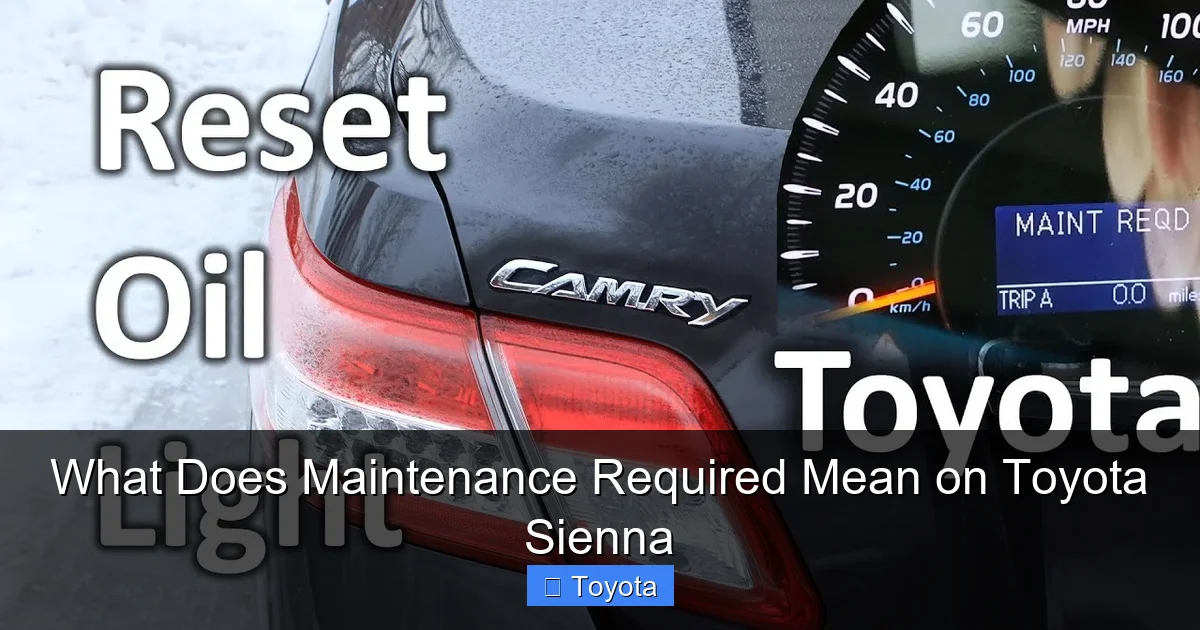
When the wrench illuminates, it’s not a mystery. The system is telling you a specific maintenance code is due. You can often see this code (like “A1”, “B2”) on your multi-information display. Here’s a general breakdown of what these codes mean for a typical Sienna:
Visual guide about What Does Maintenance Required Mean on Toyota Sienna
Image source: i.ytimg.com
Code “A” – The Basic Oil Change & Inspection
This is the most common trigger. Code “A” means it’s time for an engine oil and filter change. This is the core of the request. Additionally, it includes a multi-point inspection: checking tire pressure and condition, all fluid levels (coolant, brake, power steering, washer), the operation of lights and wipers, and a visual check of belts and hoses. Think of it as the essential health check-up.
Code “B” – The More Comprehensive Service
Code “B” includes everything in an “A” service, plus more. It typically adds inspection and/or replacement of the cabin air filter (critical for Siennas with their large interior and HVAC system) and often the engine air filter. It may also include a more in-depth brake inspection. A “B” service usually comes at a longer interval, perhaps every 15,000-20,000 miles, depending on your model year and driving.
Tire Rotation & Other Codes
The system also tracks tire rotation separately. You might see a code like “1” which specifically means tire rotation is due. Often, the tire rotation is combined with the “A” service. Other codes (like “C” or numbers 2-5) can refer to specific inspections, differential fluid service (for AWD models), or other scheduled items detailed in your manual. For AWD Siennas, the transfer case and rear differential fluid are critical items that appear on this schedule, usually at much longer intervals like 60,000 miles.
Step-by-Step: How to Reset the Maintenance Required Light
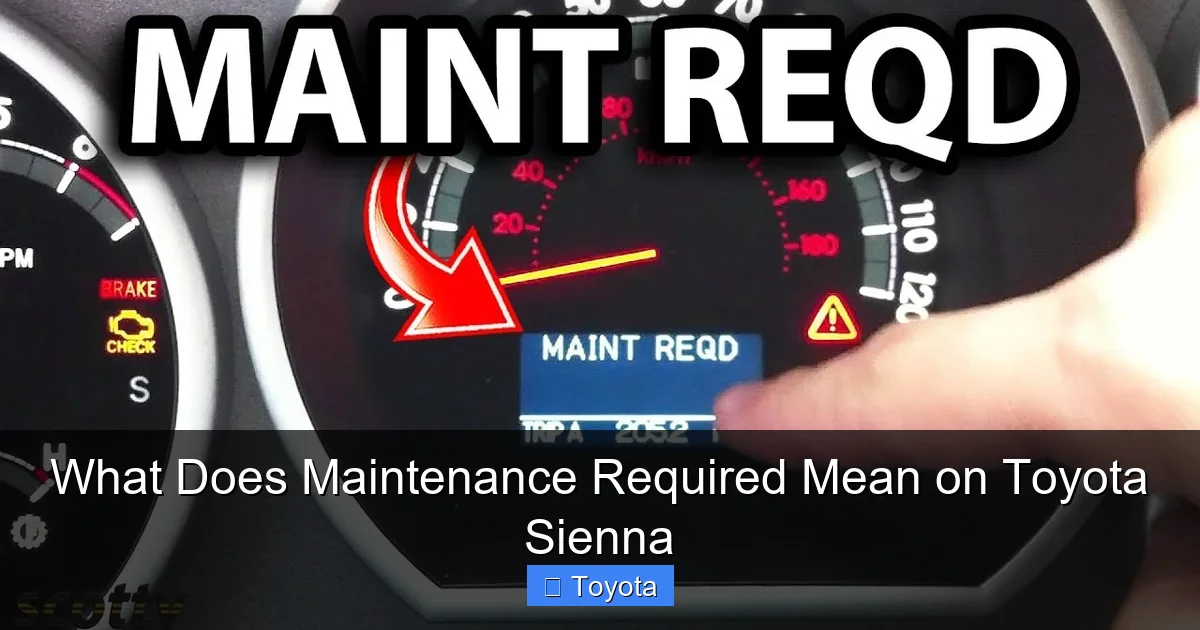
After a qualified technician completes the required services, the light must be reset. If you perform the work yourself, you’ll need to do this too. The process varies slightly by generation. Here are the most common methods:
Visual guide about What Does Maintenance Required Mean on Toyota Sienna
Image source: i.ytimg.com
For 2004-2010 Models (Using the Odometer Button)
1. Turn the ignition to “ON” (do not start the engine).
2. Ensure the odometer is displaying the normal trip meter (not the “A” or “B” service message).
3. Turn the ignition “OFF”.
4. While holding down the trip/reset button on the odometer, turn the ignition back to “ON”.
5. Continue holding the button. The odometer will display a series of dashes and then “0000000” or the service code will blink and disappear.
6. Release the button. The wrench light should be off.
For 2011-2020 Models (Using the “Menu” Button on the Steering Wheel)
1. Turn the ignition “ON”.
2. Use the arrow buttons on the steering wheel to navigate to the “Settings” menu on the multi-information display.
3. Scroll to “Vehicle Settings” and press “Enter”.
4. Scroll to “Maintenance” and press “Enter”.
5. Select “Maintenance Reset” and confirm.
6. The display will ask you to confirm reset for “Oil” and/or “Tire Rotation”. Select “Yes” for the items you just serviced.
Important Note About Scan Tools
Many independent shops and DIYers use an OBD2 scan tool that has the maintenance reset function built-in (like many Autel, Launch, or Innova tools). This is often the easiest and most foolproof method, especially if the manual button sequence doesn’t work. Simply connect the tool, navigate to the maintenance reset menu for Toyota, and follow the prompts. If the light returns immediately after a reset, it means the system hasn’t recorded the completion of the required service and you should re-check your work or have a professional diagnose if the system is faulty.
The Real Cost of Ignoring the Wrench: Why Timely Service Matters
“It’s just a light, the van seems fine,” is a common thought. But this light is your first line of defense against expensive repairs. Let’s connect the dots.
Engine Health and Oil Degradation
Modern engine oil is a complex chemical cocktail. It degrades over time and use. When it breaks down, it loses its ability to lubricate, cool, clean, and protect internal components. Driving thousands of miles past the recommended oil change interval leads to oil sludge—a thick, abrasive paste that clogs oil passages and causes catastrophic engine wear. The cost of an oil change is trivial compared to an engine rebuild or replacement. The maintenance minder exists to prevent this exact scenario by telling you when the oil’s useful life is truly over.
Tire Wear, Safety, and Fuel Economy
Neglecting tire rotations leads to uneven tread wear. Front tires on a front-wheel-drive Sienna wear faster due to steering and braking forces. Without regular rotation, you’ll replace tires in pairs more often, costing more in the long run. Uneven wear also degrades handling, braking distance, and increases the risk of a blowout. Properly inflated and evenly worn tires also roll more smoothly, directly benefiting your fuel economy—a key concern for a vehicle that can get heavy when fully loaded.
Warranty and Lease Compliance
If your Sienna is under the original factory warranty or a certified pre-owned warranty, following the maintenance schedule in your owner’s manual is often a condition of the warranty’s validity. Failure to do so can give Toyota a legal reason to deny a warranty claim for a related failure. Similarly, if you lease your Sienna, the lease agreement will require you to adhere to all manufacturer-recommended maintenance. Ignoring the light could result in hefty fees at lease-end.
Debunking Myths and Addressing Common Confusions
Let’s clear up some frequent points of confusion Sienna owners have about this light.
Myth: It’s a “Service Engine Soon” Light Like on Older Cars
This is the biggest misconception. Older cars had a simple “Service Engine Soon” light that came on at a set mileage. Toyota’s Maintenance Minder is an adaptive, intelligent system. It’s also distinct from the Check Engine Light (CEL). The CEL (usually an engine-shaped icon) means a sensor has detected a fault in the emissions or engine control system—like a loose gas cap, bad oxygen sensor, or misfire. That requires immediate diagnostic attention. The wrench is for planned care. Think of it this way: the CEL says “Something is broken!” The wrench says “Something is *due*.”
What If I Just Had an Oil Change but the Light Won’t Turn Off?
This is a classic situation. You (or your shop) did the work but forgot the final step: resetting the maintenance minder. The system has no way of knowing the oil was changed unless you tell it via the reset procedure. The light will stay on until you reset it. Always ask the technician to show you the reset was done, or do it yourself. If you reset it and it comes back on within 100 miles, there may be an issue with the system’s sensor or logic, and a dealer scan is needed.
Can I Keep Driving With It On?
Yes, but with a caveat. The light is a reminder, not an immediate “stop now” command. You have a buffer of a few hundred to a thousand miles of oil life left when it first illuminates. However, you should schedule your service appointment as soon as possible. Use it as your deadline, not your starting point. For a Sienna used for road trips or family transport, you want that scheduled maintenance completed before you embark on a long journey.
Beyond the Wrench: Other Maintenance Lights and Messages
Your Sienna’s dashboard is a communication center. The wrench is just one message. Be familiar with others:
- Oil Pressure Warning Light: This is a red, urgent light (often an oil can icon). If this comes on while driving, pull over safely and shut off the engine immediately. It means oil pressure has dropped dangerously low, risking engine seizure. This is an emergency.
- Check Engine Light (CEL): As discussed, this indicates a fault in the engine management or emissions system. Get it diagnosed promptly, but it’s not usually an immediate emergency unless it’s flashing.
- Tire Pressure Monitoring System (TPMS) Light: A cross-section of a tire with an exclamation point. It means one or more tires are significantly under-inflated. Check and adjust pressure. For more on what this means specifically, we have articles explaining tire maintenance warnings on other vehicles, which operate on similar principles of monitoring and alerting.
- Brake System Warning Light: A red exclamation point in a circle or the word “BRAKE”. Could mean low brake fluid, worn pads, or an issue with the parking brake. Check brake fluid level and have the system inspected immediately.
Understanding the language of your dashboard—what each symbol means and its level of urgency—is a key part of responsible vehicle ownership. The “Maintenance Required” light is your friend; it’s the least expensive insurance policy you can buy for your Sienna.
Conclusion: Your Proactive Partnership with Your Sienna
The “Maintenance Required” light on your Toyota Sienna is a feature, not a flaw. It’s a testament to modern automotive engineering that your van can calculate its own service needs based on how you actually drive, not just a generic calendar. By respecting this signal, understanding the codes it represents, and ensuring the reset is performed after service, you are actively participating in your vehicle’s health. You’re preventing the slow creep of neglect that leads to costly repairs. You’re ensuring your Sienna remains the safe, reliable, and comfortable chariot your family depends on. So the next time that wrench icon appears, don’t curse it. Thank it. Then, pick up the phone and schedule that appointment. Your Sienna—and your wallet—will thank you for it in the long run.
Frequently Asked Questions
Is it safe to drive my Toyota Sienna with the Maintenance Required light on?
Yes, it is generally safe for a limited distance. The light indicates scheduled maintenance is due, not an immediate system failure. However, you should schedule your service appointment within the next few hundred miles. Continuing to drive for thousands of miles without the required oil change or tire rotation risks engine damage and uneven tire wear.
How many miles can I drive after the Maintenance Required light comes on?
You typically have a buffer of several hundred to about 1,000 miles of remaining oil life when the light first illuminates, as the system triggers before the oil is completely degraded. The exact mileage depends on your recent driving conditions. The key is not to treat it as a suggestion but as your deadline to get service.
What is the difference between the Maintenance Required light and the Check Engine light?
The Maintenance Required light (wrench icon) is a proactive reminder for scheduled services like oil changes and tire rotations based on mileage/driving data. The Check Engine Light (engine icon) is a reactive warning that the engine management system has detected a fault, such as a malfunctioning sensor or emissions issue, requiring diagnostic troubleshooting.
Why did my Maintenance Required light come back on right after I had my oil changed?
The most common reason is that the maintenance minder was not reset after the service was performed. The system has no way of knowing the work was done unless it is manually reset via the dash controls or a scan tool. Always confirm with your technician that the reset was completed before leaving the shop.
Can I reset the Maintenance Required light myself without changing the oil?
Technically yes, you can perform the reset procedure without doing the work. However, this is strongly discouraged. You are then driving with degraded oil and without necessary inspections, which defeats the purpose of the system and risks serious engine damage. The reset should only be done immediately after the required maintenance is completed.
Does the Maintenance Required light mean my Toyota Sienna needs an oil change right now?
It means an oil change is the most immediate and primary service due. For most Siennas, the first wrench light appears at the first oil change interval (5,000-10,000 miles). However, the maintenance minder system also bundles this with other inspections and, depending on the code displayed, may indicate additional services like tire rotation are due simultaneously.