
How Far Can a Toyota Corolla Go with the Fuel Light On

The Toyota Corolla’s fuel light typically illuminates with 1-2 gallons of fuel remaining, granting you roughly 30-50 miles of driving range before empty. However, this estimate varies significantly based on model year, driving conditions, and your habits. Pushing beyond this range risks damaging the fuel pump and leaving you stranded. Always treat the warning as urgent and refuel promptly for safety and vehicle health.
Key Takeaways
- The fuel light is a warning, not a precise gauge: It signals low fuel, usually indicating 1-2 gallons left, but its exact trigger point varies by model and design.
- Typical safe range is 30-50 miles: Most Corolla owners report 30-50 miles after the light comes on under normal conditions, but you should not rely on this as a guarantee.
- Your driving style matters most: Aggressive acceleration, high speeds, and heavy loads drastically reduce your remaining range compared to gentle, highway driving.
- Running on empty causes damage: Frequently driving with very low fuel overworks and overheats the fuel pump, leading to premature failure and costly repairs.
- Always refuel at the first safe opportunity: The light means find a gas station now, not later. Plan routes with fuel stations in mind, especially in unfamiliar areas.
- Model year and engine type change the equation: Newer Corollas and hybrids may have different reserve capacities and more accurate warning systems than older models.
- Trust your gut, not just the light: If the car feels sluggish or you’re in a remote area, refuel immediately regardless of the mileage you think you have left.
📑 Table of Contents
- That Little Yellow Light: What It Really Means
- The Number Game: Calculating Your Corolla’s Real-World Range
- It’s Not All the Same: Factors That Change Your “On Empty” Distance
- Model Year, Engine, and The Hybrid Difference
- The Real Risks: Why “Running on Empty” Is a Bad Idea
- Smart Practices: What To Do the Moment That Light Comes On
- Real-World Stories and Final Verdict
That Little Yellow Light: What It Really Means
Panic sets in. You’re on the highway, miles from your exit, and a small amber icon of a gas pump glows on your dashboard. The fuel light in your Toyota Corolla has just come on. Your immediate question is a universal one for drivers: how far can I actually go? The answer isn’t a simple number, but understanding the system and its limitations is crucial for every Corolla owner. This isn’t just about avoiding an inconvenient walk to a gas station; it’s about protecting your car’s fuel system and ensuring your safety.
The fuel light is part of your Corolla’s low fuel warning system. Its primary job is to get your attention. It activates when the fuel level drops to a predetermined threshold set by Toyota’s engineers. This threshold is designed to provide a reasonable buffer—a reserve of fuel—before you truly run dry. That reserve is your safety net, but its size is not arbitrary. It’s calculated based on average driving conditions and consumption. The moment that light flickers on, your car is telling you: “I am now operating on reserve. Please replenish my fuel supply as soon as it is safely possible.”
The Science of the Reserve: It’s Not “Empty”
When your fuel light comes on, your tank is not empty. There is still fuel sloshing around the bottom of the tank, often referred to as “unusable fuel” or “reserve fuel.” This is the fuel that the fuel pump’s intake cannot reliably reach. The fuel pump, which sits at the bottom of the tank, needs to be fully submerged to stay cool and lubricated. As the fuel level drops, the pump is increasingly exposed, leading to heat buildup and potential damage. The fuel light is calibrated to warn you before you reach this dangerous, truly empty state.
For most Toyota Corolla models, the trigger point for the fuel light is when approximately 1 to 2 gallons of fuel remain in the tank. A standard Corolla gas tank holds between 13.2 and 14.5 gallons, depending on the model year and trim. So, when that light comes on, you generally have about 7-15% of your tank’s capacity left. Your task is to convert that liquid volume into miles you can confidently drive before you hit the true “empty” mark.
The Number Game: Calculating Your Corolla’s Real-World Range
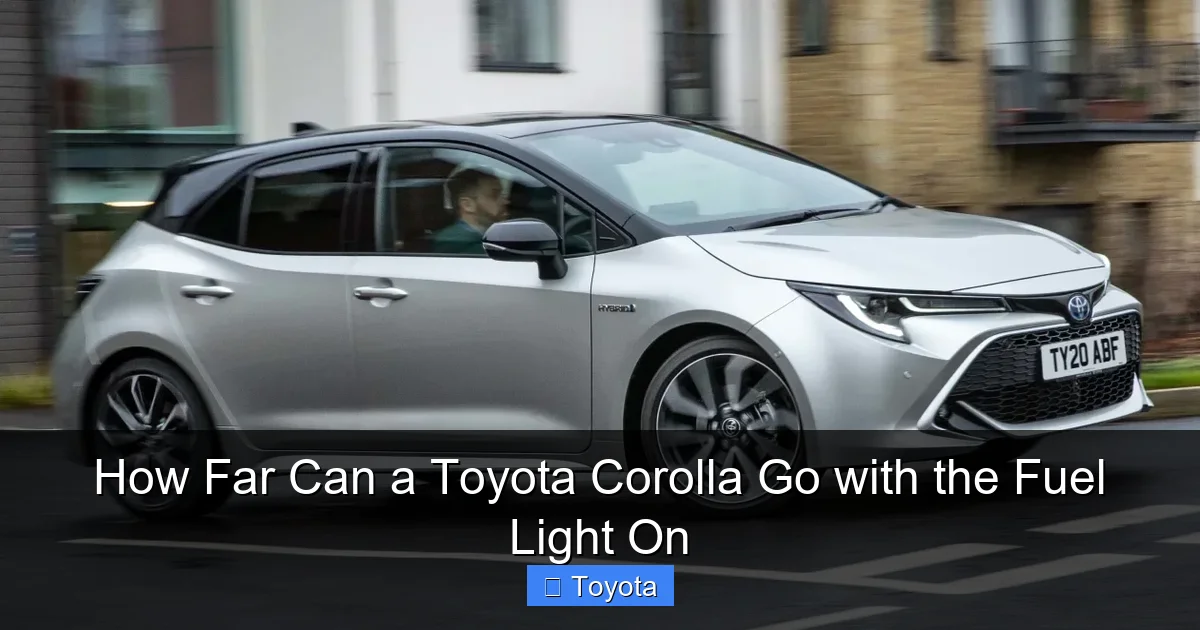
So, with 1-2 gallons left, how many miles can you expect? The theoretical answer comes from your car’s EPA fuel economy rating. A current-model Corolla with a 2.0L engine is rated for around 30-33 MPG combined. If you have exactly 1.5 gallons left and are getting 32 MPG, the math is simple: 1.5 gallons x 32 MPG = 48 miles. That’s your optimistic, best-case scenario range.
Visual guide about How Far Can a Toyota Corolla Go with the Fuel Light On
Image source: media.drivingelectric.com
However, real-world driving is rarely best-case. Factors like city traffic, cold weather, using the air conditioning, and carrying extra weight all reduce your miles per gallon. Therefore, a more realistic and widely accepted estimate among Corolla owners and mechanics is a range of 30 to 50 miles after the fuel light illuminates. This range accounts for less-than-ideal conditions. Some drivers in hyper-efficient, gentle highway cruising have reported up to 60 miles, while others in stop-and-go city traffic with the A/C blasting might see the light come on and run out in under 30 miles. For safety’s sake, always assume the lower end of that spectrum.
What Does Toyota Say? (And Why They Don’t Give a Number)
You will search your owner’s manual in vain for a specific “miles remaining” figure after the light comes on. Toyota, like most manufacturers, intentionally does not provide a guaranteed distance. Why? Because the range is too variable and depends on countless driver-specific factors. Providing a fixed number would create liability if a driver ran out of gas despite the “guarantee.” Their official guidance is simply to refuel “immediately” when the light comes on. This cautious approach protects you and them. For a more model-specific discussion, you can read our detailed breakdown of how many miles you can drive after the gas light comes on in a Toyota Corolla.
It’s Not All the Same: Factors That Change Your “On Empty” Distance
Why does your friend with the same year Corolla seem to get 45 miles on the light, while you feel anxious after 25? Your personal “fuel light range” is a dynamic figure influenced by several key variables. Understanding these helps you make a smarter, safer decision when that warning glows.
Visual guide about How Far Can a Toyota Corolla Go with the Fuel Light On
Image source: 1022980372.rsc.cdn77.org
Driving Style: The #1 Factor
Your right foot is the most powerful determinant. Aggressive driving—hard acceleration, speeding, and abrupt braking—can slash your fuel efficiency by 15-30% compared to gentle, anticipatory driving. If you’re in the city, constantly accelerating from stoplights and idling in traffic, your MPG will plummet. On a quiet highway, maintaining a steady 65 mph with cruise control, your efficiency will soar. The condition of your tires also plays a role; under-inflated tires increase rolling resistance and reduce MPG. So, when the light comes on, your immediate action should be to drive conservatively. Accelerate slowly, maintain a steady speed, and avoid the AC if possible (though safety and comfort are paramount).
Terrain and Weather: Hills and Heat Drain Fuel
Driving uphill requires more engine work and thus more fuel. If your route to the gas station involves significant elevation gain, subtract miles from your theoretical range. Conversely, downhill stretches can help, but you shouldn’t rely on them. Extreme temperatures also play a major role. In winter, the engine runs richer until warmed up, and using the heater and defroster puts a load on the engine. In summer, air conditioning is a huge fuel drain—it can reduce MPG by up to 25% in city driving. Very hot weather can also slightly increase fuel vaporization in the tank. If it’s 100°F and you’re running the AC at max, be prepared for a shorter range.
The Load: Passengers and Cargo
Every extra 100 pounds of weight in your Corolla reduces fuel economy by about 1-2%. A fully loaded car with four adults and a trunk full of luggage is working much harder than a solo driver. If you’re carrying a significant load when the light comes on, your range will be at the lower end of the estimate. Planning a trip with a full car? Be mindful of your fuel level before you pick everyone up.
Model Year, Engine, and The Hybrid Difference
Not all Toyota Corollas are created equal in this regard. While the fundamental principle is the same, the exact reserve capacity and warning system calibration have evolved.
Visual guide about How Far Can a Toyota Corolla Go with the Fuel Light On
Image source: njuskalo.hr
Generational Changes and Tank Size
Over the years, the Corolla’s gas tank size has fluctuated slightly. For example, the E210 generation (2019-present) has a 13.2-gallon tank, while some earlier models (like the E170, 2014-2018) had a 13.2 or 14.5-gallon tank depending on the market. A larger tank with the same 1.5-gallon reserve gives you a slightly smaller percentage of buffer but potentially more absolute miles if your MPG is similar. The key is that the reserve volume (the 1-2 gallons) is relatively consistent across recent models. The biggest changes are in the accuracy and timeliness of the warning itself.
The Fuel Gauge Itself: How Accurate Is It?
Modern Corollals use a float sensor in the tank to measure fuel level. This sensor sends a signal to the instrument cluster. Over time, these sensors can become less accurate due to wear, corrosion, or fuel sludge. A slightly misreading sensor might cause the light to come on a little early or a little late. If your light seems to come on at wildly inconsistent mileage points (e.g., sometimes at 40 miles remaining, sometimes at 10), it could indicate a failing fuel level sensor. This is a diagnostic issue separate from the reserve capacity but it directly impacts your trust in the warning. For those interested in dashboard warnings, understanding how to reset the check engine light on a Toyota Corolla is useful knowledge, but the fuel light is not a user-resettable warning—it’s a direct sensor reading.
Toyota Corolla Hybrid: A Special Case
The Corolla Hybrid uses a different powertrain and a slightly smaller gas tank (typically 11.4 gallons). However, its incredible fuel efficiency (up to 50 MPG combined) means that its theoretical range on that same 1-2 gallon reserve could be 50-100 miles in ideal conditions. The hybrid system’s efficiency in city driving is particularly notable. Therefore, a Hybrid owner might see the fuel light and still have a very substantial range, but the same cautions about driving conservatively and refueling promptly absolutely apply. Do not assume you have double the range just because you’re a hybrid; the reserve volume is likely similar, and you still risk damaging the fuel pump.
The Real Risks: Why “Running on Empty” Is a Bad Idea
Knowing you *can* go 40 miles is different from knowing you *should*. Deliberately pushing your luck with the fuel light has several serious downsides, from immediate inconvenience to long-term, expensive damage.
Risk #1: Stranded and Unsafe
The most obvious risk is running out of gas. This is more than a nuisance; it’s a safety hazard. Your car will lose power steering and power brakes as the engine dies. You’ll be a stationary obstacle on the road or shoulder. In bad weather, heavy traffic, or a dangerous location, this is a terrifying and potentially life-threatening situation. It also puts you at the mercy of passing motorists or costly roadside assistance. A little forethought—pulling over at the first safe exit when the light comes on—eliminates this risk entirely.
Risk #2: Damaging Your Fuel Pump
This is the most significant mechanical risk. Your electric fuel pump is located inside the gas tank. It is cooled and lubricated by the gasoline surrounding it. When fuel levels get very low, the pump starts to suck in air and can overheat. While occasional brief operation on low fuel isn’t catastrophic, making a habit of driving with the light on for extended periods dramatically shortens the pump’s lifespan. The constant overheating and lack of lubrication cause the internal components to wear out faster. Replacing an in-tank fuel pump is a labor-intensive job that often requires dropping the gas tank, costing $500-$1000 or more. You are essentially trading a $50 gas fill-up for a potential $1000 repair bill. Regularly driving until the car sputters and dies on fumes is the fastest way to kill your fuel pump.
Risk #3: Debris and Sediment Ingestion
Over time, tiny particles of rust, sediment, and debris settle at the bottom of your gas tank. This is why fuel filters exist. When you run the tank extremely low, the fuel pump’s intake is closer to this sediment layer. It can suck up this gunk, which then clogs your fuel filter much faster or, in worst-case scenarios, gets pulled into the fuel injectors. This leads to poor performance, engine misfires, and further expensive cleaning or component replacement. Keeping a reasonable level of fuel in the tank helps keep the pump intake away from the sediment layer.
Smart Practices: What To Do the Moment That Light Comes On
So, the amber pump is glowing. Don’t panic. Take a deep breath and follow this protocol to get yourself and your car to safety efficiently and without damage.
Step 1: Assess and Plan Immediately
Your first action is not to gun it to the next exit. Instead, safely check your navigation or recall the last few exits you passed. How far is the next gas station? Use your smartphone’s map app to search for “gas stations” along your route. If you’re on a long rural highway with services spaced 40 miles apart, you have a problem. If you’re in a city with stations on every corner, you’re fine. The key is to make this assessment calmly in the first 60 seconds of seeing the light.
Step 2: Drive for Efficiency, Not Speed
Once you know where you’re going, adjust your driving. Turn off all non-essential electrical loads: the radio, heated seats, and especially the air conditioning. If it’s hot, roll down windows for ventilation, but at high speeds, the aerodynamic drag of open windows can be worse than a running AC—find a balance. Drive in the right lane. Use cruise control on flat, straight highway sections to maintain a constant, moderate speed (55-65 mph is often the sweet spot for efficiency). Avoid jackrabbit starts and unnecessary braking. Your goal is to maximize the miles you get from those last gallons.
Step 3: Refuel Correctly and Reset Your Mind
When you pull into the station, fill the tank. For modern Corollas with sealed systems, you can generally fill it until the pump clicks off automatically. Don’t try to “top it off” by forcing more fuel in; this can damage the evaporative emissions system. Once filled, your fuel light will go out immediately. This is normal. Now, mentally reset. Your tank is full, your reserve is restored. Make a mental note to refuel earlier next time—perhaps when you hit a quarter-tank, not when the light comes on. This habit alone will save you stress and protect your fuel pump. If you frequently find yourself running low, consider if you need to adjust your refueling routine or if there’s an issue with your gauge. Sometimes, a simple fix like knowing how to open the gas tank on a Toyota Corolla quickly can make refueling smoother, encouraging you to do it more often.
Real-World Stories and Final Verdict
Let’s bring this home with some context. A 2020 Toyota Corolla SE owner on a popular automotive forum reported driving exactly 42 miles after the light came on during steady 70 mph highway travel before the gauge showed empty. Another driver in a 2015 model in stop-and-go Chicago traffic with A/C on reported the light came on and the car died after just 28 miles. These anecdotes fit squarely within the 30-50 mile expectation. The variation is real and expected.
For perspective, other Toyota models have different ranges. A larger vehicle like a Toyota Sienna minivan, with a bigger tank but worse fuel economy, might have a similar absolute reserve (1-2 gallons) but a shorter MPG-based range. Conversely, a Corolla’s efficient engine gives it a respectable buffer.
The final verdict is clear: your Toyota Corolla’s fuel light is a serious warning, not a casual suggestion. Treat it as a 30-50-mile countdown to refueling. The “how far” depends on you—your driving, your environment, and your car’s condition. The “how to” is simple: drive calmly, find a station immediately, and fill up. By respecting that little yellow light, you save yourself from the stress of a breakdown, avoid costly fuel system repairs, and ensure your reliable Corolla stays that way for hundreds of thousands of miles. Your car’s longevity and your peace of mind are worth far more than the few minutes it takes to stop for gas.
Frequently Asked Questions
Is it normal for the fuel light to come on at different mileages?
Yes, it’s normal. The light triggers based on fuel volume (1-2 gallons), not miles. Your actual range depends on your current MPG. A highway drive will show more miles on the odometer after the light than city driving will. A failing fuel level sensor can cause major inconsistencies, though.
Does a Toyota Corolla have a “miles to empty” display?
Many newer Corolla models (typically 2018+) have a multi-information display that shows an estimated “Distance to Empty” (DTE) in miles or kilometers. This calculation uses your recent fuel economy. However, this is also an estimate and becomes less accurate as fuel levels drop. The fuel light is the primary, fail-safe warning.
What should I do if my Corolla runs out of gas and stalls?
If safe, coast to the shoulder. Turn on hazard lights. Call for roadside assistance or a friend with a gas can. Once you refuel, you may need to turn the ignition key to the “ON” position for a few seconds to prime the fuel pump before starting. Do not repeatedly crank the engine if it doesn’t start; you risk drawing air into the fuel lines.
Can I reset the fuel light without adding gas?
No. The fuel light is directly controlled by the fuel level sensor. It will not turn off until the sensor detects a significant increase in fuel level after refueling. There is no manual reset button or procedure like there is for a maintenance light.
Is it worse for a hybrid Corolla to run on low fuel?
The risk of fuel pump damage is the same for any internal combustion engine. While the hybrid system is more efficient, the gasoline engine still requires fuel and the fuel pump still needs submersion for cooling. Do not assume the hybrid’s efficiency gives you a vastly larger safe buffer; the reserve volume is similar.
How can I make my fuel light range more predictable?
Practice consistent, efficient driving habits. Keep your tires properly inflated. Remove unnecessary weight from the car. Use the recommended motor oil. Most importantly, adopt the habit of refueling when you reach a quarter-tank, not when the light comes on. This eliminates guesswork and protects your vehicle.
