
How Do You Reset the Trunk Door on a Toyota Highlander

Is your Toyota Highlander’s power trunk not opening, closing properly, or showing an error? A system reset can often resolve temporary electronic glitches. This guide covers manual and electronic reset procedures for all Highlander generations. We’ll walk you through the steps, from simple key fob tricks to accessing the fuse box, and explain when a deeper issue might require a professional.
So, you’re standing by your Toyota Highlander, groceries in hand, and the power trunk just won’t budge. You press the button on the key fob, the release on the driver’s door, even the button on the trunk lid itself… nothing. Or maybe it opens but won’t close automatically, or it beeps angrily at you for no clear reason. It’s incredibly frustrating, but before you panic and call the dealer, take a deep breath. Many power trunk door issues on the Highlander are caused by temporary electronic hiccups that a simple reset can fix. Think of it like rebooting your computer when it freezes. This guide will walk you through exactly how to reset the trunk door on a Toyota Highlander, from the quickest tricks to more thorough procedures, for models ranging from the early 2000s to the latest 2024.
Key Takeaways
- Power trunk issues are often electronic glitches: A simple reset can clear the trunk’s control module memory, resolving unresponsiveness without mechanical repair.
- Multiple reset methods exist: You can try a key fob sequence, a manual latch override, or a full system reset via the fuse box, depending on the symptom.
- Manual release is your emergency backup: All Highlanders have a hidden mechanical trunk release (usually behind a trim panel) for when power fails completely.
- Model year matters: Procedures can differ between older (pre-2014) and newer (2014+) Highlanders due to changes in body control module software.
- Safety first: Always ensure the trunk path is clear of obstacles and children/pets before attempting any reset or manual operation.
- Resets clear temporary codes, not faults: If a physical part like a latch or sensor is broken, a reset will only work temporarily until the fault reoccurs.
- Consult your manual: Your owner’s manual has the definitive, model-specific procedures and diagrams for your specific vehicle.
📑 Table of Contents
- Why Your Highlander’s Trunk Door Might Need Resetting
- Understanding Your Highlander’s Trunk Mechanism: A Quick Tour
- Method 1: The Quick Key Fob Reset Sequence
- Method 2: The Manual Override & Reset
- Method 3: The Full System Reboot (Fuse Reset)
- When Resetting Isn’t Enough: Signs of a Deeper Problem
- Preventive Care: Keeping Your Highlander’s Trunk Happy
- Conclusion: Your Reset Toolkit for a Frustration-Free Trunk
Why Your Highlander’s Trunk Door Might Need Resetting
Before we dive into the “how,” it’s helpful to understand the “why.” The Toyota Highlander’s power trunk (available on most trims from the early 2000s onward) isn’t just a simple motor. It’s a small system. It includes the liftgate motor, position sensors, a latch mechanism, and a control module—often part of the Body Control Module (BCM) or a dedicated Power Liftgate Module. This system communicates with your key fob, the interior button, and the foot-sensing kick sensor (if equipped).
Common Triggers for Trunk System Glitches
A variety of things can confuse this system, leading to a need for a reset:
- Voltage Drops: A weak or momentarily discharged car battery can cause the control module to lose its calibration or store an error code.
- Manual Interference: Someone might have forced the trunk lid manually while the power system was engaged, confusing the position sensors.
- Obstruction Confusion: If the system detected an obstacle during closing (like a grocery bag or snow), it may have entered a “safe mode” and needs to be reset to try again.
- Software Glitches: Like any computer, the module can have a temporary bug that a full power cycle resolves.
- After Battery Disconnect: If you’ve jump-started the car or disconnected the battery, the trunk system often loses its learned position settings and needs to be recalibrated, which a reset initiates.
Recognizing these common triggers helps you choose the right reset method. For instance, if the issue started after a dead battery, a fuse-based reset is often most effective. If it happened after someone forced the lid, a manual latch reset might be the first step.
Understanding Your Highlander’s Trunk Mechanism: A Quick Tour
The reset procedure depends heavily on which generation of Highlander you own. The biggest split is around the 2014 model year, when Toyota introduced the third generation (XU50).
Visual guide about How Do You Reset the Trunk Door on a Toyota Highlander
Image source: i.ytimg.com
Pre-2014 Models (First & Second Generation)
These models typically have a simpler power trunk system. The motor is often directly connected to the latch via a cable or gear assembly. The control is usually handled by the main Body Control Module (BCM). Resets are often performed through a sequence of actions with the key fob or by disconnecting the battery/trunk fuse. The manual release is usually a pull cord or handle hidden behind a trim panel in the trunk cargo area.
2014 and Newer Models (Third Generation & Beyond)
These Highlanders feature a more sophisticated system with a dedicated Power Liftgate Module (PLM) on many trims. It has more complex logic for obstacle detection, hands-free foot activation, and adjustable opening heights. The reset procedures can be more specific and sometimes require a multi-step key fob sequence. The manual release is almost always a small, pull-tab handle located behind a rectangular or circular access panel on the inside of the trunk lid, near the center.
Pro Tip: Your owner’s manual is your best friend here. The “Liftgate” or “Power Rear Door” section will have the exact procedure and diagram for your specific model year and trim. If you don’t have the manual, Toyota’s online owner portal often has digital copies.
Method 1: The Quick Key Fob Reset Sequence
This is the first thing you should try for most modern Highlanders (2014+). It’s non-invasive and takes less than a minute. This process forces the liftgate control module to relearn its fully open and fully closed positions.
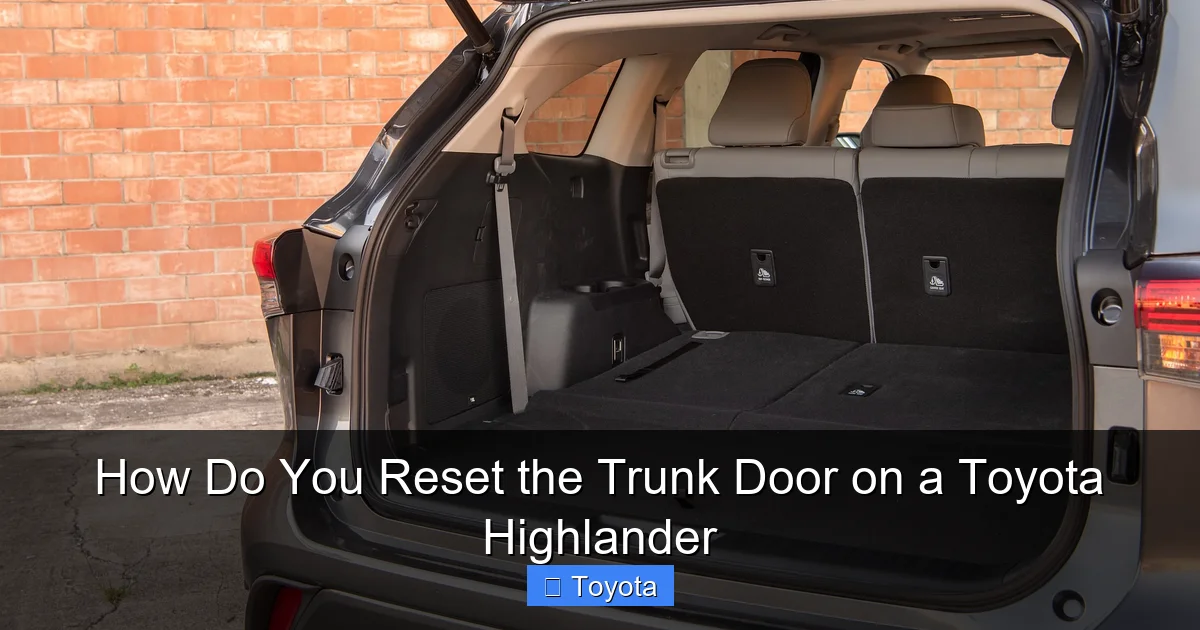
Visual guide about How Do You Reset the Trunk Door on a Toyota Highlander
Image source: images.caricos.com
Step-by-Step for Most 2014-2024 Highlanders
- Position the Vehicle: Park on level ground, engage the parking brake, and ensure the area behind the vehicle is clear.
- Initial State: The trunk must be fully closed and latched. If it’s open, close it manually by pulling it down. Do not use the power button if it’s partially open.
- The Sequence:
- Press and hold the Liftgate Open/Close button on your key fob (the button that usually looks like a trunk with an arrow).
- While holding the button, press the Lock button on the key fob twice.
- Release all buttons.
- You should hear the trunk latch cycle (click/clunk). If you don’t, repeat the sequence.
- Test: Now, press the liftgate button on the key fob normally. It should open fully. Let it open completely, then press the button again to close it automatically. Observe if it operates smoothly.
For some earlier models (like some 2008-2013), the sequence might be: Press the trunk button on the fob, then press the lock button twice while the trunk is in motion. The owner’s manual is key here.
Method 2: The Manual Override & Reset
If the key fob sequence doesn’t work, or if your trunk is stuck in a half-open position, you’ll need to manually intervene. This method physically resets the latch mechanism.
Visual guide about How Do You Reset the Trunk Door on a Toyota Highlander
Image source: i.ytimg.com
Finding and Using the Manual Release
On all Highlanders, there is a mechanical escape hatch. You’ll need to access the interior of the trunk.
- For Models with a Rear Seat: Fold down the rear seats to access the cargo area.
- For All Models: Look for a small rectangular or circular plastic panel on the inside of the trunk lid. It’s usually centered near the top of the interior cargo trim. It might have a small icon of a trunk with an arrow or a keyhole.
- Carefully pry off this panel using a flat-head screwdriver wrapped in a cloth to avoid scratching. You may need to feel for a release clip around the edges.
- Behind the panel, you’ll find a pull tab or lever (often orange or yellow). Pull this firmly. You should hear a loud clunk as the primary latch releases. The trunk lid will now be free to be lifted manually.
Performing the Reset After Manual Release
- Once the trunk is open and propped up safely, locate the latch assembly on the underside of the trunk lid. It’s the metal component the latch arm connects to.
- You’ll see a small, usually white or black, plastic reset lever or button on the latch itself. Its location varies, but it’s designed to be pressed with a finger or a tool.
- Press and hold this reset button for 5-10 seconds. This tells the latch motor it’s at the “fully open” position.
- Now, manually close the trunk lid gently until it lushes into the primary latch. You’ll feel resistance and hear a click. Do not slam it.
- Once latched, press the trunk button on your key fob. The system should now operate the trunk normally. This manual process has effectively reset the latch’s positional memory.
Important: If the manual release doesn’t work at all, the latch may be physically broken or frozen, requiring professional repair. Also, if your Highlander is equipped with a hands-free foot sensor, ensure the sensor area under the bumper is clean and free of mud or ice, as this can cause system errors.
Method 3: The Full System Reboot (Fuse Reset)
When the electronic control module itself is glitching—often after a battery jump-start or a major voltage fluctuation—a full power cycle is needed. This is the most thorough reset and is equivalent to pulling the “computer’s” plug.
Locating the Correct Fuse
You need to find the fuse that controls the Power Liftgate Module or the Body Control Module (BCM). Consult your owner’s manual’s fuse box diagram. It will be located in one of two places:
- Engine Compartment Fuse Box: Usually near the battery. Look for a large black box with a lid. The diagram is on the lid.
- Interior Passenger Compartment Fuse Box: Usually under the dash on the driver’s or passenger’s side, behind a small panel.
The fuse you’re looking for might be labeled “PWR LIFTGATE,” “POWER TAILGATE,” “BCM,” “BODY CONTROL,” or “DOOR”. For many 2014+ Highlanders, it’s often a 10A or 15A fuse in the interior fuse box.
Executing the Reset
- Turn the ignition OFF and remove the key.
- Using a fuse puller (or needle-nose pliers), carefully pull the identified fuse.
- Hold it out for at least 60 seconds. This ensures all residual power (capacitors) in the module drains completely.
- Reinsert the fuse firmly, ensuring it’s seated properly.
- Turn the ignition to the “ON” position (do not start the car). You should hear a series of clicks from the trunk area as the module powers up and initializes.
- Test the trunk operation with the key fob.
This method often resolves issues where the trunk simply doesn’t respond at all to any input. It’s a safe and effective way to clear the module’s volatile memory.
When Resetting Isn’t Enough: Signs of a Deeper Problem
A reset is for temporary glitches. If the problem returns immediately or you notice other symptoms, a reset won’t fix the underlying cause. You’ll need diagnosis and repair.
Symptoms Indicating a Mechanical or Electrical Fault
- The trunk opens/closes very slowly or with a strained motor sound. This points to a weak motor, binding in the hinge/arm mechanism, or a lack of lubrication.
- It opens partially and then reverses or stops. This is often a faulty position sensor or a misaligned latch. The system thinks it’s hit an obstacle.
- The manual release is completely broken or missing. This is a mechanical failure of the release cable or handle.
- You hear a constant clicking or buzzing from the trunk area when trying to operate it. This usually means the motor is trying to turn but is jammed (e.g., by a broken gear or severe misalignment).
- The problem is accompanied by other electrical gremlins (like power window or sunroof issues). This could indicate a broader problem with the BCM or a ground strap.
In these cases, a simple reset is like putting a band-aid on a leaky pipe. The issue will recur, sometimes immediately. At this point, you need a qualified technician, preferably at a dealership or a shop with Toyota-specific diagnostic software (Techstream), to read the stored trouble codes from the liftgate module.
Preventive Care: Keeping Your Highlander’s Trunk Happy
An ounce of prevention is worth a pound of cure. A few simple habits can drastically reduce the chances of your power trunk acting up.
Do’s and Don’ts for Power Trunk Longevity
- DO Keep the trunk lid’s weatherstripping clean and free of debris. A dirty seal can cause ice to form in winter or create extra drag.
- DO Lubricate the metal hinge arms and pivot points once a year with a silicone-based spray lubricant (like WD-40 Specialist Silicone). Avoid petroleum-based oils as they attract dust.
- DO Ensure the trunk is fully latched before driving away. A partially latched trunk can fly open and cause damage or an accident.
- DON’T Ever manually force the power trunk lid up or down. Always use the manual release if power fails. Forcing it can strip gears or break the latch.
- DON’T Exceed the weight limit specified in your manual (usually 50-75 lbs for the power-assist system). Overloading stresses the motor.
- DON’T Ignore unusual noises. A grinding, clicking, or straining sound is an early warning sign. Address it before it leads to a complete failure.
By treating your power trunk with a little respect, you’ll enjoy its convenience for the life of your Highlander. Remember, if a basic reset doesn’t solve the problem quickly, it’s time to seek professional help to avoid causing more damage.
Conclusion: Your Reset Toolkit for a Frustration-Free Trunk
Dealing with a misbehaving power trunk on your Toyota Highlander is a common headache, but it’s one you have the tools to solve. You now have a clear, step-by-step roadmap: start with the gentle key fob reset sequence for modern models, escalate to the manual latch override and reset if the system is stuck, and finally perform the full system reboot via the fuse box for persistent electronic gremlins. Always keep safety at the forefront—clear the area and never force a stuck lid.
Understanding that these resets address temporary software or calibration issues is crucial. If the problem stems from a worn motor, broken sensor, or damaged latch, a reset is only a temporary bandage. The symptoms we outlined—straining noises, partial movement, constant clicking—are your signal to get a professional diagnosis. For other common Toyota resets, like how to reset the maintenance light on a 2017 Toyota Highlander or reset the oil light, the principles are similar: identify the correct module and initiate a reset cycle. With this knowledge, you’re empowered to tackle trunk trouble and get back to loading up your Highlander with confidence.
Frequently Asked Questions
Will resetting the trunk door clear any error codes?
Yes, a reset will clear temporary fault codes stored in the liftgate module’s memory. However, if a physical component like a sensor or motor is genuinely faulty, the code will return after a few operation cycles. A permanent fix requires repairing or replacing the failed part.
My Highlander’s trunk won’t open at all. Is a reset still worth trying?
Yes, a reset is absolutely worth trying first. Start with the key fob sequence (Method 1). If that fails, your next step is the manual override (Method 2) to physically open it. Once open, you can attempt a reset of the latch or try the fuse reset (Method 3) with the trunk open. If the manual release itself is broken, you will need professional help to access the trunk.
Is the reset procedure different for a Highlander with a foot-sensor (hands-free) liftgate?
The core reset procedures (key fob sequence, fuse pull) are generally the same. However, if the foot sensor is malfunctioning (e.g., triggering randomly), cleaning the sensor area thoroughly under the rear bumper is a critical first step. A reset may clear the error, but a dirty sensor will likely cause it to return.
My 2015 Highlander’s trunk opens but won’t close automatically. What reset should I use?
>This is a classic sign of a lost positional calibration. Start with the key fob reset sequence described in Method 1. The sequence forces the module to relearn the “fully open” and “fully closed” positions. If that doesn’t work, the manual latch reset (Method 2) is your next best bet, as it physically resets the latch’s internal stops.
Can a weak car battery cause trunk problems that require a reset?
Absolutely. A low or fluctuating voltage from a weak battery can cause the liftgate control module to malfunction or lose its learned settings. After jump-starting or replacing the battery, performing a fuse reset (Method 3) is highly recommended to ensure all body control modules, including the trunk, reboot cleanly.
How is resetting the trunk different from resetting the maintenance light on a Highlander?
They are fundamentally different processes. Resetting the maintenance light is a simple, intentional procedure to turn off a service reminder after an oil change, done via the odometer/trip meter button. Resetting the trunk door addresses a malfunction in the power-assist system’s electronics or mechanics. One is a scheduled service reset; the other is a troubleshooting fix for an operational problem.
