
Does a 2014 Toyota Camry Have a Transmission Filter?

Yes, the 2014 Toyota Camry is equipped with an internal transmission filter. This crucial component is located inside the transmission pan and works to keep the transmission fluid clean of harmful debris and metal shavings. For most drivers, it’s recommended to be inspected and replaced during a major transmission service, typically every 60,000 to 100,000 miles. While a skilled DIYer can tackle this job, the messy nature and precise reassembly often make professional service the wiser choice to ensure long-term reliability and avoid costly damage.
Key Takeaways
- Yes, it has one: The 2014 Toyota Camry’s 6-speed automatic transmission contains an internal fluid filter designed to trap contaminants.
- It’s not easily accessible: The filter is located inside the transmission oil pan, requiring pan removal for access and replacement.
- Service is not frequent: Toyota’s official maintenance schedule does not list a specific filter replacement interval; it’s typically done during a full transmission fluid and filter service.
- Fluid type is critical: Using the correct Toyota WS (World Standard) or equivalent ATF (Automatic Transmission Fluid) is non-negotiable for performance and filter function.
- Neglect has serious consequences: A clogged filter can cause delayed shifts, slipping, overheating, and ultimately, catastrophic transmission failure.
- DIY is possible but messy: Replacing it involves draining fluid, removing the pan, cleaning meticulously, and proper torque specifications; professional service is often recommended.
- It’s part of a system: The filter works with the transmission fluid and the internal pump; all must be in good condition for optimal operation.
📑 Table of Contents
- Understanding Transmission Filters: The Silent Guardian of Your Gearbox
- The 2014 Toyota Camry’s Transmission: A Sealed and Sophisticated System
- Location and Access: Finding the Camry’s Transmission Filter
- Maintenance Schedule and Procedures: When and How to Service It
- DIY vs. Professional Service: Should You Do It Yourself?
- Consequences of Neglect: What Happens When the Filter Fails
- Conclusion: Proactive Care for Decades of Reliability
Understanding Transmission Filters: The Silent Guardian of Your Gearbox
When we think about car filters, the engine air filter and oil filter usually come to mind first. They’re the obvious protectors, keeping dirt out of your engine’s vital organs. But buried within the complex assembly of your automatic transmission lies another critical filter, working silently to ensure every shift is smooth and precise. This is the transmission filter, and its job is absolutely essential for the health and longevity of your vehicle’s drivetrain.
Think of your transmission fluid as the lifeblood of the gearbox. It lubricates dozens of moving parts, cools the system, and transmits hydraulic pressure to engage gears. Over time, normal wear and tear produces tiny metal particles. Heat can also break down the fluid, creating sludge and varnish. The transmission filter’s sole purpose is to trap these contaminants before they can circulate and cause abrasion, clog narrow fluid passages, or damage sensitive valves and clutches inside the valve body. A clean filter means clean fluid, which means a happy, cool, and efficiently shifting transmission. A clogged filter is like a clogged artery—it restricts flow, leading to pressure problems, erratic behavior, and eventual system failure.
How It Differs From Other Filters
Unlike your engine oil filter, which is externally mounted and easy to access during an oil change, the transmission filter is an internal component. It’s typically a pleated paper or mesh screen element housed in a plastic or metal casing, sitting at the bottom of the transmission oil pan. Its design is optimized for the viscosity of transmission fluid and the specific particle sizes generated within a gearbox. Because it’s inside the pan, replacing it is a more involved procedure than simply unscrewing a canister. This internal placement is a key reason why many car owners are unaware of its existence until a problem arises.
The 2014 Toyota Camry’s Transmission: A Sealed and Sophisticated System
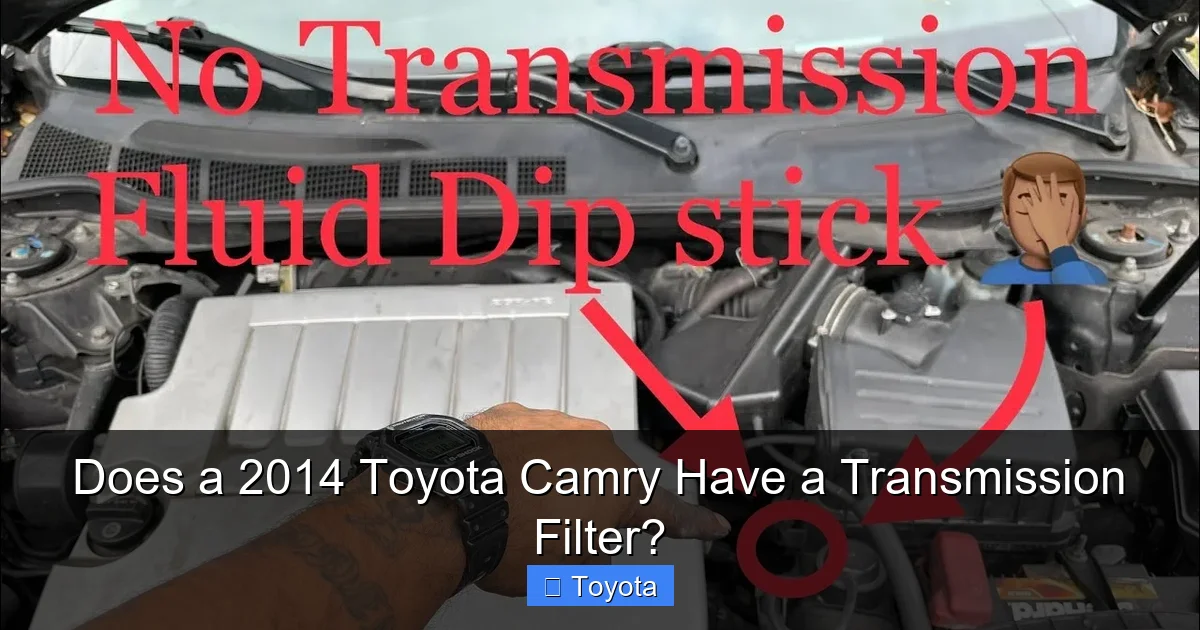
To understand the filter, we must first understand what it’s protecting. The 2014 Toyota Camry comes primarily with the U660E 6-speed automatic transmission. This is a robust, electronically controlled unit known for its smooth shifts and reliability when properly maintained. It’s part of a family of transmissions used across many Toyota and Lexus models of that era.
Visual guide about Does a 2014 Toyota Camry Have a Transmission Filter?
Image source: thecarhow.com
This transmission is considered a “sealed” or “lifetime” design in many manufacturer contexts, which can be a point of confusion. The term “lifetime” refers to the lifespan of the transmission itself under ideal conditions, not an infinite service interval for the fluid and filter. In reality, “lifetime” fluid still degrades, and “lifetime” filters still clog. The 2014 Camry’s owner’s manual does not specify a fixed interval for transmission fluid or filter replacement under normal driving conditions, instead relying on a “sealed for life” claim for the fluid. However, the vast consensus among professional mechanics and transmission specialists is that this is overly optimistic for long-term ownership, especially for vehicles subjected to severe service (frequent short trips, extreme temperatures, towing, or dusty conditions).
The Role of the U660E Transmission
The U660E is a complex unit with multiple planetary gear sets, clutch packs, and a sophisticated valve body controlled by solenoids. The transmission fluid under pressure is directed by the valve body to apply and release various clutches, which changes the gear ratios. Any debris or sludge in this fluid can quickly cause valves to stick or clutch materials to wear prematurely. The filter is the first line of defense, stationed right where the fluid exits the pan and is sucked up by the transmission pump. It ensures that only clean fluid reaches the heart of the transmission.
Location and Access: Finding the Camry’s Transmission Filter
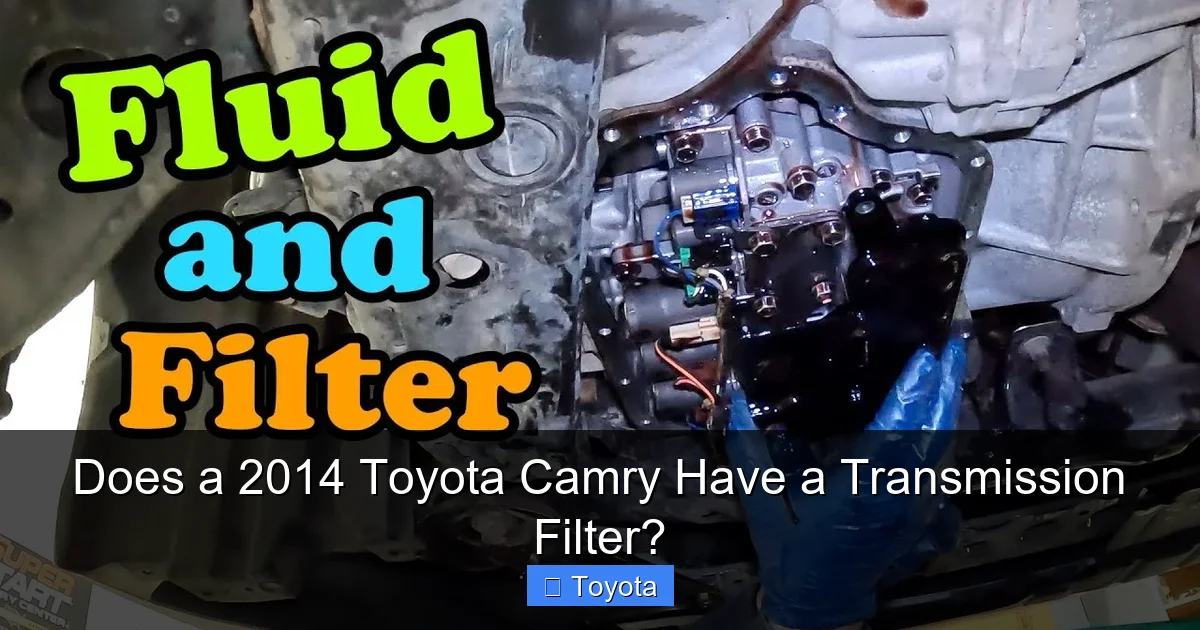
So, where exactly is this hidden component? The transmission filter in your 2014 Camry is located inside the transmission oil pan, which is bolted to the bottom of the transmission case. It is not accessible from underneath the car without first removing the pan itself. This is a significant undertaking compared to, say, locating the transmission dipstick on a 2010 Toyota Camry, which is an entirely different design feature used for checking fluid level.
Visual guide about Does a 2014 Toyota Camry Have a Transmission Filter?
Image source: platform.cstatic-images.com
To access the filter, you must:
- Raise and securely support the vehicle.
- Remove the transmission oil pan bolts. Note that some bolts may be longer and serve as locator pins.
- Carefully lower the pan. The filter is attached to the valve body or the inside top of the pan, depending on the exact design.
- Disconnect any electrical connectors or tubes that may be attached to the pan.
- Once the pan is off, the filter is visible, usually held in place by a few bolts or clips.
The process is messy, as transmission fluid will drain as soon as the pan is loosened. It requires a large drain pan, new pan gasket or RTV sealant, a new filter, and typically between 4 to 6 quarts of new Toyota WS fluid. Proper torque on the pan bolts is critical to prevent leaks.
Maintenance Schedule and Procedures: When and How to Service It
This is the most debated topic for Camry owners. While the manual is silent, industry best practice is clear. For a 2014 Camry, a proactive approach is highly advisable.
Visual guide about Does a 2014 Toyota Camry Have a Transmission Filter?
Image source: nissankaengine.com
Recommended Service Intervals
Most independent transmission shops and mechanics recommend a full transmission fluid and filter service every 60,000 to 100,000 miles for normal driving. If your Camry sees a lot of severe service—daily stop-and-go traffic, very hot or cold climates, frequent trailer towing (though Camry’s aren’t rated for towing), or dusty environments—lean toward the 60,000-mile mark. Waiting until you experience problems (slipping, harsh shifts, delayed engagement) is often too late, as the damage may already be done. A simple, preventative fluid and filter change is a fraction of the cost of a transmission rebuild or replacement.
The Complete Service Procedure
A proper service involves more than just swapping the filter. Here is the general procedure a professional will follow, which is also the roadmap for a confident DIYer:
- Warm the Fluid: Drive the car for 10-15 minutes to warm the transmission fluid to operating temperature. Warm fluid flows better and carries more contaminants out.
- Lift and Drain: Safely lift the front of the car. Place a large catch pan under the transmission. Remove the transmission pan bolts, starting from the rear and sides, leaving the front corners loosely attached. This allows fluid to drain gradually without a sudden gush. Once dripping stops, remove the last bolts and lower the pan.
- Inspect and Clean: This is critical. With the pan off, inspect the bottom of the pan and the magnetic plug (if equipped) for excessive metal shavings. A light coating is normal; large chunks or a “clump” indicate serious internal wear. Thoroughly clean the pan and magnet with solvent. Do not use cloth fibers.
- Replace the Filter: Remove the old filter. Note how it mounts. Install the new filter with a new seal (if applicable) and torque the bolts to specification (usually 7-10 ft-lbs).
- Reinstall the Pan: Place a new gasket on the transmission case or apply a thin, even bead of RTV silicone sealant (per Toyota spec) to the pan. Carefully position the pan and hand-tighten all bolts. Torque the bolts in the specified sequence (usually a criss-cross pattern) to the correct torque (often around 8-12 ft-lbs). Over-torquing can crack the pan; under-torquing causes leaks.
- Refill Fluid: Through the dipstick tube (if equipped) or a fill plug on the transmission, add the correct type and amount of fluid. For the 2014 Camry 2GR-FE engine, this is typically Toyota WS ATF. Capacity is usually around 4-5 quarts for a pan drop, but consult a factory manual or a reliable source like this article on Toyota RAV4 transmission fluid capacity for a comparable reference, as capacities can vary slightly by model.
- Circulate and Check: Start the engine, let it idle, and shift through all gears (P, R, N, D, 4, 3, 2, 1). Check for leaks. With the engine running and transmission at operating temperature, check the fluid level on the dipstick (with the car level) and adjust to the “Full” mark.
DIY vs. Professional Service: Should You Do It Yourself?
This is a classic automotive dilemma. Replacing the transmission filter is not like changing your oil. It’s a moderate-to-advanced DIY job that requires mechanical aptitude, the right tools, and a high tolerance for mess and frustration.
The Case for Professional Service
For most owners, taking the car to a reputable independent mechanic or a transmission specialist is the smartest move. Here’s why:
- Expertise and Cleanliness: Professionals have lifts, transmission jacks, and fluid evacuators that make the job cleaner and faster. They know the exact torque specs and gasket/sealant procedures.
- Diagnostic Insight: While the pan is off, a good mechanic will inspect the internal components for signs of wear, clutch material, or metal shavings. This is invaluable early warning data you can’t easily get yourself.
- Warranty and Peace of Mind: Reputable shops guarantee their work. If a leak develops or a bolt is cross-threaded, they fix it. DIY mistakes can lead to thousands in transmission damage.
- Proper Disposal: They handle the old fluid and filter disposal legally and responsibly.
The cost for a professional transmission service (fluid and filter) on a 2014 Camry typically ranges from $200 to $400, depending on your region and the shop. Given the complexity, this is often excellent value.
The DIY Path: For the Bold and Prepared
If you have experience working on cars, a solid set of tools, and patience, you can save money doing it yourself. The key is preparation:
- Buy a high-quality filter kit that includes the filter, pan gasket, and any seals.
- Purchase the exact amount of Toyota WS ATF. Using the wrong fluid, like a cheaper generic “Dexron” type, can cause slippage and damage. Always follow the specification.
- Have a large drip tray, plenty of shop towels, and a fluid pump or suction gun for refilling.
- Consult a factory service manual for your specific VIN. Torque specs and procedures can vary.
- Take pictures during disassembly to ensure correct reassembly.
Remember, a botched DIY job often costs more to fix than the initial professional service would have. If you’re not 100% confident, professional maintenance for related components like the oil filter is always a safe bet, and the transmission is even more critical.
Consequences of Neglect: What Happens When the Filter Fails
Ignoring your transmission filter is a classic case of “pay me now or pay me a lot more later.” A clogged filter doesn’t just cause minor inconvenience; it sets off a chain reaction of damage.
Symptoms of a Clogged or Failing Filter
Watch for these warning signs:
- Delayed or Harsh Shifts: The transmission struggles to build hydraulic pressure quickly, causing a noticeable pause (1-2 seconds) between Drive/Reverse engagement or jarring, firm shifts.
- Transmission Slipping: The engine RPMs rise without a corresponding increase in vehicle speed, especially when accelerating uphill. This means the clutches aren’t being applied firmly due to low or contaminated fluid pressure.
- Erratic Behavior: The transmission may hunt for gears, shift at the wrong times, or refuse to shift out of a certain gear (limp mode).
- Overheating: Restricted fluid flow reduces cooling. You might smell a burnt odor (like burnt toast) from the transmission area, and the fluid itself will turn dark brown or black and smell acrid.
- Fluid Leaks (Indirect):strong> A severely clogged filter can create excessive pressure behind it, potentially stressing old seals and causing new leaks at the pan or other joints.
The Ultimate Cost: Catastrophic Failure
If these early symptoms are ignored, the internal clutches and bands will wear rapidly due to insufficient lubrication and pressure. Metal particles multiply, sludge builds, and the valve body can become clogged or have sticking solenoids. Eventually, a clutch pack will burn out completely, leading to a transmission that will not move the car in any gear. At this point, the only options are a complete rebuild or a replacement transmission, with costs easily exceeding $3,000 and often reaching $4,000-$5,000 or more for a 2014 Camry. A $300 filter and fluid service is a tiny fraction of that cost.
Conclusion: Proactive Care for Decades of Reliability
The 2014 Toyota Camry is celebrated for its reliability, and that reputation holds true for the drivetrain when maintained properly. The presence of an internal transmission filter is a key part of that system. While Toyota’s “lifetime” fluid claim may cause hesitation, the evidence from mechanics and owners alike strongly supports a proactive fluid and filter change every 60,000 to 100,000 miles as a smart investment in your car’s future.
Treat this service not as an optional extra, but as a fundamental part of your Camry’s long-term health, akin to regular oil changes. If you are a hands-on enthusiast with the right skills and tools, it’s a rewarding project. For everyone else, allocating $200-$400 at a trusted shop for this service is one of the wisest maintenance decisions you can make. It preserves the smooth, quiet shifting that makes the Camry such a pleasant car to own and drives, and it safeguards against a financial disaster. Don’t wait for symptoms to appear. Check your service history, and if you’re unsure when the transmission fluid was last refreshed, schedule a service. Your future self, and your transmission, will thank you.
Frequently Asked Questions
Does a 2014 Toyota Camry actually have a transmission filter?
Yes, absolutely. All automatic transmissions, including the 6-speed unit in the 2014 Camry, have an internal filter. It’s located inside the oil pan and is designed to trap metal shavings and other debris from the transmission fluid.
How often should the transmission filter be replaced in a 2014 Camry?
Toyota’s official manual does not specify a replacement interval, calling the fluid “lifetime.” However, industry standard best practice is to replace the filter and fluid every 60,000 to 100,000 miles. For severe driving conditions, aim for the lower end of that range to ensure maximum transmission longevity.
Can I replace the transmission filter myself on a 2014 Camry?
It is possible for an experienced DIYer with the proper tools, a clean workspace, and a strong understanding of the procedure. However, it is a messy, involved job requiring precise torque specifications and meticulous cleaning to avoid leaks or damage. For most owners, professional service is strongly recommended to ensure it’s done correctly.
What are the signs that my Camry’s transmission filter is clogged?
Common symptoms include delayed or harsh gear shifts, transmission slipping (engine revs but car doesn’t accelerate properly), erratic shifting behavior, a burnt smell from the transmission, and dark, degraded fluid. If you notice any of these, have the transmission inspected immediately.
What type of transmission fluid and filter does a 2014 Camry require?
It requires genuine Toyota WS (World Standard) Automatic Transmission Fluid or an exact equivalent approved for the U660E transmission. The filter is a specific part number; always use a high-quality OEM or OEM-spec filter to ensure proper fit and filtration.
Is it safe to just change the fluid without replacing the filter?
While a simple fluid drain and refill (without pan removal) is better than nothing, it does not address the filter. The old, clogged filter remains in place, limiting the effectiveness of the new fluid. A true service requires pan removal to access, inspect, and replace the filter for complete protection.
