
How to Reset the Aeb System on a Hyundai

Resetting the Automatic Emergency Braking (AEB) system on a Hyundai is not a simple dashboard button press. It typically requires a professional-grade OBD2 scanner to clear fault codes after the underlying issue is fixed. Attempting a reset without repairing the cause is unsafe and will cause the warning light to return. Always diagnose the problem first, and consider professional help for safety-critical systems like AEB.
Hey there, Hyundai owner! Have you seen that little car icon with an exclamation point, or maybe the words “AEB” or “Forward Collision-Avoidance Assist” light up on your dashboard? That’s your Automatic Emergency Braking system telling you it needs attention. Your first instinct might be to figure out how to turn that light off. But here’s the crucial thing you need to know: resetting the AEB system on a Hyundai is fundamentally different from resetting your oil light or tire pressure monitor. It’s not about following a simple on-board procedure; it’s about fixing a problem. Let’s walk through exactly what this system does, why that light is on, and what the real steps are to get your Hyundai’s safety net back online and working correctly.
We’re going to break this down in plain English. No confusing jargon, just clear facts. You’ll learn why a “reset” is really a “clear code after repair,” what tools you actually need, the common reasons the system flags an error, and the safe, correct way to get that light off for good. Your safety, and the safety of everyone on the road, depends on this system working perfectly.
Key Takeaways
- AEB is a safety-critical system: The Automatic Emergency Braking system is a primary safety feature. Resetting it without addressing the root cause is dangerous and will likely lead to system failure when you need it most.
- Diagnosis before reset is mandatory: The AEB warning light indicates a stored fault code. You must use a compatible scan tool to read this code, diagnose the faulty component (e.g., radar sensor, camera), and repair it before a reset is possible.
- Most resets require professional tools: Unlike resetting a maintenance light, AEB system resets almost always require an advanced diagnostic scanner that can access the vehicle’s ADAS (Advanced Driver Assistance Systems) modules.
- Manual “reboots” are not true resets: Disconnecting the battery or performing a key cycle may clear the light temporarily, but it does not clear the underlying fault code from the system’s memory. The light will return immediately upon the next ignition cycle.
- Sensor calibration is often needed: After repairing or replacing an AEB component (like the front radar or forward-facing camera), the system must be calibrated to the vehicle’s exact specifications. This is a precise process requiring specialized equipment.
- Model and year matter significantly: Hyundai’s AEB implementation has evolved. The procedure and required tools for a 2020 Sonata differ from a 2017 Tucson. Always verify the exact process for your specific vehicle.
- When in doubt, seek a professional: Given the life-saving nature of AEB, if you are unsure about any step, the diagnosis, or the required equipment, take your Hyundai to a dealer or a certified ADAS repair shop. Safety must come first.
📑 Table of Contents
- Understanding Hyundai’s AEB System: More Than Just a Sensor
- When and Why the AEB Light Comes On: It’s a Cry for Help
- The Critical Preparation: Diagnosis is Non-Negotiable
- The “Reset” Process: What It Actually Involves
- Model-Specific Considerations: Hyundai’s Evolution
- Common Pitfalls and Why Professional Help is Often the Safest Choice
- Conclusion: Safety Over Convenience
Understanding Hyundai’s AEB System: More Than Just a Sensor
Before we talk about resetting anything, we need to understand what we’re dealing with. AEB, or Automatic Emergency Braking, is a cornerstone of Hyundai’s SmartSense suite of safety features. Its job is to monitor the road ahead using a combination of a forward-facing camera (usually mounted near the rearview mirror) and a radar sensor (typically behind the front grille or bumper).
These two components work together, constantly analyzing the distance and relative speed of vehicles, pedestrians, and sometimes cyclists in your path. If the system detects an imminent collision and determines you haven’t reacted, it will provide audible and visual warnings. If you still don’t respond, it can automatically apply the brakes to either avoid the crash entirely or reduce its severity. It’s a brilliant piece of technology that has been proven to save lives and reduce injuries.
The Brain of the Operation: The ADAS Control Module
This isn’t just a sensor talking to the brake light switch. The camera and radar feed data to a dedicated computer called the ADAS (Advanced Driver Assistance Systems) control module. This module processes all the information, makes split-second decisions, and commands the braking system, steering (for some models with lane-keeping integration), and the dashboard alerts. It’s a complex, integrated network.
Because it’s so critical, the system is designed to be fail-safe. If any part of this network has a problem—a misaligned camera, a dirty or blocked radar, a faulty wiring harness, or an internal module error—it will illuminate a warning light on your dash. This is the system’s way of saying, “I’m offline. I can’t guarantee my function. You need to get me checked.” It’s a self-diagnostic warning, and it’s storing a specific fault code in the module’s memory.
When and Why the AEB Light Comes On: It’s a Cry for Help
You might see the AEB warning light come on under several conditions. Understanding these scenarios is key to knowing why a simple reset won’t work.
Visual guide about How to Reset the Aeb System on a Hyundai
Image source: jeepfixes.com
- During normal driving: The most common scenario. The system detects a temporary obstruction (like heavy mud or snow caked on the grille, covering the radar) or a genuine component failure and disables itself.
- After a windshield replacement: If your front windshield was replaced and the camera wasn’t recalibrated to the new glass’s exact position, the AEB system will not function correctly and will trigger a warning.
- After a front-end collision: Even a minor bump can misalign the radar sensor or camera. The system’s calibration is thrown off, and a warning is inevitable.
- Extreme weather conditions: Very heavy rain, fog, or snow can temporarily blind the sensors, causing a warning that may clear once conditions improve and the sensors are clean.
- Electrical system issues: A weak or dead battery, or a voltage drop from a failing alternator, can cause a communication error between the ADAS module and other vehicle computers, triggering a warning.
In every single one of these cases, the system has logged a Diagnostic Trouble Code (DTC). This code points to the nature of the problem (e.g., “Radar Sensor Alignment Out of Specification,” “Camera Communication Error,” “Sensor Dirty”). The only way to permanently extinguish the warning light is to address the issue that caused that code to be set in the first place. Then, and only then, can the code be cleared from the module’s memory.
Think of It Like a “Check Engine” Light for Your Safety Net
This is the most important analogy. You wouldn’t just clear a check engine light code for a misfire without fixing the spark plug or ignition coil. The light would just come right back. The AEB light is even more serious. It’s a “Check Safety System” light. The “reset” you’re looking for is actually the final step in a repair process: Repair → Verify Repair → Clear Fault Code. The clearing of the code is the “reset” action, but it is utterly meaningless without the repair and verification steps that come before it.
The Critical Preparation: Diagnosis is Non-Negotiable
So, your AEB light is on. What’s the first step? It’s not buying a tool or searching for a secret button sequence. The first step is diagnosis. You need to know what’s wrong.
Visual guide about How to Reset the Aeb System on a Hyundai
Image source: jeepfixes.com
Step 1: The Visual Inspection
Before you even plug anything in, do a thorough walk-around and clean. Grab a gentle car wash soap and a soft microfiber cloth.
- Check the front grille and bumper: Is there mud, snow, ice, dirt, or a big bug stuck right in front of the radar sensor? This is a very common cause. Clean the area carefully. Don’t use high-pressure water directly on the sensor area.
- Check the windshield: Look at the area behind the rearview mirror. Is the camera lens clean? Is there a crack or chip in the glass directly in front of it? Any aftermarket windshield tint or coatings can interfere with the camera’s function.
- Check for obvious damage: Look at the front bumper and grille. Is there any dent, scrape, or misalignment? Even a small misalignment can throw off radar alignment.
- Check your battery: If your battery is old or you’ve had recent electrical issues, have the battery and charging system tested. Low voltage can cause all sorts of module communication errors.
After cleaning and a visual check, drive the car for a few minutes under clear conditions. Sometimes, the light will go out on its own if the issue was just a temporary obstruction. If it stays on, you need to move to the next step.
Step 2: Reading the Fault Code
This is where things get technical. You need a scan tool that can communicate with Hyundai’s ADAS system. A basic, generic OBD2 reader you get at the auto parts store will not work. It can read engine and transmission codes, but it cannot access the ADAS module. You need a more advanced, often manufacturer-specific or high-end universal scanner.
Tools like the Hyundai GDS (Global Diagnostic System), the Autel MaxiSys series, the Launch X431 series, or other professional-level scanners have this capability. They can connect to the ADAS module, read the specific DTC (like C1A00-xx for radar issues or C1B00-xx for camera issues), and provide a definition.
This is the point where many DIYers hit a wall. Without the code, you’re guessing. Guessing with a safety system is not an option. If you don’t have access to the proper tool, this is your sign to take the car to a professional. They will plug in, get the code, and tell you what’s wrong.
The “Reset” Process: What It Actually Involves
Okay, let’s assume you’ve diagnosed the problem. You replaced the faulty radar sensor, repaired the wiring harness, or had the windshield recalibrated. Now, the new part is installed, and the repair is complete. The warning light is still on because the old fault code is still stored in the ADAS module’s memory. Now, and only now, can you proceed with the “reset.”
Visual guide about How to Reset the Aeb System on a Hyundai
Image source: jeepfixes.com
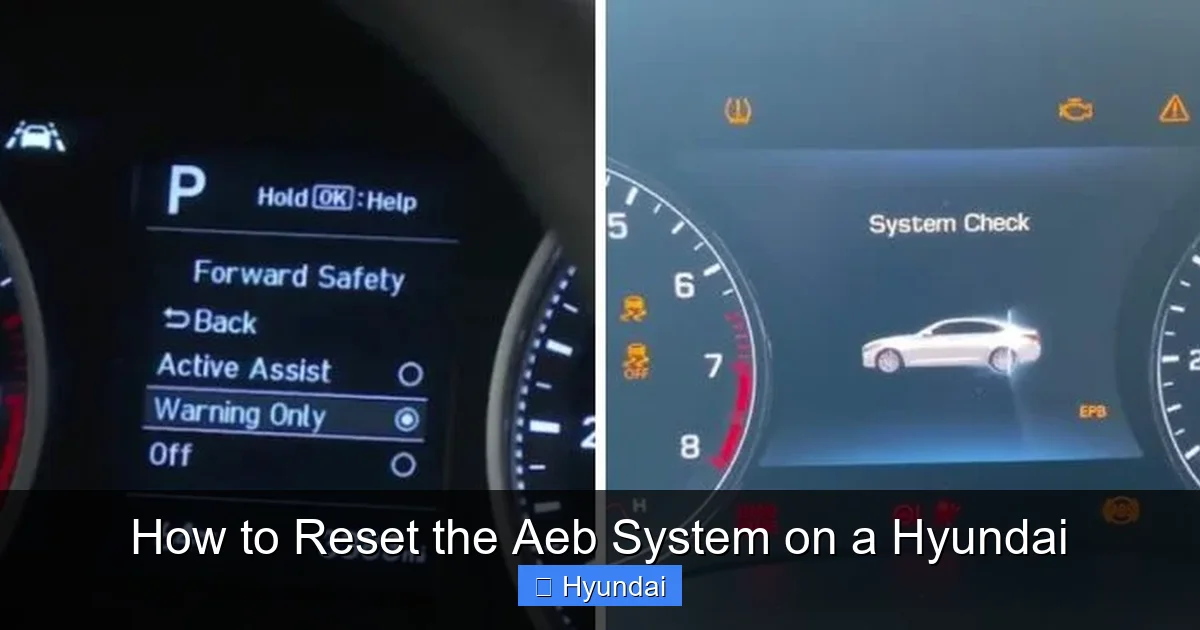
The process is simply: Use your advanced scan tool to connect to the ADAS module, navigate to the “Clear Codes” or “Erase DTC” function, and execute it. The tool will communicate with the module and wipe its memory of the past fault.
The Vital Final Step: Verification and Calibration
Clearing the code is not the end. You must verify the repair and ensure the system is functional. Here’s what that entails:
- Perform a System Check: After clearing the code, use your scan tool to go into the ADAS module’s “Live Data” section. You should see parameters like “Radar Status: OK,” “Camera Status: OK,” and “AEB System: Active.” No active faults should be listed.
- Test Drive Under Specific Conditions: Find a safe, straight, empty road. Have a friend drive another car in front of you at a steady speed. Gradually decrease your following distance. The AEB system should eventually show a visual warning on your dash (a red car icon) and may provide an audible alert. Do not rely on it to actually brake during this test! The goal is to see the *warning* activate, proving the sensors are “seeing” the target. If the warning never appears under a clear, controlled approach, the system is not calibrated correctly or there is still an issue.
- Calibration (If Required): This is the most critical part. If you replaced the radar or camera, or if the windshield was replaced, calibration is almost always required. This is not something you can eyeball. It involves placing special calibration targets (boards with precise patterns) at exact distances and angles from the vehicle, then using the scan tool to guide the module to “learn” the correct position of its sensors relative to the vehicle’s centerline. This process must be done on a level surface, in ideal lighting conditions, and with meticulous attention to detail. An error here can render your AEB system useless or, worse, cause it to brake inappropriately.
If, after a successful calibration and road test, the light stays off and the system activates its warnings properly, you have successfully completed the reset process. The light should remain off.
Model-Specific Considerations: Hyundai’s Evolution
Hyundai has been equipping its vehicles with AEB for several years now, and the technology has evolved. Here’s what you need to know about different model lines:
- Earlier Models (approx. 2015-2018): Models like the earlier Sonata and Tucson from this era often use a single radar sensor (usually a 24GHz unit) and a separate camera. The calibration process for these typically requires both a radar target and a camera target. The scan tool procedures are well-established but still require professional equipment.
- Mid-to-Late 2010s Models (approx. 2019-2021): Hyundai began migrating to a more integrated “fused” sensor system, often using a higher-resolution camera and a more advanced 77GHz radar (which has better range and resolution). The calibration process might be slightly different, and the fault codes will be different. A scanner with up-to-date software is essential.
- Current Models (2022+): The latest Hyundai vehicles, especially in the Genesis line and top trims of Sonata, Santa Fe, and Palisade, feature even more sophisticated ADAS with features like Highway Driving Assist. These systems are incredibly complex, with multiple radar units and high-definition mapping. Resetting and calibrating these is absolutely a job for a dealer or a highly specialized independent shop with the latest factory-level information and tools.
Bottom Line: Never assume the procedure from a 2017 model applies to a 2023 model. The specific steps, required targets, and tool software versions are model-year-and-engine-package specific.
Common Pitfalls and Why Professional Help is Often the Safest Choice
Let’s be real. You might be a capable DIY mechanic who can change brakes and spark plugs. But AEB system work is a different beast. Here are the common pitfalls that make this a pro job:
1. The “Battery Disconnect” Myth
Some online forums suggest disconnecting the negative battery terminal for 10 minutes to “reset” all systems. This is a waste of time for an AEB fault. The ADAS module stores its fault codes in non-volatile memory. They will survive a battery disconnect. The light will come right back on as soon as you reconnect the battery and start the car. This does not solve the problem; it only creates a temporary, false sense of resolution.
2. Using the Wrong Scan Tool or Outdated Software
Even if you have a “professional” scanner, if its software doesn’t have the latest coverage for your 2021 Hyundai Santa Fe, it won’t be able to access the ADAS module or perform the calibration. The tool must explicitly list your vehicle’s year, make, model, and engine. Using a generic “Asian” selector may not work.
3. Incorrect Calibration Setup
This is the most dangerous error. Setting the calibration target even a few millimeters off, or not having the vehicle perfectly level, will calibrate the sensor to the wrong “view” of the world. The result could be an AEB system that fails to detect a real obstacle, or one that slams on the brakes because it “sees” a phantom car in an empty road. Both outcomes are catastrophic.
4. Ignoring Related Systems
The AEB system relies on clean inputs from other systems. If your vehicle has a stored fault in the ABS (Anti-lock Braking System) or the ESC (Electronic Stability Control), those systems may need to be healthy and without codes for the AEB to function and be reset. A comprehensive diagnostic should check all related networks.
Because of these complexities, and because the stakes are literally life and death, the overwhelming recommendation from mechanics and Hyundai themselves is to have AEB work performed by trained professionals. The cost of a proper diagnostic and calibration at a dealer or reputable ADAS shop is an investment in your safety and the correct function of a multi-thousand-dollar safety system.
Conclusion: Safety Over Convenience
So, how do you reset the AEB system on a Hyundai? The full, honest answer is: You don’t just reset it. You fix what’s broken, then clear the code with the right tool.
The process is a cascade: see the light → perform a visual clean-up → use a professional scan tool to read the specific fault code → repair the faulty component (sensor, wiring, camera, etc.) → if a sensor/camera was touched, perform a precise, equipment-assisted calibration → finally, use the scan tool to clear the stored fault code → verify system function with a controlled test drive.
Skipping any of these steps—especially the diagnosis, repair, and calibration—is not only ineffective but actively dangerous. That dashboard light is your car’s way of telling you its most advanced safety feature is offline. Treat it with the seriousness it deserves. If you have the expertise, tools, and patience for precise calibration, you can attempt it. For the vast majority of drivers, the correct and safest “reset” is to drive your Hyundai to a qualified service center, let them diagnose the issue, and let them perform the repair and recalibration. Your peace of mind, and your safety on the road, are worth far more than the cost of a professional service.
Frequently Asked Questions
Can I just disconnect the battery to reset my Hyundai’s AEB light?
No. Disconnecting the battery will not clear the fault code stored in the ADAS module. The light will return immediately when you reconnect the battery and start the car. This only addresses a symptom, not the cause, and is a waste of time for this specific system.
What tools do I absolutely need to reset the AEB system?
You need an advanced OBD2 scan tool that can communicate with Hyundai’s ADAS (Advanced Driver Assistance Systems) module. Basic code readers cannot access this system. Tools like the Hyundai GDS, high-end Autel, or Launch scanners with the correct software are required to read codes, clear them, and perform calibrations.
Is it safe to drive with the AEB warning light on?
You can physically drive the car, but you should do so with extreme caution and get the issue diagnosed immediately. The AEB system is disabled, meaning you lose a critical automated safety net. Your reaction times must be perfect, as the car will not automatically brake to prevent or mitigate a collision. It is strongly advised not to drive long distances or in heavy traffic with this light illuminated.
How much does it cost to have a professional reset/calibrate Hyundai AEB?
Costs vary widely by region, shop, and model. A simple diagnostic scan might be $100-$150. If calibration is required after a sensor replacement, the total cost (parts + labor + calibration) can range from $300 to over $1,000 for some models, especially if a new radar or camera is needed. Dealerships are typically at the higher end but have the most up-to-date tools and information.
My windshield was recently replaced. Could that cause the AEB light?
Absolutely, yes. The forward-facing camera is mounted to the windshield. If the replacement glass is not the exact OEM specification or if the camera was not recalibrated to the new windshield’s position after installation, the AEB system will not function correctly and will trigger a warning. This is a very common cause of AEB warnings and requires a professional recalibration.
After fixing the problem, do I need to do anything besides clearing the code?
Yes, verification is critical. After clearing the code, you must confirm the system is active and functioning. This involves checking live data on your scan tool for “OK” statuses and performing a controlled road test to ensure the warning chime and visual alert activate appropriately when you approach a vehicle ahead. Skipping verification risks having a non-functional system.
