
How to Put a Bmw M4 in Park

Putting a BMW M4 in park is straightforward thanks to its electronic shifter (iDrive controller), but it works differently than a traditional column or console lever. You must press the brake pedal firmly, then push the iDrive controller to the left and forward into the “P” position. Always engage the electronic parking brake for safety. If the system fails, a manual override procedure using a hidden slot allows you to shift to park or neutral.
Key Takeaways
- The BMW M4 uses an electronic shifter (iDrive controller), not a traditional mechanical lever. You operate it by pressing the brake and moving the controller on the center console.
- Always press the brake pedal fully before attempting to shift out of Drive. This is a critical safety interlock that prevents accidental movement.
- The “Park” position is accessed by pushing the iDrive controller to the left and then forward. The display will show a “P” icon, and you’ll often hear a chime.
- Engage the Electronic Parking Brake (EPB) separately using its dedicated switch. This is a separate system from the transmission “Park” gear and is essential for securing the vehicle on inclines.
- Know the manual override procedure for dead battery or electronic failure scenarios. A hidden cover on the center console allows physical selection of P, R, N, or D with a key or tool.
- If the car won’t shift into Park, check for common issues like a dead 12V battery, faulty brake light switch, or a blocked shifter mechanism. These are often the culprits before assuming major transmission failure.
📑 Table of Contents
Understanding the BMW M4’s Transmission System
So, you’ve got the keys to a stunning BMW M4. The roar of the twin-turbocharged inline-six, the sharp handling, the aggressive stance—it’s a driver’s car through and through. But then you pull into your driveway, ready to shut it down, and you’re faced with a sleek, minimalist center console. Where’s the big, clunky gear lever you’re used to? Welcome to the world of BMW’s iDrive electronic shifter system. Figuring out how to put a BMW M4 in park is your first and most crucial lesson in operating this modern machine. It’s not complicated, but it is different. This isn’t your grandfather’s column shifter or even the traditional console lever from a 1990s 3 Series. It’s a computer-controlled system that prioritizes space, design, and integrated electronics. Mastering it is key to safe and confident driving. Many new owners, especially those transitioning from cars with mechanical linkages, experience a moment of hesitation. That’s perfectly normal. This guide will walk you through every detail, from the standard daily procedure to what to do when things go wrong, ensuring you’re never left stranded and confused by your M4’s transmission.
The Shift from Mechanical to Electronic
Traditional automatic transmissions use a physical cable or rod connected to the valve body to select gears. When you move the lever, you’re directly mechanically commanding the transmission. In the BMW M4, particularly from the F82/F83 generation (2014-2020) and the current G82 generation (2021+), that physical connection is gone. The small, elegant button-like shifter on the center console is an electronic transducer. When you push it forward, backward, left, or right, it sends a signal to the car’s main computer (the DME/DDE for the engine and transmission control). That computer then commands an electric motor on the transmission itself to engage the requested gear. This “shift-by-wire” technology is common in modern luxury cars. It allows for more compact center console designs, integrates with start-stop systems seamlessly, and enables features like automatic parking (Auto P) in some models. However, it means your action is a request, not a direct command. The car’s computer must be awake, have power, and agree with your input—like pressing the brake—before it will execute the shift. This is the core concept you need to understand.
Locating the Shifter and Indicator
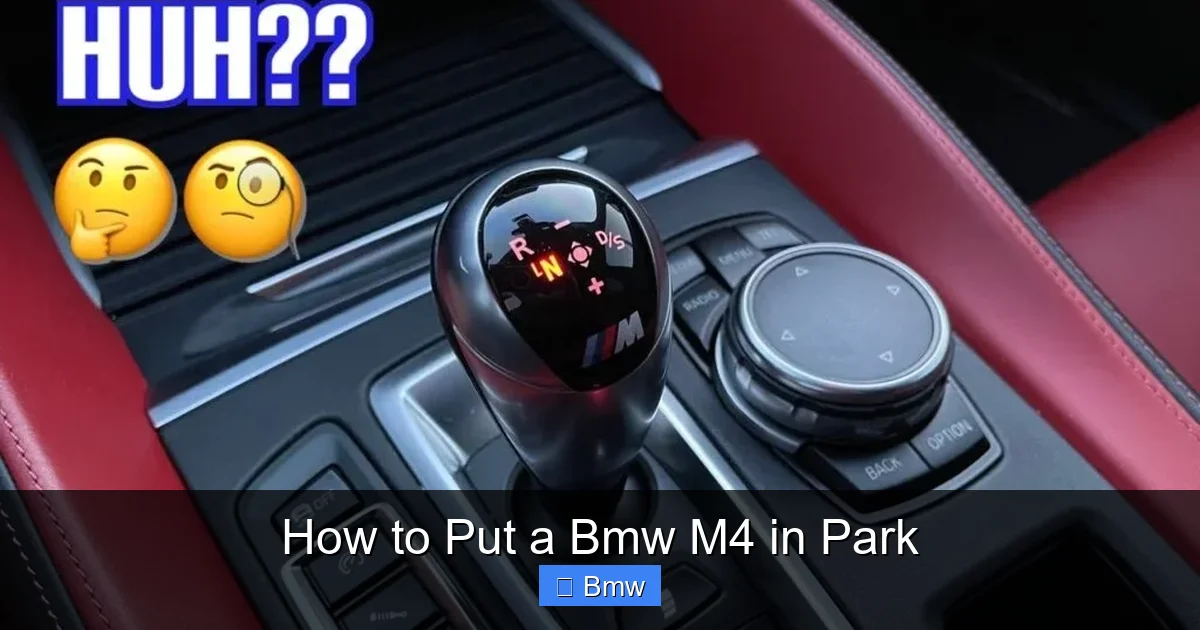
On your BMW M4, find the iDrive controller on the center console. It’s the large, knurled knob used for navigating the infotainment system. Right next to it, or integrated into the same panel on newer models, is the transmission shifter. It’s a small, flat piece that protrudes slightly. You don’t pull it or push it down like a traditional lever. Instead, you press it in the direction indicated by the subtle graphics on the console surface. You’ll see small white letters and icons: “P” (Park) is typically at the top-left, “R” (Reverse) at the top-right, “N” (Neutral) in the middle, and “D” (Drive) at the bottom. The current selected gear is also prominently displayed on the instrument cluster (the gauge area behind the steering wheel) and often on the central information display. Always confirm the gear selection in the gauge cluster, as it’s the most authoritative indicator. The physical position of the shifter can sometimes feel ambiguous, so the digital readout is your true guide.
The Step-by-Step Process to Engage Park
Alright, let’s get to the heart of the matter. This is the standard, everyday procedure you will use 99% of the time. It’s simple, but each step has a specific reason. Performing these steps in the correct order is non-negotiable for safety and to prevent damage to the transmission or surrounding components.
Visual guide about How to Put a Bmw M4 in Park
Image source: buzzlyo.com
Step 1: Bring the Vehicle to a Complete Stop
This might seem obvious, but it’s a critical safety step. Your M4’s transmission is designed to shift between Drive, Reverse, and Neutral while moving at very low speeds (creeping), but it absolutely will not allow a shift into Park while there is any significant forward or rearward motion. The computer will ignore your command, and you might hear a warning chime. Always come to a full, complete stop before attempting to select Park. This means your speedometer reads zero, and the car is stationary. If you try to shift into Park while rolling, you will likely damage the parking pawl—a small metal pin that locks the transmission output shaft—causing a loud bang and potentially catastrophic internal damage. So, foot on the brake, bring the car to a halt.
Step 2: Depress the Brake Pedal FIRMLY
This is the most important physical action you must take. The BMW M4 has a brake pedal switch that must be activated. The car’s computer needs to know you intend to shift. Press the brake pedal down firmly and hold it there. You don’t need to stand on it, but a confident, deliberate press is required. A light tap often won’t register. You’ll know it’s working if you hear a slight click or feel a soft detent under your foot as the switch engages. On some models, you might also see the brake lights illuminate on the rear of the car. This brake-interlock is a primary safety feature preventing accidental shifts out of Park (which we’ll cover later) and into Drive or Reverse from a stopped position. Without this signal, the shifter is essentially locked, and you will be unable to move it from its current position. So, brake first, always.
Step 3: Move the iDrive Shifter to “P”
With your foot firmly on the brake, look at the shifter graphics. To engage Park, you need to push the shifter to the left and then forward in a diagonal motion. It’s not a straight push forward from Neutral. Think of it as pushing it toward the top-left corner of its travel range. You don’t need to use excessive force; a firm, deliberate press in that direction is sufficient. As you do this, watch the instrument cluster. The gear indicator should change from “D” (or “R” or “N”) to a bright, bold “P”. You will typically hear a solid, confirming chime from the car’s speaker system. That chime and the “P” on the gauge are your confirmation that the command was successful and the transmission’s parking pawl has engaged. Once you see and hear this, you can safely release the brake pedal.
Step 4: Engage the Electronic Parking Brake (EPB)
Here is a point of major confusion for many new M4 drivers. Shifting into “P” is NOT the same as setting the parking brake. The “P” gear uses a mechanical pawl inside the transmission to lock the output shaft, preventing the drive wheels from turning. This is fine for flat surfaces, but on any incline, the pawl can be stressed and may not hold the car securely, especially if it’s bumped. The Electronic Parking Brake is a separate, dedicated system that uses electric calipers to clamp the rear brakes. You must engage it separately. Locate the EPB switch, which is usually on the center console near the shifter or on the dashboard. It’s marked with a “P” inside a circle or the standard parking brake symbol. Press and hold this switch for about 2-3 seconds. You’ll hear the rear brakes engage with a whirring or clunking sound, and the EPB indicator light (a red “P” symbol) will illuminate on your instrument cluster. Always use the EPB when parking on hills. Forgetting this is a common mistake that can lead to a rolling car. For a deeper dive into BMW’s specific brake systems and maintenance, resources on how to put oil in the car often touch on the importance of comprehensive brake system care.
Step 5: Turn Off the Engine
Now that you are in Park and the parking brake is set, you can safely turn off the engine. Press the Start/Stop button (the one you use to start the car) while your foot is on the brake pedal. The engine will shut down. You can then remove your foot from the brake. The car will remain secure in Park with the EPB holding it. When you return, the standard start-up sequence is: press the brake (which also releases the EPB automatically on most models), then press the Start/Stop button. The car will start and be in Park, ready for you to select Drive.
Safety Features and Why They Matter
Your BMW M4 isn’t just fast; it’s packed with intelligent safety systems designed to prevent the very mistakes that lead to accidents or injury. Understanding these features isn’t just about operating the car; it’s about respecting its engineering. The shift-by-wire system is the backbone, but several layers of protection are built around it.
Visual guide about How to Put a Bmw M4 in Park
Image source: thecarhow.com
The Brake-Interlock System
We mentioned this in the steps, but it’s worth emphasizing. You cannot shift out of Park (into Drive, Reverse, or Neutral) without having your foot firmly on the brake pedal. This prevents the dreaded “accidental acceleration” scenario where a car lurches forward because someone bumped the shifter while reaching for something. The system is so sensitive that if your brake lights aren’t working (due to a blown fuse or faulty brake light switch), you may also be prevented from shifting out of Park. This is a common issue and a primary diagnostic check if your M4 is stuck in Park. The brake light switch is a wear item and can fail. It’s a simple fix, but a critical one for your ability to drive the car at all.
Auto Park (Auto P) Function
Many BMW models, including some M4 variants, feature an “Auto P” or “Auto Park” function. This is an extension of the safety system. If you turn off the engine while the car is still in Drive, Neutral, or Reverse, the car’s computer will automatically shift the transmission into Park after a few seconds. It’s a last-ditch safety net to prevent a car from rolling away if the driver forgets to select Park before switching off the ignition. However, you should never rely on this. Always manually select Park and set the EPB. The Auto P function is for forgetfulness, not for proper procedure. It’s also why you might see the “P” flash on the display right after you turn the car off if you didn’t do it yourself.
The Role of the Electronic Parking Brake (EPB)
As stated, the transmission Park gear is not a brake. It’s a mechanical lock. The EPB is your primary, active braking system for stationary holding. It’s automatically applied in some situations (like on steep hills with Hill Descent Control) and automatically released when you drive off in many models (if you press the accelerator). But you must manually activate it for secure parking. The system is powerful and designed to hold the car on significant grades. Never assume “P” is enough. On a hill, always use both: transmission in Park and EPB engaged. This is standard safe driving practice for any automatic vehicle, but it’s doubly important in a high-performance car like the M4 where you might be more focused on driving dynamics than parking procedures.
Troubleshooting Common Issues
What happens when the simple procedure fails? You press the brake, you push the shifter, and… nothing. The gear indicator doesn’t change. No chime. The shifter feels stiff or doesn’t move. Don’t panic. There are a few very common, often simple, reasons for this. Always diagnose from the simplest to the most complex.
Visual guide about How to Put a Bmw M4 in Park
Image source: i.ytimg.com
“My Shifter is Stuck and Won’t Move!”
This is the most frequent complaint. First, ensure you are pressing the brake pedal firmly and fully. A weak press is the #1 cause. Second, check your 12V battery. The M4’s entire shift-by-wire system is electronic. If the main battery is completely dead or has a severe voltage drop, the system will not have power to operate the transmission solenoid. You might also notice other electrical gremlins—windows won’t work, infotainment is dead, or the car won’t start. A jump start or battery charge often resolves this. Third, inspect the area around the shifter. Is there a loose coin or a small object jammed under the shifter boot preventing its movement? This happens surprisingly often. Gently lift the leather/alcantara boot and check. If something is lodged there, carefully remove it.
“The Car Won’t Shift Out of Park”
The opposite problem. You’re parked, brake is pressed, but the shifter won’t budge from “P”. Again, check the brake pedal switch. If the car doesn’t think you’re braking, it won’t let you move. A faulty brake light switch is a prime suspect. Do your brake lights come on when you press the pedal? If not, that’s your issue. Another possibility is a faulty ignition switch or key. The system needs to recognize a valid key inside the car. A weak key fob battery can sometimes cause communication issues. Try replacing the key fob battery. Also, ensure your foot is completely on the brake pedal and not inadvertently resting on the accelerator—the system detects this and will block the shift as a safety measure.
Manual Override Procedure
If you’ve checked the battery, brake lights, and cleared any debris, and the shifter is still completely unresponsive (often due to a total electrical failure or a faulty shift module), you need the manual override. This is a mechanical release that allows you to physically move the transmission into a gear. This is an emergency procedure for moving the car a short distance (like to the side of the road) or getting it onto a tow truck. It is not for daily use. Here’s how: Locate the small, rectangular cover on the front of the center console, just below the iDrive controller and shifter. It’s usually made of a different texture (like soft-touch plastic) and has a tiny slot or notch. Use a flat-head screwdriver, a key, or even the pull-out tab from a BMW key fob to gently pry this cover off. Underneath, you’ll see a small, colored (often red or yellow) plastic tab. Pull this tab firmly upward. This mechanically disengages the electronic lock on the shifter mechanism. Now, while holding that tab up, you should be able to move the iDrive shifter freely through P, R, N, D. You can then push the car (it will roll freely in Neutral) or, if the engine is running, carefully drive it a very short distance to a safe location. Remember: the parking pawl is not engaged when you use the override. The car will roll if not on a perfectly flat surface. This is where knowledge from articles like how to put a car in neutral with a dead battery becomes invaluable in a real-world emergency, as the principles of mechanical override are similar across many modern vehicles.
Special Situations and Considerations
Life isn’t always a straight, flat road. What about towing? What about an automatic car wash? What if you’re on a steep hill? Let’s cover these edge cases.
Towing and Flat-Bedding Your M4
This is extremely important. You must never tow your BMW M4 with its wheels on the ground (all four wheels rolling) for any significant distance. The transmission is not designed for this and will be severely damaged. The only safe way to tow an M4 with a traditional tow truck (hook and chain or wheel-lift) is if it is placed on a flat-bed trailer. If you absolutely must move it a very short distance (a few feet) with all wheels on the ground (e.g., to push it out of a tight spot), you must first put the transmission into Neutral. Use the manual override procedure described above to get it into “N”. Then, and only then, can you carefully push or tow it with all wheels rolling. For any longer distance, a flat-bed is mandatory. Always consult your owner’s manual for the definitive towing procedure for your specific model year.
Using an Automatic Car Wash
This is a classic point of anxiety. When you pull into an automatic tunnel wash, you’ll be asked to put the car in Neutral. Do this using your iDrive shifter normally (press brake, push shifter to center “N”). The car will then be pushed/pulled through the wash by its conveyor. Do not use the manual override for this. The normal electronic shift to Neutral is perfectly fine and designed for this scenario. Once through, you’ll be asked to drive out. Simply press the brake, shift to “D”, and go. It’s a simple, routine procedure. The key is to ensure your 12V battery is healthy so the shifter works normally.
Parking on Steep Inclines
We touched on this, but it bears repeating. On a steep hill, follow this enhanced procedure: 1) Come to a stop. 2) Press and hold the brake pedal. 3) Shift into Park (“P”). 4) Before releasing the brake pedal, engage the Electronic Parking Brake by pressing and holding its switch. 5) Now, slowly release the brake pedal. The car should be held securely by the EPB. The transmission pawl in Park takes some of the load, but the EPB is doing the heavy lifting. When leaving: 1) Press the brake pedal firmly. 2) Press the accelerator pedal slightly (this often automatically releases the EPB on modern BMWs). 3) Once you feel the car wants to move forward, shift to Drive and proceed. This method prevents you from having to fight a heavily stressed parking pawl when you try to shift out of Park on a hill.
Maintaining Your M4’s Transmission
Your M4’s transmission is a robust piece of engineering, but like any high-performance component, it thrives on proper care. While the shift mechanism itself is sealed and requires no user service, the health of the entire drivetrain depends on general maintenance habits.
Transmission Fluid and Service Intervals
The M4 uses a high-performance ZF or Getrag automatic transmission (depending on generation) filled with specific synthetic fluid. Unlike engine oil, transmission fluid in these units is often considered “lifetime” by the manufacturer, meaning there’s no scheduled replacement under normal use. However, “lifetime” in engineering terms often means “the life of the warranty” or “under ideal conditions.” For a car driven hard, tracked, or in extreme climates, many specialists recommend a fluid and filter change every 60,000-80,000 miles. This is a complex procedure requiring specialized tools and knowledge. It is not a DIY job for the average enthusiast. You must take it to a qualified BMW specialist or transmission shop. Using the correct fluid spec (e.g., BMW LT-1, ZF Lifeguard 8) is absolutely critical. Mixing or using the wrong fluid can cause shuddering, harsh shifts, or failure. For general fluid maintenance philosophy, understanding how much oil to put in a car reinforces the principle that fluid levels and quality are paramount for any lubricated system.
Driving Habits That Matter
How you drive directly impacts your transmission’s longevity. Avoid “creeping” for long periods in heavy traffic. This means holding the car on a hill with the accelerator in Drive instead of using the brake and then the EPB. This causes unnecessary heat and wear in the transmission’s torque converter. When stopped for more than a few seconds, shift to Neutral and use the brake/EPB. Also, allow the transmission to warm up properly. When the engine is cold, the transmission fluid is thicker. Avoid aggressive, full-throttle launches from a stop until the oil temperature gauge (if equipped) shows normal operating temperature. Similarly, after hard driving, let the car idle for 30-60 seconds before shutting off. This allows transmission fluid to circulate and cool critical components. These habits are especially important for a car with the M4’s performance potential.
Warning Signs to Heed
Your transmission will give you warnings before it fails. Pay attention to them. These include: Delayed or harsh engagement when shifting from Park to Drive or Reverse. A noticeable shudder or vibration, especially when cold. Whining, humming, or clunking noises from the transmission tunnel. The gear indicator flickering or showing the wrong gear. A general feeling of slippage—the engine revs rise without a corresponding increase in speed. If you experience any of these, get the car diagnosed immediately by a professional. Early intervention can save a costly rebuild. A diagnostic scan will read transmission control module fault codes, which are the most direct path to the problem.
Conclusion: Confidence Behind the Wheel
Mastering how to put a BMW M4 in park is more than just a single action; it’s about understanding the philosophy of your car’s modern design. The electronic shifter, the brake interlock, and the separate parking brake are all pieces of a sophisticated safety and ergonomic puzzle. The standard procedure—stop, brake firmly, push shifter left-forward to “P”, engage EPB—becomes second nature with practice. Remember that the digital indicator in the gauge cluster is your final authority, not the physical position of the shifter. Equally important is knowing what to do when the system doesn’t respond: check your brake lights, check your battery, clear debris, and as a last resort, use the manual override. This knowledge transforms potential anxiety into confident control. Your BMW M4 is a tool for enjoyment, and part of that enjoyment comes from the seamless, intuitive operation of its systems. Treat it with respect, follow proper procedures, and it will reward you with thousands of miles of driving exhilaration. For any major work, always consult a BMW specialist, but for this fundamental operation, you now have the complete guide.
Frequently Asked Questions
What should I do if my BMW M4 shifter is stuck and won’t move out of Park?
First, ensure you are pressing the brake pedal firmly and fully. This is the most common fix. Second, check if your 12V battery is completely dead, as the electronic shifter needs power. Third, look for objects jammed under the shifter boot. If none of these work, you may have a faulty brake light switch or a failed shift module, requiring a professional diagnosis.
Is shifting into “P” the same as setting the parking brake?
No, they are completely separate systems. Shifting into “P” engages a mechanical pawl inside the transmission. The Electronic Parking Brake (EPB) uses the rear brake calipers. You must always engage the EPB separately, especially on inclines, for true safety. Relying solely on the transmission “P” gear is not sufficient on hills.
Can I tow my BMW M4 with all four wheels on the ground?
No, you should never tow an M4 with wheels on the ground for any distance. This will destroy the transmission. The only safe method is using a flat-bed tow truck. If you must move it a very short distance (a few feet), you must first put it in Neutral using the manual override procedure, and then it can be pushed or towed with all wheels rolling.
What is the manual override and when do I use it?
The manual override is an emergency procedure that physically disengages the electronic shifter lock. You access it by prying off a small cover on the front of the center console and pulling a colored tab. This allows you to manually move the shifter to P, R, N, or D. Use it only if the electronic shifter is completely unresponsive due to a dead battery or system failure, to move the car a short distance or onto a tow truck. The parking pawl will not be engaged when used.
Why does my M4 sometimes not shift into Park until I press the brake harder?
The brake pedal switch that signals the car you are braking is a wear item. If it becomes weak or misaligned, it may not activate with a normal press. The car’s computer doesn’t receive the “brake applied” signal and therefore will not allow the shift into Park (or out of Park). A technician can adjust or replace this inexpensive switch.
Should I use the Auto Park (Auto P) feature instead of shifting manually?
No. Auto Park is a backup safety feature that activates if you turn off the engine while still in Drive/Reverse/Neutral. You should always manually select “P” and set the EPB before turning off the engine. Relying on Auto P is poor practice and could lead to the car rolling if the system fails or if you exit the vehicle before it engages.
