
What Is the Life Expectancy of a 2016 Toyota Sequoia?

The 2016 Toyota Sequoia is renowned for its exceptional longevity, with many examples reliably surpassing 300,000 miles when properly maintained. Its robust body-on-frame construction, proven 5.7L V8 engine, and simple, durable design are key factors. However, achieving this milestone requires strict adherence to maintenance schedules, especially for the transmission and drivetrain. While generally trouble-free, owners should be mindful of age-related wear items like suspension components and electronics as the vehicle ages. Ultimately, a well-cared-for 2016 Sequoia can provide over two decades of dependable service.
Key Takeaways
- Exceptional Baseline Reliability: The 2016 Sequoia’s proven 5.7L V8 and 6-speed automatic transmission are engineered for longevity, often lasting 200,000+ miles with basic care.
- Maintenance is Non-Negotiable: Rigorous, timely maintenance—particularly transmission fluid/differential changes and timing belt/water pump service—is the single biggest factor in reaching 300,000+ miles.
- Body-on-Frame Durability: Its traditional truck-based architecture resists sag and fatigue better than unibody crossovers, contributing to a longer structural life.
- High-Mileage Weak Points: Expect to address suspension bushings, engine/transmission mounts, and minor electrical gremlins after 150,000 miles; major powertrain failures are rare.
- Cost of Ownership vs. Longevity: While repairs are inevitable, the cost per mile for a high-mileage Sequoia often undercuts financing a new vehicle, making it a smart long-term investment.
- Driving Style Matters: Frequent heavy towing, extreme idling, or neglect of scheduled services will significantly shorten its service life compared to gentle, consistent use.
📑 Table of Contents
- Introduction: The Million-Mile Question for a Legendary SUV
- What “Life Expectancy” Really Means for a Modern Vehicle
- The 2016 Sequoia: A Foundation Forged in Truck DNA
- Real-World Evidence: What the High-Mileage Data Shows
- Critical Factors That Determine Your Sequoia’s Fate
- Known Issues and High-Mileage Concerns for the 2016 Model Year
- How to Maximize Your 2016 Sequoia’s Lifespan: A Practical Guide
- The Sequoia vs. The Competition: A Longevity Showdown
- The Verdict: Is a High-Mileage 2016 Sequoia a Smart Buy?
Introduction: The Million-Mile Question for a Legendary SUV
You’re looking at a 2016 Toyota Sequoia. Maybe it’s a used listing with 150,000 miles that catches your eye. Maybe you already own one and are plotting its future. The question burning in your mind is simple, yet profound: “How long can this thing actually last?” It’s not just about the odometer reading; it’s about trust. It’s about knowing whether this massive, family-hauling, road-tripping machine will be there for you when you need it, year after year. The Toyota Sequoia, especially the second generation that spans from 2007 to 2021, has cultivated a near-mythical reputation for durability. Stories of Sequoias and their platform siblings, the Tundra trucks, rolling past 500,000 and even 1,000,000 miles are not internet folklore—they are documented realities. But the 2016 model year sits at an interesting point. It’s not the first of its generation, nor the last. It benefits from over a decade of engineering refinement but lacks the headline-grabbing updates of a complete redesign. So, what is the realistic life expectancy of a 2016 Toyota Sequoia? Let’s cut through the hype and look at the steel, the engineering, the real-world data, and the cold, hard truth of what it takes to make this SUV a generational vehicle.
What “Life Expectancy” Really Means for a Modern Vehicle
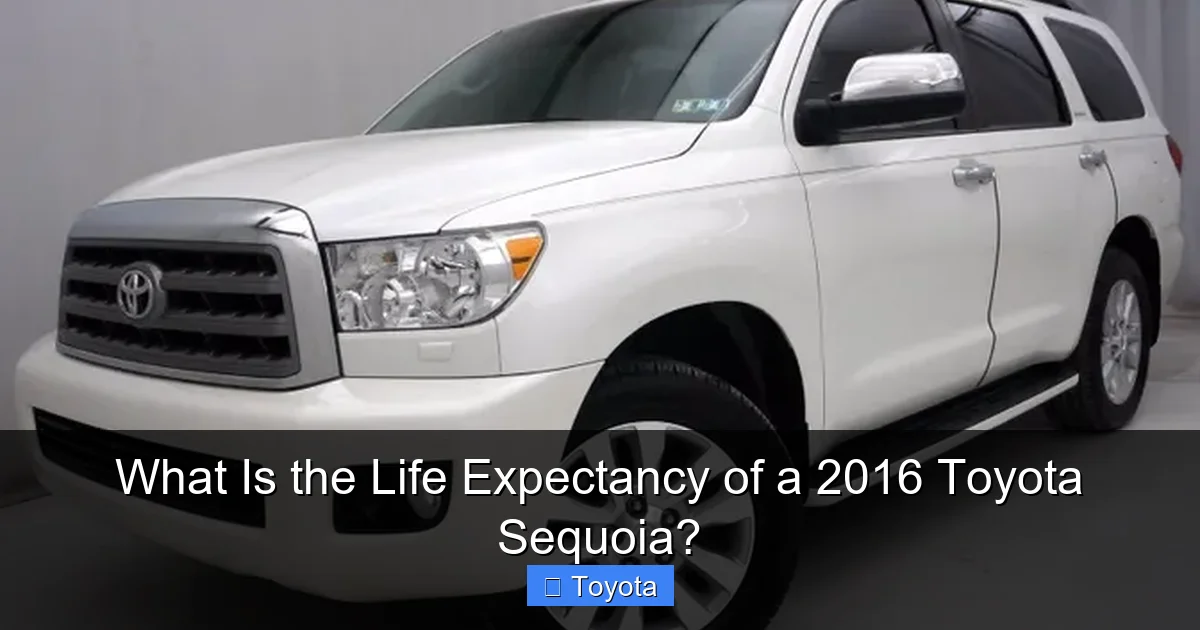
Before we dive into Sequoia specifics, we need to define our terms. “Life expectancy” isn’t a magic number from Toyota. It’s a practical estimate of how many miles and years a vehicle can provide reliable, cost-effective transportation before major component failures make repair uneconomical. For modern vehicles, this isn’t about the first check engine light. It’s about the big-ticket items: the engine, the transmission, the frame, and the core drivetrain. A vehicle with a “life expectancy” of 300,000 miles might need a new alternator at 120,000 and a set of struts at 180,000, but its heart—the engine and transmission—remains strong. The goalposts have moved dramatically in the last 20 years. Where 150,000 miles was once a benchmark for “high-mileage,” today’s well-maintained gasoline-powered trucks and SUVs routinely double that. The Sequoia is a prime example of this shift. Its life expectancy is a function of its innate mechanical robustness, the quality of its maintenance history, and its operating environment. A 2016 Sequoia garaged in Arizona and driven predominantly on highways will have a vastly different service ceiling than one used as a daily workhorse in a cold, salty Midwest town, even with identical maintenance records.
Visual guide about What Is the Life Expectancy of a 2016 Toyota Sequoia?
Image source: images.classic.com
The Mileage vs. Age Debate
This is a critical distinction. A 2016 vehicle is now 8 years old (as of 2024). Time itself is a factor. Rubber bushings dry out, seals harden, and plastic components become brittle regardless of mileage. A 2016 Sequoia with 80,000 miles might be in worse shape than one with 180,000 miles if the low-mileage example sat unused for years with old, degraded fluids. Conversely, a high-mileage example that has been consistently driven and maintained is often healthier. The Sequoia’s simple, overbuilt design tolerates high mileage better than complex, tightly-toleranced European engines. Its life expectancy is therefore more mileage-centric, but you must always weigh the “calendar life” of wear items against the odometer.
The 2016 Sequoia: A Foundation Forged in Truck DNA
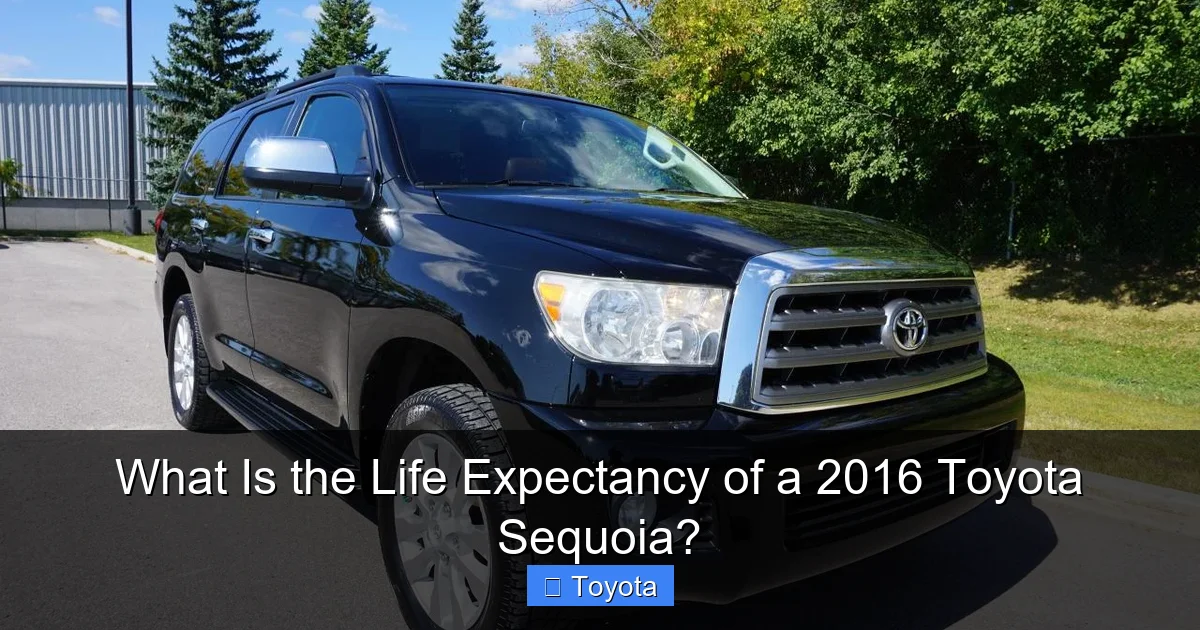
To understand its longevity, you must first understand its bones. The 2016 Sequoia is not a car-based crossover. It is a body-on-frame SUV, sharing its fundamental architecture with the Toyota Tundra full-size pickup. This is the cornerstone of its durability. Body-on-frame construction separates the passenger cabin from the structural and load-bearing elements. This design inherently resists the flex, twist, and eventual fatigue that unibody vehicles experience, especially under heavy loads or over rough terrain. It’s heavier and less fuel-efficient, but for a vehicle built to last decades and carry heavy cargo or trailers, it’s the superior engineering choice.
Visual guide about What Is the Life Expectancy of a 2016 Toyota Sequoia?
Image source: images.carpages.ca
Under the hood, the 2016 Sequoia is powered by the legendary 5.7-liter V8 engine (codenamed 3UR-FE). This is not a high-revving, peaky powerplant. It’s a low-compression, iron-block, torque-focused workhorse. It produces 381 horsepower and a substantial 401 lb.-ft. of torque. Its design philosophy prioritizes low-end grunt and reliability over ultimate efficiency. The iron block and cylinder heads are incredibly robust, capable of handling significant power increases with basic upgrades. The engine’s simplicity—fewer complex variable valve timing systems compared to some rivals—translates to fewer potential failure points. Paired with this engine is the proven 6-speed automatic transmission (Aisin SE61). While not the newest 8- or 10-speed unit, this transmission is known for its strength and simplicity. It’s a workhorse that, when maintained with regular fluid changes, is one of the most reliable automatic transmissions in the full-size SUV segment. The combination of this bulletproof V8 and this stout transmission is the Sequoia’s powertrain promise.
It’s also worth noting the luxury connection. The Sequoia shares its platform and many core components with the Lexus LX 570. This means the Sequoia benefits from engineering and refinement that was developed for a luxury flagship. The sound insulation, the interior material quality, and the overall build feel are a step above many of its American rivals. This “over-engineering” for the luxury market means the Sequoia’s core components are often built to a higher standard than the bare minimum required for its class.
Drivetrain and Chassis: Built for the Long Haul
The Sequoia’s part-time 4WD system (on 4WD models) is another study in simplicity. It uses a manually-engaged transfer case with a low-range gear for serious off-roading. There are no complex, computer-controlled multi-plate clutches that can be expensive to replace. The system is mechanical, robust, and reliable. The solid rear axle, while not offering the ride comfort of an independent setup, is incredibly strong and simple to repair. The entire undercarriage is designed for towing and abuse. This truck DNA is the Sequoia’s greatest asset for longevity. It’s designed to be a workhorse, and workhorses are built with redundancy and strength.
Real-World Evidence: What the High-Mileage Data Shows
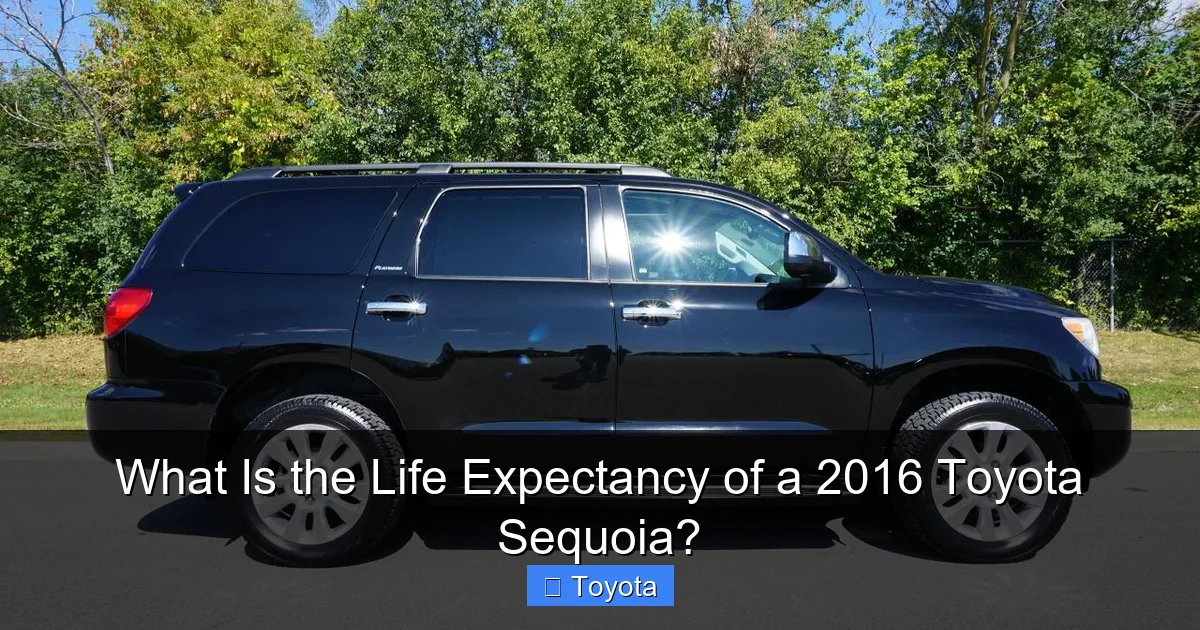
Manufacturer estimates are one thing, but the true test is the used market. Scouring owner forums like ToyotaNation, Sequoia-specific Facebook groups, and high-mileage vehicle databases reveals a consistent and compelling picture. It is genuinely common to find 2015-2017 Sequoias for sale with 250,000, 300,000, and even 400,000 miles on the clock. These are not anomalies; they are the rule for well-maintained examples. A quick search shows multiple listings for 2016 models with over 300,000 miles, often with clean titles and service histories.
Visual guide about What Is the Life Expectancy of a 2016 Toyota Sequoia?
Image source: images.carpages.ca
The most famous benchmark is the “300,000-mile club.” For the Sequoia (and Tundra), this is not an exclusive club; it’s a large, casual gathering. Owners routinely report needing only routine maintenance and wear-and-tear replacements (brakes, tires, suspension bushings, starters, alternators) to reach these milestones. The 5.7L V8, when serviced with high-quality oil at recommended intervals (often 5,000-7,500 miles for conventional oil, 10,000 for synthetic), shows minimal internal wear. The 6-speed transmission, with its fluid changed every 60,000-100,000 miles, is similarly resilient. The body on these vehicles is famously resistant to rust, especially in drier climates, meaning the structural integrity often outlasts the powertrain. This real-world evidence strongly suggests that a 2016 Sequoia, with a solid maintenance history, has a realistic life expectancy of 300,000 to 400,000 miles before a major powertrain rebuild or replacement becomes a consideration. Reaching 500,000+ miles is possible but requires exceptional care and a bit of luck with non-powertrain components.
The “Average” vs. The “Exceptional”
It’s crucial to separate the average from the exceptional. The average 2016 Sequoia on the road today will likely see 200,000-250,000 miles with moderate maintenance. This is still an outstanding figure. The exceptional examples—the ones with meticulous, documented service from day one, driven by owners who treat maintenance as an investment—are the ones pushing into the 400,000+ mile range. Your Sequoia’s destiny lies entirely in the hands of its maintenance record. A neglected Sequoia can become a money pit at 150,000 miles. A cherished one will feel like it’s just broken in at 250,000.
Critical Factors That Determine Your Sequoia’s Fate
So, what separates the 300,000-mile hero from the 150,000-mile problem child? It’s a combination of factors, most of which are within your control. Let’s break down the pillars of longevity.
1. Uncompromising Maintenance Discipline
This is the #1, 2, and 3 rule. Toyota’s maintenance schedule for the Sequoia is not a suggestion; it’s a blueprint for longevity. The most critical items are:
- Engine Oil & Filter: Every 5,000-7,500 miles with conventional oil, or 10,000 miles with full synthetic. Do not exceed. The 5.7L holds 6.6 quarts. Using a high-quality filter (Toyota OEM, Wix XP, Mobil 1) is as important as the oil itself.
- Transmission Fluid & Filter: This is arguably the most important service for automatic transmission longevity. Toyota’s “lifetime” fluid claim is widely disputed by mechanics and high-mileage owners. The consensus in the community is to change it every 60,000 to 80,000 miles. This is a non-negotiable service if you aim for 300k+ miles. Use only Toyota WS fluid.
- Differential Fluid (Front & Rear): Change every 60,000-100,000 miles. The differentials work hard, especially when towing. Old, contaminated fluid leads to premature wear and expensive failures.
- Timing Belt/Water Pump: The 5.7L V8 uses a timing belt, not a chain. This is a major service item. Toyota recommends replacement at 90,000 miles. Do not skip this. A timing belt failure on an interference engine like the 3UR-FE results in catastrophic engine damage. Often, the water pump, tensioner, and idler pulleys are replaced at the same time. This is a $1,000-$1,500 service that saves a $5,000+ engine.
- Cooling System: Hoses, thermostat, and radiator cap should be inspected regularly and replaced preventatively every 100,000 miles. A cooling system failure leads to overheating and engine destruction.
- Spark Plugs: Replace every 120,000 miles. The 5.7L uses 16 plugs. This is a large but necessary job.
A complete, documented service history is the single best predictor of a Sequoia’s remaining lifespan and its resale value.
2. Driving Habits and Usage Patterns
How you drive matters. The Sequoia’s engine loves to run at highway RPMs. Constantly lugging it at low RPMs under heavy load (like towing a max trailer in 6th gear) can cause carbon buildup and increase cylinder pressure. It’s designed to rev. Let it breathe. Frequent short trips where the engine never reaches full operating temperature are the enemy, leading to sludge formation in the oil and condensation in the exhaust. If your Sequoia is primarily a city commuter, try to get it on the highway for 20-30 minutes at least once a week. Towing is a major factor. The Sequoia is rated to tow up to 7,400 lbs (when properly equipped). Consistently towing near or at this maximum, especially in hot conditions or mountainous terrain, puts extreme stress on the transmission and engine. It accelerates wear. A Sequoia used for occasional towing of a boat or camper will last longer than one used as a daily heavy hauler.
3. Environment and Geography
Climate is a silent killer. In areas that use road salt (the “Salt Belt” in the Northeast and Midwest), corrosion is the primary enemy. While Toyota’s paint and rustproofing are good, they are not magic. Inspect the frame rails, brake lines, and body panels regularly. In extremely hot climates (Arizona, Nevada), rubber components (hoses, belts, seals) degrade faster due to UV exposure and heat cycling. In extremely cold climates, the increased strain on the starter and battery during winter starts can shorten their life. A garage-stored vehicle in a moderate climate like the Pacific Northwest has a significant longevity advantage.
4. The Quality of Repairs and Parts
When something breaks, how it’s fixed matters immensely. Using cheap, aftermarket parts—especially for critical components like engine mounts, suspension bushings, or transmission solenoids—will lead to repeated failures. Investing in OEM or high-quality aftermarket (e.g., Timken bearings, KYB struts) pays dividends in longevity. Similarly, the skill of the mechanic is paramount. A botched transmission fluid change (using the wrong fluid or not replacing the filter) can doom a healthy transmission in 20,000 miles. Find a reputable, Toyota-specialist independent shop or a dealer with a strong service department reputation. Your repair history is part of your maintenance history.
Known Issues and High-Mileage Concerns for the 2016 Model Year
No vehicle is perfect, and the Sequoia is no exception. However, its issues are generally well-understood, predictable, and inexpensive to address compared to the complex electronic failures or turbocharger problems that plague some rivals. For the 2016 model year, which is in the middle of the second generation’s production run, most “bugs” were worked out. The common concerns are typically age and wear-related, not design flaws.
Recalls and Common Complaints
It’s wise to check the NHTSA website for any open recalls on a specific VIN. For the 2016 Sequoia, past recalls have involved things like potential fuel pump issues or software updates for the stability control system. These are generally resolved at a dealer at no cost. The more relevant data comes from owner-reported common problems as mileage accumulates:
- Exhaust Manifold Cracks: This is a known issue on many 5.7L V8 Toyotas, including the Sequoia. The cast iron manifolds can develop cracks, leading to a ticking or tapping noise, especially when cold. It’s not a catastrophic failure but an annoying one. Repair involves replacing the manifold(s), which can be a labor-intensive job due to their location.
- Water Pump Failure: The 5.7L’s external water pump (driven by the timing belt) is a wear item. Failure leads to immediate overheating. This is why the timing belt/water pump service at 90,000 miles is so critical. Replacing it proactively is far cheaper than dealing with a warped head or blown head gasket from an overheating event.
- Spark Plug Blow-Out: While less common in the 3UR-FE than in some other Toyota V8s (like the 4.6L), there are reports of spark plugs ejecting from the cylinder head, causing major damage. This is often linked to improper torque during a previous plug change. Using a torque wrench and following the exact spec (13 ft-lbs for the 5.7L) is vital.
- Engine/Transmission Mounts: These rubber components wear out. Symptoms include harsh shifts, thuds when accelerating/braking, and visible engine movement. Replacement is straightforward and inexpensive for the longevity it restores.
- Oxygen (O2) Sensors: The downstream O2 sensors (after the catalytic converters) are known to fail around 150,000-200,000 miles, triggering a check engine light. While not urgent, they should be replaced to maintain fuel efficiency and pass emissions tests.
- Minor Electrical Gremlins: Things like failing door lock actuators, malfunctioning rear HVAC controls, or issues with the power rear gate are common age-related complaints. These are nuisances, not showstoppers, and are usually affordable to fix.
Notice what’s not on this list: widespread transmission failure, engine block cracking, or major drivetrain design flaws. The Sequoia’s problems are almost exclusively wear items, which is the hallmark of a mechanically sound platform.
How to Maximize Your 2016 Sequoia’s Lifespan: A Practical Guide
If you own a 2016 Sequoia, your mission is clear: treat it like the investment it is. Here is a actionable plan.
The Golden Maintenance Schedule
Create a spreadsheet or use a maintenance tracking app. Here is a prioritized checklist based on mileage intervals:
- Every 5,000-7,500 Miles: Oil & filter change. Check tire pressure and rotate tires.
- Every 15,000 Miles: Inspect all fluid levels (coolant, brake, power steering, windshield washer). Inspect belts and hoses.
- Every 30,000 Miles: Replace engine air filter. Inspect cabin air filter. Inspect brakes (pads, rotors, calipers).
- Every 60,000 Miles: Replace transmission fluid and filter (if serviceable). Replace differential fluid (front & rear). Replace spark plugs (if not done at 90k for timing belt). Replace fuel filter (if applicable).
- Every 90,000 Miles: Replace timing belt, water pump, tensioner, and idler pulleys. This is a major service. Budget for it.
- Every 100,000 Miles: Replace all engine and transmission mounts. Replace major coolant system components (hoses, thermostat, radiator cap). Replace brake fluid (hygroscopic, absorbs water).
- Every 120,000 Miles: Replace spark plugs (if not done with timing belt). Replace accessory drive belts.
Stick to this regimen religiously. Keep every receipt. A complete history is worth thousands at resale and is your best diagnostic tool.
Driving and Usage Best Practices
- Warm-Up Properly: After a cold start, drive gently for the first 1-2 minutes. Let the oil circulate fully before applying heavy load. No need to idle for 10 minutes.
- Cool Down After Heavy Use: If you’ve been towing or driving hard in the mountains, let the engine idle for 30-60 seconds before shutting off. This allows turbo (if equipped on some markets) and turbocharger oil to circulate and cool, preventing coking. (Note: The US-spec 5.7L is naturally aspirated, but this is still good practice for the exhaust and turbo on some international models).
- Use the Correct Fuel: The manual recommends 87 octane. Using premium offers no benefit and is a waste of money unless you experience engine knock (unlikely).
- Don’t Ignore Noises: A new rattle, hum, or clunk is a message. Get it diagnosed immediately. A small problem ignored becomes a large, expensive problem.
- Keep It Clean: Wash the undercarriage regularly, especially in winter if you drive on salted roads. This prevents corrosion on vital components.
When to Be Proactive
At 150,000 miles, start budgeting for the “age-related refresh.” This includes:
- All suspension bushings (control arm, trailing arm, sway bar links). Polyurethane bushings offer longer life but more noise.
- Engine and transmission mounts.
- Starter and alternator (they are serviceable and will eventually fail).
- Complete brake system overhaul (calipers, hoses, master cylinder).
- Major coolant system overhaul.
Doing these items proactively, as a package, is often cheaper than waiting for each component to fail individually and cause collateral damage (e.g., a failed bushing destroying a tire or control arm).
The Sequoia vs. The Competition: A Longevity Showdown
How does the Sequoia stack up against its primary rivals in the full-size SUV arena? The main competitors are the Chevrolet Tahoe/Suburban and the Ford Expedition. This comparison is essential for context.
The Chevrolet Tahoe/Suburban (GMT K2XX platform, 2015-2020) uses a reliable 5.3L or 6.2L V8 and a 6-speed or 8-speed transmission. Their construction is also body-on-frame. They are very durable vehicles. However, the general consensus among mechanics and high-mileage owners is that the Sequoia edges them out in long-term reliability. The Tahoe’s 5.3L V8 has known issues with active fuel management (AFM) systems leading to lifter and camshaft wear at higher mileages if oil changes are neglected. The 6-speed transmission in the 2015-2017 models is also considered less robust than Toyota’s Aisin unit. The Sequoia’s simpler, non-AFM engine (the 5.7L uses a different VVT-i system without the problematic cylinder deactivation of the 5.3L at that time) and bulletproof transmission give it a slight but meaningful advantage in the 300k+ mile pursuit.
The Ford Expedition (2018+ is the current generation, but the 2016 is the previous generation based on the T1 platform) uses a powerful 3.5L EcoBoost V6 twin-turbo engine. While incredibly potent, turbocharged engines introduce more complexity and potential failure points (turbochargers, high-pressure fuel pumps, intercoolers) than a naturally aspirated V8. The 6R80 transmission is robust but has its own set of known solenoid and torque converter issues. The Expedition is a fantastic, comfortable SUV, but for sheer, no-nonsense, high-mileage durability, the Sequoia’s naturally aspirated V8 and simpler drivetrain are generally viewed as the more reliable long-term bet. You can also compare towing capacities; the Sequoia’s 7,400 lbs is competitive, but rivals like the Nissan Frontier (a pickup, not an SUV) or even the Subaru Forester (a much smaller crossover) offer different profiles. The Sequoia’s towing capacity is in a sweet spot for its class, and its platform is designed for it.
The Sequoia’s main “competition” for longevity might actually be its sibling, the Toyota Tundra. They share almost everything. The life expectancy is identical. Your choice between them is purely about body style and interior layout.
The Verdict: Is a High-Mileage 2016 Sequoia a Smart Buy?
Let’s bring it all home. You’re considering a 2016 Toyota Sequoia with, say, 180,000 miles on it. Should you buy it? The answer is a qualified, enthusiastic yes, with one massive condition: maintenance history.
If the vehicle has a complete, consistent service record from a reputable shop or dealer, showing timely oil changes, transmission fluid services, and the 90,000-mile timing belt/water pump service (and possibly a second one around 180,000 if it was done on time), then it is likely in the prime of its life. The major wear items (timing belt, major fluids) have been addressed. The engine and transmission are likely in excellent health. You are buying a vehicle that has already proven its reliability and has many more miles to give. The price will reflect its high mileage, offering tremendous value. You can drive it for another 5-10 years with predictable maintenance costs.
If the history is spotty, missing, or non-existent, walk away. A 2016 Sequoia with 180,000 miles and no records is a gamble. The previous owner may have neglected the transmission fluid. The timing belt could be original and on borrowed time. You could be buying a $20,000 project. Always, always get a pre-purchase inspection by a trusted, Toyota-savvy mechanic. They can check for signs of neglect, scan for codes, and assess the condition of the belts, fluids, and suspension.
The 2016 Toyota Sequoia is not the most fuel-efficient, the most tech-laden, or the most comfortable full-size SUV. But if your priority is a trustworthy, spacious, capable vehicle that will not strand you and will cost relatively little to keep on the road for 15 more years, it is arguably the best used SUV on the market. Its life expectancy is not a guess; it’s a proven track record written in miles by thousands of owners. Your job is to find one that has been cared for and then continue that legacy of care. Treat it right, and it will reward you with a million smiles and miles.
Frequently Asked Questions
What is the realistic mileage I can expect from a 2016 Toyota Sequoia?
With diligent maintenance, a 2016 Sequoia can reliably reach 300,000 to 400,000 miles. The powertrain (5.7L V8 and 6-speed transmission) is exceptionally robust, but reaching these milestones requires strict adherence to service intervals, especially for transmission fluid and the timing belt/water pump.
What are the most common problems as these Sequoias age?
The most frequent issues are wear-related, not design flaws. Expect to replace exhaust manifolds (cracking), engine/transmission mounts, oxygen sensors, and suspension bushings around 150,000-200,000 miles. The critical timing belt/water pump must be replaced at 90,000-mile intervals to prevent engine destruction.
Is maintenance on a high-mileage Sequoia expensive?
While individual services like a timing belt replacement ($1,000-$1,500) are significant, the cost per mile is very low. Major powertrain failures are rare. Most expenses are for predictable wear items (brakes, suspension, mounts), which are affordable compared to the cost of a new vehicle. A well-maintained high-miler is often cheaper to own than financing a new SUV.
How does the 2016 Sequoia’s longevity compare to a Chevrolet Tahoe or Ford Expedition from the same era?
The Sequoia generally has an edge. The Tahoe’s 5.3L V8 can suffer from AFM-related lifter wear if oil changes are missed. The Expedition’s EcoBoost V6 introduces turbo complexity. The Sequoia’s naturally aspirated V8 and simpler, proven Aisin transmission are viewed by many mechanics as the most reliable long-term platform in this segment.
What is the towing capacity of a 2016 Toyota Sequoia?
The properly equipped 2016 Sequoia has a maximum towing capacity of 7,400 pounds. This is a strong figure for its class, thanks to its powerful V8 and robust frame. Consistent max-weight towing will accelerate wear on the transmission and engine, so it’s important to follow severe service maintenance intervals if used this way. You can compare this to other vehicles’ capacities, like the Toyota RAV4, which is much lower due to its smaller size and different design purpose.
Should I buy a 2016 Sequoia with over 200,000 miles?
Only if it has a comprehensive, consistent service history proving all major services were done on time. A 200k+ mile Sequoia with full records is likely a fantastic value and has many miles left. A similar example with no records is a major risk, as critical services like transmission fluid changes and timing belt replacement may have been neglected. Always get a pre-purchase inspection.
