

Are Infiniti Parts Expensive

Infiniti parts are generally more expensive than those for standard Nissan models due to their luxury branding, higher-quality materials, and advanced technology. While genuine OEM (Original Equipment Manufacturer) parts carry a premium, robust aftermarket and used markets offer significant savings. Understanding the cost drivers and exploring all purchasing options—including Nissan dealership servicing—can help you manage ownership costs effectively without compromising quality.
Key Takeaways
- Luxury Brand Premium: Infiniti, as Nissan’s luxury division, uses higher-grade materials, tighter tolerances, and more sophisticated engineering, which inherently increases part costs compared to mainstream brands.
- OEM vs. Aftermarket: Genuine Infiniti OEM parts are the most expensive but guarantee perfect fit and warranty coverage. Quality aftermarket parts from reputable brands can offer 30-50% savings with comparable reliability for many components.
- Shared Nissan Architecture: Many core mechanical parts (engines, transmissions, suspension components) are shared with Nissans. You can often use genuine Nissan parts for non-logo-stamped items, leading to major savings—a key reason why a Nissan dealer can service an Infiniti cost-effectively.
- Maintenance is Key: Proactive maintenance using the correct fluids and quality parts (even aftermarket) prevents catastrophic failures of expensive systems like turbochargers or advanced suspensions, protecting your long-term budget.
- Long-Term Value: While parts are costly, Infiniti’s reputation for reliability and the durability of its powertrains mean major component failures are less frequent than in some European luxury rivals, balancing the higher routine maintenance costs over time.
📑 Table of Contents
- Are Infiniti Parts Expensive? The Straight Answer
- Breaking Down the Cost: OEM, Aftermarket, and Used
- The Nissan Parts Shortcut: Your Secret Weapon
- Category-Specific Costs: What to Really Expect
- The Long-Term Value Equation: Is It Worth It?
- Smart Strategies for the Infiniti Owner: Saving Money Without Cutting Corners
- Conclusion: The Infiniti Parts Reality Check
Are Infiniti Parts Expensive? The Straight Answer
Yes, as a general rule, Infiniti parts are more expensive than those for your average commuter car. If you’re asking this question, you’re likely a current or prospective Infiniti owner doing your homework, and that’s a smart move. The short answer is that Infiniti is a luxury brand, and luxury comes with a price tag that extends beyond the showroom and into the repair shop. But the story is more nuanced than a simple yes or no. The cost isn’t uniform across all parts, and there are absolutely strategies to manage these costs without sacrificing your vehicle’s performance or longevity. Let’s break it down, piece by piece.
The “Luxury Tax” on Every Component
When you buy an Infiniti, you’re paying for a premium experience: superior interior materials, advanced noise cancellation, more powerful and refined engines, and cutting-edge technology like their intelligent ALL-WHEEL CONTROL or hydraulic body motion systems. Every one of those features relies on parts that are engineered to a higher standard. A brake pad on an Infiniti Q50 isn’t the same as one on a Nissan Altima, even if they share a platform. The Infiniti part is designed for higher speeds, more aggressive braking regimes, and quieter operation. The materials (ceramic composites, specialized friction formulations) and the R&D behind them cost more. This “luxury tax” is baked into virtually every component, from the intricate sensors in the INFINITI QX60’s ProPILOT Assist system to the dual-turbochargers on the Q50 Red Sport 400.
It’s Not All Bad News: The Nissan Connection
Here’s the most important piece of context: Infiniti is Nissan’s luxury division. This isn’t just a marketing relationship; it’s an engineering one. Many core mechanical architectures—the engine blocks, transmission casings, basic suspension knuckles, and chassis components—are shared with Nissan models. For example, the 3.5L V6 VQ-series engine in the older Infiniti G35 and Nissan Maxima is fundamentally the same powerplant. This means that for a huge swath of “hard parts” that don’t bear the Infiniti logo, you can often buy a genuine Nissan part at a Nissan price. This is a massive opportunity for savings. A control arm, a wheel bearing, a starter motor—these are often identical. Knowing which parts are shared and which are Infiniti-specific is the first secret to controlling your repair bills.
Breaking Down the Cost: OEM, Aftermarket, and Used
To understand if parts are “expensive,” you need to compare them to the available alternatives. The Infiniti parts market isn’t a monolith; it has distinct tiers.
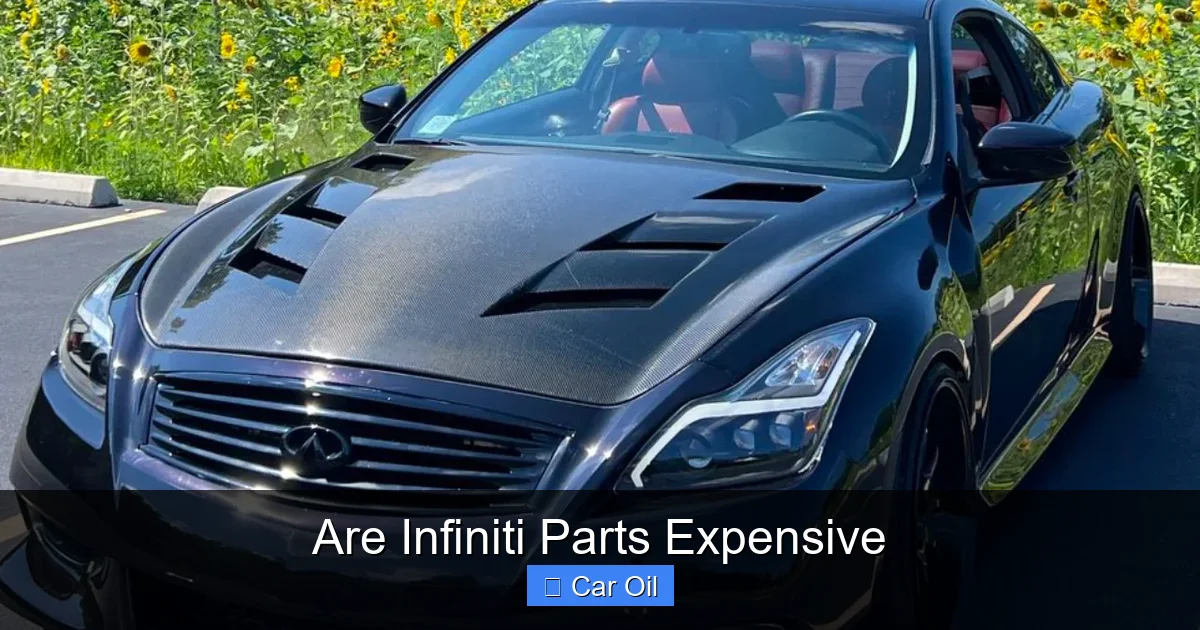
Visual guide about Are Infiniti Parts Expensive
Image source: mrinfinitiparts.com
Genuine Infiniti OEM Parts: The Gold Standard Price
OEM (Original Equipment Manufacturer) parts are the parts that bear the Infiniti logo and come in the official Infiniti parts box. They are manufactured to the exact specifications used on the assembly line. For complex, electronically controlled systems, safety components (like airbags), or parts where precise fit and finish are critical (like body panels or interior trim), OEM is the safest and often the only warranty-compliant choice. The price here is non-negotiable; you’re paying for the brand, the guarantee of compatibility, and the peace of mind that comes with a factory part. A genuine Infiniti OEM alternator might cost $800-$1,200, while a high-quality aftermarket equivalent could be $400-$700.
High-Quality Aftermarket: The Smart Savings Play
The aftermarket is a vast ecosystem. It ranges from cheap, no-name parts to premium brands that actually supply components to Nissan/Infiniti’s own factories (these are called “Tier 1” suppliers). Brands like Bosch, DENSO, Aisin, Meyle, and Febi Bilstein are renowned for their quality and often make parts that are superior to the OEM version in terms of material quality or design enhancements. For wear-and-tear items like brake pads/rotors, spark plugs, oil filters, wiper blades, and even suspension bushings, buying from a top-tier aftermarket brand is a brilliant way to save 30-50% without compromising performance. You must do your research, read reviews, and stick to reputable brands. For complex sensor modules or modules with software integration, aftermarket can be riskier.
Used and Remanufactured: The Budget Frontier
For very expensive, long-life components like engines, transmissions, or turbochargers, the used and remanufactured markets are thriving. A remanufactured transmission from a specialist like Jasper or Monster will come with a solid warranty and cost a fraction of a new Infiniti OEM unit. Used parts from a reputable salvage yard (like those certified through the Infiniti/Nissan network) can be an even cheaper option, but carry more risk regarding unknown wear history. This path requires more mechanical knowledge or a trusted installer.
The Nissan Parts Shortcut: Your Secret Weapon
This is the single most important strategy for an Infiniti owner. Because of the deep mechanical sharing, a staggering number of parts are sold under the Nissan part number but are physically identical to the Infiniti part. The difference? The price tag and the branding on the box.
Visual guide about Are Infiniti Parts Expensive
Image source: 10pcg.com
How to Identify Shared Parts
You cannot assume every part is shared. The rule of thumb is: if the part is related to the core mechanical operation of the car and doesn’t involve Infiniti-specific styling, badging, or tuning, it’s a candidate. Here are concrete examples where you should always check the Nissan part:
- Engine Internals: Gaskets, seals, timing chains, water pumps, oil pumps.
- Drivetrain: Clutch kits (manual), differential seals, axles (if not styled), transmission mounts.
- Suspension & Steering: Control arms, tie rod ends, ball joints, wheel bearings, struts/shocks (many are shared), sway bar links.
- Brakes (Non-Red Sport): Standard brake calipers, rotors, and pads on most models are often shared with the equivalent Nissan. The high-performance brakes on the Q50 Red Sport or Q60 Red Sport are usually unique.
- Cooling System: Radiators, thermostats, coolant reservoirs, hoses.
- Exhaust (Manifold to Mid-Pipe): The catalytic converters are often unique, but the manifold gaskets and mid-pipe sections may be shared.
The Practical Process: A Step-by-Step Guide
1. Identify Your Infiniti’s Chassis and Engine Code. Know your exact model year and trim (e.g., 2018 Infiniti Q50 3.0t). Also, find your VIN. The 10th character often denotes the platform.
2. Find the Infiniti Part Number. Use an Infiniti parts catalog website or your dealer’s parts department to get the official Infiniti part number for the component you need.
3. Cross-Reference with Nissan. Take that Infiniti part number and plug it into a Nissan parts catalog for the equivalent Nissan model from the same year (e.g., a 2018 Nissan Maxima or 370Z, depending on platform). Often, the Nissan part number will be identical or have a very similar suffix. You can also call a Nissan parts department, give them the Infiniti part number, and ask if there’s a Nissan equivalent. They have sophisticated cross-reference tools.
4. Price Compare. Once you have the Nissan part number, price it at a Nissan dealer, an online Nissan parts retailer, and an Infiniti dealer. The savings can be dramatic. For a $250 Infiniti-branded engine mount, you might find the Nissan version for $120.
5. Verify Physical Fitment. Before buying, if possible, compare the old part side-by-side with the Nissan version or look for online forums where owners have documented the swap. The community knowledge is invaluable here.
This process turns a potentially $1,000 repair into a $400 repair. It’s a game-changer.
Category-Specific Costs: What to Really Expect
Let’s get specific. Here’s a look at typical cost ranges for common services and parts, comparing Infiniti OEM to potential alternative pricing.
Routine Maintenance: Oil, Filters, Fluids
This is where you have the most flexibility and the biggest savings. Infiniti-specific oil filters are priced at a premium. However, high-quality aftermarket filters from brands like Mobil 1, WIX, or K&N are perfectly suitable and cost less. The same goes for air filters, cabin filters, and wiper blades. Even engine oil: while Infiniti recommends their branded oil, any full synthetic that meets the specified Nissan/Infiniti standard (e.g., NS-2 for newer models) will work. An Infiniti OEM oil filter might be $15-$20; a premium aftermarket one is $8-$12. For a professional Infiniti oil change at a dealer, you’re looking at $120-$180. Doing it yourself with aftermarket parts and a good synthetic oil drops to $50-$70. Using a Nissan dealer for the same service (they can do it) might be $90-$130. You can learn more about the specific costs in our detailed guide on how much an Infiniti oil change costs.
Brake System: Pads, Rotors, Calipers
Brake components are a major cost center. Infiniti OEM pads and rotors are expensive, especially on larger wheel models or performance trims. For standard models, the sharing with Nissan is common. A set of front OEM pads/rotors might be $600-$900 installed. A set of high-quality aftermarket pads (like Akebono, Power Stop) and rotors could be $300-$500 installed. Calipers are another story. If you need a replacement caliper, an Infiniti OEM unit is pricey. A remanufactured caliper from a trusted brand (like Cardone) is a fantastic cost-saving alternative and often comes with a new piston and hardware.
Suspension & Steering: The Wear-and-Tear Zone
These are classic wear items where the Nissan parts shortcut shines. A single Infiniti OEM front control arm might be $350-$500. The Nissan equivalent could be $180-$250. Wheel bearings, struts, and sway bar links follow the same pattern. For a full set of four quality aftermarket struts (like KYB or Bilstein), you might spend $500-$800 installed, versus $1,200-$1,800 for Infiniti OEM. This is a category where skipping the Infiniti logo provides the most dramatic and risk-free savings.
Electronics & Sensors: The Tricky Territory
This is where costs can skyrocket and alternatives are limited. A faulty Infiniti-specific sensor for the Around View Monitor, a steering angle sensor for the stability control, or a module for the adaptive cruise control will almost certainly require an Infiniti OEM part. There is little to no aftermarket for these proprietary components. Programming and calibration at the dealer may also be required, adding $150-$400 to the part cost. A simple oxygen sensor might be shared with Nissan and have great aftermarket options. A complex radar module for ProPILOT will not. This is where your Infiniti’s advanced tech can hurt the wallet.
The Long-Term Value Equation: Is It Worth It?
So, parts are expensive. Does that mean an Infiniti is an expensive car to own? Not necessarily. You have to look at the total cost of ownership over 5-10 years.
Reliability as a Cost Mitigator
Infiniti, particularly its VQ-series V6 and VQ-based V6 engines (pre-2019), has a stellar reputation for mechanical reliability. These are not finicky, high-strung European engines. They are robust, overbuilt, and can easily surpass 250,000 miles with basic upkeep. This means the probability of a $5,000 engine or transmission failure is statistically low. Compare this to some turbocharged European luxury engines where major failures before 150,000 miles are more common. Your higher routine maintenance costs (brakes, fluids, suspension) are buying you a lower risk of a catastrophic, wallet-destroying event. Infiniti’s core powertrain is its financial saving grace.
Depreciation and Resale Impact
Luxury cars depreciate faster than mainstream ones. However, a well-maintained Infiniti with a complete service history using quality parts (even if aftermarket) will hold its value better than one with neglected maintenance or questionable repairs. Using the correct Nissan-shared parts and keeping all receipts proves diligent ownership. It doesn’t hurt that Infiniti’s design language ages gracefully. Your investment in proper parts pays off at trade-in time.
Comparing to the Competition: Lexus and Acura
How do Infiniti part costs stack up against its direct Japanese luxury rivals? Lexus, Toyota’s luxury brand, is often cited as having the most expensive parts due to its even more rigorous quality standards and sometimes more unique engineering. Acura, Honda’s luxury brand, tends to have more affordable parts because of its deeper integration with Honda’s parts bin and a slightly less “ultra-luxury” positioning. So, while Infiniti parts are costly, they are typically not the most expensive in the segment. For a deeper dive into this comparison, you might find our article on are Lexus parts expensive insightful, as it highlights the similar premium pricing structures in the luxury space.
Smart Strategies for the Infiniti Owner: Saving Money Without Cutting Corners
Armed with knowledge, you can be a savvy owner. Here is your actionable playbook.
1. Build a Relationship with an Independent Infiniti/Nissan Specialist
This is your #1 recommendation. Avoid the dealer for everything except warranty work and complex computer diagnostics. Find an independent shop that specifically states they work on Infiniti and Nissan. These mechanics know the Nissan-sharing secret inside and out. They will recommend the Nissan part for the control arm without you even asking. They have relationships with parts suppliers who sell both OEM and premium aftermarket. They charge 30-50% less in labor. This single decision will save you thousands over your ownership period.
2. Become a Parts Detective
Take 30 minutes when you buy the car to research the major shared systems. Join Infiniti forums (like InfinitiG35.com or specific model forums). Search for “[Your Model Year] [Your Model] shared Nissan parts” or “Nissan part number for Infiniti [part name].” Create a small spreadsheet of common parts and their Nissan equivalents. This empowers you at the counter.
3. Source Your Own Parts
When you have a repair done, ask the shop if you can provide the parts. Most reputable independent shops will agree, often offering a slight labor discount. Then, source the part yourself. Buy the Nissan part from an online Nissan OEM parts retailer (often cheaper than the dealer). Or, buy a premium aftermarket part from RockAuto, PartsGeek, or a brand’s direct website. This eliminates the shop’s parts markup, which can be 20-40%.
4. Consider Remanufactured for Big Tickets
For an alternator, starter, power steering pump, or transmission, always get a quote for a remanufactured unit from a national rebuilder (Jasper, CARDONE, Raxles). These come with excellent warranties (often 3-year/unlimited mileage) and are built to a high standard. They are almost always a better value than a used part and far cheaper than new OEM.
5. Don’t Neglect the Simple Stuff
The most expensive repair is the one you could have prevented. Stick to a strict maintenance schedule using the correct fluids. Use high-quality oil and filters. Replace spark plugs on time (a common question is about cost, and why some brands’ spark plugs are so expensive often relates to design complexity—Infiniti’s are typically accessible and reasonably priced). Address small leaks, replace worn bushings before they destroy other components, and keep your cooling system in perfect shape. This prevents a $200 coolant leak from turning into a $3,000 head gasket job.
Conclusion: The Infiniti Parts Reality Check
So, are Infiniti parts expensive? The unvarnished truth is yes, if you walk into an Infiniti dealership and buy a box stamped with the Infiniti logo for everything, you will pay a luxury premium. However, that is a choice, not a necessity. The deep engineering synergy with Nissan is your escape hatch. By understanding which parts are shared and having the confidence to use Nissan OEM or premium aftermarket equivalents for the vast majority of mechanical components, you can bring your real-world parts costs much closer to mainstream brand levels.
The expensive parts are the Infiniti-specific electronics and modules. There is no workaround there; you pay the premium or find a reputable used unit. But these failures are less common than worn brakes or suspension bushings. Your strategy should be: use the Nissan shortcut for 80% of repairs, budget for the 20% that are Infiniti-exclusive, and build a relationship with a trusted independent mechanic who knows the platform better than anyone. This approach allows you to enjoy the superb driving dynamics, comfort, and reliability of your Infiniti without the financial anxiety that plagues owners of some other luxury marques. It turns the question from “Are Infiniti parts expensive?” into “How smartly can I manage Infiniti maintenance costs?” The answer to the second question is: very smartly, indeed.
Frequently Asked Questions
Are Infiniti parts more expensive than Nissan parts?
Yes, for the same physical part, the Infiniti-branded version is almost always more expensive than the Nissan-branded equivalent due to the luxury brand premium. This is why identifying shared parts and using Nissan part numbers is a primary money-saving strategy.
Can I use Nissan parts on my Infiniti?
For many core mechanical parts (engine, transmission, suspension, cooling), yes, the Nissan part is physically identical. However, for Infiniti-specific items like body panels, interior trim, badging, and advanced electronic modules, you must use the Infiniti OEM part. Always verify fitment before purchasing.
What are the most expensive Infiniti parts to replace?
The most costly replacements are typically Infiniti-specific electronic modules (ADAS sensors, infotainment units), turbochargers on turbocharged models, and complex components of the advanced suspension systems (like the hydraulic actuators on some Q50/Q60 models). Major engine or transmission rebuilds are also very expensive.
How much can I save by using aftermarket parts?
For wear-and-tear items like brakes, suspension, and filters, you can save 30-50% by using high-quality aftermarket parts from reputable brands compared to Infiniti OEM. For major components like remanufactured alternators or transmissions, savings of 40-60% are common.
Do all Infiniti models have the same parts cost?
No. Models with more advanced technology (like ProPILOT Assist, active suspension), larger engines, or performance packages (Red Sport 400) will have more unique and expensive parts. A base-model Infiniti Q50 will generally be cheaper to maintain than a top-trim Q50 Red Sport.
Is it worth buying an extended warranty for an Infiniti?
It can be, especially for models with complex turbocharged engines or advanced driver-aid systems. An extended warranty can cap your exposure to the high cost of those Infiniti-specific electronic and turbo failures. Carefully evaluate the warranty cost versus the potential repair costs for your specific model’s known weak points.
