
Who Makes Kia Oil Filters?

Kia doesn’t manufacture its own oil filters. The company partners with established, global automotive filtration specialists to produce its OEM filters. Primary suppliers include Mann+Hummel, Mahle, and Hyundai Mobis. Understanding who makes your Kia’s oil filter helps you make informed choices between genuine OEM parts and high-quality aftermarket alternatives, ensuring your engine gets the protection it deserves. Always verify part numbers and buy from reputable sources to avoid counterfeits.
You’re standing in the auto parts aisle, staring at a wall of oil filters. One package says “Genuine Kia Parts.” Another says “OEM Replacement.” A third just has a brand name you recognize. A question bubbles up: Who actually makes the oil filter that goes into my Kia? It’s a fantastic question, and the answer is more interesting than you might think. It gets to the very heart of how modern car manufacturing works. Kia, like virtually every other major automaker on the planet, does not typically own and operate the factories that produce its consumable parts like oil filters, wiper blades, or spark plugs. Instead, they partner with world-class specialists. Understanding this supply chain is your first step toward becoming a savvier car owner who can truly protect their engine. Let’s pull back the curtain and see exactly who is behind that Kia-branded filter on your shelf.
Key Takeaways
- Kia outsources filter production: Like most automakers, Kia does not make its own oil filters. They are engineered to Kia’s strict specifications but manufactured by specialist filtration companies.
- Primary OEM suppliers are Mann+Hummel, Mahle, and Hyundai Mobis: These are the most common manufacturers for genuine Kia-branded oil filters, known for their high-quality media and construction.
- “Genuine Kia” means Kia-spec, not Kia-made: A filter purchased from a Kia dealership with Kia branding is an OEM part made by one of their certified partners, meeting all original factory standards.
- High-quality aftermarket filters are often made by the same OEM suppliers: Many premium aftermarket brands (like Fram, Wix, Mobil 1) source filters from the same factories, offering similar performance at a lower price.
- Never assume all filters are equal: Filtration media quality, anti-drainback valves, and construction vary widely. Using a poor-quality filter can lead to accelerated engine wear, even with perfect oil.
- Part number is king for compatibility: Always use the correct Kia part number or a reputable aftermarket cross-reference number to ensure perfect fit and function for your specific engine.
- Beware of counterfeit filters: The market is flooded with fake “genuine” filters. Buy from authorized Kia dealers, major auto parts stores, or highly reputable online retailers to avoid dangerous imitations.
📑 Table of Contents
- The OEM Supply Chain: Kia’s Filter Manufacturing Partners
- Aftermarket Oil Filters: The Same Factories, Different Labels
- How to Decode the Label: Identifying a Genuine Kia Oil Filter
- The Real Difference: Why Filter Quality Matters More Than the Logo
- Practical Advice: Choosing and Changing Your Kia’s Oil Filter
- Conclusion: Knowledge is Engine Protection
The OEM Supply Chain: Kia’s Filter Manufacturing Partners
When you buy a “Genuine Kia” oil filter from a dealership, you’re buying a part that was made to Kia’s exact engineering specifications. However, the physical creation of that filter—the stamping of the metal can, the pleating of the filter media, the assembly of the relief valve—was almost certainly done by one of a handful of global filtration powerhouses. These companies are the unsung heroes of the automotive world, specializing in the science of keeping fluids clean.
Who Are the Main Players? Mann+Hummel, Mahle, and Hyundai Mobis
Through industry reports, supplier announcements, and part number decryption, three names consistently emerge as the primary manufacturers for Kia’s OEM oil filters:
- Mann+Hummel: A German-based global leader in filtration. They are one of the largest and most respected names in the business, supplying filters to dozens of OEMs worldwide. Their technology is top-tier, and their manufacturing quality control is exceptionally rigorous. If you have a Kia, chances is high your genuine filter came from a Mann+Hummel facility.
- Mahle: Another German engineering giant, Mahle is a direct competitor to Mann+Hummel. They are a massive supplier to the automotive industry, not just for filters but for engine components, pistons, and more. Mahle’s filter media technology is renowned.
- Hyundai Mobis: This is the parts and service arm of the Hyundai Motor Group, of which Kia is a subsidiary. For many Kia and Hyundai vehicles, especially those sharing platforms and engines, Hyundai Mobis is the direct supplier. This makes perfect logistical and corporate sense. A filter from Hyundai Mobis is, for all intents and purposes, a genuine part sourced from within the corporate family.
So, when you buy a Kia-branded filter, you are very likely buying a Mann+Hummel, Mahle, or Hyundai Mobis product with a Kia logo and part number stamped on it. The engineering collaboration is deep; Kia’s engineers work with these suppliers during vehicle development to design a filter that meets the specific demands of their engines—whether it’s handling the high temperatures of a turbocharged Theta II engine or the extended drain intervals recommended for newer models.
Why Does Kia Outsource This? Focus on Core Competencies
The reason is simple: economics and expertise. Building a state-of-the-art filtration manufacturing plant, staffing it with materials scientists and process engineers, and maintaining the complex supply chain for filter media (which is a specialized product in itself) is a monumental task. For an automaker like Kia, the core competency is designing, engineering, and assembling vehicles. It is far more efficient to contract the specialist who already has the global scale, cutting-edge R&D, and production expertise to make a component that meets their precise standards. This model allows Kia to benefit from the best available filtration technology without the colossal capital investment of building that capability from scratch.
Aftermarket Oil Filters: The Same Factories, Different Labels
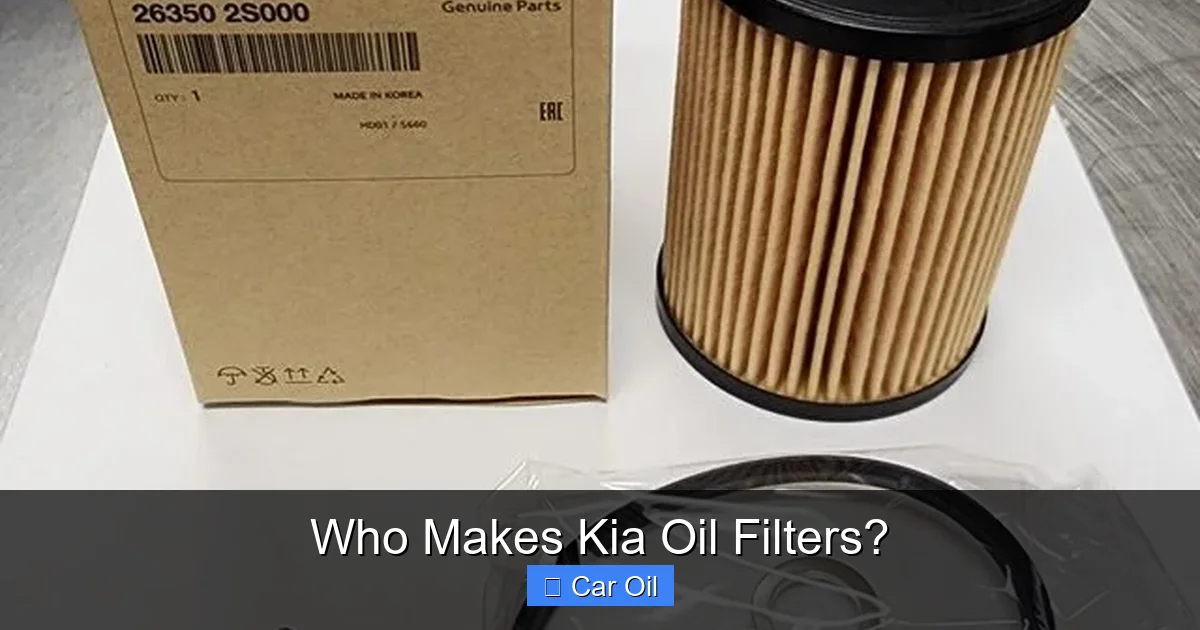
Here’s where it gets really useful for you, the consumer. Those same OEM suppliers—Mann+Hummel, Mahle, and Hyundai Mobis—don’t just supply filters to automakers. They also sell their products on the open aftermarket, often under their own brand names or as private-label products for major retailers.
Visual guide about Who Makes Kia Oil Filters?
Image source: cdn.revolutionparts.io
Premium Aftermarket Brands: Often the OEM Source
When you pick up a filter from a brand like Fram (specifically their “Ultra” or “Tough” lines), Wix, Mobil 1, Purolator, or Royal Purple, you are very likely getting a filter manufactured by one of the same companies that makes the genuine Kia part. These brands have their own engineering teams and specifications, but they frequently source manufacturing from the global giants. They may use a slightly different filter media formulation or a different valve design, but the base construction and quality level can be identical to or even exceed the OEM standard. For example, a high-end Fram filter might use a more advanced synthetic media blend than the standard OEM filter for the same engine. This is the “sweet spot” for many DIYers: a high-quality, often better-than-OEM filter for less money than the dealership part.
Budget Aftermarket Brands: The Wild West
The other end of the spectrum is the world of ultra-budget filters. These are the $3-$5 filters you might find at a discount store or online marketplace of questionable repute. These are not made by Mann+Hummel or Mahle. They are typically manufactured by unknown, often overseas, factories with minimal quality control. The filter media may be less dense, allowing more abrasive particles to pass through. The metal can may be thinner and more prone to collapse under oil pressure surge. The anti-drainback valve may be a cheap rubber flap instead of a reliable silicone valve. Using one of these is a false economy. You might save $5 on the filter but risk thousands in engine repair due to inadequate filtration. It’s critical to remember that the oil filter is the only line of defense between the abrasive, microscopic metal particles in your crankcase and the precision-machined surfaces of your engine’s bearings, cam lobes, and cylinder walls.
How to Decode the Label: Identifying a Genuine Kia Oil Filter
If you want a genuine Kia filter, you need to know what to look for. Counterfeit filters are a serious problem, especially on online marketplaces. They will have a Kia logo, but they are dangerous fakes.
Visual guide about Who Makes Kia Oil Filters?
Image source: partsavatar.ca
Part Numbers Are Your Best Friend
The single most reliable identifier is the Kia part number. Every genuine filter has one. For example, a common part number for many Kia/Hyundai 2.4L and 2.0L engines is 26300-35505. You can look this up in any Kia dealership parts catalog or on reputable parts websites. If the filter you’re holding has a different number, it is not a genuine Kia filter, even if it says “Kia” on the box. Counterfeiters often use part numbers that are close but not exact.
Packaging, Holograms, and Print Quality
Examine the box. Genuine Kia filters come in sturdy, well-printed boxes with clear, crisp logos and text. There is often a hologram or a security seal. The part number on the box must match the part number on the filter itself. Misspellings, blurry print, flimsy cardboard, or missing security features are huge red flags. The filter itself should feel solid. The can should be made of thick, stamped steel with smooth edges. The gasket should be a high-quality rubber or silicone, not a cheap, hard plastic ring.
Buy From Authorized Sources
The safest way to buy is from an authorized Kia dealership parts department. This guarantees authenticity. The next safest is from a major, reputable auto parts retailer (like Advance Auto Parts, AutoZone, O’Reilly, NAPA) that has a direct relationship with Kia or the OEM suppliers. When buying online, stick to the websites of these brick-and-mortar stores or the official Kia parts website. Avoid third-party sellers on Amazon, eBay, or Wish who offer prices that seem too good to be true—they almost always are. If you’re looking for a high-quality alternative, buying a premium aftermarket filter (Fram Ultra, Wix XP, etc.) from these same reputable retailers is an excellent and often more cost-effective strategy.
The Real Difference: Why Filter Quality Matters More Than the Logo
Now we get to the engine of the matter (pun intended). What does a good filter actually do, and what are the consequences of a bad one?

Visual guide about Who Makes Kia Oil Filters?
Image source: blogger.googleusercontent.com
Filtration Efficiency: The 99.9% vs. 95% Debate
Oil filters are rated by their efficiency—the percentage of particles of a certain size they can trap. A high-quality filter will capture 99%+ of particles larger than 20-25 microns. A cheap filter might only be 90-95% efficient. That 4-5% difference sounds small, but consider this: your engine produces millions of abrasive particles every minute of operation. A less efficient filter allows a significantly higher volume of these particles to circulate, acting as a liquid sandpaper that slowly but surely wears down bearings, piston rings, and cylinder walls. This wear is cumulative and irreversible. It leads to increased oil consumption, lower compression, and ultimately, engine failure. The filter media—whether it’s a treated cellulose blend, a synthetic blend, or pure synthetic fiber—is the heart of this performance.
Construction and Flow Dynamics
An oil filter isn’t just a sieve; it’s a pressure vessel. Under normal operation, oil is forced through the media at 10-60 PSI. A well-constructed filter has a robust steel can that won’t crack or distort. Inside, the media is pleated to maximize surface area for flow and filtration. Poorly made filters have fewer pleats, coarser media, and weaker casings. They can also suffer from “media migration,” where fibers from the filter itself break off and enter the oil stream, becoming contaminants themselves. Furthermore, a properly designed filter ensures optimal flow to prevent starvation during cold starts while still providing sufficient restriction to catch particles.
The Critical Anti-Drainback Valve
Ever noticed your oil pressure gauge takes a second to register after a cold start? That’s because the oil has drained from the filter and the engine’s oil passages. The anti-drainback valve (ADBV) is a one-way valve, usually a rubber or silicone flap, that prevents oil from emptying out of the filter when the engine is off. When you start the car, oil is immediately available from the filter, preventing that brief moment of dry-start wear. A cheap filter will have a stiff, poor-quality ADBV that leaks. This means every single cold start, your engine is running for a second or two with oil only in the sump, not in the filter or upper galleries. Multiply that by hundreds of starts over years, and it adds up to significant additional wear. A good filter has a reliable, temperature-resistant silicone ADBV that works perfectly for the life of the filter.
Practical Advice: Choosing and Changing Your Kia’s Oil Filter
So, what should you, as a Kia owner, actually do?
Your Best Path: Three Solid Options
- The Dealership Genuine Part: Use this if your Kia is under warranty and you want zero questions asked. It also provides peace of mind for those who simply want “exactly what came out.” Be prepared to pay a premium.
- A Premium Aftermarket Filter: This is the smart choice for most owners, especially after the warranty expires. Brands like Wix XP / XP Pro, Fram Ultra / Toug, Mobil 1 Extended Performance, and Royal Purple are excellent. They often use superior synthetic media and are built to exacting standards. Check a cross-reference guide (many are available online from the filter manufacturers) to find the exact model for your Kia’s engine (e.g., 2.4L GDI, 1.6L Turbo, 3.3L V6).
- Hyundai Mobis Brand: If you can find it, a Hyundai Mobis filter is a genuine OEM part for many Kias, often at a slightly lower price than the Kia-branded box. It’s literally the same part.
Never Skimp on the Filter or the Oil
This cannot be stressed enough. The oil filter and the oil itself are the two most important consumable products for your engine’s longevity. Using a high-quality full synthetic oil is a waste of money if you pair it with a cheap, inefficient filter. The filter is the cleanup crew. The best oil in the world will become contaminated quickly if the filter can’t do its job. For modern Kia engines, especially the turbocharged gasoline direct injection (GDI) engines, using a filter that can handle the increased heat and soot load is critical. Always follow Kia’s recommended oil viscosity and specification (e.g., SP, SN+) and pair it with a filter that meets or exceeds those same performance standards.
Where to Buy: Stick to the Good Guys
As mentioned, your primary sources should be:
- Kia Dealership Parts Department
- Major National Auto Parts Chains (store or website)
- Reputable Online Retailers specializing in auto parts (e.g., FCP Euro, RockAuto—though with RockAuto, be vigilant about the specific manufacturer listed for the filter)
Avoid random Amazon third-party sellers, eBay listings from unknown sources, and discount websites. The risk of a counterfeit is simply too high. Remember, if a deal seems too good to be true for a known premium brand, it is.
Conclusion: Knowledge is Engine Protection
So, who makes Kia oil filters? The answer is a “who’s who” of global filtration engineering: Mann+Hummel, Mahle, and Hyundai Mobis. This knowledge empowers you. It tells you that the “Genuine Kia” filter is a high-quality, OEM-spec part. It also reveals that you have excellent, often identical, options from the aftermarket at a better value. The key takeaway is to prioritize quality and specification over the brand name on the box. Whether you choose the Kia-branded Mann+Hummel filter or a Wix XP made to the same standards, you are making a wise investment in your engine’s health. Focus on the correct part number for your specific engine, buy from a trusted source, and never compromise on filter quality. Your Kia’s engine, and your future repair bill, will thank you for it. An engine is a complex orchestra of moving parts; the oil filter is the guardian that keeps the fine silt of wear from clogging its works. Choose your guardian wisely.
Frequently Asked Questions
Are Kia oil filters made by Hyundai?
Often, yes. Because Kia and Hyundai are part of the same corporate group (Hyundai Motor Group), many Kia and Hyundai vehicles share engines and parts. The OEM supplier Hyundai Mobis frequently produces the oil filters for both brands. However, other Kia models may use filters from Mann+Hummel or Mahle.
Can I use a Fram or Wix filter instead of a genuine Kia filter?
Absolutely, and it’s a great choice. Premium Fram (Ultra/Tough) and Wix (XP) filters are manufactured to high standards, often by the same OEM suppliers. Using a correctly specified premium aftermarket filter is a cost-effective way to get equal or better filtration performance than the genuine part. Always verify the correct application using your vehicle’s year, make, model, and engine size.
How often should I change my Kia’s oil filter?
You should change your Kia’s oil filter every time you change the oil. Modern Kia recommendations typically range from 7,500 to 10,000 miles when using full synthetic oil, but always consult your owner’s manual for the specific interval for your model and driving conditions. Never skip the filter change.
What happens if I use a poor-quality or counterfeit oil filter?
A poor-quality filter can have inefficient media, a weak casing, and a faulty anti-drainback valve. This leads to increased engine wear from unfiltered particles, potential filter collapse causing oil starvation, and dry-start wear. Over time, this significantly shortens engine life and can cause catastrophic failure. Counterfeit filters are particularly dangerous as they have no quality control.
Where is the oil filter located on my Kia?
The location varies by engine. On most Kia sedans and crossovers (like the Optima, Sonata, Sorento, Sportage) with 4-cylinder engines, the filter is typically located on the bottom or side of the engine, accessible from below. On some V6 engines, it may be higher and accessible from the top. Your owner’s manual or a quick online search for your specific model and engine will provide the exact location and any special procedures.
Is a Kia dealership oil change worth the extra cost?
A dealership oil change uses genuine Kia parts (oil and filter) and technicians trained specifically on Kia vehicles. The cost is higher, but you get OEM parts and a service record that is flawless for warranty purposes. For many, the peace of mind is worth it. However, a competent independent mechanic using a high-quality synthetic oil and a premium filter (like a Wix XP or Fram Ultra) will perform an equally effective service for less money, provided they follow the correct specifications and procedures.
