
How Many Gallons Can a Jeep Wrangler Hold?

The Jeep Wrangler’s fuel tank capacity varies significantly by model generation and specific trim. Current JL Wrangler models hold between 17.5 and 22.5 gallons, while the Gladiator (JT) pickup ranges from 17.5 to 22.5 gallons as well. Understanding your specific Wrangler’s tank size is crucial for planning adventures and managing fuel stops.
Key Takeaways
- Tank capacity varies by model year and generation: From the early YJ/TJ models to the current JL and JT Gladiator, capacities have changed, with modern models generally holding more fuel.
- Current JL Wrangler specs: Standard models have a 17.5-gallon tank, while the 4xe plug-in hybrid uses a 15.5-gallon tank. The Rubicon and Sahara trims can be optioned with a larger 22.5-gallon tank.
- Gladiator (JT) pickup tank size: The Wrangler-based pickup shares similar capacity options, with most models having a 17.5-gallon tank and the Rubicon offering the 22.5-gallon option.
- Real-world range is key: Your actual miles-per-tank depend heavily on driving style, terrain, vehicle modifications (like bigger tires), and whether you’re running 4WD off-road.
- The “miles to empty” gauge is an estimate: Always treat the fuel warning light as your true signal to refuel, as driving habits and conditions can drastically alter remaining range.
- Aftermarket options exist: For extreme overlanders, auxiliary fuel tanks or larger replacement tanks are available, but they require professional installation and affect vehicle weight and center of gravity.
- Know your specific VIN: The most accurate way to confirm your Wrangler’s exact tank capacity is to check your owner’s manual or use your Vehicle Identification Number (VIN) with a dealer or online decoder.
📑 Table of Contents
- Introduction: More Than Just a Number
- A Historical Journey: Wrangler Tank Sizes Through the Years
- Current Model Deep Dive: JL Wrangler & JT Gladiator Specs
- Real-World Range vs. Stated Capacity: The Adventure Equation
- Fuel Economy vs. Tank Size: The Trade-Off in the Wrangler Lineup
- Beyond the Factory Tank: Aftermarket Solutions for the Ultimate Range
- Practical Tips for Maximizing Your Wrangler’s Fuel Range
- Conclusion: Your Tank, Your Adventure
Introduction: More Than Just a Number
So, you’re staring at the fuel gauge of your trusty Jeep Wrangler, planning your next off-road expedition or cross-country trip. The big question bubbles up: “Just how many miles can I really go before I need to find a pump?” The answer starts with a seemingly simple number—the fuel tank capacity. But for a vehicle as versatile and customizable as the Wrangler, that number is a gateway to understanding its real-world adventure range. It’s not just about the size of the tank; it’s about how that tank serves your driving style, your modifications, and your journeys. This guide will dive deep into every gallon, for every generation, giving you the definitive answer to “How many gallons can a Jeep Wrangler hold?”
We’ll break down the specs for the iconic YJ, TJ, JK, JL, and the JT Gladiator. We’ll explore why a Wrangler with a 22.5-gallon tank might still have less usable range than a sedan with a smaller tank. We’ll talk about that anxiety-inducing moment when the low fuel light flickers on and what you can realistically expect to squeeze out of the last drops. Whether you’re a new owner or a seasoned Jeeper, knowing your tank’s capacity is the first step to mastering your vehicle’s fuel range and becoming a more confident, prepared adventurer.
A Historical Journey: Wrangler Tank Sizes Through the Years
The Jeep Wrangler’s lineage is a story of evolution, and its fuel tank is part of that narrative. What started as a utilitarian box has transformed into a more sophisticated, sometimes larger, container for gasoline. Let’s take a trip back in time.
Visual guide about How Many Gallons Can a Jeep Wrangler Hold?
Image source: adventurejeep.com
The Early Days: YJ (1987-1995) and TJ (1997-2006)
The YJ Wrangler, the direct successor to the CJ series, typically came with a 15-gallon tank. It was simple, steel, and located under the vehicle, making it susceptible to damage on rocky trails. When the TJ launched with its round headlights and more comfortable ride, the tank size remained similar for many years, often around 15-19 gallons depending on the specific model year and engine. The TJ’s tank was also external, a point of concern for hardcore off-roaders who often installed protective skid plates. The introduction of the longer-wheelbase Unlimited (LJ) model in 2004 saw a slightly larger tank, often around 19 gallons, to compensate for the increased weight and slightly poorer fuel economy.
The JK Revolution (2007-2018)
The JK generation was a massive leap. It introduced a completely new, more comfortable body and, crucially, moved the fuel tank inside the frame rails for better protection. This design change allowed for a more efficient shape. The standard JK Wrangler and Unlimited typically featured a 18.5-gallon tank. However, the high-performance Rubicon model, aimed at the most extreme terrain, often came standard with a larger 22-gallon tank to extend its already limited off-road range. The introduction of the turbocharged 2.0L engine in the later JK years didn’t change the physical tank size, but its better efficiency meant those 18.5 gallons went a bit further on pavement.
The Modern Era: JL Wrangler (2018-Present) and JT Gladiator (2020-Present)
The current JL Wrangler refined the formula. It kept the protected, in-frame tank but optimized packaging. Here’s where it gets interesting and where most new buyers are focused. The standard JL Wrangler (2-door and 4-door) with the 3.6L V6 or 2.0L turbo engine comes with a 17.5-gallon tank. This might seem like a step back from the JK’s 18.5 gallons, but improved powertrain efficiency partly offsets this. The big news is the return of a large-capacity option. For the 2020 model year and onward, Jeep reintroduced the 22.5-gallon tank as an option on Sahara and Rubicon trims (both 2-door and 4-door). This is a direct response to customer demand for more range on long overland trips.
The plug-in hybrid JL Wrangler 4xe has a unique setup. It uses a 15.5-gallon tank (for the 2021-2023 models; 2024+ models have a 17.5-gallon tank) paired with a battery that provides ~21 miles of electric-only range. Your total “fuel” capacity is a combination of gas and electric, fundamentally changing the range equation.
The JT Gladiator pickup, sharing the JL platform, follows a similar pattern. Most Gladiator models have the 17.5-gallon tank, while the Rubicon model offers the 22.5-gallon tank as an option. The bed-mounted spare tire on some Gladiators doesn’t affect tank size, but it’s a key visual difference from the Wrangler.
Current Model Deep Dive: JL Wrangler & JT Gladiator Specs
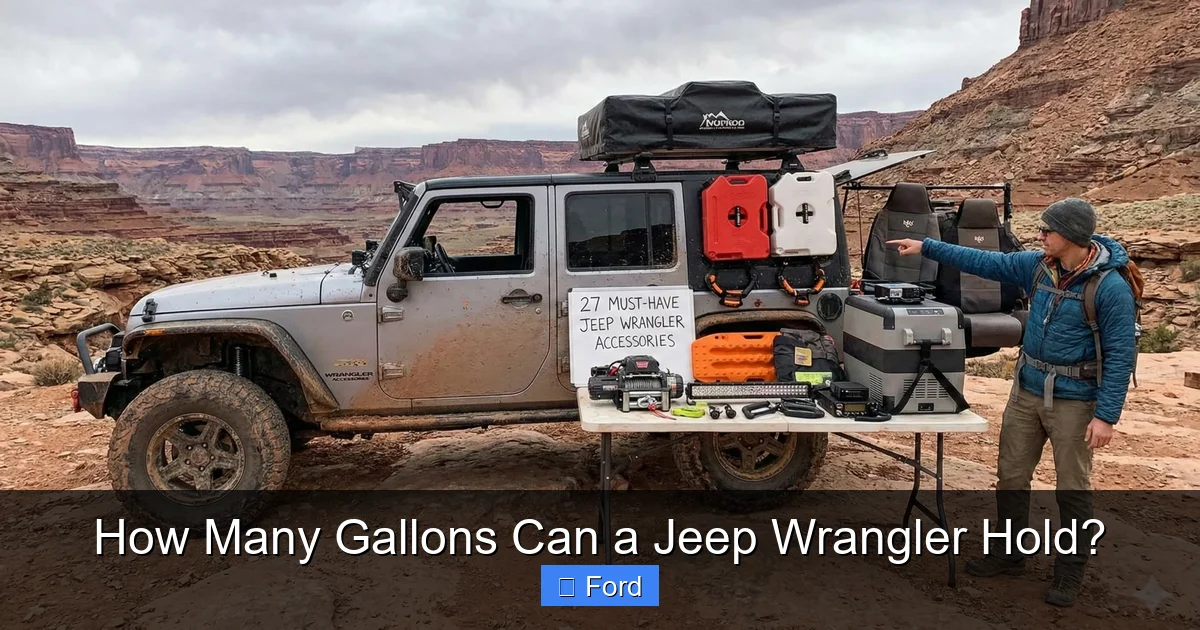
Let’s get specific. If you’re shopping for a new or recent used Wrangler, here is the breakdown you need. Remember, your specific configuration—engine, transmission, and trim—determines your tank.
Visual guide about How Many Gallons Can a Jeep Wrangler Hold?
Image source: adventurejeep.com
Standard vs. Large Tank: The 17.5 vs. 22.5 Gallon Decision
For the JL Wrangler and JT Gladiator with conventional engines (3.6L V6 or the 2.0L Turbo), the choice boils down to two physical tank sizes. The 17.5-gallon tank is standard on Sport, Sport S, Willys, and Sahara (unless the large tank is optioned). The 22.5-gallon tank is either standard or available on Rubicon and Sahara models. It’s not a simple “Rubicon gets the big tank.” A Sahara can be ordered with either. A Rubicon almost always has the 22.5-gallon tank, but it’s worth confirming on the window sticker or build sheet. The 4xe hybrid’s tank size changed for the 2024 model year, moving from 15.5 to 17.5 gallons, aligning it with the standard gas models’ capacity.
Why does this matter? That extra 5 gallons translates directly to potential range. With a conservative 15 MPG average (typical for a Wrangler with average driving), the 17.5-gallon tank gives you about 262 miles. The 22.5-gallon tank bumps that to 337 miles—a full 75-mile difference. On a long, remote highway stretch or a multi-day off-road adventure, that’s the difference between a stressful fuel stop and a confident, uninterrupted journey.
Engine and Transmission: Do They Affect Tank Size?
This is a common point of confusion. For the gas-powered JL/JT models, the engine (3.6L V6 vs. 2.0L Turbo) does not change the physical size of the fuel tank. Both engines use the same 17.5-gallon or 22.5-gallon tank hardware. However, the engine dramatically affects your real-world range from that tank. The 2.0L turbo, especially when paired with the smooth 8-speed automatic, can achieve 22-25 MPG on the highway under ideal conditions. That same 17.5 gallons could yield 385-437 miles! The 3.6L V6, particularly with the manual transmission or in heavier 4-door models, might only get 17-19 MPG, reducing the theoretical range from the same tank. So, while the tank’s “hold” is fixed, what you “get” from it is highly engine-dependent.
The 4xe’s system is different. Its smaller gas tank is part of a complex powertrain where the battery and electric motors do a significant portion of the work. For daily commuting, you might rarely touch the gas tank at all. For long trips, you’ll use a combination of electric and gas, and the total “energy” capacity is best thought of in miles rather than gallons alone.
Real-World Range vs. Stated Capacity: The Adventure Equation
Knowing your tank holds 22.5 gallons is great. Knowing you’ll get 350 miles from it is the real goal. But achieving that is a complex equation with several variables. Let’s solve for your actual range.
Visual guide about How Many Gallons Can a Jeep Wrangler Hold?
Image source: automadesimply.com
Driving Conditions: The Biggest Wild Card
This is non-negotiable. A Wrangler’s MPG—and thus its miles per tank—plummets in certain conditions. Off-road driving in low range 4WD is the most extreme. You might see single-digit MPG crawling over rocks or through deep mud. A full tank could be gone in under 150 miles. Strong headwinds, steep mountain grades, and cold weather also severely impact fuel economy. The engine works harder, and rolling resistance increases. Conversely, steady, flat highway cruising at 65-70 MPH is where you’ll see your best numbers. Your “real” average is a blend of all your driving. A 50/50 split of highway and light off-road might net you 18 MPG in a V6 4-door. That 17.5-gallon tank then gives you about 315 miles, not the ideal 350+.
The Modification Multiplier: Tires, Gears, and Weight
Here’s where Wrangler owners live. That 33-inch all-terrain tire you just installed? It adds unsprung weight and rolling resistance. A lift kit? Changes aerodynamics and may require gear re-calibration. A heavy front bumper, rock rails, and a roof-top tent? That’s hundreds of pounds of extra mass. All of these modifications can reduce fuel economy by 10-20% or more. A Wrangler Rubicon with 37-inch tires and a heavy aftermarket bumper might struggle to get 14 MPG on the highway. Suddenly, that 22.5-gallon tank is only providing ~315 miles, similar to a stock 17.5-gallon tank on a highway-optimized setup. It’s a crucial reality check: your tank size is only part of the picture; your vehicle’s overall build dictates the final range.
Calculating Your Personal “Miles to Empty”
Don’t rely solely on the Jeep’s computer. It’s a good guide but can be optimistic. The best method is the old-school one: Fill the tank completely, reset your trip odometer, drive normally until you have about 1/4 tank or the light comes on, then fill again. Note how many gallons it takes to fill and how many miles you drove. (Miles Driven ÷ Gallons Added = Your Actual MPG). Do this a few times in different conditions (highway trip, mixed driving) to get a realistic average for your Jeep. Then, multiply that average MPG by your tank’s capacity (17.5 or 22.5). This is your true, usable range. For example: 16 MPG average x 17.5 gallons = 280 miles. Plan your trips with a 20% buffer (so plan for 225 miles between stops) to be safe.
Fuel Economy vs. Tank Size: The Trade-Off in the Wrangler Lineup
Jeep has made interesting strategic choices with the Wrangler’s powertrain and tank pairing, creating a spectrum of trade-offs for buyers.
The Efficiency Champion: The 4xe Plug-in Hybrid
The Wrangler 4xe is in a class of its own. With a 15.5-gallon (now 17.5-gallon) gas tank and a 17.4 kWh battery, its total “range” is a combination. For the first ~21 miles, you can drive on pure electricity, using zero gas. For a daily commuter, the gas tank might last weeks. For a long-distance overlander, the system seamlessly switches to hybrid mode, where the gas engine and electric motors work together to maximize efficiency. In hybrid mode on the highway, it can achieve impressive MPG numbers. Its “fuel capacity” is effectively larger because of the electric buffer, but you must plan for charging access to fully utilize this advantage. It represents the future: smaller gas tank, but vastly extended total range through electrification.
The Torque King: The 3.6L V6
The legendary Pentastar V6 is all about smooth, reliable power. Its strength is low-end torque, great for low-speed off-road maneuvers and towing. The trade-off is fuel economy. Even with the 8-speed automatic, it’s the thirstiest option in the current lineup. Pair this engine with a 17.5-gallon tank, and you have the shortest gas-only range of the bunch. However, if you opt for the 22.5-gallon tank, you significantly mitigate this weakness, making the V6 Rubicon with the big tank a formidable, long-range off-road machine. It’s a direct choice: prioritize proven, simple power and compensate with a larger tank, or choose the turbo for better MPG and live with the standard tank.
The Modern Turbo: The 2.0L Turbo I4
This engine is the fuel economy winner among gas options. Its turbocharged power is punchy, and with the 8-speed automatic, it can achieve the highest MPG figures. Its Achilles’ heel for some is its power delivery characteristics and the added complexity of a turbo system. For the pure fuel-range calculator, a 2.0L Wrangler with the standard 17.5-gallon tank can often match or exceed the highway range of a V6 with the 22.5-gallon tank. If your adventures are more highway-miles-to-trailhead than all-day rock crawling, the 2.0L is the smart play for maximizing the utility of every gallon in your tank.
Beyond the Factory Tank: Aftermarket Solutions for the Ultimate Range
For the Wrangler owner whose adventures take them to the far frontiers, the factory tank—even the 22.5-gallon one—might not be enough. This is where the robust aftermarket world comes in.
Larger Replacement Tanks
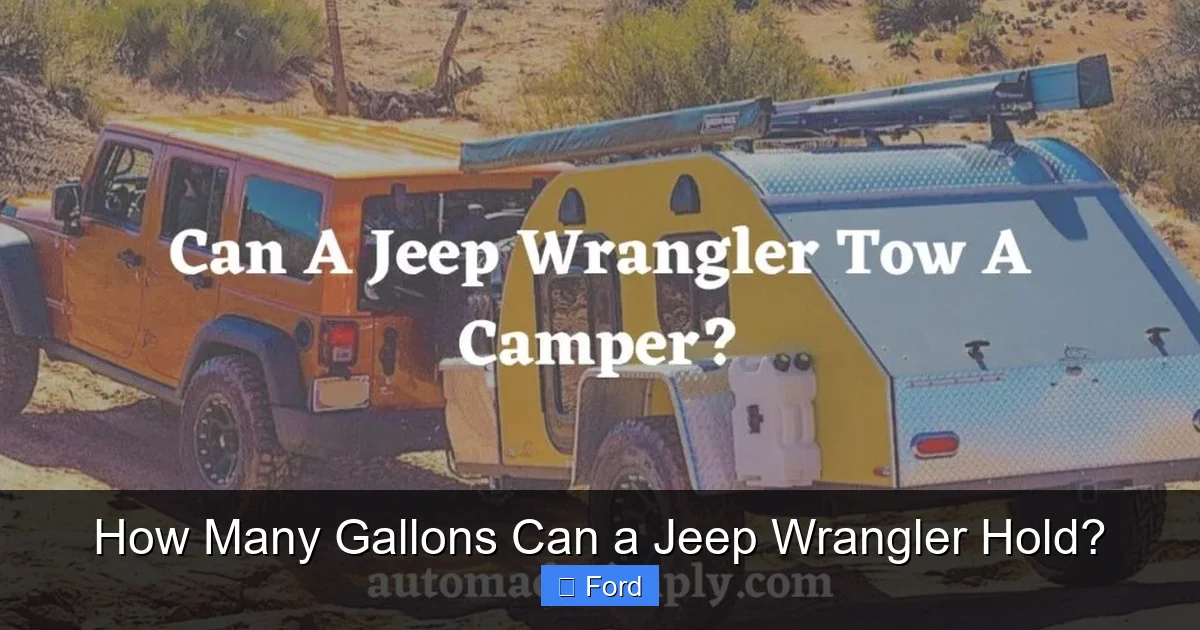
Companies like Roadside Fuel Tanks and Jeep Tanks manufacture larger, direct-replacement steel or aluminum tanks that bolt into the original location. These can boost capacity to 30, 35, or even 40+ gallons. This is the cleanest look but requires significant modification (often involving cutting the floor or modifying the skid plates). It’s a major undertaking for a shop and adds considerable weight high up in the vehicle, affecting handling and center of gravity. It’s for the serious overlander who needs to cross vast deserts or remote tundra without fuel stops for 500+ miles.
Auxiliary and Saddle Tanks
More common are auxiliary tanks. These are smaller (5-10 gallon) tanks mounted externally. Popular locations are behind the rear bumper (replacing the spare tire carrier or mounted on it), inside the cargo area, or on a rear bumper carrier. They require their own fuel pump, lines, and a switchover valve system to select which tank feeds the engine. This allows you to carry extra fuel without permanently altering the main tank. The downside is complexity, potential for leaks if not installed perfectly, and the fact that you’re carrying liquid weight (gas weighs ~6.3 lbs/gallon) externally, which can affect rear axle load and door operation on a 2-door.
The Practical and Legal Considerations
Before you go down this road, research thoroughly. Check local laws regarding auxiliary fuel containers. Some states have restrictions on how much extra fuel you can carry and where it can be mounted (often requiring a DOT-approved container). Insurance implications are another factor—modifying the fuel system could affect coverage in an accident. Most importantly, assess your actual need. A 22.5-gallon tank in a well-maintained, efficiently-driven Wrangler can comfortably handle most multi-day trips in the continental U.S. with its dense fuel station network. The aftermarket path is for the true expedition rigs heading to the Arctic Circle, the Moab backcountry for a week, or the continental divide trails. For 95% of owners, the factory tank, especially the large one, is more than sufficient when paired with smart planning.
Practical Tips for Maximizing Your Wrangler’s Fuel Range
Knowledge is power, but action is range. Here’s how to stretch every last drop from your Wrangler’s tank, regardless of its size.
Driving Habits: The #1 Lever
Your right foot is the most powerful fuel-saving tool. Smooth, anticipatory driving is key. Accelerate gently, maintain steady speeds on the highway (use cruise control), and brake early and gradually. Avoid excessive idling—a Wrangler’s 3.6L can burn 0.5-0.8 gallons per hour just sitting. When off-roading, use the lowest gear necessary and avoid excessive throttle. Sometimes, a slower, more deliberate crawl saves more fuel than constantly revving the engine to maintain momentum. In city traffic, combine errands to reduce cold starts, which use more fuel.
Maintenance is Non-Negotiable
A well-maintained engine is an efficient engine. Stay on top of oil changes with the correct viscosity. Use high-quality, OEM-spec fuel. A clean air filter is critical—a clogged one reduces airflow and forces the engine to work harder. Ensure your tires are properly inflated to the recommended PSI (usually found on the driver’s door jamb sticker). Under-inflated tires create more rolling resistance. For Wranglers with larger aftermarket tires, you may need to adjust pressure slightly, but never go significantly below spec for safety and efficiency. Regular spark plug and fuel system cleaning as per the maintenance schedule also pays dividends at the pump.
Smart Trip Planning & The “Reserve” Reality
Never trust the “miles to empty” readout as gospel. It’s a dynamic calculation based on recent MPG. In mountainous terrain, it can drop like a stone. The rule of thumb for any vehicle, especially a Wrangler, is to refuel when you have 1/4 tank or as soon as the low fuel light comes on. That 1/4 tank in a 22.5-gallon tank is still about 4-5 gallons, giving you a crucial buffer. Use apps like GasBuddy to plan stops on long trips. In remote areas, carry a certified, safe fuel container (like a NATO-style jerry can) as a last-resort backup, but understand the weight penalty and legal considerations. For overlanding, the mantra is “plan for the worst, hope for the best.” Know your daily driving plan and identify fuel points along the way.
Conclusion: Your Tank, Your Adventure
So, how many gallons can a Jeep Wrangler hold? The definitive answer is: it depends. For the vast majority of new JL Wranglers and JT Gladiators, the answer is either 17.5 or 22.5 gallons. For the efficient 4xe, it’s 17.5 gallons of gas plus a large battery. For older models, it ranges from 15 to 22 gallons. But the true value of that number lies not in the isolation of the spec, but in its application to your life. The 22.5-gallon tank on a Rubicon is an invitation to go farther, to skip that worrying fuel stop in the middle of nowhere. The 17.5-gallon tank on a 2.0L Willys is a testament to efficiency, squeezing maximum adventure from a smaller package.
Ultimately, understanding your Wrangler’s fuel capacity is about empowerment. It transforms the low fuel light from a moment of panic into a planned checkpoint. It allows you to compare configurations with confidence when buying. It helps you budget for trips and understand the real impact of that set of 37-inch tires you’re dreaming of. Whether you’re a weekend warrior hitting the local trails or a full-time overlander crossing continents, knowing your tank—and how to maximize it—is a fundamental piece of the Jeep Wrangler ownership experience. Fill it up, check the pressure, and go explore. You’ve got the numbers you need to do it right.
Frequently Asked Questions
Does a Jeep Wrangler have a reserve fuel tank?
No, the Jeep Wrangler does not have a separate, hidden “reserve” tank. The low fuel light illuminates when there is approximately 2-3 gallons of fuel remaining in the main tank, depending on the model and driving conditions. This remaining fuel is your operational reserve, and you should plan to refuel immediately when the light comes on.
How far can a Jeep Wrangler go on empty after the gas light comes on?
This varies significantly by model, tank size, and driving conditions. As a general estimate, once the low fuel light illuminates, you can typically expect to drive between 30 and 70 miles before running out of fuel. It is highly advisable to find a gas station within 30 miles of the light coming on to avoid the risk of stranding yourself and potentially damaging the fuel pump, which relies on gasoline for cooling and lubrication.
Can I put a larger gas tank in my Jeep Wrangler?
Yes, aftermarket larger replacement tanks and auxiliary saddle tanks are available for most Wrangler generations. However, this is a major modification that requires professional installation, can affect vehicle weight distribution and ground clearance, and may have legal or insurance implications. For most owners, opting for the factory 22.5-gallon tank on newer models is the simplest and safest way to increase range.
Does a 2-door or 4-door Wrangler have a bigger gas tank?
For the current JL generation, the gas tank capacity is not determined by the door count. Both 2-door and 4-door models can be equipped with either the standard 17.5-gallon tank or the optional 22.5-gallon tank, depending on the trim level and options selected. In older JK generations, the 4-door Unlimited sometimes had a slightly different tank, but the current lineup offers the same tank options across both wheelbases.
How many gallons does a Jeep Wrangler 4xe hold?
The Jeep Wrangler 4xe plug-in hybrid uses a 15.5-gallon gasoline tank for the 2021-2023 model years. For the 2024 model year and newer, the gasoline tank capacity was increased to 17.5 gallons, matching the standard gas-powered models. Remember, its total range is a combination of this gasoline and its electric battery capacity (approximately 21-26 miles of electric-only range, depending on model year).
Is the fuel tank on a Jeep Wrangler under the vehicle?
No, on modern Wrangler models (JK from 2007 onward, and current JL/JT), the fuel tank is located inside the frame rails for protection. It is not exposed underneath like the steel tanks on very early YJ and TJ models. This design change significantly improves the tank’s vulnerability to damage from rocks and road debris during off-road use.
