
How Long Has the Toyota Camry Been the Best-selling Car

The Toyota Camry held the title of America’s best-selling car for an astonishing 15 consecutive years, from 1997 through 2011. This unprecedented dominance cemented its status as the quintessential reliable, practical, and value-packed family sedan. While it no longer holds the #1 overall vehicle title due to the rise of trucks and SUVs, it remains the best-selling passenger car in the United States, a testament to its enduring appeal and Toyota’s manufacturing excellence.
You’re driving down the highway, and it seems like every other car is a Toyota Camry. That’s not just your imagination. For a generation of car buyers, the Camry was the default choice. But pinning down exactly how long it was the absolute “best-selling car” in America requires a dive into the fascinating history of the modern auto industry. The short answer is both staggering and nuanced: the Toyota Camry was the best-selling car (passenger car, specifically) in the United States for 15 consecutive years. However, the full story of its dominance, and what that title really means today, is a masterclass in automotive strategy and shifting consumer tastes.
Let’s set the stage. When we say “best-selling car,” we’re typically talking about the best-selling passenger car. This is a crucial distinction. Since the early 1990s, the top spot on the overall best-selling vehicle list in the U.S. has been held by full-size pickup trucks, primarily the Ford F-Series. So, the Camry’s reign was at the pinnacle of the sedan world, a world that once accounted for over half of all U.S. auto sales. Its 15-year streak from 1997 to 2011 is a record of sustained excellence that no other sedan has come close to matching. To understand how it got there, we have to look at the car that came before it and the market it conquered.
Key Takeaways
- 15-Year Reign: The Camry was the best-selling car in America for 15 straight years (1997-2011), a record for any passenger car.
- Not the #1 Vehicle: It lost the overall #1 vehicle title to pickup trucks (like the Ford F-150) in the 2010s, not to another sedan.
- Consistency is Key: Its success was built on consistent, generational improvements in reliability, fuel efficiency, and comfort.
- A Family Sedan Benchmark: It defined the mid-size sedan segment and became the default choice for millions of American families and fleets.
- Sales Context: Peak sales exceeded 427,000 units in a single year (2007), a number most sedans can only dream of today.
- Enduring Legacy: Even in an SUV-dominated market, the Camry remains the best-selling passenger car in the U.S., proving its formula still works.
📑 Table of Contents
The Genesis: From Corona to Camry (Pre-1991)
Before the Camry, there was the Toyota Corona. Introduced in the U.S. in the 1960s, the Corona was Toyota’s workhorse, a reliable but unremarkable compact car. By the mid-1980s, Toyota recognized a growing demand for a larger, more comfortable family sedan. The answer was the Camry, launched for the 1983 model year. It was larger, more powerful, and significantly more refined than the Corona, which was phased out of the U.S. market after 1991.
Building a Foundation (1983-1991)
The first-generation Camry (1983-1986) and its second-gen successor (1987-1991) were solid, competent cars. They offered Toyota’s legendary reliability in a more spacious package. However, they were still playing catch-up to domestic and European rivals in terms of driving dynamics and interior quality. Sales were good, but not yet spectacular. The car was seen as a smart, sensible choice—a “white appliance” as some critics called it—but it lacked the emotional pull or standout styling to dominate headlines. This era was about building the reputation and the manufacturing capacity that would fuel the upcoming explosion.
During this time, Toyota was also perfecting its production systems and building the Kentucky plant that would become the largest auto manufacturing facility in the world. This investment in American manufacturing was a stroke of genius, allowing Toyota to avoid import tariffs, reduce shipping costs, and build a “American-made” image that resonated with buyers. It also meant they could produce Camrys at a scale and cost that competitors found hard to match. This period of quiet, steady growth set the stage for the perfect storm of factors that would propel the Camry to the top.
The Unstoppable Force: 15 Years at the Top (1992-2012)
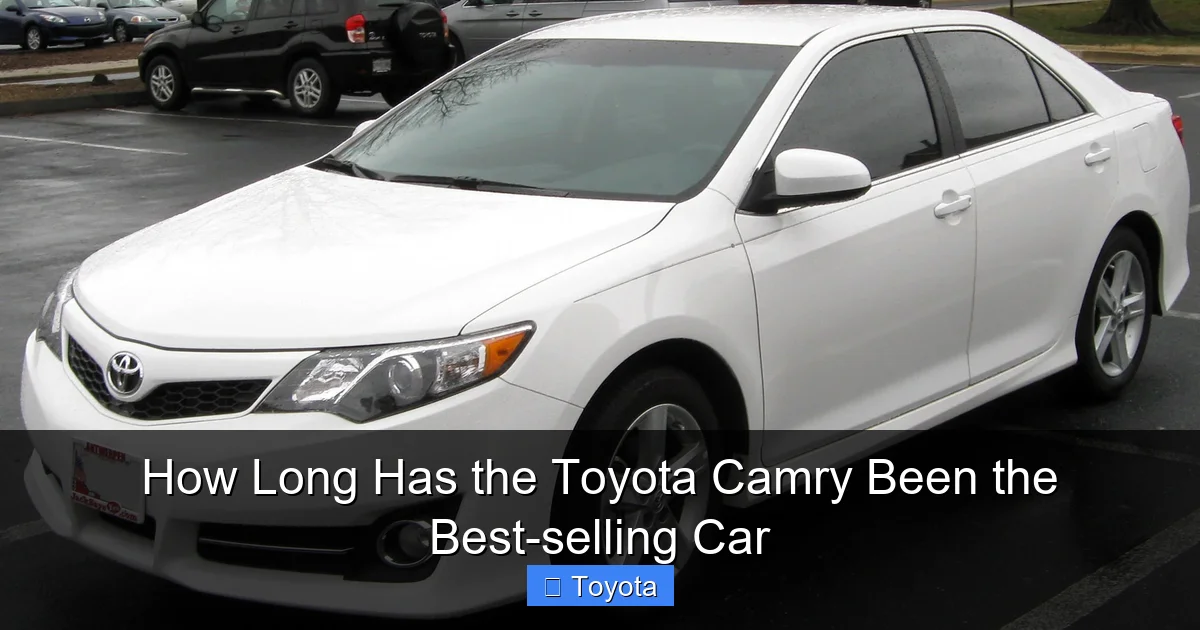
The third-generation Camry, introduced for the 1992 model year, was the turning point. It was larger, quieter, and more sophisticated than ever. But the real catalyst was the 1997 redesign. The fourth-generation Camry was a revelation. It was bigger inside and out, offered a smooth V6 option, and featured a more refined, upscale interior that blurred the lines between mainstream and luxury. Critically, it was launched during a period of economic stability and low fuel prices, which massively benefited the gas-guzzling V6 sedan segment.
Visual guide about How Long Has the Toyota Camry Been the Best-selling Car
Image source: goodfreephotos.com
The Formula for Success
What made the late-90s and 2000s Camry so unbeatable? It was a combination of factors that created a virtuous cycle.
- Bulletproof Reliability: This was, and remains, Toyota’s core strength. Camrys were known to run for hundreds of thousands of miles with basic maintenance. The best motor oil for a Toyota Camry used in these years, combined with robust engineering, meant owners faced minimal catastrophic failures. This built immense trust and fantastic word-of-mouth.
- Unmatched Value: You got more car for your money than almost any competitor. Standard features, space, and build quality were superior to the Ford Taurus, Chevrolet Lumina, and Honda Accord in many buyers’ eyes. The price-to-features ratio was a killer argument.
- Low Cost of Ownership: Beyond reliability, Camrys had excellent fuel economy for their size, affordable insurance rates, and readily available, inexpensive parts. A trip to the dealer or mechanic was less stressful and costly than with many rivals.
- Fleet and Rental Sales: A huge, often under-discussed, piece of the puzzle. Rental car companies (like Hertz and Enterprise) and corporate fleets bought Camrys by the thousands because they were cheap to buy, cheap to maintain, and durable. These sales are counted in the total, inflating the numbers significantly but also getting thousands of drivers behind the wheel, many of whom later bought one for themselves.
- The “No-Worries” Car: For the average American family, the Camry was the ultimate low-stress vehicle. It didn’t demand attention. It started every morning, got the kids to soccer practice, and didn’t break down. In a world of complex cars with finicky electronics, that simplicity was a huge selling point. You didn’t need to know how to reset the airbag light on a Toyota Camry regularly; it simply didn’t come on.
This formula hit its zenith in the 2007 model year, when Toyota sold a staggering 427,236 Camrys in the U.S. alone. It was an icon, ubiquitous on roads and in parking lots from sea to shining sea.
The Competition That Was and Wasn’t
During its reign, the Camry’s primary rival was the Honda Accord. The Accord was often the driver’s choice—more engaging to steer, with a sportier feel. The Camry was the comfortable, isolated, and spacious choice. It was a classic “apples to oranges” rivalry that both brands won, with sales often neck-and-neck. However, the Camry consistently edged out the Accord in total sales, partly due to its stronger fleet sales and slightly broader model range (including the more popular V6).
Visual guide about How Long Has the Toyota Camry Been the Best-selling Car
Image source: i0.wp.com
The domestic competition, the Ford Taurus and Chevrolet Impala, struggled to match the Camry’s combination of quality and value. They were often seen as less refined and less reliable. The Chrysler 300 was a different kind of car—a rear-wheel-drive, V8-powered sedan that captured a distinct niche but couldn’t compete with the Camry’s all-rounder appeal. The real threat to the Camry’s crown didn’t come from another sedan. It came from a complete market shift.
The SUV Tsunami and the End of the streak
Starting around 2010, the American auto landscape transformed. Fuel prices stabilized, and consumer preferences swung violently toward crossovers and SUVs. These vehicles offered higher seating, more cargo flexibility, and a sense of security that sedans couldn’t match. The all-new, un-truck-like crossover became the new family hauler. The Toyota RAV4, a compact SUV, began outselling the Camry. The Honda CR-V followed suit. Even within Toyota, the RAV4 eventually surpassed the Camry in annual sales.
Visual guide about How Long Has the Toyota Camry Been the Best-selling Car
Image source: media.cheggcdn.com
The Camry’s 15-year streak as the best-selling car ended in 2012 when it was surpassed by the Chevrolet Cruze and, more permanently, by the continued dominance of trucks. But here’s the most important nuance: the Camry is still the best-selling passenger car in America today. In 2023, it sold over 311,000 units, far outselling the Honda Accord, Nissan Altima, and Hyundai Sonata. The “best-selling car” title is now a contest within a shrinking segment. The overall best-selling vehicle is, and will likely remain for the foreseeable future, the Ford F-150. The Camry’s legacy isn’t that it was ever the #1 vehicle overall; it’s that it was the #1 *car* for 15 years straight, a record that stands alone.
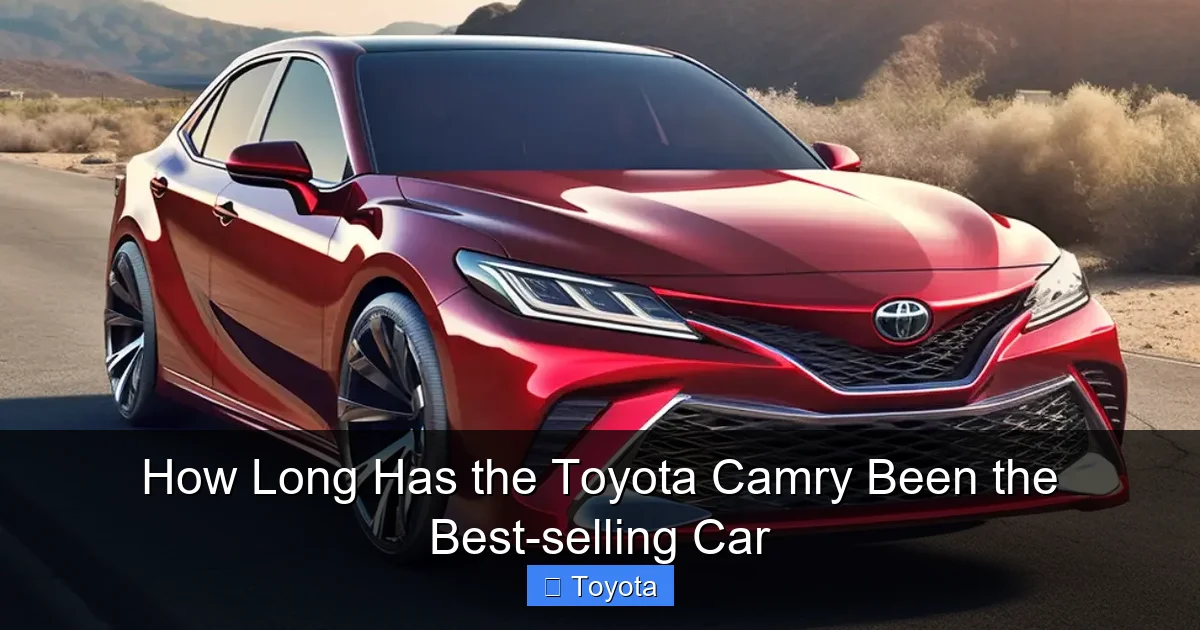
This shift also changed the Camry itself. For the 2018 model year, Toyota gave it a radical, sporty redesign with a lower, wider stance and aggressive styling—a direct response to a market that now prioritized style and SUV-like presence. It also made the entire lineup hybrid, a move that secured its future in an efficiency-conscious world. The modern Camry is a far cry from the appliance it once was, but its core values of reliability and value remain intact. Owners still prioritize upkeep, seeking the best floor mats for a Toyota Camry to protect their investment and the best car battery for a Toyota Camry to ensure years of trouble-free starts.
The Blueprint for Longevity: Why the Camry Still Matters
So, what can we learn from the Camry’s 15-year dynasty? It’s a case study in understanding your customer. Toyota didn’t try to make the most exciting car. It made the most *right* car for millions of people. It prioritized the things that matter most to mainstream buyers: not breaking down, not costing a fortune to run, and providing a comfortable, safe, and spacious ride. It was a product of incredible focus.
This focus also extended to its ownership experience. The simplicity that defined its early years made it a dream for maintenance. Tasks like how to reset the trip meter on a 2022 Toyota Camry were straightforward, and major components were engineered for longevity. This created a virtuous cycle: happy owners told their friends, who then bought Camrys, creating a loyal customer base with one of the highest repurchase rates in the industry. It also created a massive aftermarket for accessories and parts, from the best roof rack for a Toyota Camry for adventure seekers to custom seat covers for families with pets.
The Camry’s story is also a lesson in adaptability. It didn’t rest on its laurels after 2011. It evolved with the times, embracing hybridization, aggressive styling, and advanced safety suites (Toyota Safety Sense) as standard. It recognized the sedan’s decline but committed to being the best sedan available, knowing a loyal niche would remain. For those who still prefer the driving dynamics, fuel efficiency, and lower center of gravity of a car over an SUV, the Camry remains the undisputed leader.
Looking Forward: The Camry in an SUV World
What does the future hold? The Camry will continue as a key model for Toyota, but its role has changed. It is no longer the volume kingpin it once was; that title belongs to crossovers like the RAV4 and Highlander. Its production is now concentrated at the Kentucky plant, which also builds the RAV4 and Lexus ES, showcasing Toyota’s flexible manufacturing.
The next evolution is already here: the Camry is a hybrid-only lineup in many markets, with the powerful hybrid powertrain being the primary seller. This secures its relevance in an era of stringent emissions regulations. While we will almost certainly never see it reclaim the title of America’s best-selling vehicle from the pickup truck, its position as the best-selling passenger car is secure for as long as sedans remain a viable segment. It represents a bastion of practicality in an era of excess, a reminder that for many, a car is simply a tool to get from A to B, reliably and efficiently.
The 15-year streak from 1997-2011 remains a historic benchmark, a golden age for the sedan that the Camry defined and dominated. It proved that with relentless focus on quality, value, and customer needs, a single model could achieve a level of market penetration and trust that is almost unimaginable today. The next time you see a Camry—and you will see many—remember that you’re looking at a car with a legacy of popularity that is simply unmatched in American automotive history.
Conclusion
The Toyota Camry’s reign as America’s best-selling car lasted an incredible 15 consecutive years, from 1997 to 2011. This unprecedented dominance was built on a rock-solid foundation of legendary reliability, outstanding value, and low cost of ownership, amplified by massive fleet sales. It defined the mid-size sedan category and became the default vehicle for millions of families. While the rise of SUVs and trucks has relegated sedans to a smaller segment, the Camry’s legacy is untarnished. It remains the best-selling passenger car in the United States today, a testament to a formula that has been refined over four decades. Its story is not just about sales figures; it’s about understanding what mainstream buyers truly want and delivering it, year after year, with remarkable consistency.
Frequently Asked Questions
Was the Toyota Camry ever the best-selling vehicle in America overall?
No, the Camry has never been the best-selling vehicle overall in the U.S. That title has been held by the Ford F-Series pickup truck continuously since the early 1990s. The Camry was the best-selling passenger car for 15 years.
What years was the Toyota Camry the best-selling car?
The Toyota Camry was the best-selling passenger car in the United States for 15 consecutive years, from the 1997 model year through the 2011 model year.
What car finally beat the Toyota Camry as the best-selling car?
The Camry’s streak ended due to a massive market shift toward SUVs and crossovers. It was surpassed by other cars like the Chevrolet Cruze in 2012, but the real reason was that vehicles like the Toyota RAV4 (an SUV) and Ford F-150 (a truck) were selling in far higher volumes. The Camry remains the best-selling passenger car today.
How many Camrys were sold at its peak?
The Camry’s peak sales year was 2007, when Toyota sold 427,236 units in the United States alone. This was during the height of its 15-year best-selling car streak.
Is the Camry still a good car to buy today?
Absolutely. The modern Camry is highly rated for its excellent fuel economy (especially the hybrid), strong reliability scores, comfortable ride, and standard Toyota Safety Sense features. It consistently ranks at the top of its class in reviews.
Why was the Camry so popular for so long?
Its popularity stemmed from a perfect storm of factors: exceptional long-term reliability, low cost of ownership, spacious and comfortable interiors, strong resale value, and massive fleet sales to rental and corporate companies that put it in front of millions of drivers. It was the quintessential worry-free family sedan.
