
How Much Does It Cost to Replace a Toyota Camry Starter

Replacing a Toyota Camry starter typically costs between $400 and $1,000+, with the average landing around $600-$800 for most models. The final price depends heavily on your Camry’s model year, engine type (4-cylinder vs. V6), whether you choose an OEM or aftermarket part, and your geographic labor rates. While a skilled DIYer can save on labor, professional installation is recommended for most to ensure reliability and avoid potential electrical issues.
Your trusty Toyota Camry has been a reliable companion for years, but one morning it just clicks instead of turning over. That sinking feeling is all too familiar. The starter motor—a small but mighty electrical component—has likely given up the ghost. Your immediate question is practical and pressing: how much does it cost to replace a Toyota Camry starter? The answer isn’t a single number, but a range influenced by several key factors. This guide will walk you through every detail, from understanding what a starter does to getting a precise estimate for your specific Camry, empowering you to make an informed and cost-effective repair decision.
Key Takeaways
- Average Cost Range: Total replacement cost (parts + labor) for a Toyota Camry starter generally falls between $400 and $1,000+, with $600-$800 being the most common range for models from 2012-2021.
- Parts are the Main Variable: The starter motor itself can cost from $150 (aftermarket) to $500+ (OEM), with V6 engines and newer models often requiring more expensive units.
- Labor Adds $200-$400: Professional installation typically takes 1.5-3 hours, with shop rates varying widely by region and dealership vs. independent mechanic.
- DIY Saves Money but Requires Skill: A competent mechanic can replace a Camry starter for parts-only cost, but it involves working in a tight engine bay and handling electrical connections properly.
- Don’t Ignore the Symptoms: Common signs include a clicking sound, slow cranking, or a complete no-crank situation. Ignoring these can lead to a stranded vehicle and a potential tow bill.
- Model Year Matters Greatly: Pre-2012 Camries (especially 2007-2011) often have different, sometimes more accessible starters than the 2012+ redesigned models, affecting both parts price and labor time.
- Consider the Battery: A weak or failing battery is a leading cause of starter failure. It’s wise to have the battery and charging system tested simultaneously to avoid a repeat repair.
📑 Table of Contents
- Understanding Your Camry’s Starter Motor
- Recognizing Starter Failure Symptoms
- The Complete Cost Breakdown: Parts and Labor
- DIY vs. Professional Replacement: Weighing Your Options
- Key Factors That Influence Your Final Price
- Prolonging Your Starter’s Life: Maintenance Tips
- Conclusion: Making the Right Call for Your Camry
Understanding Your Camry’s Starter Motor
Before diving into costs, it helps to know what you’re paying for. The starter motor is an electric motor that engages the engine’s flywheel (or flexplate in automatics) to crank the engine and initiate combustion. When you turn the key or press the start button, a signal is sent to the starter solenoid, which pushes a small gear (the Bendix drive) to mesh with the engine’s ring gear. The motor then spins, turning the engine over until it fires up on its own power.
How It Works and Why It Fails
In your Toyota Camry, the starter is a robust but wear-prone part. It’s designed for short, high-torque bursts of energy. Common failure points include worn-out carbon brushes inside the motor, a failed solenoid, or burnt windings. Heat is a major enemy—starters located near hot exhaust manifolds (common in transverse-mounted V6 engines) are particularly susceptible. Electrical issues, like corroded connections or a weak battery that forces the starter to work harder, dramatically shorten its lifespan. A failing starter often gives warning signs before a complete breakdown, which we’ll cover next.
Recognizing Starter Failure Symptoms
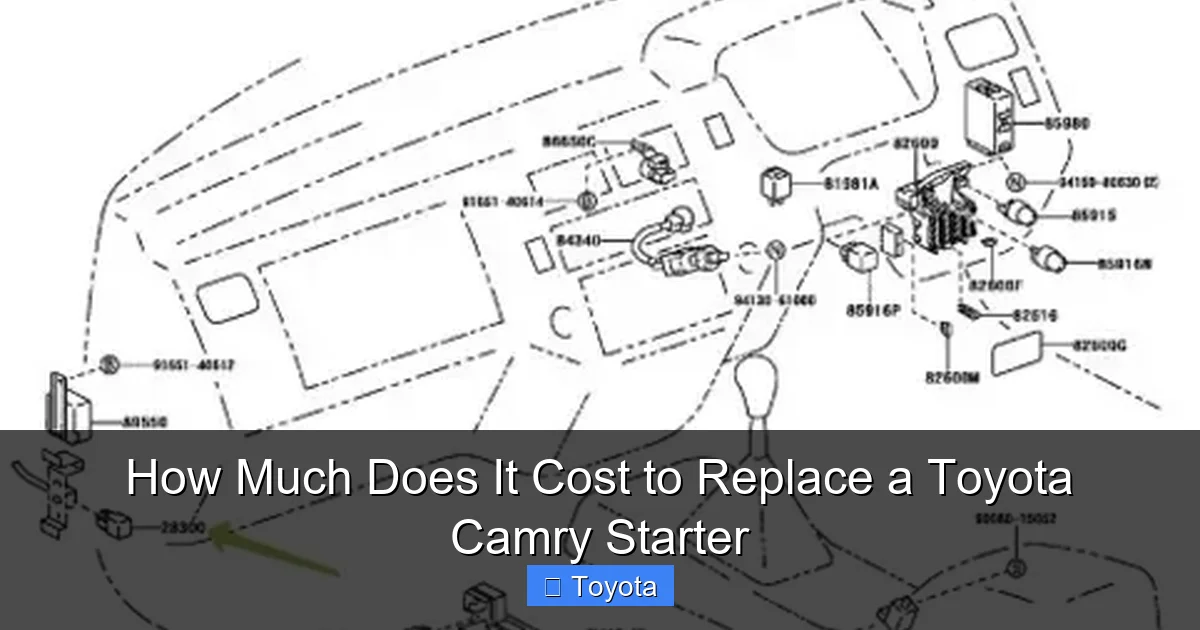
Diagnosing a bad starter isn’t always straightforward, as symptoms can mimic other problems like a dead battery or faulty ignition switch. Knowing the classic signs helps you confirm the issue and avoid unnecessary part replacements.
Visual guide about How Much Does It Cost to Replace a Toyota Camry Starter
Image source: i2.wp.com
Classic “Bad Starter” Sounds and Behaviors
The most universal symptom is a rapid, repetitive clicking sound when you turn the key. This usually means the solenoid is engaging (you hear the click) but the motor isn’t turning, often due to internal failure. Another clear sign is a slow, labored crank where the engine turns over very sluggishly, as if the battery is weak, but the battery is actually fine. The most definitive symptom is a complete no-crank, no-start condition with all other electrical systems (lights, radio) working normally—this points squarely at the starter or its circuit.
Less Obvious Signs and Intermittent Issues
Sometimes the problem is intermittent. Your Camry might start fine one day and act up the next. This can indicate a failing starter that’s overheating and seizing up until it cools down, or a loose/worn electrical connection at the starter or battery. Grinding or whirring noises can occur if the starter’s gear doesn’t disengage properly, which could also damage the engine’s flywheel ring gear—a much more expensive repair. If you hear grinding, stop cranking immediately and seek professional diagnosis.
The Complete Cost Breakdown: Parts and Labor
Now, the core of your question: the bill. Total cost is a sum of parts and labor. We’ll break down each component with real-world examples for different Camry generations and engines.
Visual guide about How Much Does It Cost to Replace a Toyota Camry Starter
Image source: i1.wp.com
Parts Cost: OEM vs. Aftermarket and Model Differences
The starter motor assembly for a Toyota Camry can range widely in price. For a common 2012-2017 model with the 2.5L 4-cylinder engine, you can expect:
- OEM (Toyota Genuine Part): $350 – $550. These are built to exact factory specifications and come with a Toyota warranty (typically 12 months/unlimited miles). They are the most reliable but also the most expensive option.
- High-Quality Aftermarket (Bosch, Denso, ACDelco): $200 – $350. Brands like Denso (a major Toyota supplier) and Bosch offer excellent reliability, often at a 30-50% discount to OEM. They are a very popular and sensible choice.
- Economy Aftermarket/Remanufactured: $120 – $200. These can be hit-or-miss. Some remanufactured units are excellent, replacing all worn parts, while others are minimally rebuilt. For a daily driver, spending a bit more on a reputable brand is advisable.
For a V6 model, like the 3.5L found in SE and XLE trims from 2012-2017, the starter is often more complex and expensive. OEM prices can jump to $450-$700, with high-quality aftermarket in the $280-$450 range. Newer model years (2018+) may have slightly different part numbers and pricing, but the ranges are similar. Always get the exact part number for your VIN when shopping.
Labor Costs: Time and Rates
Labor is where costs can vary dramatically. Replacing a starter on a Camry is not the simplest job due to its transverse-mounted engine and tight engine bay, but it’s also not the most complex. Here’s what affects labor:
- Access: On 4-cylinder models (2012+), the starter is typically accessible from the top, near the transmission bellhousing. It’s moderately difficult. On V6 models, access is often worse, requiring work from underneath or around tight components, increasing time.
- Shop Hourly Rate: This is the biggest variable. Dealerships in major metropolitan areas can charge $150-$200+ per hour. Independent shops in suburban or rural areas might charge $80-$120 per hour.
- Estimated Time: A professional mechanic will likely book 1.5 to 2.5 hours for a 4-cylinder Camry and 2 to 3 hours for a V6. This includes diagnosis, removal, installation, and testing.
Labor Cost Example: At a $120/hour independent shop, 2 hours of labor = $240. At a $180/hour dealership, 2.5 hours = $450. This difference alone can swing your total bill by over $200.
Total Estimated Cost Summary Table
While I can’t use a markdown table, here is a text-based breakdown for clarity:
- Scenario 1 (Budget-Conscious, 4-Cyl, 2012-2017): $200 (aftermarket part) + $240 (2 hrs @ $120/hr labor) = $440 total.
- Scenario 2 (Balanced, V6, 2012-2017): $350 (quality aftermarket part) + $300 (2.5 hrs @ $120/hr labor) = $650 total.
- Scenario 3 (OEM at Dealership, V6, 2018+): $600 (OEM part) + $450 (2.5 hrs @ $180/hr labor) = $1,050+ total.
Additional Fees: Don’t forget potential shop supplies fees (a few dollars), environmental disposal fees, and sales tax on parts. Always ask for a detailed estimate before authorizing work.
DIY vs. Professional Replacement: Weighing Your Options
Given the labor cost, many owners wonder if they can save money by doing it themselves. The answer depends entirely on your mechanical skill, tools, and comfort level.
Visual guide about How Much Does It Cost to Replace a Toyota Camry Starter
Image source: i1.wp.com
What DIY Replacement Involves
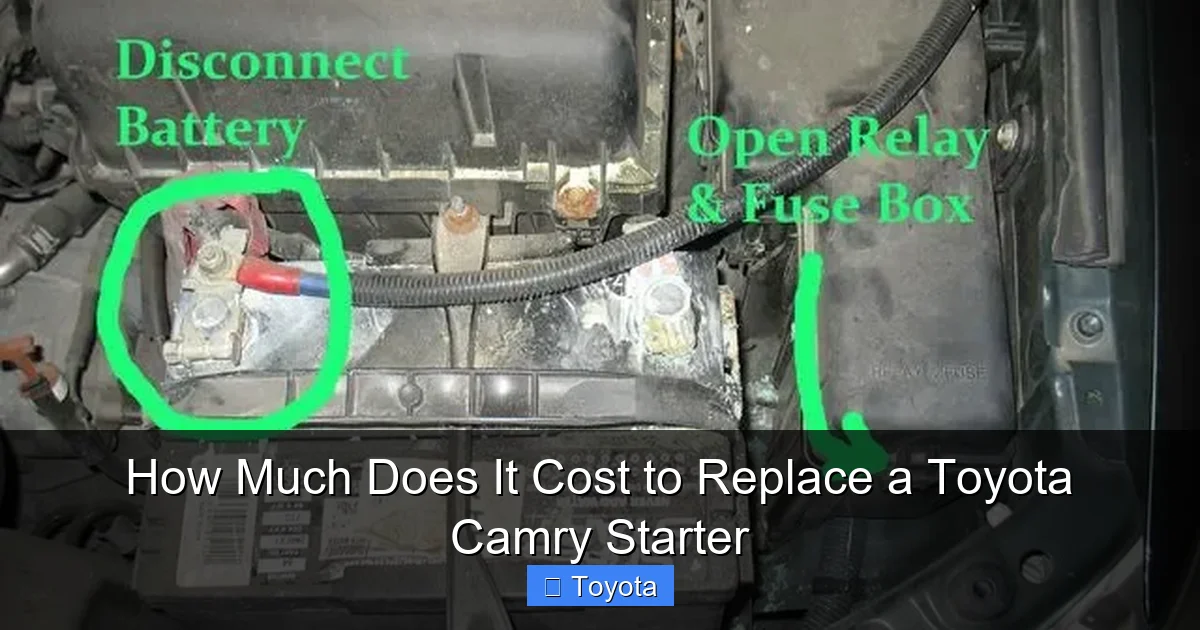
For a 4-cylinder Camry (2012+), the process generally involves: 1) Disconnecting the negative battery terminal. 2) Removing the air intake ductwork for access. 3) Unbolting the starter (usually 2-3 bolts). 4) Disconnecting the main power cable and the small signal wire from the solenoid. 5) Removing the old starter and installing the new one in reverse order. 6) Reconnecting the battery and testing.
Tools, Skills, and Pitfalls
Required Tools: Basic socket set and ratchet (usually 14mm and 17mm bolts), extensions, possibly a swivel socket for tight angles, wrenches for battery terminals, and screwdrivers. A torque wrench is highly recommended for re-installation.
Key Skills: You must be comfortable working under the hood, handling electrical connections safely (always disconnect the battery first!), and troubleshooting if it doesn’t start after replacement (e.g., checking connections, ensuring the solenoid wire is secure).
Major Pitfalls: The number one mistake is cross-threading or over-tightening the starter bolts, which can crack the starter housing. The electrical connections must be clean and tight. On some models, the starter is tucked behind the engine mount or exhaust, making access extremely difficult without a lift. For V6 models, DIY difficulty increases significantly. If you are not 100% confident, professional installation is worth the cost for peace of mind.
When to Definitely Call a Professional
Call a mechanic if: Your Camry is a V6 (especially pre-2012), you have limited tools or experience, the starter is seized and won’t budge, you’ve already tried a new starter and it didn’t work (indicating a wiring/ignition switch issue), or you simply don’t want the hassle. A professional will also perform a full circuit test to confirm the starter is the culprit and not, for example, a faulty neutral safety switch or ignition lock.
Key Factors That Influence Your Final Price
Beyond parts and labor, several other factors can push your final cost up or down. Understanding these helps you get the most accurate quote.
1. Model Year and Engine Type
This is the single biggest factor. The Camry underwent a complete redesign for the 2012 model year (XV50 series). The 2007-2011 (XV40) generation has a different starter layout, often considered slightly easier to access on 4-cylinders but with its own quirks. Pre-2002 models (XV20, XV10) are a different beast entirely with different part numbers and potentially higher labor times due to age and corrosion. Always specify your exact year, trim (LE, SE, XLE), and engine size (2.5L 4-cyl, 3.5L V6) when requesting quotes.
2. Your Geographic Location and Shop Choice
As mentioned, labor rates are a massive variable. A starter replacement in New York City or San Francisco will cost significantly more in labor than in the Midwest or Southeast. Dealerships consistently charge more for labor than independent shops, but they use OEM parts and have technicians specifically trained on your vehicle. Independent shops offer better value but require you to vet their reputation. Getting 3-4 written estimates is the best strategy.
3. Part Quality Decisions: OEM, Aftermarket, or Reman
Choosing between a genuine Toyota starter, a premium aftermarket unit from a name brand, or a remanufactured core is a personal decision balancing cost, warranty, and perceived reliability. For a car you plan to keep long-term, a high-quality aftermarket or OEM is a smart investment. For an older, high-mileage Camry you might sell soon, a remanufactured unit may suffice. Ask about the warranty—OEM often offers longer coverage (e.g., 12 months/unlimited miles vs. a 1-year/12,000-mile warranty on some aftermarket parts).
4. “While You’re In There” Services
A good mechanic will inspect related components once the starter is out. They might recommend:
- Flywheel/Flexplate Inspection: If the starter’s gear was grinding, the ring gear on the flywheel may be damaged. Resurfacing or replacing a flywheel adds $200-$800+ to the bill, but it’s critical to do now while the transmission is out of the way.
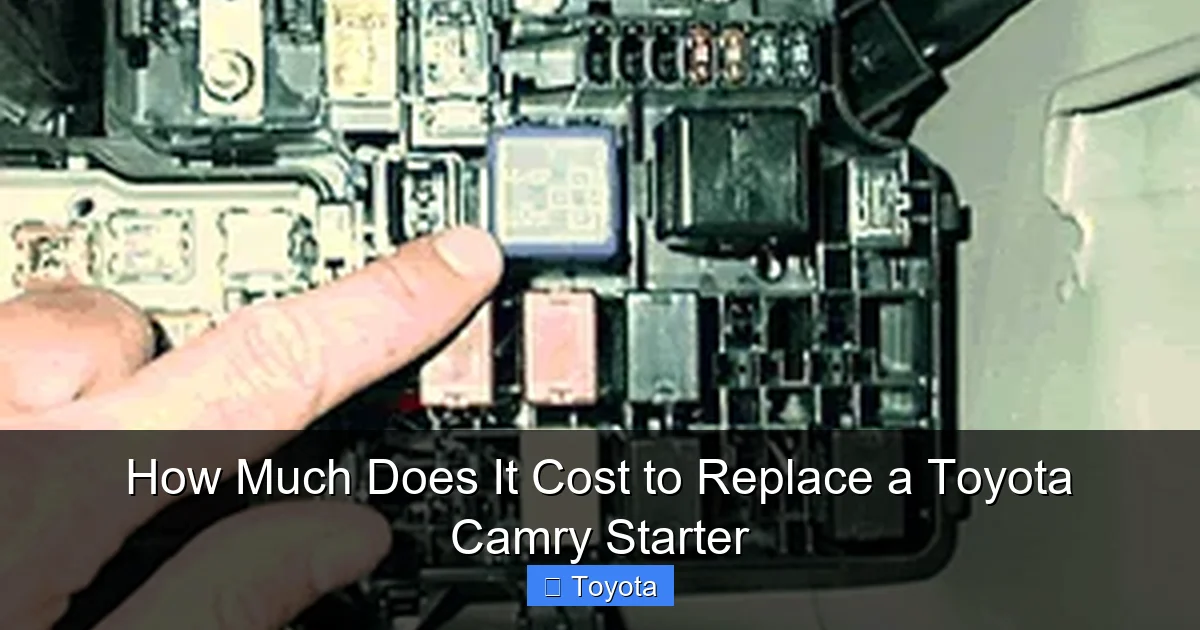
- Battery and Charging System Test: As stressed, a weak battery kills starters. A professional should test this. A new battery adds $150-$300.
- Cleaning Connections: Corroded battery cables or ground straps can cause starter issues. Cleaning these is cheap but important.
Be wary of shops that push unnecessary “while you’re in there” services, but a flywheel inspection is a legitimate and valuable part of the process.
Prolonging Your Starter’s Life: Maintenance Tips
Starters aren’t meant to last forever, but you can maximize their lifespan with good habits.
The #1 Rule: Maintain a Healthy Battery
A strong, healthy battery is the starter’s best friend. A weak battery forces the starter to draw excessive current, overheating its windings and wearing it out prematurely. Have your battery’s cold cranking amps (CCA) tested at least once a year, especially before winter. Clean any white, crusty corrosion from the battery terminals and cable ends. If your battery is over 4-5 years old, consider a proactive replacement. This single habit can add years to your starter’s life. For more on electrical system upkeep, understanding general car maintenance costs can help you budget for these essential services.
Driving Habits That Help
Avoid the instinct to “jump” a sluggish engine by holding the key in the start position for extended periods. If the engine doesn’t start within 3-5 seconds of cranking, release the key, wait 10-15 seconds, and try again. This prevents the starter from overheating. Also, ensure your Camry is in Park (or Neutral with the parking brake set) before starting—the neutral safety switch prevents cranking in gear, but a faulty switch can cause excessive wear.
Regular Inspections
During routine oil changes, a quick visual inspection by a tech can check the starter’s mounting bolts for tightness and look for signs of oil or fluid leaks (which can happen from a rear main seal leak onto the starter on some V6 models). Catching a small oil leak early can prevent starter contamination and failure.
Conclusion: Making the Right Call for Your Camry
Replacing the starter on your Toyota Camry is a common and predictable repair. By now, you should have a clear picture of the cost landscape: expect to pay $400 to $1,000+, with the final number hinging on your specific model year, engine, choice of parts, and where you have the work done. For most owners, sourcing a quality aftermarket starter from a reputable brand and having it installed by a trusted independent mechanic offers the best balance of reliability and value.
Remember, the cheapest quote isn’t always the best. A shop that diagnoses correctly, uses quality parts, and stands behind their work with a good warranty is worth a slightly higher price. If your Camry is a 4-cylinder from 2012 onward and you have the tools and confidence, a DIY replacement can be a rewarding project that saves you several hundred dollars. However, for V6 models, older generations, or if any step feels uncertain, investing in professional installation is a smart choice that ensures the job is done safely and correctly the first time.
Ultimately, addressing a failing starter promptly saves you from the greater inconvenience and cost of a tow bill and potential damage from being stranded. Your Toyota Camry’s reliability is one of its greatest assets; protecting that reliability with a proper, timely repair keeps it on the road for years to come.
Frequently Asked Questions
What are the most common symptoms of a failing Toyota Camry starter?
The most common symptoms are a rapid clicking sound when turning the key, a slow or labored engine crank, or a complete no-crank situation where the engine doesn’t turn over at all. Intermittent starting problems, where it starts fine one moment and fails the next, are also a strong indicator of a failing starter motor.
How long does a starter typically last in a Toyota Camry?
There is no set lifespan, but a starter motor in a Toyota Camry typically lasts between 100,000 and 150,000 miles under normal conditions. Factors like frequent short trips (which don’t fully recharge the battery), extreme temperatures, and a chronically weak battery can significantly shorten its life. Some starters fail much earlier, while others last well beyond 200,000 miles.
Can I drive my Toyota Camry with a bad starter?
No, you cannot drive a car with a bad starter. The starter’s sole function is to start the engine. If it’s failing, you may get a few more starts out of it, but it will eventually fail completely, leaving you stranded. Driving with a failing starter also risks it failing while the engine is running (if the solenoid sticks), which can cause severe damage to the starter and flywheel.
Should I replace my Camry’s starter with an OEM or aftermarket part?
Both can be good choices. OEM (Toyota Genuine) parts guarantee exact fitment and factory-level reliability with a Toyota warranty, but they are the most expensive. High-quality aftermarket brands like Denso, Bosch, or ACDelco are often made to or exceed OEM specifications and are very reliable at a lower cost. Economy remanufactured units vary in quality. For most owners, a premium aftermarket starter offers the best value.
How long does it take a mechanic to replace a starter on a Camry?
For a typical 2012-2021 Toyota Camry with a 4-cylinder engine, a professional mechanic will usually take between 1.5 and 2.5 hours. For a V6 model, which often has more difficult access, it can take 2 to 3 hours. This time includes diagnosis, removal, installation, and final testing. Complex jobs on very old models or with seized bolts can take longer.
Will a weak battery cause my Camry’s starter to fail prematurely?
Yes, absolutely. A weak or failing battery is one of the leading causes of premature starter failure. When a battery is weak, it forces the starter motor to draw excessive electrical current and work harder to crank the engine, generating excessive heat that damages the starter’s internal windings and brushes. Always test the battery and charging system when replacing a starter to avoid a repeat failure.