
What Is the American Equivalent of the Toyota Fortuner?

The Toyota Fortuner is a rugged, body-on-frame midsize SUV popular globally, but it’s not sold in the U.S. The closest American equivalents are body-on-frame SUVs like the Toyota 4Runner (its mechanical sibling), the Ford Explorer, and the full-size Chevrolet Tahoe/Suburban. These offer similar towing, off-road prowess, and three-row seating, though each has distinct strengths in powertrain, refinement, and price.
You’ve probably seen the Toyota Fortuner in movies or travel blogs—a tough, boxy SUV navigating dusty roads or crowded city streets with ease. It’s a global phenomenon, a favorite from Australia to South Africa. But if you’re an American buyer, you’ve likely never seen one on a dealership lot. That’s because Toyota doesn’t sell the Fortuner here. So, what do you buy instead when you want that same blend of rugged capability, three-row space, and no-nonsense durability? Let’s find the American equivalent of the Toyota Fortuner.
This isn’t a simple answer. The U.S. SUV market is a different universe. While the rest of the world often buys body-on-frame, truck-based SUVs for their toughness, America has largely shifted to car-like unibody crossovers for daily comfort and better fuel economy. But for those who need real towing, serious off-road chops, or a body that can take a beating, the body-on-frame segment still thrives—just with a different lineup. We’re going to break down exactly what the Fortuner is, why it’s not here, and which American-market SUVs come closest in spirit and capability.
Key Takeaways
- The Fortuner is a body-on-frame, truck-based SUV built for durability, off-road adventures, and heavy-duty tasks like towing, which is a niche segment in the American SUV market dominated by unibody crossovers.
- There is no direct one-to-one American equivalent because U.S. buyers prioritize on-road comfort and fuel efficiency, while the Fortuner’s market (Asia, Africa, Latin America) values ruggedness and value.
- The Toyota 4Runner is the Fortuner’s mechanical sibling, sharing the same platform and many components, making it the most similar in capability and character, though it’s Japanese-made.
- The Ford Explorer and Jeep Grand Cherokee are American-branded, unibody alternatives that offer three rows (Explorer) or strong off-road packages (Grand Cherokee), but lack the Fortuner’s true body-on-frame toughness.
- For maximum towing and space, full-size SUVs like the Chevrolet Tahoe/Suburban are the American step up, offering more power and room but at the cost of size and fuel economy.
- Consider your primary need: If off-road trails are key, the 4Runner or Jeep Grand Cherokee Trailhawk lead. For family hauling, the Explorer or Tahoe. For serious towing, look at the Tahoe or a truck-based SUV like the Nissan Armada.
- Fuel efficiency is a major differentiator: The Fortuner’s diesel engines (in other markets) are more efficient, while American V8s and turbo V6s prioritize power, leading to higher MPG costs in the U.S.
📑 Table of Contents
What Exactly Is the Toyota Fortuner?
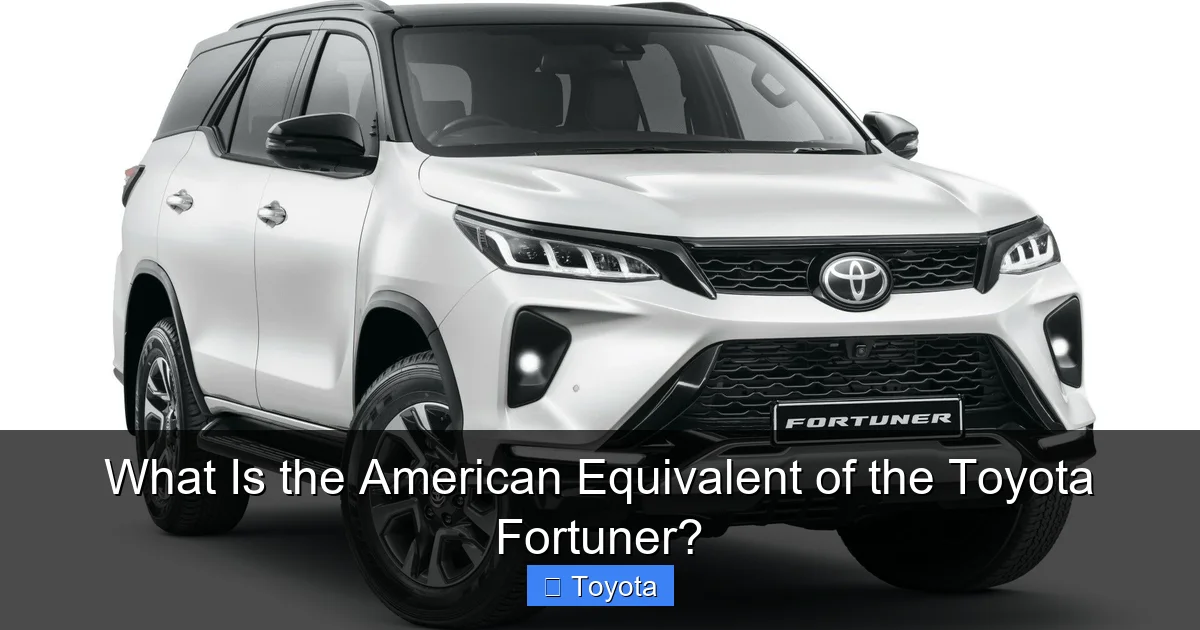
Before hunting for an equivalent, we must understand the original. The Toyota Fortuner (also sold as the SW4 in some markets) is a midsize, body-on-frame SUV. It’s built on the same platform as the Toyota Hilux pickup truck. This construction means it has a separate, rigid ladder-frame chassis with the body mounted on top. The result? Exceptional torsional stiffness, incredible durability under load, and superior capability for off-roading and towing.
Global Popularity and Market Positioning
The Fortuner is a massive hit in emerging markets and regions with challenging terrain. In Australia, it’s a top seller among “dual cabs” (crew cab utes) and family haulers. In Southeast Asia and Africa, it’s the go-to vehicle for both urban families and rural professionals who need a single vehicle that can do everything. Its appeal lies in its simplicity, low maintenance costs, and Toyota’s legendary reliability. It’s often offered with efficient turbo-diesel engines—a rarity in the U.S.—that provide massive torque for towing and climbing.
Body-on-Frame Construction: The Core of Its Identity
This is the key differentiator. Most American SUVs you see on the road today—like the Honda Pilot, Ford Explorer (recent generations), or Toyota Highlander—are unibody. Their frame and body are a single, integrated structure. This makes them lighter, more car-like to drive, and generally more fuel-efficient. But they can twist and flex more under heavy loads or during severe off-road articulation. The Fortuner’s body-on-frame design gives it a higher payload capacity, better resistance to bending, and the ability to handle more severe off-camber situations without damage. It’s built like a truck because, underneath, it essentially is one.
Powertrain and Capability
Globally, the Fortuner is powered by a range of engines. The most famous is the 2.8-liter turbo-diesel (1GD-FTV), producing about 500 Nm (369 lb-ft) of torque. This is a towing beast. Gasoline options include a 2.7-liter and a 4.0-liter V6. Part-time 4WD systems are standard, with low-range gearing and solid rear axles on most models. Towing capacities typically range from 3,500 lbs to over 7,700 lbs (depending on market and engine), and payloads are substantial. It’s a workhorse.
Why There’s No Direct American Equivalent
So, why doesn’t Toyota just sell the Fortuner here? The answer is a classic case of “right vehicle, wrong market.” American consumer preferences and regulatory environments have evolved differently.
Visual guide about What Is the American Equivalent of the Toyota Fortuner?
Image source: down-ph.img.susercontent.com
The American Love Affair with Crossovers
Since the early 2000s, American buyers have overwhelmingly chosen unibody crossovers and SUVs over truck-based models for their daily driving needs. The ride is smoother, the handling is more predictable, and fuel economy is better. Even large families often choose a three-row crossover like a Kia Telluride or Honda Pilot over a body-on-frame SUV. The market demand for a vehicle like the Fortuner—which prioritizes ruggedness over on-road refinement—is niche here. Toyota sells the 4Runner, which is its body-on-frame offering, and it does well, but its sales are a fraction of the RAV4 and Highlander. The Fortuner would likely cannibalize 4Runner sales without adding significant volume.
Emissions, Fuel Economy, and Diesel’s Failure
The Fortuner’s global appeal is heavily tied to its diesel engines. Diesel’s high torque and excellent fuel economy are perfect for its role. However, in the United States, diesel passenger vehicles never gained widespread traction outside of heavy-duty trucks. Strict emissions regulations (particularly around NOx and particulate matter) make diesel powertrains expensive to certify and maintain. The cost of adding a diesel to the U.S. Fortuner would push its price into a range where few buyers would consider it, especially when gasoline V6s are available. Toyota would have to re-engineer it for a gasoline-only lineup, which might dilute its core character.
Brand Strategy and Platform Sharing
Toyota already has the 4Runner, which shares the same J150 platform as the Fortuner (they are essentially twins, with different styling and tuning for regional tastes). Selling both would create internal competition. For American buyers who want a Toyota body-on-frame SUV, the 4Runner is the answer. For those who want a more comfortable, car-like ride with three rows, the Highlander or Grand Highlander exists. The Fortuner’s value-oriented, workhorse positioning doesn’t have a clear place in Toyota USA’s carefully segmented lineup.
The Closest American Midsize SUVs
Now, to the meat of the question. If you can’t have a Fortuner, what American-sold SUV gives you the closest experience? We’ll break them into true body-on-frame contenders and capable unibody alternatives.
Visual guide about What Is the American Equivalent of the Toyota Fortuner?
Image source: images.carexpert.com.au
Toyota 4Runner: The Mechanical Twin
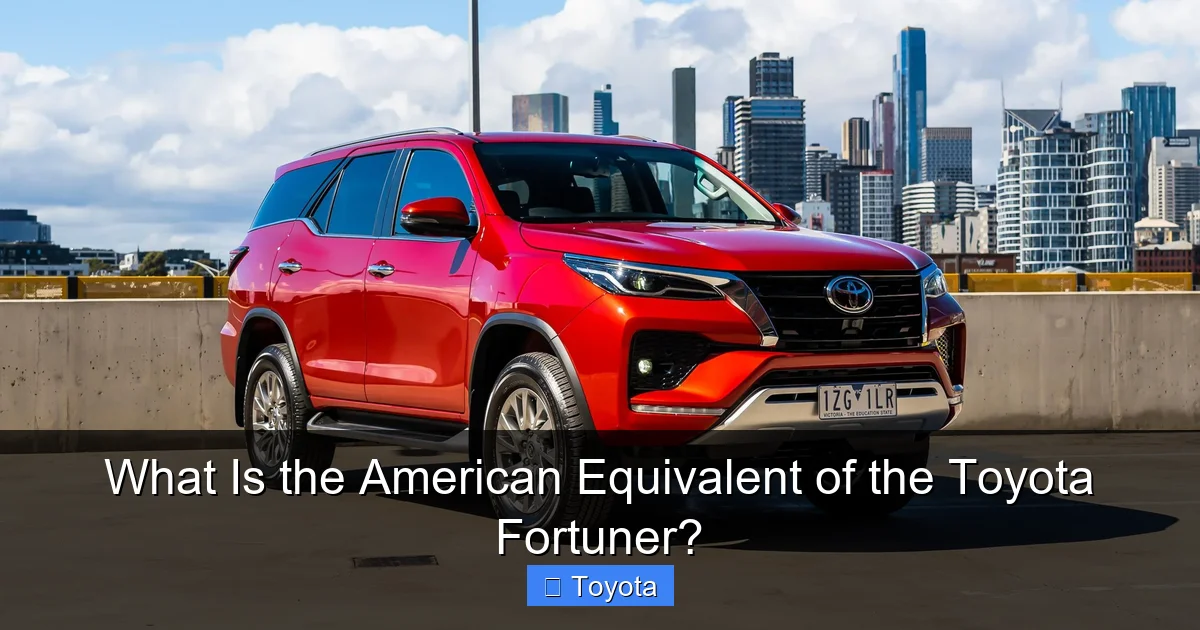
Let’s start with the obvious. The Toyota 4Runner is the Fortuner’s sibling. Both are built on the same global platform. In fact, the current generation 4Runner (J150) and Fortuner are nearly identical under the skin. The differences are mostly in styling, suspension tuning, and interior appointments for local tastes. The 4Runner sold in the U.S. comes with a 4.0-liter V6 (270 hp, 278 lb-ft) or a 4.7-liter V8 in older models. It has part-time 4WD with a transfer case low range, solid rear axle, and a body-on-frame construction. Its towing capacity is 5,000 lbs, payload around 1,500 lbs. It’s not as torquey as a diesel Fortuner, but it’s the most direct equivalent you can buy here. It’s also Japanese-made, not American, but it’s sold by Toyota USA. If you want the Fortuner experience, this is your first stop.
Ford Explorer: The American Unibody Stalwart
The Ford Explorer is a completely different animal. Since 2011, it has been a unibody crossover. But it’s included here because it’s a quintessential American three-row SUV that many Fortuner buyers might consider. It offers powerful turbocharged engines (up to 400 hp in the ST), a comfortable ride, and advanced tech. The Explorer has a maximum towing capacity of up to 5,600 lbs when properly equipped—competitive with the 4Runner. Its off-road capability, however, is limited to the optional Terrain Management System on some trims; it’s not built for rock crawling like a 4Runner. For a family that wants space, power, and American branding, but doesn’t need extreme off-road prowess, the Explorer is a strong alternative. Its strength is on-road performance and family comfort.
Jeep Grand Cherokee: Off-Road Prestige in a Unibody
Here’s another unibody that deserves mention. The Jeep Grand Cherokee, especially in its Trailhawk trim, is a surprisingly capable off-roader. It features Quadra-Drive II 4×4, a rear limited-slip differential, and impressive water fording and approach/departure angles. Its body is unibody, but Jeep has engineered it to be remarkably tough. The Grand Cherokee offers a range of engines, including a potent 5.7-liter HEMI V8 (360 hp, 390 lb-ft) that can tow up to 7,200 lbs—significantly more than the 4Runner. It’s available with three rows in the Grand Cherokee L model. It’s more refined than the 4Runner, with a quieter cabin and better on-road manners, but it doesn’t have a low-range transfer case, which is a key off-road tool. For those who want serious off-road ability without the truck-like ride, the Grand Cherokee Trailhawk is a compelling choice.
Full-Size American SUVs: Chevrolet Tahoe/Suburban and Ford Expedition
If your priority is maximum towing capacity and passenger/cargo space, you need to step up to full-size SUVs. These are also body-on-frame, based on full-size pickup truck platforms. The Chevrolet Tahoe (and extended-length Suburban) and Ford Expedition are the leaders.
The Tahoe/Suburban offer huge V8 power (5.3L or 6.2L gas, plus a 3.0L diesel option—a rare U.S. diesel SUV). Towing capacities reach up to 8,000 lbs, easily besting the Fortuner. They have massive cargo space, especially the Suburban, which is one of the longest SUVs on the market. Their body-on-frame construction means they’re built for heavy duty. However, they are enormous, making them cumbersome in cities and tight trails. Fuel economy is predictably poor. The Ford Expedition, with its twin-turbo V6, offers similar space and power (up to 9,300 lbs towing) with slightly better fuel economy. These are not direct size matches for the Fortuner (they’re one segment larger), but they are the American answer to “I need a huge, tough, high-capacity SUV.”
Detailed Feature-by-Feature Comparison
Let’s put these contenders head-to-head with the Fortuner’s key attributes. We’ll use the Fortuner’s common 2.8 diesel as a benchmark, but remember U.S. models lack diesel.
Visual guide about What Is the American Equivalent of the Toyota Fortuner?
Image source: media.cdntoyota.co.za
Towing and Payload
The Fortuner’s diesel engine gives it a towing advantage in its class, often rated around 7,700 lbs. Among our American equivalents, the full-size SUVs dominate: Tahoe/Suburban and Expedition can tow 8,000-9,300 lbs. The Jeep Grand Cherokee V8 tows up to 7,200 lbs, very close. The 4Runner and Explorer are limited to 5,000-5,600 lbs. For payload, the Fortuner can handle over 1,800 lbs in some markets. The 4Runner is similar (~1,500 lbs). Full-size SUVs carry much more, often over 1,800 lbs. The Explorer’s payload is around 1,300 lbs. If towing a large boat or horse trailer is your primary need, the full-size SUVs or Grand Cherokee V8 are your best bets.
Off-Road Capability
This is where body-on-frame shines. The Fortuner has a solid rear axle, high ground clearance, and part-time 4WD with low range. The Toyota 4Runner mirrors this exactly, with additional trims like the TRD Off-Road and TRD Pro that add locking differentials and lifted suspensions. The Jeep Grand Cherokee Trailhawk, despite being unibody, has a sophisticated 4WD system, skid plates, and impressive approach/departure angles, making it a serious contender. The Explorer has no true low-range gearing; its system is more for light snow and mud. The full-size SUVs have decent 4WD systems but their size limits them on narrow, technical trails. For dedicated off-roading, the 4Runner is the clear winner, with the Grand Cherokee Trailhawk as a capable, more comfortable alternative.
Passenger and Cargo Space
The Fortuner typically seats 7-8 in a 2-3-2 or 2-3-3 configuration, with a spacious third row suitable for children. Cargo space behind the third row is modest but usable. The Toyota 4Runner offers similar seating (2-3-3) but its third row is famously cramped for adults; cargo space is also tight. The Ford Explorer has a more comfortable third row and excellent cargo space, especially with the fold-flat seats. The Grand Cherokee L (three-row) has a decent third row but less cargo than the Explorer. The full-size Tahoe/Suburban and Expedition are in a league of their own, with massive third rows and cavernous cargo holds. If family space is paramount, the American full-size and the Explorer beat the Fortuner and 4Runner.
On-Road Comfort and Refinement
Here, the Fortuner’s truck roots show. Its ride is firm, and road noise is noticeable. The 4Runner shares this character—it’s capable but not plush. The American unibody SUVs excel: the Explorer and Grand Cherokee offer quieter cabins, smoother rides, and more responsive steering. The full-size SUVs, while still truck-based, have improved dramatically with independent rear suspensions (Tahoe/Suburban) and advanced damping, offering a more compliant ride than in the past, though still not as smooth as a unibody. For daily commuting and highway travel, the Explorer or Grand Cherokee will feel more luxurious.
Fuel Economy and Running Costs
This is the Fortuner’s secret weapon in other markets: diesel efficiency. In the U.S., with only gasoline, the comparison changes. The 4Runner’s 4.0L V6 gets about 16/19 MPG city/highway. The Explorer’s turbo V6s get similar or slightly worse. The Grand Cherokee V8 is a gas guzzler at 13/19 MPG. The full-size SUVs with V8s are in the 14-17 MPG range. The Fortuner’s diesel would theoretically achieve 22-26 MPG, but since it’s not here, American equivalents are all thirstier. Maintenance costs for the 4Runner are very low due to its simplicity and Toyota reliability. The American rivals have more complex systems that could be costlier over time. If fuel costs are a major concern, consider a hybrid like the Toyota Grand Highlander, but that’s a different class entirely.
Pricing and Value
The Fortuner is known for being value-packed—lots of standard features for the money in its markets. In the U.S., the 2024 Toyota 4Runner starts around $41,000 and can exceed $60,000 for the TRD Pro. The Ford Explorer starts lower, around $39,000, and can reach $65,000+. The Jeep Grand Cherokee starts near $43,000, with the Trailhawk and Summit models pushing $70,000+. The full-size Chevrolet Tahoe starts around $56,000, easily exceeding $80,000. The Ford Expedition starts at about $61,000. The 4Runner holds its value exceptionally well, often better than the American rivals. The Fortuner, if sold here, would likely be priced between the 4Runner and the larger SUVs, targeting value-conscious buyers who need capability.
Which American SUV Should You Choose?
With no perfect one-to-one match, your choice depends on which Fortuner traits matter most to you.
For Off-Road Adventures: The 4Runner or Grand Cherokee Trailhawk
If your vision of the Fortuner involves muddy trails, rocky paths, and desert washes, you need true off-road gear. The Toyota 4Runner is the undisputed king in this segment. Its solid axles, low-range transfer case, and extensive aftermarket support make it a trail legend. The Jeep Grand Cherokee Trailhawk offers more luxury and on-road comfort while still being shockingly capable, thanks to its advanced 4WD system and air suspension. The 4Runner is more raw and reliable; the Trailhawk is more refined. The Nissan Frontier, a midsize truck, also shares this body-on-frame ethos and can be a budget-friendly alternative, though its SUV variant, the Pathfinder, is unibody.
For Family Hauling and Daily Comfort: The Ford Explorer
If your Fortuner would spend 90% of its time on pavement, shuttling kids to soccer practice and groceries home, then comfort, space, and on-road manners are key. The Ford Explorer delivers here. Its third row is genuinely usable for adults, the ride is smooth, and tech features are abundant. It tows respectably and has enough ground clearance for gravel roads or snow. It’s the most “American” of the bunch—big, comfortable, and powerful. It won’t win any rock-crawling contests, but for most families, it’s a more practical daily driver than a 4Runner.
For Maximum Towing and Space: The Chevrolet Tahoe/Suburban or Ford Expedition
Need to pull a large trailer, a boat, or carry a huge family plus all their gear? The midsize SUVs will feel strained. Step up to a full-size. The Chevrolet Tahoe/Suburban (especially with the 6.2L V8 or diesel) offers the highest towing capacities in this comparison, plus staggering cargo space. The Ford Expedition is arguably more refined, with its independent rear suspension providing a better ride, and it can tow even more with the right setup. These are the true workhorses, but their size makes them unwieldy in cities and parking lots. They are the American equivalent of scaling up from a Fortuner to a Land Cruiser 200 Series or a Nissan Patrol.
The Premium Alternative: Lexus GX 460
Here’s a curveball. The Lexus GX 460 is the luxury version of the Toyota 4Runner (they share the same platform). It’s not American—it’s Japanese luxury—but it’s sold in the U.S. and represents the most upscale interpretation of the Fortuner’s core formula. It has the same body-on-frame toughness and off-road ability (with a multi-terrain system), but wrapped in a quieter, more opulent cabin with premium materials. If you want Fortuner-level capability with first-class comfort, the GX is worth a look, though it starts well above $60,000. Its platform sibling, the Toyota Land Cruiser, is also available but in limited numbers and at a very high price point.
The Future: Are American Brands Catching Up?
The segment is evolving. With electrification, the lines are blurring. Electric vehicles can deliver instant torque for towing, but their heavy batteries affect payload. Will we ever see a true Fortuner equivalent sold here?
Electric Body-on-Frame? The Tesla Cybertruck Effect
The upcoming Tesla Cybertruck has sparked interest in electric truck-based vehicles. Rivian’s R1T is another. While these are trucks, their underlying skateboard platforms could spawn SUV variants. Imagine a three-row, all-electric SUV with the towing capacity of a diesel and the low-end torque of an electric motor. It could be the modern evolution of the Fortuner’s ethos. However, these will be premium, expensive vehicles initially. The challenge will be building an affordable, durable, electric SUV for the masses that retains true off-road capability without the weight penalty of huge batteries.
Market Shifts and Diesel’s Possible Return
American buyers are showing more interest in efficient diesel engines for trucks, thanks to models like the Ram 1500 EcoDiesel. There’s a niche that appreciates diesel’s torque and range. Could we see a diesel option return to a body-on-frame SUV? Possibly, but emissions technology makes it costly. More likely, we’ll see advanced turbocharged gasoline engines and hybrids filling the gap. The Toyota Grand Highlander Hybrid, for example, offers three rows and great fuel economy but is unibody. The future Fortuner equivalent might be a hybrid body-on-frame SUV, but that’s speculative.
Conclusion
So, what is the American equivalent of the Toyota Fortuner? The honest answer is: there isn’t a single one. The Fortuner occupies a unique space that the U.S. market has intentionally moved away from. Its closest sibling, the Toyota 4Runner, is available here and captures the essence perfectly—rugged, capable, no-frills. If you want American branding, the Ford Explorer offers family-friendly space and comfort, while the Jeep Grand Cherokee Trailhawk provides a luxurious off-road experience. For sheer size and towing power, the Chevrolet Tahoe/Suburban or Ford Expedition are the giants you’d scale up to.
Your decision should hinge on your priorities. Ask yourself: How often will I truly go off-road? How much will I tow? How many people will I carry? How much do I value a smooth ride? The Fortuner’s global success comes from doing many things adequately for a great price. In the U.S., you have to choose which “adequate” matters most—and pay for it accordingly. The 4Runner remains the purest spiritual successor, a testament to the Fortuner’s winning formula. But America’s diverse needs have birthed a diverse set of alternatives, each with its own strengths. Test drive them with your specific tasks in mind. You’ll find an American SUV that fits your version of the Fortuner dream.
Frequently Asked Questions
What is the closest American equivalent to the Toyota Fortuner?
The Toyota 4Runner is the most direct equivalent, as it shares the same body-on-frame platform and is sold in the U.S. For American-branded options, the Ford Explorer (unibody) and Jeep Grand Cherokee (unibody) offer similar size and capability, while the Chevrolet Tahoe is a larger, full-size body-on-frame alternative.
Why doesn’t Toyota sell the Fortuner in the United States?
Toyota doesn’t sell the Fortuner in the U.S. because American buyers prefer unibody crossovers for comfort and fuel economy. The Fortuner’s diesel engines, which are key to its global appeal, are not commercially viable in the U.S. due to emissions regulations and low demand. Toyota already offers the 4Runner for the niche body-on-frame SUV market here.
How does the Toyota 4Runner compare to the Fortuner?
The 4Runner and Fortuner are mechanical twins, built on the same platform. The main differences are styling and engine options: the U.S. 4Runner uses a gasoline V6, while global Fortuners often have turbo-diesel engines. The 4Runner is slightly more focused on on-road comfort for American tastes, but both offer identical body-on-frame construction, part-time 4WD, and off-road capability.
Is the Ford Explorer a good alternative to the Fortuner?
The Ford Explorer is a good alternative if you prioritize three-row family space, on-road comfort, and powerful turbocharged engines over extreme off-road capability. It’s a unibody crossover, so it rides smoother and is more fuel-efficient than the Fortuner, but it lacks a low-range transfer case and solid rear axle for serious off-roading.
What about the Chevrolet Tahoe or Suburban as equivalents?
The Chevrolet Tahoe and Suburban are larger, full-size, body-on-frame SUVs. They offer significantly more towing capacity, passenger space, and cargo room than the Fortuner. They are the American step up if you need maximum capacity, but their size makes them less maneuverable and much less fuel-efficient.
Which American SUV has the best towing capacity like the Fortuner?
For towing capacity similar to or exceeding the Fortuner’s diesel models, look at the Jeep Grand Cherokee with its V8 (up to 7,200 lbs) or the full-size SUVs: Chevrolet Tahoe/Suburban and Ford Expedition, which can tow up to 8,000-9,300 lbs. The Toyota 4Runner is limited to 5,000 lbs.