
Twin Cam 88 Oil Capacity Guide

Knowing the precise Twin Cam 88 oil capacity is non-negotiable for engine health. This guide provides the exact specifications for all models, explains how to read the dipstick correctly, and highlights the critical importance of using the right oil type and avoiding overfilling. Protect your investment with these essential, model-specific details.
So, you own a Twin Cam 88. That legendary V-twin heart that defines a generation of Harley-Davidson motorcycles. You love the rumble, the feel, the freedom. But to keep that heart beating strong for the long haul, there’s one fundamental piece of knowledge you absolutely must master: the correct Twin Cam 88 oil capacity. It sounds simple, right? Just drain the old stuff and pour in the new. But getting it wrong—even by a small margin—is one of the fastest tracks to a very expensive engine rebuild. This isn’t just about a number; it’s about understanding your machine, respecting its engineering, and performing a maintenance task that directly impacts its survival. Let’s dive deep into everything you need to know, from factory specs to the final dipstick check.
Key Takeaways
- Exact Capacity Varies: The Twin Cam 88 oil capacity is not one-size-fits-all. It differs between Softail, Dyna, and Touring models, and even between years with or without a oil cooler.
- Dipstick is King: The final, correct oil level is always determined by the dipstick reading after the engine is at operating temperature, not by the initial quarts poured in.
- Oil Type Matters: Using the correct viscosity (typically 20W-50) and specification (Harley-Davidson or equivalent) is as important as the correct volume for proper lubrication and cooling.
- Overfilling is Dangerous: Adding too much oil causes aeration, foaming, and pressure buildup, leading to severe engine damage. Always verify with the dipstick.
- Filter Change = Capacity Change: The stated capacity usually includes a new oil filter. If you reuse the old filter, you will need slightly less oil to achieve the correct level.
- Temperature Affects Reading: Oil expands when hot. The only accurate dipstick check is when the engine is warm and on level ground, following the specific procedure in your manual.
- Regular Checks Prevent Disaster: Frequently checking the oil level is the single best habit a rider can have to catch leaks early and ensure long-term engine reliability.
📑 Table of Contents
Understanding the Twin Cam 88 Engine Family
Before we talk quarts, we need to talk models. The “Twin Cam 88” name refers to the 88 cubic inch (1450cc) displacement engine, but it was used across multiple Harley-Davidson motorcycle platforms from 1999 to 2006. The primary families are:
- Dyna: Sportster-based frame models like the Dyna Super Glide, Wide Glide, and Low Rider.
- Softail: Models with hidden rear suspension, like the Heritage Softail, Fat Boy, and Springer Softail.
- Touring: The full-dresser giants: Road King, Road Glide, Electra Glide, and Street Glide.
Each of these platforms has a slightly different oiling system, sump design, and sometimes, an optional oil cooler. This is the first critical reason the oil capacity isn’t universal. The engine’s internal architecture dictates how much oil it needs to properly lubricate the top end (valvetrain, rockers, cam bearings) and the bottom end (crank, rods, piston pins) while also being splashed around for cooling and having enough volume in the sump to supply the pump without aeration. For a comprehensive look at how different systems affect fluid needs, our general guide on oil capacity truths explains the core principles that apply here, too.
The Factory Specs: A Breakdown by Model
Here are the official, dry fill capacities from Harley-Davidson service manuals. “Dry fill” means the engine is completely empty of oil—no residual oil in the crankcase, lines, or filter after a proper drain.
- Dyna Models (1999-2006): Approximately 3.0 quarts (2.8 liters). This is the baseline capacity for most non-cooler Dyna configurations.
- Softail Models (1999-2006): Approximately 3.5 quarts (3.3 liters). The Softail’s frame design and oil tank placement typically require a half-quart more than the Dyna platform.
- Touring Models (1999-2006) WITHOUT Oil Cooler: Approximately 4.0 quarts (3.8 liters). The larger frame and longer oil paths necessitate more fluid.
- Touring Models (1999-2006) WITH Oil Cooler: Approximately 4.5 quarts (4.3 liters). The auxiliary oil cooler and its connecting lines add significant volume to the system.
Critical Note: These are starting points. Your final, correct level is always set by the dipstick. Factors like a slightly overfilled or underfilled factory, residual oil left in the case after a drain, or even the specific brand of oil filter (some hold more or less) can change the exact amount you need by up to a half-cup. Never rely solely on the quart count.
The Holy Grail: Reading the Dipstick Correctly
This is the most important skill in this entire guide. You can have the exact factory spec memorized, but if you don’t check the dipstick properly, you might as well be guessing. The process is specific and must be followed exactly.
Visual guide about Twin Cam 88 Oil Capacity Guide
Image source: takeuroil.com
The Step-by-Step Procedure
1. Warm the Engine: Start your bike and let it idle until it reaches normal operating temperature. The oil must be hot (around 180-200°F / 82-93°C) to expand to its working volume. Cold oil will give a falsely low reading.
2. Park Level: This is non-negotiable. Park your motorcycle on a perfectly level surface, ideally on a garage floor, not a slanted driveway or side stand on uneven ground. Use the center stand if you have one.
3. Idle and Check: With the engine still running and at idle, pull the dipstick, wipe it clean, reinsert it fully, and then pull it out again for the reading. The oil level should be between the “F” (Full) and “L” (Low) marks, or within the crosshatched area. For many Twin Cams, the ideal spot is right at the “F” mark or just below it when the engine is hot and idling.
4. Adjust and Re-check: If it’s low, add oil in small increments (a few ounces at a time), let it settle for a minute, and re-check. If it’s over the “F” mark, you must drain some out. Overfilling is a silent killer that causes foaming and loss of lubrication. If you’re ever in doubt about removing excess, our detailed guide on how to safely drain oil covers the principles that apply to motorcycles as well.
Why the Running Check? When the engine is running, the oil pump is circulating oil through the entire system—the tank, cooler, filter, and engine passages. Checking it this way ensures the level is correct with the system full and pressurized, which is the true operational state. Checking it with the engine off can give a reading that is too high, as oil drains back into the sump from the top end and cooler.
Choosing the Right Oil: It’s Not Just About Weight
You’ve got the capacity right. Now, what are you putting in there? For the Twin Cam 88, the recommended viscosity is almost universally SAE 20W-50. But the “W” grade and the specification are equally important.
Visual guide about Twin Cam 88 Oil Capacity Guide
Image source: takeuroil.com
Harley-Davidson Specification vs. Generic Oil
Harley-Davidson licenses its oil specification (often seen as “H-D” or “Harley-Davidson” on the bottle) to major brands like Mobil 1, Castrol, and Shell. These oils are formulated to meet the specific demands of the air-cooled V-twin: high temperatures, high shear forces, and resistance to dilution from fuel and combustion byproducts. A generic “20W-50” motorcycle oil may not have the same additive package or shear stability.
Our Recommendation: Use a high-quality oil that meets the Harley-Davidson specification. Look for the JASO MA/MA2 standard (for wet-clutch compatibility) and the H-D spec on the bottle. Brands like Mobil 1 V-Twin 20W-50, Castrol Power 1 V-Twin 20W-50, or Shell Rotella T6 (a favorite among many HD owners for its value and performance, though it’s a heavy-duty diesel oil that meets motorcycle specs) are excellent choices. Synthetic or synthetic-blend is strongly recommended for the high operating temperatures of the Twin Cam.
Performing the Oil Change: A Practical Walkthrough
Now, let’s put it all together. Here is a simplified, best-practice procedure.
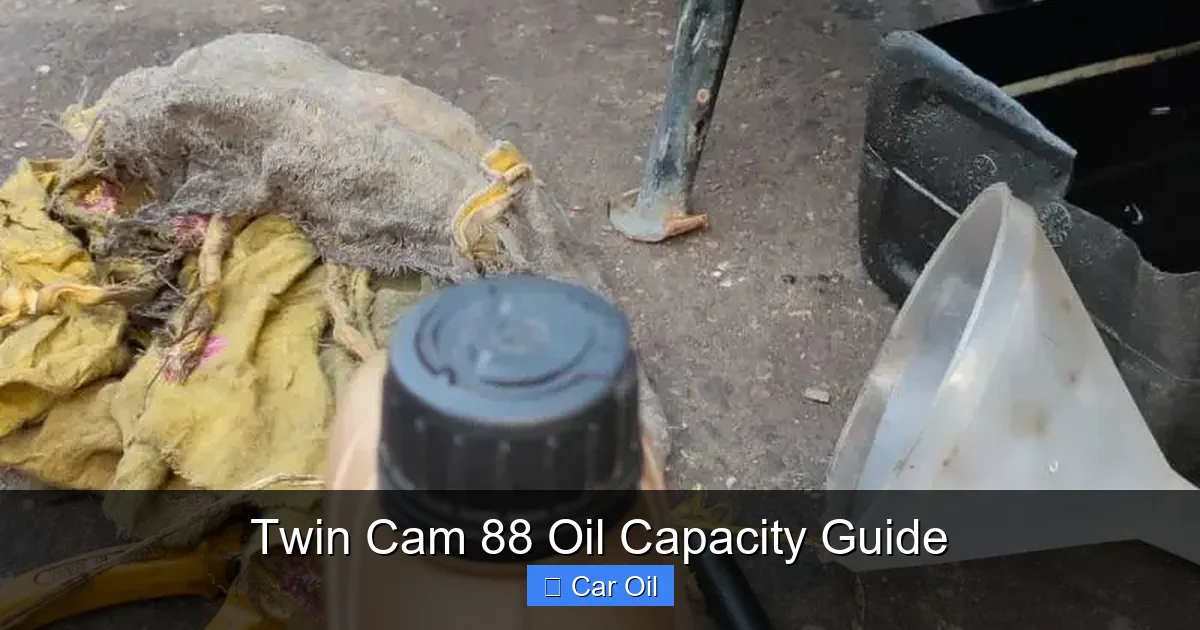
Visual guide about Twin Cam 88 Oil Capacity Guide
Image source: takeuroil.com
- Warm the Oil: Ride the bike for at least 15-20 minutes to get the oil thoroughly hot. Hot oil flows out faster and carries more contaminants with it.
- Prepare: Position your drain pan. You’ll need a 5/8″ or 10mm Allen wrench for the drain plug (location varies—often under the left side footboard or frame). Have your new oil filter (Harley OEM or a high-quality aftermarket like K&N or Donaldson) and the correct amount of new oil ready.
- Drain: Remove the drain plug. Let it drip completely. Some models also have a drain plug on the oil tank itself; consult your manual. Replace the drain plug washer with a new one and torque the plug to spec (usually around 18-20 ft-lbs).
- Replace Filter: Remove the old filter. Before installing the new one, lightly coat the rubber seal with fresh oil. Hand-tighten it until the seal contacts, then give it the specified additional turn (usually 3/4 to 1 turn). Do not overtighten.
- Fill and Check: Pour in about 75% of the estimated capacity (e.g., 3 quarts for a Dyna). Start the engine, let it idle for a minute (this fills the filter and lines), then shut it off. Wait 2-3 minutes for oil to settle. Now, perform the hot, running dipstick check as described above. Add oil in small amounts until it’s correct. You will likely not need the full last quarter-quart.
Remember to properly dispose of your old oil and filter. Our complete guide on safe oil disposal provides eco-friendly options that work for motorcycle oil as well.
Common Pitfalls and How to Avoid Them
Even with the best intentions, mistakes happen. Here are the most frequent ones.
Overfilling: The Silent Assassin
This is the #1 error. More oil is not better. When the crankshaft churns through an overfilled sump, it whips the oil into a frothy, aerated foam. This foam cannot be pumped effectively, leading to a sudden and catastrophic loss of oil pressure. The engine is suddenly running on foam, not liquid, and metal-to-metal contact occurs in seconds. Symptoms can include a sudden spike and then drop on the oil pressure gauge, smoke from the breathers, and ultimately, engine seizure. If you suspect overfilling, drain some out immediately and re-check the level.
Using the Wrong Oil
Using a non-motorcycle oil (like car engine oil) or a non-JASO MA oil can cause clutch slippage because many motorcycle clutches share the same oil bath. Using the wrong viscosity (like 10W-40 in a hot climate) can lead to excessive wear and oil consumption. Stick to the specs.
Ignoring the Dipstick Procedure
Checking the oil cold, on a slope, or with the engine off will give you a false reading. You will either overfill or, just as bad, run low. Running low starves the engine of lubrication, causing premature wear on cam lobes, bearings, and piston pins. Make the proper dipstick check a non-negotiable ritual after every oil change and at least once a month.
Conclusion: Your Engine’s Lifeline
The Twin Cam 88 is a robust, beloved engine, but it is not indestructible. Its oiling system is finely tuned, and the correct oil capacity is a fundamental part of that tune. By understanding that the capacity varies by model, that the dipstick reading is the ultimate authority, and that using the specified 20W-50 oil is critical, you take a massive step in ensuring your Harley’s longevity. An oil change is more than a maintenance task; it’s a direct conversation with your engine. You’re telling it you care. You’re giving it the clean, correct-volume fluid it needs to cool, lubricate, and protect its intricate parts under extreme stress. Don’t guess. Don’t eyeball it. Use this guide, consult your owner’s manual, and always, always verify with the dipstick while the engine is hot and running. A few extra minutes of care now saves thousands of dollars and countless heartbreak down the road. Ride safe, maintain faithfully, and enjoy that glorious Twin Cam rumble for years to come.
Frequently Asked Questions
What happens if I overfill the oil in my Twin Cam 88?
Overfilling causes the crankshaft to aerate the oil, turning it into foam. This foam cannot be pumped, leading to a sudden loss of oil pressure and potential catastrophic engine failure within minutes. Always verify the level with the hot, running dipstick.
Is the oil capacity different for a Softail vs. a Dyna Twin Cam 88?
Yes. Dyna models typically hold about 3.0 quarts, while Softail models usually require about 3.5 quarts when dry. Touring models require even more, up to 4.5 quarts with an oil cooler. Always use the dipstick to confirm the final level.
Can I use regular car oil in my Twin Cam 88?
No. You must use a motorcycle-specific oil with the JASO MA or MA2 specification. Car oils contain friction modifiers that can cause clutch slippage in a motorcycle’s wet-clutch design. Use a high-quality 20W-50 that meets Harley-Davidson’s specification.
How often should I check the oil level on my Twin Cam?
You should check the oil level at least once a month using the proper hot, running, level-ground procedure. It’s also a good habit to check it before every long ride. Catching a slow leak or consumption issue early can prevent a major problem.
Why is my oil level dropping between changes?
A small, steady drop can be normal due to oil consumption, especially in high-mileage engines or with hard riding. However, a rapid or significant drop indicates a leak (check the primary chaincase, gearcase, and seals) or an internal issue like worn piston rings or valve guides. Investigate any significant loss promptly.
Do I need to change the oil filter every time I change the oil?
Absolutely yes. The oil filter is a critical component that traps metal particles and contaminants. Reusing an old, clogged filter restricts oil flow and allows dirty oil to circulate, defeating the purpose of the oil change. Always install a new, high-quality filter with every oil change.
