
What Is the Check Engine Light on a 2018 Toyota Sienna?

The check engine light on a 2018 Toyota Sienna is a critical dashboard warning indicating the engine computer has detected a problem affecting emissions or performance. It can range from a simple loose gas cap to a serious mechanical failure. Driving with a steady light is generally safe temporarily, but a flashing light requires immediate stop-and-tow service to prevent engine damage. Always retrieve the stored diagnostic trouble codes (DTCs) for an accurate diagnosis.
Key Takeaways
- It’s a universal warning: The check engine light (CEL) illuminates when the Sienna’s Engine Control Module (ECM) detects an issue outside normal parameters, primarily related to emissions.
- Steady vs. Flashing: A steady light means a non-emergency issue (like a faulty gas cap). A flashing light indicates a severe misfire that can damage the catalytic converter—stop driving immediately.
- Code is key: The light itself doesn’t diagnose the problem. A mechanic or scan tool must read the stored Diagnostic Trouble Code (DTC) to pinpoint the faulty system or component.
- Common culprits: Frequent causes include a loose or damaged gas cap, faulty Oxygen (O2) sensors, failing catalytic converter, bad mass airflow sensor, or spark plug/ignition coil issues.
- Don’t ignore it: Even if the van drives fine, an illuminated CEL will cause it to fail emissions testing and can lead to poor fuel economy, reduced performance, and expensive future repairs.
- DIY vs. Pro: You can safely check and tighten the gas cap and read basic codes with an inexpensive OBD2 scanner. Complex repairs like sensor or catalytic converter replacement should be left to professionals.
- Reset after repair: The light will not turn off on its own after fixing the problem. The DTC must be cleared using a scan tool, and the van must complete its self-tests (drive cycle) to ensure the issue is truly resolved.
📑 Table of Contents
- Understanding Your Sienna’s “Service Engine Soon” Light
- What the Check Engine Light Means: Steady vs. Flashing
- Top 5 Common Causes in a 2018 Toyota Sienna
- How to Diagnose the Problem: From Simple to Advanced
- How to Reset the Check Engine Light (And Why You Shouldn’t Do It Prematurely)
- When to Seek Professional Help Immediately
- Preventive Maintenance to Avoid Future Lights
Understanding Your Sienna’s “Service Engine Soon” Light
That little, amber-colored engine-shaped icon on your 2018 Toyota Sienna’s dashboard isn’t just a decorative annoyance. It’s the central nervous system’s primary way of communicating that something under the hood needs your attention. Officially called the Malfunction Indicator Lamp (MIL), it’s more commonly known as the check engine light. Its sole purpose is to protect your vehicle’s emissions systems and overall engine health. When it glows, it means the Sienna’s sophisticated computer, the Engine Control Module (ECM), has run a self-test on a system or component and found a value outside its acceptable range. Think of it as your van’s way of saying, “Hey, I’m not running as cleanly or efficiently as I should be.”
For a family hauler like the Sienna, reliability is paramount. Ignoring this light is like ignoring a persistent cough—it might be nothing, or it could be the sign of a serious condition getting worse. The light is your first and most important line of defense against minor issues becoming major, costly repairs. In this guide, we’ll break down everything a Sienna owner needs to know about this crucial warning, from the simple fixes you can check yourself to the problems that demand a professional’s touch.
What the Check Engine Light Means: Steady vs. Flashing
Not all check engine light illuminations are created equal. The behavior of the light provides your first, most critical clue about the severity of the problem. Paying attention to this difference can save you from a tow bill or, worse, catastrophic engine damage.
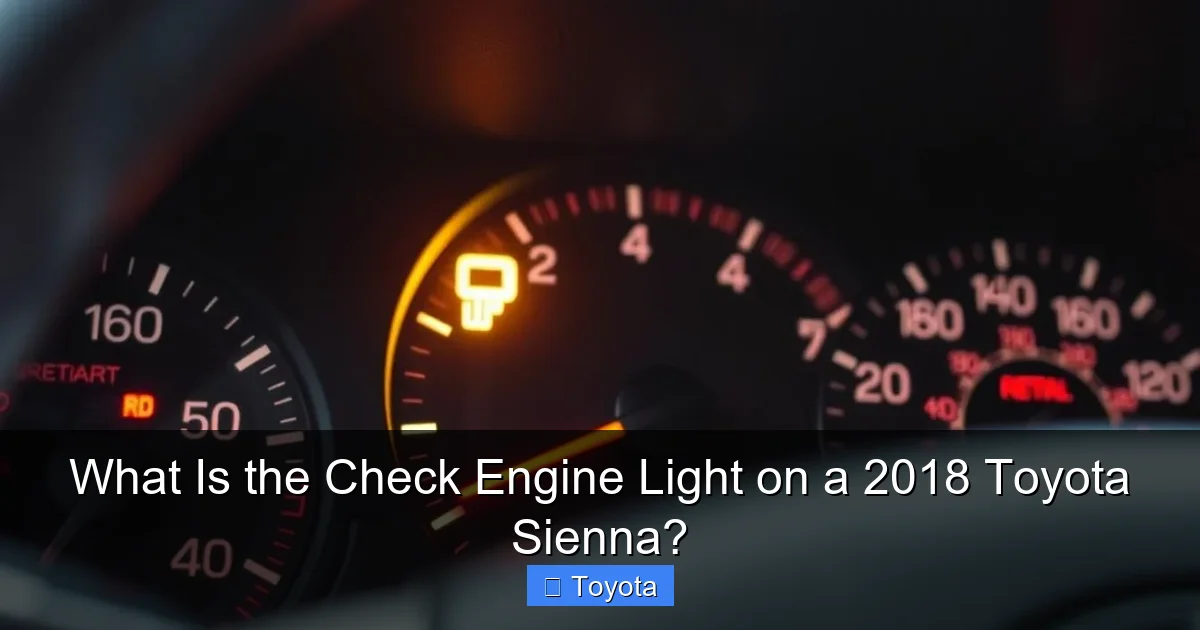
Visual guide about What Is the Check Engine Light on a 2018 Toyota Sienna?
Image source: vehiclebright.com
The Steady Glow: A “Schedule an Appointment” Signal
A solid, steady check engine light is the most common scenario. It indicates a problem that is currently affecting your Sienna’s emissions output but is not immediately destructive to the engine. You can usually drive the van for a short period to reach a safe location or a repair shop. Common steady-light causes include a loose gas cap (the most frequent culprit!), a failing oxygen sensor, or an issue with the evaporative emission (EVAP) system, which manages fuel vapors. While driving, you might not notice any change in performance, or you might experience slightly reduced fuel economy. The key point: it’s a “get it checked soon” warning, not a “stop now” emergency.
The Flashing or Blinking Light: A “Stop Now” Emergency
This is the scenario that should never be ignored. If the check engine light is flashing or blinking, it means the ECM has detected a severe engine misfire. A misfire is when fuel in one or more cylinders fails to ignite, or ignites at the wrong time. Unburned fuel is then being dumped directly into the exhaust system. This has a devastating effect: it rapidly overheats and can permanently destroy the catalytic converter, a critical and expensive emissions component. Driving even a mile with a flashing CEL can cause thousands of dollars in damage. If your 2018 Sienna’s check engine light is flashing, pull over safely, turn off the engine, and call for a tow. Do not attempt to drive it to a shop.
Top 5 Common Causes in a 2018 Toyota Sienna
The Sienna, especially the 2018 model with its likely 3.5L V6 (2GR-FKS) engine, is a robust vehicle, but it has common failure points that trigger the MIL. Understanding these can help you anticipate the problem before a mechanic even plugs in the scan tool.
Visual guide about What Is the Check Engine Light on a 2018 Toyota Sienna?
Image source: nissancheckenginelight.com
1. Loose, Damaged, or Missing Gas Cap
This is the #1 cause of a check engine light across all makes and models, and the Sienna is no exception. The gas cap seals the fuel system, preventing vapors from escaping. If it’s not tightened properly (you should hear at least three clicks), is cross-threaded, or the seal is cracked, the EVAP system fails its pressure test, and the ECM sets a code like P0455 (Large EVAP Leak) or P0440 (EVAP Malfunction). The fix is simple: remove the cap, inspect the seal for cracks, reinstall it firmly until it clicks, and drive for a few days. If the light persists, the cap itself may need replacement.
2. Faulty Oxygen (O2) Sensors
Your Sienna has multiple O2 sensors—typically one before and one after the catalytic converter on each exhaust bank. They monitor oxygen levels in the exhaust to help the ECM adjust the air-fuel mixture for optimal combustion and catalyst efficiency. Over time, these sensors can become sluggish or fail, sending incorrect data. A common code is P0131/P0135 (Bank 1 Sensor 1) or similar. A bad O2 sensor reduces fuel economy, increases emissions, and can cause rough running. Replacement is the typical fix.
3. Failing Catalytic Converter
The catalytic converter is an expensive part that burns off unburned hydrocarbons and other pollutants. It can fail due to age, contamination from oil or antifreeze, or from being destroyed by a prolonged engine misfire (see the flashing light section). Codes like P0420 (Catalyst System Efficiency Below Threshold) indicate it’s no longer working effectively. Symptoms include poor acceleration, rotten egg smells, and failing an emissions test. This is a major repair.
4. Bad Mass Airflow (MAF) Sensor
The MAF sensor measures the amount of air entering your Sienna’s engine. This data is absolutely critical for the ECM to calculate the correct amount of fuel to inject. A dirty or failed MAF sensor (often code P0101/P0102) will cause a rich or lean air-fuel mixture, leading to rough idling, hesitation, stalling, and significantly worse fuel economy. Sometimes, cleaning it with a dedicated MAF cleaner can help, but replacement is often necessary.
5. Ignition System Issues (Spark Plugs & Coils)
The 3.5L V6 in the 2018 Sienna uses individual coil-on-plug ignition. Worn-out spark plugs or a failing ignition coil can cause a misfire. A single-cylinder misfire will often set a code like P0301 (Cylinder 1 Misfire Detected). If multiple cylinders are affected, you might see P0300 (Random/Multiple Cylinder Misfire). Symptoms include a rough idle, loss of power, and potentially a flashing check engine light if the misfire is severe enough. This is a common and relatively straightforward repair on this engine.
How to Diagnose the Problem: From Simple to Advanced
So the light is on. Now what? You have a path from a 5-minute DIY check to a full professional diagnosis.
Visual guide about What Is the Check Engine Light on a 2018 Toyota Sienna?
Image source: nissancheckenginelight.com
Step 1: The Immediate, Free Check
Before you do anything else, pop the hood and check the gas cap. Is it on tight? Give it a firm turn until you hear the clicks. Look at the cap’s seal—is it cracked, shrunk, or missing? If you have a spare cap, try it. Sometimes, simply reseating the cap will cause the light to go off after a few drive cycles. This solves a huge percentage of cases.
Step 2: Read the Diagnostic Trouble Codes (DTCs)
This is the non-negotiable next step. You need to know what the computer is complaining about. You have two main options:
- Use an OBD2 Scanner: Any basic OBD2 scanner (available for $20-$50) can plug into the port under your Sienna’s dashboard (left of the steering wheel). Turn the ignition to “ON” (don’t start), and read the codes. Note the alphanumeric code (e.g., P0420). Look it up online for a general description. For Toyota-specific codes and live data, a more advanced scanner like an AutoEnginuity or a professional-grade tool is better.
- Visit a Parts Store or Mechanic: Many auto parts stores (like AutoZone, Advance Auto Parts) offer free code reading as a customer service. A repair shop will do this as part of their diagnostic fee, which is usually credited toward the repair if you use them.
Remember, the code tells you *what* system has a problem, not *which specific part* is bad. A P0301 code means “Cylinder 1 Misfire,” but the cause could be the spark plug, ignition coil, fuel injector, or even a compression issue.
Step 3: Research and Basic Inspection
Once you have a code, research it specifically for your 2018 Sienna 3.5L engine. Forums like SiennaChat are invaluable resources where real owners document their fixes. With the code in hand, you can perform basic visual inspections: look for damaged wiring, disconnected vacuum hoses, or obvious leaks. For sensor-related codes, you might check connector cleanliness. However, many components require testing with a multimeter or scope, which is where professional expertise is often needed.
How to Reset the Check Engine Light (And Why You Shouldn’t Do It Prematurely)
Once the underlying problem is fixed, the check engine light will remain on until the code is cleared and the vehicle’s onboard diagnostic system verifies the repair through a series of “drive cycles.” Simply disconnecting the battery is an old-school method that often doesn’t work on modern vehicles like the Sienna and can also reset other systems like the radio and climate control presets.
The Correct Way to Reset
The only reliable way to turn off the light is by using an OBD2 scan tool that has a “Clear Codes” or “Erase DTCs” function. After clearing the codes, you must then drive the van under varying conditions (cold start, highway speeds, idle, deceleration) to allow all the ECM’s monitors to run and complete successfully. This process can take 50-100 miles of driving. If the problem persists, the light will come back on, and the code will be stored again.
Why You Should Fix, Not Just Reset
Resetting the light without repairing the cause is pointless and harmful. The light is a symptom, not the disease. Clearing it is like turning off a fire alarm without putting out the fire. The problem will worsen, potentially leading to more expensive damage. Furthermore, if you take your Sienna for a state emissions inspection, they will perform a readiness check. If your monitors haven’t completed (because you cleared the code and didn’t drive enough, or because the problem is still there), you will fail the inspection automatically, even if the light is off. Always repair first, then reset and drive to complete the cycle. For specific reset procedures on other Toyota models, you can find detailed guides here.
When to Seek Professional Help Immediately
While some check engine light causes are DIY-friendly, others absolutely require a trained technician, especially on a complex vehicle like a 2018 Sienna.
Call a professional if:
- The light is flashing. This is an emergency.
- You have severe symptoms like complete loss of power, engine overheating, thick smoke from the exhaust, or unusual loud noises accompanying the light.
- The codes point to critical emissions components like the catalytic converter, or complex sensor systems like the Variable Valve Timing (VVT-i) system.
- You’ve fixed a simple issue (like the gas cap), but the light returns with the same or a new code after a drive cycle.
- You are uncomfortable or lack the tools to perform electrical tests or component replacements.
A professional shop will not only read the codes but will perform “pinpoint tests” to verify the actual faulty component. They have access to factory service manuals, advanced diagnostic software, and the experience to interpret live data streams from your Sienna’s engine. For a related Toyota issue involving dashboard warnings and system resets, understanding the ECT Power button’s function on your Sienna can be helpful context for overall vehicle operation.
Preventive Maintenance to Avoid Future Lights
The best way to deal with a check engine light is to prevent it from coming on in the first place. Adhering to your 2018 Sienna’s maintenance schedule is your strongest defense.
- Regular Oil Changes: Clean oil reduces engine wear and prevents sludge, which can cause a host of sensor and performance issues.
- Replace Air Filters: A clogged engine air filter starves the engine of air, causing a rich condition that can trigger MAF and O2 sensor codes. Replace it as recommended.
- Use Quality Fuel: Poor-quality or contaminated gasoline can cause misfires and carbon buildup. Stick to Top Tier-rated fuels when possible.
- Inspect Spark Plugs & Ignition Components: Follow the severe or normal service intervals in your owner’s manual. On the 3.5L V6, replacing spark plugs and coils as preventative maintenance is a wise investment.
- Address Small Problems Fast: That minor rough idle or slight drop in fuel economy? Get it checked before it sets a code and triggers the light. Catching a small vacuum leak or a slightly weak coil early saves money.
By staying proactive with your Sienna’s care, you’ll keep that check engine light off for the long haul, ensuring your family hauler remains reliable, efficient, and ready for the next adventure.
Frequently Asked Questions
Can I keep driving my Sienna if the check engine light is on?
If the light is steady and the van is running normally, you can drive it a short distance to a repair shop. However, if the light is flashing, or if you notice severe roughness, loss of power, or overheating, stop driving immediately and seek a tow.
What’s the first thing I should do when the light comes on?
The very first step is to safely pull over and check your gas cap. Ensure it’s tightened properly until it clicks. A loose cap is the most common cause. If that doesn’t turn the light off after a few trips, you’ll need to have the diagnostic codes read.
How much does it typically cost to diagnose a check engine light?
Many auto parts stores offer free code reading. Repair shops usually charge a diagnostic fee (often $80-$150) which is typically applied to the repair cost if you proceed with them. This fee covers the technician’s time to scan, research, and perform tests to pinpoint the exact faulty part.
Will the check engine light turn off on its own after I fix the problem?
No. The light will stay on until the stored Diagnostic Trouble Code (DTC) is manually cleared with a scan tool. After clearing, you must drive the vehicle through its complete “drive cycle” so the computer’s monitors can verify the repair is successful. If the problem persists, the light will come back on.
My Sienna seems to run fine. Is it safe to ignore the light?
It is not advisable. Even with normal driving feel, the light indicates your emissions system is not working properly. You will fail any required emissions inspection. More importantly, a minor issue like a failing O2 sensor can reduce fuel economy and, if left unchecked, cause damage to the catalytic converter, leading to a very expensive repair.
Can low oil cause the check engine light to come on?
Low oil pressure will typically trigger the oil pressure warning light, not the check engine light. However, extremely low oil can cause engine damage that may eventually set a check engine code (like a misfire from damaged components). They are generally separate warning systems for separate issues.