
When to Change Haval Engine Oil

Your Haval’s engine oil is its lifeblood. Changing it at the right interval—based on mileage, time, or your oil life monitor—prevents costly damage. Always use Haval-approved oil and don’t ignore warning signs, even if your monitor hasn’t alerted you yet. Following the manufacturer’s schedule is the first step, but your driving habits can shorten that timeline significantly.
So, you’ve got a Haval. Maybe it’s the stylish H6, the efficient Jolion, or the sporty F7x. You love its value, its features, and that 5-year warranty. But to keep that Chinese-engineered SUV running smoothly for the long haul, there’s one ritual you absolutely cannot skip: the engine oil change. It’s not just a suggestion; it’s the single most important maintenance item for your engine’s health. But when exactly should you change Haval engine oil? The answer isn’t as simple as “every 3,000 miles” anymore. Let’s break down the science, the schedules, and the real-world signs that your Haval is crying out for fresh lubrication.
Key Takeaways
- Haval’s baseline recommendation is typically every 6 months or 5,000-7,500 miles, but your owner’s manual is the final authority. Newer models with synthetic oil may extend to 10,000 miles, but never exceed the time limit (usually one year).
- “Severe” driving—like frequent short trips, heavy traffic, or extreme temperatures—can cut your oil change interval in half. If your driving matches this description, plan for changes every 3,000-5,000 miles.
- Your Haval’s oil life monitor is a helpful tool, not a complete replacement for manual checks. It calculates based on engine revolutions and temperature, but you must still verify oil level and condition monthly.
- Using the correct oil viscosity and specification (e.g., 5W-30 meeting API SP/ILSAC GF-6) is non-negotiable for Haval engines. The wrong oil can cause wear, poor fuel economy, and trigger the check engine light.
- Ignoring oil change intervals leads to sludge, increased engine wear, and eventually catastrophic failure. The cost of a new engine far exceeds the price of regular oil changes.
- For brand-new Havals, the first oil change is critical for engine break-in and often occurs sooner (around 3,000 miles). Always follow the specific break-in procedure in your manual.
- You cannot simply add oil to extend a change interval. Topping up dilutes the existing oil and doesn’t remove contaminants; a full drain and refill is required.
📑 Table of Contents
- Understanding Haval’s Official Oil Change Recommendations
- How Your Driving Habits Shorten Oil Change Intervals
- Decoding Your Haval’s Oil Life Monitor System
- The Manual Oil Change Checklist: 5 Signs It’s Time (Even If the Light Isn’t On)
- Choosing the Perfect Oil for Your Haval Engine
- The Real Cost of Skipping Your Haval Oil Change
- Conclusion: A Simple Habit for a Long-Lasting Haval
Understanding Haval’s Official Oil Change Recommendations
Your first stop for the truth is the driver’s seat—specifically, the glove compartment. Haval, like all manufacturers, provides a tailored maintenance schedule in your owner’s manual. This isn’t a random guess; it’s the result of extensive dyno testing and fleet evaluations for your specific engine and model year. For most current Haval models equipped with turbocharged gasoline engines (like the 1.5T or 2.0T found in the H6 and F7x), the standard recommendation for Haval engine oil changes using full synthetic oil is every 7,500 miles or 12 months, whichever comes first. Some older models or those using conventional oil might still cite a 5,000-mile interval.
The Manufacturer’s Baseline Schedule
Think of this baseline as the “ideal conditions” scenario. It assumes you’re driving on clean roads, in moderate temperatures, and mostly at steady highway speeds. For the 2023 Haval H6, for instance, the manual clearly states the interval under “Normal” driving. But here’s the crucial part: Haval also defines “Severe” driving conditions, and if your lifestyle fits that category—which most urban drivers’ does—your interval drops significantly. It’s vital to read these definitions carefully. They often include:
- Driving primarily in heavy city traffic (stop-and-go).
- Frequent short trips (less than 5-10 miles) where the engine doesn’t fully warm up.
- Driving in extremely hot (above 95°F/35°C) or cold (below 0°F/-18°C) temperatures.
- Dusty, sandy, or muddy conditions.
- Towing a trailer or carrying heavy cargo regularly.
If you check even two of these boxes, you should default to the “Severe” schedule, which for many Havals means an oil change every 5,000 miles or 6 months. To fully grasp how these universal principles apply, it’s helpful to review a comprehensive guide on when to change car engine oil, which explains these driving condition categories in detail.
Reading Your Owner’s Manual Correctly
Don’t just glance at the first table you see. Dig into the “Maintenance Schedule” chapter. Look for the two-column chart: one for “Normal” and one for “Severe” driving. Find your model year and engine type. Also, note any special break-in procedures. For a brand-new Haval, the first oil change is almost always sooner—sometimes as early as 1,000 miles and certainly by 3,000-5,000 miles—to clear metal debris from the engine’s break-in period. This initial change is critical for long-term engine health and is a point many new owners miss. If you’ve just driven your Haval off the lot, you should familiarize yourself with the specifics of the first oil change on a new car, as the principles for engine break-in are universal across brands.
How Your Driving Habits Shorten Oil Change Intervals
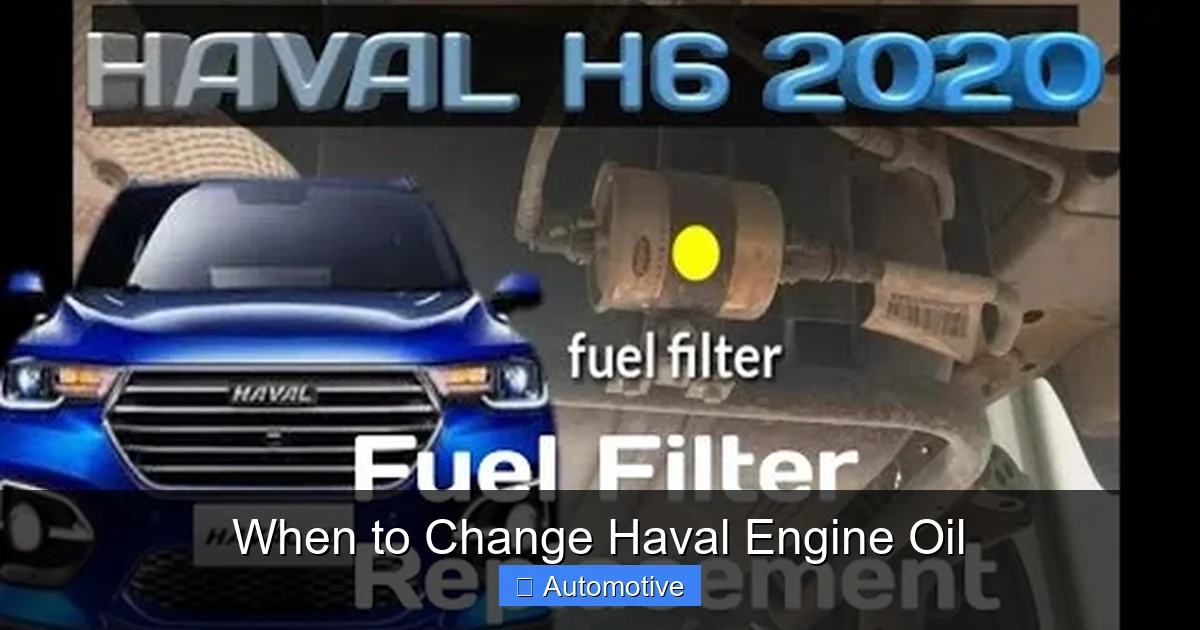
Let’s be honest: most of us live in the “Severe” driving category. That daily commute in bumper-to-bumper traffic, the quick trip to the grocery store, the school run—these are exactly what Haval’s engineers consider hard on your engine oil. Why? Because under these conditions, the oil isn’t getting hot enough to burn off moisture and fuel contaminants that naturally seep past piston rings. This leads to oil dilution, where fuel thins the oil and reduces its lubricating ability. At the same time, short trips mean the oil never reaches its optimal operating temperature, allowing sludge and varnish to form on internal components.
Visual guide about When to Change Haval Engine Oil
Image source: i.ytimg.com
What Counts as “Severe” Driving?
Take an honest audit of your driving. Do you:
- Make multiple trips per day, each under 10 minutes?
- Spend more than 50% of your driving time in city speeds below 40 mph?
- Live in a region with harsh winters or scorching summers?
- Often drive on gravel roads or in areas with high dust?
- Regularly use your Haval to tow a small trailer or carry a roof-top carrier?
If you answered “yes” to any of these, you should treat your Haval as a severely driven vehicle. This means changing the Haval engine oil at the shorter interval. For a turbocharged engine, which runs hotter and under more pressure, this is even more critical. The turbocharger itself relies on a constant supply of clean, cool oil; degraded oil can lead to turbo failure, a repair that can cost thousands.
Climate and Terrain: The Hidden Stressors
Extreme temperatures are oil’s enemy. In freezing climates, oil thickens, making cold starts harder on the engine and delaying oil flow to critical parts. Haval recommends a specific winter viscosity (like 0W-20 or 5W-30) for a reason. In desert heat, oil thins out faster and oxidizes more quickly, losing its protective properties. If you live in Phoenix or Las Vegas, you might consider changing oil at the shorter end of the range, even if your mileage is low. Similarly, mountainous terrain with constant steep climbs puts extra load on the engine, generating more heat and stress. Adjust your mindset: your Haval’s oil change timer isn’t just counting miles; it’s measuring the cumulative stress on the lubricant. For more on how environmental factors dictate oil change frequency, exploring resources on oil change intervals by kilometers can provide additional global perspective on these principles.
Decoding Your Haval’s Oil Life Monitor System
Modern Havals are smart. They don’t just rely on a sticker on your windshield. They have an Oil Life Monitor (OLM) or Maintenance Reminder system. This computer algorithm tracks engine runtime, RPMs, and temperature to estimate oil degradation. When it’s time, a message like “Engine Oil Change Required” or an illuminated wrench icon appears on your dashboard. This is a fantastic tool that personalizes the interval beyond a simple mileage count.
Visual guide about When to Change Haval Engine Oil
Image source: i.ytimg.com
How It Calculates Oil Degradation
The system doesn’t “test” your oil. Instead, it uses a mathematical model based on duty cycles. A long highway run at steady speed is “easy” on oil and adds little to the degradation percentage. A morning full of 2-minute trips to drop kids at school, then to the coffee shop, then back home? That’s a severe cycle and will rapidly increase the “oil life used” percentage. The system assumes you’re using the correct oil specification (like API SP) as recommended by Haval. If you use a lower-grade oil, the system’s calculations become invalid, and you must revert to the fixed mileage/time schedule.
When to Trust the System vs. Your Own Judgment
Trust the OLM, but never blindly. It’s a superb primary indicator. However, you must still perform manual checks. The system doesn’t know if you’ve accidentally added the wrong oil, if you have a small leak, or if your engine is burning oil. It also doesn’t account for the physical condition of the oil itself—its color and smell. Therefore, even if your Haval’s display shows 40% oil life remaining, you should still check the dipstick monthly. If the oil is dark black and gritty at 30% life, change it. If you’ve driven under severe conditions, consider resetting the monitor and changing the oil at 50% life as a precaution. Understanding how your car knows when to change oil helps you use the technology as a tool, not a crutch.
The Manual Oil Change Checklist: 5 Signs It’s Time (Even If the Light Isn’t On)
Technology can fail. Stickers can fall off. Sometimes, you need to rely on your senses. Here are the undeniable signs that your Haval engine oil is past its prime and needs immediate replacement, regardless of mileage or monitor status.
Visual Clues: Dark, Gritty Oil on the Dipstick
This is your number one diagnostic tool. Once a month, with the engine cold and on level ground, pull the dipstick, wipe it clean, reinsert it fully, and pull it out again. Look at the oil on the end. Fresh synthetic oil is typically amber or light brown. As it ages, it darkens to a deep brown and eventually black. More importantly, rub a bit between your thumb and forefinger. If you feel a gritty, abrasive texture, that’s microscopic metal particles and sludge—the oil has lost its cleaning ability and is now wearing your engine. If it’s so dark you can’t see the stick through it, change it now.
Engine Noises and Performance Changes
Oil’s primary job is to lubricate and quiet the engine. As it degrades, you might notice a slight increase in valve train tick or a low rumble from the engine bay, especially on cold starts. You may also experience a subtle loss of power or responsiveness, as thicker, degraded oil creates more internal friction. If your Haval feels “sluggish” or less peppy than usual, and you’ve ruled out other issues, old oil could be the culprit.
The Smell Test and Exhaust Smoke
Sniff the oil on the dipstick (after it cools). Fresh oil has a characteristic petroleum smell. Degraded oil often smells burnt or acrid. Also, look at your exhaust. A healthy tailpipe should emit nearly invisible vapor (on a cold start) or slight white/blueish steam that dissipates quickly. If you see persistent blueish-gray smoke, it could be a sign your engine is burning oil due to worn seals or, simply, because the oil has thinned out from heat and dilution. While this points to a larger issue, it’s a red flag that the oil situation is critical.
Choosing the Perfect Oil for Your Haval Engine
Using the wrong oil is as bad as not changing it. Haval engineers design engines with tight tolerances that require specific oil properties. Using a 10W-40 conventional oil in an engine that calls for 0W-20 synthetic can cause increased wear, reduced fuel economy, and potentially trigger check engine lights related to variable valve timing systems.
Decoding Viscosity: What 5W-30 Really Means
The “W” stands for winter. The number before it (5) indicates how easily the oil flows at cold temperatures. A lower number (like 0W) is better for extreme cold. The number after the W (30) indicates the oil’s thickness at normal operating temperature (212°F/100°C). Haval typically recommends 5W-30 or 0W-20 for most of its global models. You must use the viscosity specified in your manual. Using a thicker oil (like 10W-40) in a modern turbocharged engine designed for 0W-20 can cause the turbo to overheat because it doesn’t get lubricated quickly enough on startup. It can also increase drag on moving parts, hurting fuel economy.
Synthetic vs. Conventional: Which Is Best for Your Haval?
For any modern Haval, especially turbocharged models, full synthetic oil is non-negotiable. Synthetic oil is engineered molecule-by-molecule to be more stable, resist breakdown at high temperatures, and flow better in the cold. It contains superior additive packages for cleaning and protection. Haval’s own recommendations almost always specify “API SP” or “ILSAC GF-6” certified oil, which are standards primarily met by full synthetics. While you *could* use a high-quality conventional oil in an older, non-turbo Haval, you’d be sacrificing protection and likely shortening the recommended change interval. The slightly higher cost of synthetic is offset by longer intervals and far better engine protection. To understand the fundamental differences and why your engine needs a specific type, a clear guide on synthetic vs. conventional oil is invaluable.
The Real Cost of Skipping Your Haval Oil Change
It’s easy to think, “I’ll just go 1,000 miles over.” But that mindset is how engines get destroyed. The extra $50 you save on an oil change is a false economy that can lead to a $5,000+ engine rebuild or replacement.
From Sludge to Engine Failure: The Domino Effect
As oil degrades, it loses its ability to suspend dirt and metal particles. These particles clump together with oxidized oil to form sludge—a thick, tar-like substance that clogs oil passages, preventing oil from reaching the top of the engine (the valvetrain) and the turbocharger. Simultaneously, the oil’s anti-wear additives are depleted. Metal begins to grind on metal. Bearings wear, piston rings stick, and camshafts get scored. Once sludge forms, it’s often too late; a simple oil change won’t clean it out. The damage is progressive and irreversible, leading to low oil pressure, overheating, and ultimately, a seized engine.
Warranty Voidance: A Risk You Can’t Afford
Haval’s powertrain warranty is a major selling point. But failing to adhere to the maintenance schedule—especially oil changes—can void that warranty. If your engine fails and Haval’s investigation shows a history of neglected oil changes (via oil analysis reports or visual inspection of sludge), they can deny your warranty claim. Keeping detailed records of every oil change (date, mileage, oil type, shop) is your best defense. This isn’t just about following rules; it’s about protecting your investment. For a deep dive into the catastrophic consequences of neglect, you can read about what happens when you need an oil change and ignore it.
Conclusion: A Simple Habit for a Long-Lasting Haval
So, when should you change your Haval engine oil? Start with your owner’s manual. Respect the “Severe” driving interval if it applies. Pay attention to the oil life monitor, but confirm with a monthly dipstick check. Use only the specified full synthetic oil with the correct viscosity. And never, ever skip it. This one maintenance task is the foundation of your engine’s longevity, fuel efficiency, and reliability. It’s a small, predictable expense that shields you from massive, unexpected ones. Whether you have a 2024 Haval Dargo or a 2019 H2, making oil changes a non-negotiable part of your routine is the smartest thing you can do for your vehicle. Set a calendar reminder, find a trusted mechanic or learn to do it yourself, and give your Haval the clean blood it needs to thrive for years to come.
Frequently Asked Questions
What specific oil grade does my Haval need?
Most modern Havals require a full synthetic oil meeting API SP or ILSAC GF-6 standards, with a viscosity of 5W-30 or 0W-20. Always verify the exact specification in your owner’s manual, as requirements can differ by engine type and model year.
How do I reset the oil change reminder on my Haval?
Typically, you reset it via the steering wheel menu controls. The process varies by model but often involves turning the ignition on, navigating to “Settings” or “Vehicle” on the dash display, selecting “Oil Life” or “Maintenance Reset,” and holding a button to confirm. Consult your manual for the exact steps for your specific Haval model.
Does mostly highway driving allow for longer oil change intervals?
Yes, steady highway driving is considered “Normal” conditions and allows you to use the longer interval (e.g., 7,500-10,000 miles). However, you must still adhere to the annual time limit (usually 12 months), as oil degrades over time even with low mileage.
How often should I check my Haval’s oil level between changes?
You should check the oil level at least once a month and before any long road trip. Always check with the engine cold, on level ground, after waiting a few minutes for oil to settle in the pan. This helps you catch low oil levels or leaks early.
What are the first signs of engine damage from neglected oil changes?
Early signs include a noticeable increase in engine noise (ticking or tapping), a burning oil smell, blueish exhaust smoke, and a dipstick that shows oil that is extremely dark, sludgy, or has a gritty texture. If you see any of these, change the oil immediately and inspect for other issues.
Can I just add oil instead of getting a full change if it’s low?
You can and should add oil to bring the level up to the full mark if it’s low between changes. However, this is only a temporary top-up. It does not replace the degrading oil and contaminants. You must still perform a full drain and refill at the recommended interval to maintain engine health.