
What Is the Life Expectancy of a Toyota Corolla 2024

The 2024 Toyota Corolla is engineered for exceptional longevity, with a well-maintained example easily reaching 250,000 to 300,000 miles or more. Its life expectancy hinges overwhelmingly on consistent, proper maintenance and driving habits rather than any inherent flaw. The hybrid variant offers similar durability with the added consideration of its battery system, which is warrantied for 10 years. Ultimately, the Corolla’s reputation for reliability is built on decades of proven real-world performance.
When you hear the word “reliable,” what car comes to mind? For millions of drivers worldwide, the answer is the Toyota Corolla. It’s a name that has become synonymous with dependable, no-fuss transportation. But what does that really mean for the brand-new 2024 model sitting in your driveway or on the dealer’s lot? Specifically, what is the life expectancy of a 2024 Toyota Corolla? This isn’t just about a warranty period; it’s about understanding the engineering, the care required, and the real-world potential to turn your car into a trusted companion for the long haul. Let’s break down exactly how long you can expect your new Corolla to last and what you can do to maximize its years of service.
Key Takeaways
- Proven Engineering: The Corolla’s simple, robust design and high-quality materials are foundational to its potential for extreme longevity.
- Maintenance is King: Adherence to the factory maintenance schedule is the single most critical factor in determining how many miles and years your Corolla will faithfully serve you.
- Hybrid vs. Gas Parity: Both powertrain options are built for durability; the hybrid’s battery pack is a long-life component covered by a separate, lengthy warranty.
- Real-World Validation: Countless high-mileage Corollas from previous generations provide concrete evidence of this model’s potential when cared for properly.
- Owner Impact: Your driving style, storage conditions, and attention to minor issues have a profound effect on the vehicle’s ultimate lifespan.
- Resale Value Anchor: Exceptional reliability translates directly into strong resale value, making the Corolla a financially smart long-term ownership proposition.
📑 Table of Contents
- The Foundation of Fortitude: 2024 Corolla Engineering & Build Quality
- The #1 Determinant: A Culture of Consistent Maintenance
- Gas vs. Hybrid: Does One Last Longer?
- What the Data Says: Real-World High-Mileage Evidence
- Maximizing Your Corolla’s Lifespan: An Owner’s Action Plan
- The Bottom Line: A Smart, Long-Term Investment
The Foundation of Fortitude: 2024 Corolla Engineering & Build Quality
The life expectancy of any vehicle starts long before it ever rolls off the assembly line. It begins in the design studio and engineering lab. For 2024, the Corolla continues a legacy of conservative, over-engineered components. Toyota prioritizes longevity and low cost of ownership over cutting-edge, unproven technology. This philosophy is your best friend when thinking about long-term durability.
Powertrain Provenance: Engines and Transmissions Built to Last
The 2024 Corolla offers two primary propulsion choices: a proven 2.0-liter four-cylinder gasoline engine (in most trims) and the efficient 1.8-liter hybrid system. Both are evolutionary designs, meaning they are refinements of powertrains with decades of service behind them. The gasoline engine is paired with a continuously variable transmission (CVT) that, in this application, is tuned for smoothness and efficiency rather than sporty response. These components are not designed for high-stress racing but for steady, reliable operation. Their simplicity—fewer complex moving parts compared to turbocharged or dual-clutch setups—naturally reduces potential failure points. The hybrid system adds an electric motor/generator and a high-voltage battery pack, but the core principle remains the same: robust, well-understood technology.
It’s worth noting that Toyota subjects these engines and transmissions to brutal, accelerated life testing in extreme heat, cold, and under constant load. They simulate hundreds of thousands of miles of operation in a fraction of the time. The fact that these components pass these tests is a direct indicator of their potential lifespan. If you ever have questions about specific features like the Hold button on a Toyota Corolla, which relates to transmission behavior, understanding its purpose can also inform how you use the vehicle to minimize wear.
Body and Chassis: Resistance to the Elements
Longevity isn’t just about what’s under the hood. Rust and corrosion are historical enemies of vehicle life, especially in regions that use road salt. Toyota has invested heavily in corrosion protection for the Corolla. The 2024 model features extensive use of galvanized steel, high-quality paints, and advanced sealants. While no modern car is completely rust-proof, the Corolla’s body structure is designed to resist perforation for well beyond a typical ownership period. The chassis and suspension components are also built to handle years of imperfect roads without significant fatigue, provided they are not subjected to constant severe overload or off-road abuse.
The #1 Determinant: A Culture of Consistent Maintenance
You can have the most over-engineered car in the world, but neglect will shorten its life dramatically. For the 2024 Corolla, following a strict maintenance regimen is non-negotiable for achieving its maximum life expectancy. Think of maintenance not as an expense, but as an investment that pays massive dividends in longevity and reliability.
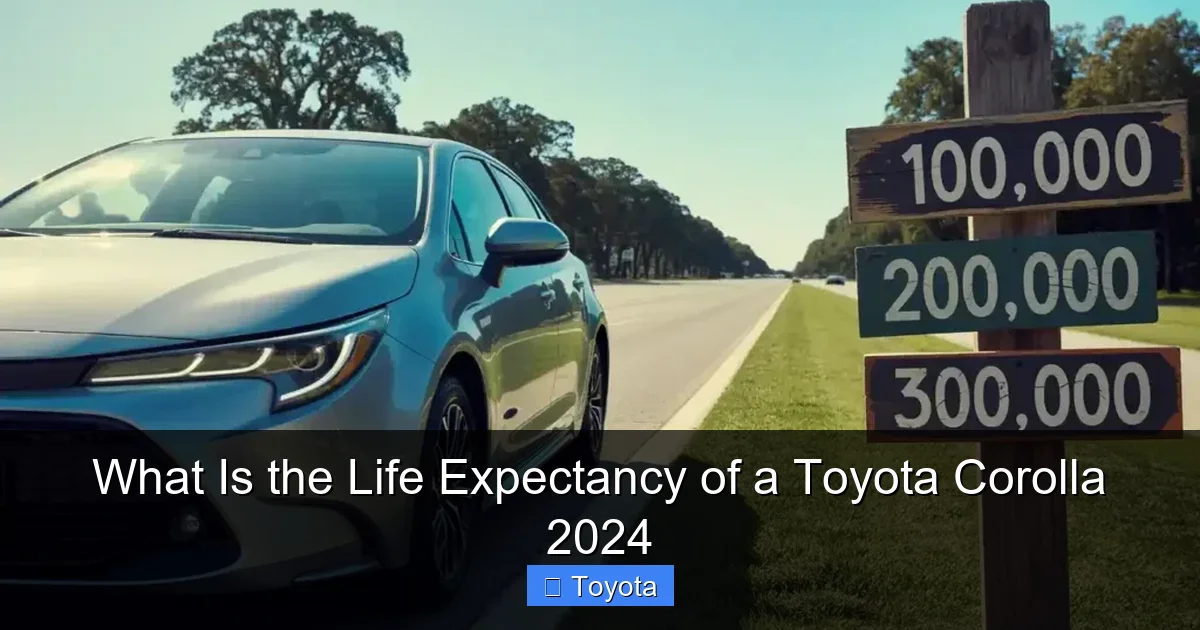
Visual guide about What Is the Life Expectancy of a Toyota Corolla 2024
Image source: mtoyos.com
Following the Factory Schedule: Your Roadmap
Your owner’s manual is the bible for your Corolla’s life. It provides a detailed maintenance schedule based on mileage and time intervals. This includes:
- Engine Oil & Filter: This is the most critical recurring service. Modern synthetic oil allows for longer intervals (often 10,000 miles), but never exceed the time limit (usually 12 months). Clean oil is lifeblood for the engine.
- Fluids: Coolant, transmission fluid (for the CVT), brake fluid, and power steering fluid (if applicable) all degrade. Following the schedule for flushes and replacements prevents internal corrosion and component wear.
- Filters: Cabin air filter, engine air filter. A clogged air filter makes the engine work harder and can allow contaminants into the combustion chamber.
- Brakes & Tires: Regular inspections of pads, rotors, and tire tread/wear patterns are essential for safety and to prevent damage to other components.
- Spark Plugs: Replacing them at the specified interval ensures optimal combustion and fuel efficiency.
Adhering to this schedule, whether you do it yourself or through a trusted mechanic, is the single best predictor of a long-lived Corolla. For those who like to get hands-on, learning how to open the hood of a Toyota Corolla is a simple first step to checking fluid levels and performing basic visual inspections between services.
The Power of Preventive Action: Addressing Small Problems Early
The second rule of maintenance is to never ignore warning lights or unusual noises. A small coolant leak that leaves a puddle today can lead to a catastrophic overheating event and a warped cylinder head tomorrow. A faint squeal from a belt can turn into a broken belt and a stranded vehicle. The Corolla’s genius is in its simplicity, but that simplicity means a minor issue rarely fixes itself. Catching problems when they are small and cheap is the hallmark of a long-term owner.
Gas vs. Hybrid: Does One Last Longer?
A common question is whether the hybrid version has a different life expectancy than the gasoline model. The answer is nuanced but generally positive for both.

Visual guide about What Is the Life Expectancy of a Toyota Corolla 2024
Image source: mtoyos.com
The Gasoline Engine: A Known Quantity
The 2.0-liter naturally aspirated engine in the 2024 Corolla is the culmination of 50+ years of Toyota’s four-cylinder development. It uses a traditional, efficient design with no turbocharger to add complexity or stress. These engines, when maintained, are known to comfortably surpass 300,000 miles. The CVT, while a different technology than a traditional automatic, is designed for this specific engine’s output and has been in use in Corollas for several model years now with generally good reliability reports.
The Hybrid System: Longevity Through Simplicity (in a different way)
The hybrid system might seem complex, but its core principle reduces wear on the traditional engine components. The electric motor handles low-speed starts and assists under acceleration, meaning the gasoline engine spends more time operating in its efficient, low-stress range. The largest point of curiosity is the high-voltage (HV) battery pack. Toyota has been making hybrids since the late 1990s. The data from the original Prius shows that these nickel-metal hydride (NiMH) batteries are remarkably durable. Degradation is slow, and many high-mileage hybrids still have functional, if slightly reduced-capacity, batteries.
For the 2024 Corolla Hybrid, Toyota provides a separate, transferable warranty for the HV battery and related components (typically 10 years or 150,000 miles, depending on state). This warranty is a direct statement of confidence in the component’s longevity. In practice, a well-maintained hybrid system is not a liability for life expectancy; it may even be an asset due to reduced engine wear. The potential long-term cost is the eventual HV battery replacement, but the incidence of this needing to happen before 200,000+ miles is statistically very low based on historical data.
What the Data Says: Real-World High-Mileage Evidence
Warranties and engineering specs are one thing. What happens in the real world, with real owners, is the ultimate test. The evidence for the Corolla’s longevity is overwhelming and comes from previous generations.
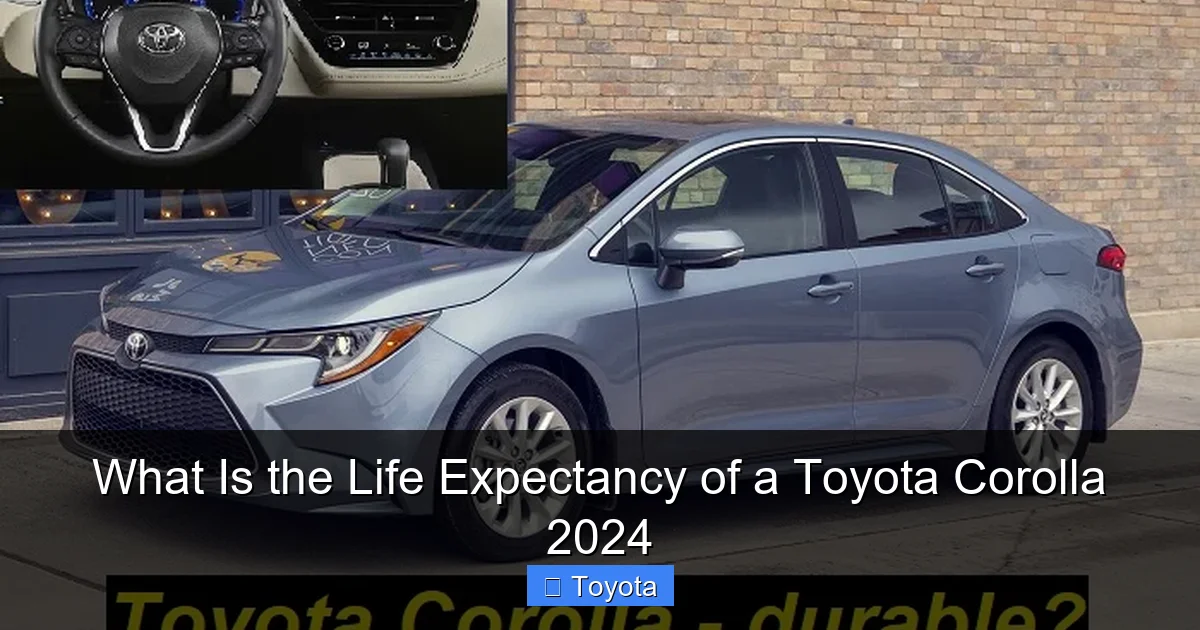
Visual guide about What Is the Life Expectancy of a Toyota Corolla 2024
Image source: cararac.com
Legacy of the 2000s and 2010s Corollas
It is exceedingly common to find Toyota Corollas from the early 2000s and late 2010s with 250,000, 300,000, and even 400,000 miles on the odometer still on the road. They are a staple of used car listings in this mileage range. What do these high-mileage survivors typically have in common? Meticulous maintenance records. They are not neglected commuter cars; they are cars that received their oil changes, had belts and hoses replaced, and had minor issues addressed promptly. Their bodies, while often showing cosmetic wear, are often still structurally sound. Their engines and transmissions, while perhaps a bit noisier, are still running reliably.
Projecting Forward to the 2024 Model
The 2024 Corolla benefits from incremental improvements in materials, lubricants, and manufacturing precision over those older models. If a 2005 Corolla with a 1.8-liter engine can hit 300,000 miles, there is every reason to believe a 2024 model with a more refined version of that engine philosophy and better synthetic oils can achieve the same or better. The key variable remains human: the owner’s commitment to the maintenance schedule. The engineering provides the potential; the maintenance fulfills it.
Maximizing Your Corolla’s Lifespan: An Owner’s Action Plan
So you’ve bought your 2024 Corolla with the intention of keeping it for the long term. What specific actions can you take to stack the deck in your favor?
Drive with Mechanical Sympathy
While the Corolla is tough, it appreciates gentle treatment. This means:
- Avoiding short trips that don’t allow the engine and oil to fully warm up. Condensation in the oil can cause dilution and increased wear.
- Gentle acceleration and braking when possible. Hard, constant use increases stress on all drivetrain and brake components.
- Allowing the engine to idle for just 30 seconds after a cold start before driving gently. This lets oil circulate fully.
- For hybrid owners, this driving style is almost second nature, as the system naturally rewards smooth, predictable driving for maximum efficiency and minimal engine engagement.
Create a Long-Term Storage and Care Strategy
If you live in an area with harsh winters, consider seasonal storage tips. Use a garage if possible. If you must park outside, a high-quality car cover can protect the paint from UV and minor abrasions. In snowy climates, frequent car washes in winter are crucial to remove road salt and prevent undercarriage corrosion. For the interior, use sunshades to prevent dashboard and seat cracking.
Build a Relationship with a Trusted Mechanic
Find a reputable, independent mechanic or a Toyota service department you trust. They will get to know your specific car. They can spot emerging issues that a quick-lube shop might miss. They can provide advice on whether to follow the severe or normal maintenance schedule based on your actual driving conditions (stop-and-go traffic, dusty roads, extreme temperatures all qualify as “severe” service).
The Bottom Line: A Smart, Long-Term Investment
Based on its engineering, historical performance, and owner experiences, a reasonable and achievable life expectancy for a well-maintained 2024 Toyota Corolla is 250,000 to 300,000 miles, or 15-20 years of reliable service. Many will go significantly further. This is not a guarantee—every car has its day—but it is a realistic expectation grounded in decades of evidence.
The financial implication is powerful. A car that lasts this long dramatically reduces your total cost of ownership. You spread the initial purchase price over many more years and avoid car payments for a decade or more. The Corolla’s strong resale value, a direct result of this reputation for longevity, means you can recoup a significant portion of your investment when you eventually decide to sell or trade. It’s a virtuous cycle: reliability leads to high demand on the used market, which supports high resale values.
Choosing the 2024 Toyota Corolla is choosing a tool for the job of getting you where you need to go, dependably, for a very, very long time. It won’t be the most exciting car you ever own, but it very well might be the most faithful. By respecting its design with proper care, you unlock its full potential and become part of the legacy of Corolla owners who have logged hundreds of thousands of trouble-free miles.
Frequently Asked Questions
What is a realistic mileage expectation for a 2024 Toyota Corolla before major repairs?
With strict adherence to maintenance, major powertrain repairs (engine, transmission) should not be expected before 200,000-250,000 miles for most drivers. Wear items like brakes, tires, and suspension components will need periodic replacement throughout its life, which is normal.
How long does the hybrid battery last, and is it expensive to replace?
Historical data from older Toyota hybrids suggests the high-voltage battery pack often lasts 150,000-200,000 miles or more with gradual capacity loss. Replacement cost can be significant ($2,000-$4,000+), but failures before 150,000 miles are very rare. The 2024 Corolla Hybrid’s battery is warrantied for 10 years/150,000 miles.
What are the biggest threats to a Corolla’s long-term life expectancy?
The biggest threats are neglect: skipped oil changes, ignoring coolant/transmission fluid changes, and driving with known issues like small leaks or noises. Severe environmental factors like constant exposure to road salt without washing, and extremely aggressive driving habits, also accelerate wear and tear.
Is rust still a concern for modern Corollas like the 2024 model?
Rust is less of a concern than on cars from 20 years ago due to better galvanizing and coatings. However, it’s not immune. In regions with heavy winter road salt use, regular undercarriage washes and addressing any stone chips or scratches in the paint promptly are key to preventing corrosive damage over decades.
How does the CVT in the 2024 Corolla affect its longevity compared to a traditional automatic?
Modern CVTs like Toyota’s are designed for reliability in mainstream applications. They have fewer moving parts than a traditional geared automatic, which can be an advantage. Their longevity is highly dependent on proper fluid maintenance at the specified intervals. With that maintenance, they are expected to last as long as the vehicle itself.
Will the 2024 Corolla last as long as older models from the 2000s?
Yes, and potentially longer. While older Corollas are famously durable, the 2024 model benefits from 20+ years of engineering refinement, better materials, and superior synthetic lubricants. Assuming similar maintenance standards, the 2024 model has at least equal, if not greater, potential for extreme mileage due to these incremental improvements.