
How Often Do You Change the Oil in a Toyota Highlander?

Determining how often to change the oil in your Toyota Highlander isn’t a one-size-fits-all answer. While the traditional 3,000-mile rule is outdated, modern recommendations range from 5,000 to 10,000 miles, heavily dependent on your driving conditions and whether you use conventional or synthetic oil. Always prioritize your vehicle’s specific maintenance reminder system and consult your owner’s manual for the definitive schedule for your model year.
So, you’re staring at the sticker on your windshield or maybe that little maintenance light just popped on, and the question hits you: “How often do you change the oil in a Toyota Highlander?” It’s one of the most fundamental—and frequently misunderstood—aspects of car ownership. For years, we were all taught to religiously change our oil every 3,000 miles. But times, and engines, have changed dramatically. The Toyota Highlander, a reliable family SUV known for its longevity, has specific needs that depend on a mix of factory recommendations, your driving style, and the type of oil you use. Getting this right isn’t just about following a rule; it’s about protecting a significant investment and ensuring your Highlander is ready for every school run, road trip, and grocery haul for years to come. Let’s break down everything you need to know, from the official manuals to the gritty reality of your daily commute.
Key Takeaways
- Modern Intervals Are Longer: Thanks to advances in engine design and synthetic oil, most new Toyota Highlanders can go 7,500-10,000 miles between changes under normal conditions.
- Driving Conditions Are Key: “Severe” driving (frequent short trips, extreme temps, dusty roads, towing) can cut your interval in half, requiring changes every 3,500-5,000 miles.
- Oil Type Dictates Schedule: Conventional oil typically requires changes every 5,000 miles, while full synthetic oil extends that to 7,500-10,000 miles or more per manufacturer specs.
- Trust Your Maintenance Light: Your Highlander’s onboard computer calculates oil life based on actual engine operation. When it illuminates, change the oil promptly, usually within 1,000 miles.
- The Manual Is Your Bible: Your specific model year’s owner’s manual contains the official, manufacturer-backed oil change interval and oil viscosity specification (e.g., 0W-20).
- Neglecting Oil Changes Causes Damage: Old, degraded oil loses its lubricating and cooling properties, leading to increased engine wear, sludge buildup, and potentially catastrophic failure.
📑 Table of Contents
- Why Oil Changes Are Non-Negotiable for Your Highlander
- Manufacturer Recommendations: What Toyota Says
- The Oil Type Factor: Conventional vs. Synthetic
- Decoding the Maintenance Required Light: Your Car’s Best Friend
- Practical Scenarios: Customizing Your Interval
- The Step-by-Step: What an Oil Change Involves (Beyond Just Draining)
- Conclusion: A Simple Plan for Peace of Mind
Why Oil Changes Are Non-Negotiable for Your Highlander
Before we dive into the “how often,” let’s quickly revisit the “why.” Engine oil is the lifeblood of your Highlander’s powerplant. It performs three critical jobs: it lubricates moving parts to reduce friction and wear, it helps cool the engine by carrying heat away, and it suspends harmful contaminants and byproducts of combustion so they don’t coat internal components as sludge. Over time, oil breaks down due to heat, shear forces, and contamination. Its additives are depleted, its viscosity changes, and it becomes less effective at its job. Running your engine on old oil is like asking a marathon runner to perform while dehydrated and covered in grit—it will eventually lead to a breakdown. For a vehicle like the Highlander, which is often used for family duties and can see a wide range of driving conditions, maintaining clean, effective oil is paramount to its famed reliability.
The Consequences of Skipping or Stretching Intervals
What happens if you ignore the schedule? In the short term, you might not notice anything. But the damage is cumulative. As oil degrades, friction increases, leading to premature wear on bearings, piston rings, and valve train components. The oil’s detergents become exhausted, allowing sludge and varnish to form in tight engine passages, restricting oil flow. In extreme cases, this can lead to oil starvation in critical areas, causing scored cylinder walls or seized bearings—a repair bill that often exceeds the value of the vehicle itself. Furthermore, modern engines with tight tolerances and complex systems like variable valve timing (VVT) are especially sensitive to oil quality and viscosity. Using the wrong oil or running it too long can damage these sophisticated systems. Simply put, consistent, timely oil changes are the single most cost-effective maintenance you can perform to ensure your Highlander’s engine lasts 200,000 miles or more.
Manufacturer Recommendations: What Toyota Says
This is your starting point. Toyota provides official guidelines for every model year of the Highlander. These are not arbitrary numbers; they are the result of extensive dyno testing and real-world fleet data. For most recent model years (2014-present), Toyota’s official recommendation for normal driving conditions is to change the oil every 10,000 miles or 12 months, whichever comes first, when using 0W-20 full synthetic oil. This is a significant jump from the old 3,000/3-month rule and reflects the superior protection synthetic oil provides. For earlier models (pre-2014), the interval was typically 5,000-7,500 miles for synthetic. It is absolutely critical to check your specific owner’s manual, as the approved oil viscosity (like 0W-16 on some newer hybrids) and exact interval can vary. You can also find this information on the official Toyota Owner’s Portal online. Remember, this “normal” schedule assumes you are not engaging in what Toyota classifies as “severe” driving conditions.

Visual guide about How Often Do You Change the Oil in a Toyota Highlander?
Image source: i.ytimg.com
Understanding “Normal” vs. “Severe” Driving Cycles
Here’s where most people get confused. Toyota’s “normal” driving cycle is actually quite specific and doesn’t describe the average American commute. It primarily means consistent highway speeds at moderate temperatures. The “severe” driving cycle, which Toyota says requires more frequent changes (often every 5,000 miles or so), includes many common real-world scenarios. Does your Highlander primarily do short trips (less than 5-10 miles) where the engine never fully warms up? That’s severe. Do you drive in extremely cold (<0°F) or hot (>100°F) weather? Severe. Do you frequently drive on dusty, sandy, or gravel roads? Severe. Do you tow a trailer or carry heavy cargo regularly? Severe. Do you experience extensive idling or stop-and-go traffic? Severe. If you check even one or two of these boxes, you are likely in the severe category and should adjust your interval downward. A great rule of thumb: if your trips are mostly under 20 minutes, you are probably in severe service. For more general guidance on how driving habits affect your car, you can read our article on how often you should change the oil in your car.
The Oil Type Factor: Conventional vs. Synthetic
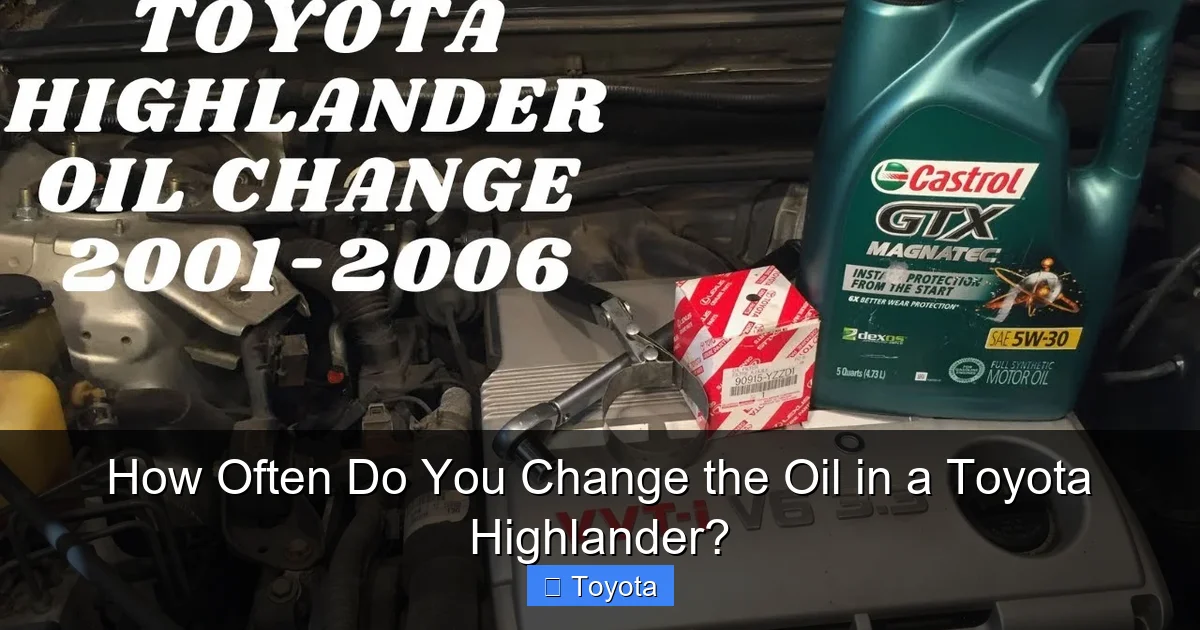
The single biggest factor influencing your change interval is the type of oil in your crankcase. This isn’t just marketing; it’s chemistry. Conventional motor oil is refined from crude oil. It performs well but breaks down faster under thermal stress and provides less protection against wear and deposits. If your older Highlander (pre-2014) uses conventional oil, Toyota’s recommendation was typically every 5,000 miles or 6 months. Full synthetic oil is man-made from a base of highly refined petroleum products or even esters. Its molecules are uniform and more stable, giving it superior resistance to breakdown, better performance in extreme temperatures, and enhanced cleaning properties. This stability is why the interval can be safely extended to 7,500-10,000 miles. Most new Highlanders come from the factory with full synthetic 0W-20 oil. Using a high-quality full synthetic is not just an option; for the recommended long intervals, it’s a requirement. Using conventional oil in an engine designed for extended synthetic intervals is a recipe for accelerated wear. To dive deeper into the nuances of synthetic oil longevity, our piece on how often to change synthetic oil in a car offers additional insights.
Visual guide about How Often Do You Change the Oil in a Toyota Highlander?
Image source: i.ytimg.com
What About High-Mileage Oil?
If your Highlander is well past 75,000 or 100,000 miles, you might consider a “high-mileage” synthetic blend or full synthetic. These oils contain special seal conditioners and additives designed to help soften and restore aging valve stem seals and other rubber components, which can become brittle over time, potentially reducing minor oil consumption (burning oil). They also have higher levels of anti-wear additives. While not strictly necessary for every high-mileage engine, they can be a good preventative choice. The change interval for high-mileage oils generally follows the same rules as standard synthetic oil for your driving conditions. The key is to continue using the viscosity grade specified in your manual, usually 0W-20.
Decoding the Maintenance Required Light: Your Car’s Best Friend
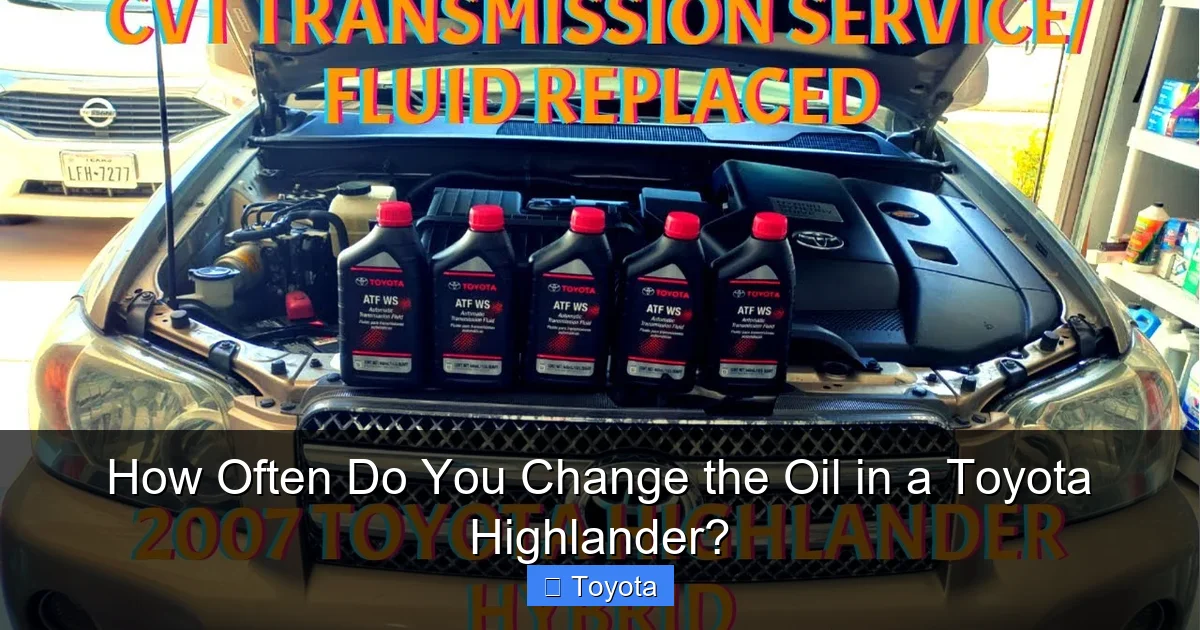
Here’s the best part: you don’t have to guess. Since the early 2000s, Toyota has equipped vehicles like the Highlander with an advanced Maintenance Required (or Oil Maintenance) light. This is not a simple mileage counter. It’s an onboard computer algorithm that monitors engine operating conditions—things like engine speed, temperature, drive time, and vehicle speed—to calculate the actual degradation of your engine oil. It learns your driving habits. If you do a lot of short trips, it will trigger sooner. If you’re on the highway constantly, it will allow for more miles. When the light illuminates (usually a small wrench icon or the words “MAINTENANCE REQUIRED”), it means the system has determined an oil change is due. The general rule is to schedule your oil change within the next 1,000 miles after the light comes on. Never ignore it. This system is your most accurate guide for normal driving conditions. If you’re ever unsure how to reset this light after an oil change, we have a dedicated guide for resetting the maintenance light on a Toyota Highlander.
Visual guide about How Often Do You Change the Oil in a Toyota Highlander?
Image source: i.ytimg.com
How the System Works (And Its Limitations)
The system uses a complex formula, but the input is primarily engine runtime and conditions. It does not, however, test the actual chemical condition of your oil. It cannot detect if you’ve accidentally added the wrong oil, if your engine is consuming oil excessively, or if coolant is leaking into the oil. Therefore, it’s still a good practice to check your oil level manually at least once a month or every 1,000 miles. A proper oil check (with the car on level ground, after it has sat for a few minutes) tells you about quantity, not quality. The maintenance light is an excellent scheduler for quality changes, but it’s not a substitute for basic owner vigilance. For more on when and how to check your oil properly, see our article on checking your car’s oil.
Practical Scenarios: Customizing Your Interval
Let’s make this concrete. Let’s say you own a 2020 Toyota Highlander with the 3.5L V6, and your manual says 10,000 miles/12 months for synthetic oil under normal conditions. Here’s how that plays out:
- The Highway Commuter: You drive 30 miles each way to work, mostly on the highway. Your engine warms up quickly and runs at stable, efficient temperatures. You could likely stretch to the full 10,000 miles without issue. The maintenance light will probably come on around 9,000-10,000 miles.
- The School Run & Grocery Getter: You make dozens of short, 2-3 mile trips around town each week, dropping kids at school, running errands. The engine rarely gets fully hot, allowing fuel dilution and moisture to accumulate in the oil. You should plan for an oil change every 5,000-7,500 miles, even if the light hasn’t come on yet.
- The Tow Vehicle: You regularly pull a camper or a large boat. The extra load and strain on the engine generate more heat and stress. You should be changing your oil every 3,500-5,000 miles with a high-quality synthetic and ensure you’re using the correct viscosity. Check your manual for any specific towing recommendations.
- The Extreme Climate Dweller: You live in Arizona (115°F summers) or Minnesota (-20°F winters). Temperature extremes thin oil when hot and thicken it when cold, increasing engine strain. Aim for the lower end of your interval range, around 6,000-7,500 miles.
When in doubt, especially if your driving is a mix of these scenarios, err on the side of caution. Changing your oil a little more often costs far less than an engine rebuild. It’s also worth noting that while the interval may be long, you should still check the oil level monthly. Some modern engines, including certain Highlander models, can consume a small amount of oil between changes. Letting the level drop too low is a surefire way to cause damage.
The Step-by-Step: What an Oil Change Involves (Beyond Just Draining)
Understanding what happens during an oil change helps you understand why it’s necessary and how to talk to your mechanic. A proper oil change is more than just draining the old stuff and pouring in new. It’s a multi-point service:
- Drain & Replace: The old oil is drained from the crankcase. The old oil filter is removed and discarded. A new, high-quality filter (OEM or reputable brand) is installed. The drain plug is torqued to specification.
- Fresh Oil: The correct type and amount of new oil (as specified in your manual, typically 6.1 quarts for most V6 Highlanders) is poured in.
- Level Check: The oil level is checked with the dipstick to ensure it’s perfect. Overfilling can be as bad as underfilling.
- Reset System: The technician (or you) resets the Maintenance Required light using a specific procedure (usually involving the odometer button and ignition). If this isn’t done, the light will come on prematurely.
- Additional Inspections: A good technician will also perform a basic safety inspection: check tire pressure, look for leaks, inspect belts and hoses, and check other fluid levels (coolant, brake, washer). This is added value. For more on other critical fluids, our guides on changing antifreeze in a Toyota and changing transmission fluid in a Highlander provide complementary maintenance knowledge.
While many people DIY oil changes to save money, a professional service has advantages: proper disposal of old oil, warranty compliance (using OEM filters and correct oil), and the added inspection. If you do it yourself, ensure you use the exact oil spec (API SN/SP, ILSAC GF-6) and viscosity (0W-20) your manual demands.
Conclusion: A Simple Plan for Peace of Mind
So, how often do you change the oil in a Toyota Highlander? The answer is a tailored one. Start with your owner’s manual—that’s your ultimate authority. For most modern Highlanders on full synthetic under normal driving, plan on every 7,500 to 10,000 miles or 12 months. If your driving is severe, shorten that to 5,000 to 7,500 miles. Use your vehicle’s Maintenance Required light as your primary, intelligent reminder, but don’t let it go more than 1,000 miles past its illumination. And never, ever neglect checking your oil level between services. By understanding these principles—manufacturer specs, your driving reality, oil technology, and your car’s own computer—you move from blindly following an old rule to practicing intelligent, proactive maintenance. This approach will keep your Toyota Highlander’s engine humming smoothly, reliably, and efficiently for the long haul, protecting your family’s safety and your wallet. It’s a small, regular investment that pays enormous dividends in vehicle longevity and dependability.
Frequently Asked Questions
Can I use conventional oil in my Highlander?
You can, but it’s not recommended for most models. New Highlanders are designed for full synthetic 0W-20 oil. Using conventional oil will require more frequent changes (every 5,000 miles) and may not provide the necessary protection for modern engine components, potentially affecting performance and longevity. Always use the oil type specified in your owner’s manual.
My Maintenance Required light is on. How long can I drive?
You should plan to change your oil within the next 1,000 miles after the light illuminates. The light is a final warning system based on your actual driving conditions. Driving significantly beyond this point risks engine wear as the oil has degraded past its effective service life. Schedule the service promptly.
Is it ever okay to change my oil less often than recommended?
No. The manufacturer’s recommended interval, especially when using synthetic oil, is already the maximum safe limit based on extensive testing. Stretching beyond this interval, even with high-quality oil, increases the risk of sludge formation and accelerated engine wear. The small savings on an oil change are insignificant compared to the cost of major engine repair.
What happens if I accidentally miss an oil change?
One missed change, especially if you’re only a few thousand miles over, likely won’t cause immediate catastrophic damage. However, it’s a step in the wrong direction. The oil has been running past its effective additives and viscosity stability. Have the oil changed as soon as possible and get back on your regular schedule. Consistent neglect, however, leads to the severe problems described earlier.
Should I change the oil filter every time?
Absolutely, yes. The oil filter is cheap insurance. It traps metal shavings, dirt, and other contaminants from circulating in your engine. A clogged filter restricts oil flow, causing wear just like dirty oil. Always replace the filter with a high-quality unit (OEM is best) at every oil change. Skipping it negates the benefit of fresh oil.
My Highlander burns oil. Does that change the interval?
Yes, significantly. If your engine is consuming oil between changes (you’re adding a quart or more every 1,000 miles), it’s a sign of internal wear. You must check the oil level more frequently—ideally every 500 miles—and top it up as needed. You should also shorten your change interval to every 3,000-5,000 miles to ensure the remaining oil isn’t overly depleted or contaminated by the combustion process. Have the engine diagnosed by a professional to find and fix the cause of the consumption.
