
What Type of Gas Does a Jeep Wrangler Take?

Most Jeep Wranglers run perfectly on regular unleaded gasoline with an 87 octane rating. However, certain high-performance models, like those with the 392 HEMI V8 or the older 5.7L HEMI, require premium 91 octane fuel. Always check your owner’s manual or fuel door sticker, as requirements can vary by model year and engine option. Using the correct gas ensures optimal performance, fuel efficiency, and prevents long-term engine damage.
So, you’ve just brought home a glorious new (or new-to-you) Jeep Wrangler. The open road calls, the trails whisper your name, and you’re ready to fill ‘er up. But a simple question stops you at the pump: “What type of gas does a Jeep Wrangler take?” It’s a crucial question, and the answer isn’t just about keeping the tank full—it’s about protecting a significant investment and ensuring your rig performs exactly as Jeep intended. Getting it wrong can mean everything from a slight drop in power to serious, costly engine damage. This guide will walk you through everything you need to know, from decoding octane ratings to understanding your specific model’s needs, so you can fuel with confidence.
Key Takeaways
- Standard Requirement: The vast majority of Jeep Wranglers, including the popular 3.6L V6 and 2.0L turbo-4 models, are designed to run on regular unleaded gasoline (87 octane).
- Premium for Performance: Models equipped with the 6.4L 392 HEMI V8 engine (2020-2024) and some earlier 5.7L HEMI V8 models require premium 91 octane fuel to prevent engine knock and achieve rated power.
- Ethanol Blends are Generally Safe: Jeep Wranglers are approved for gasoline blends containing up to 15% ethanol (E15). Flex Fuel Vehicle (FFV) models can handle up to E85, but standard models should not use E85.
- Using Lower Octane Can Cause Harm: Consistently using fuel with an octane rating below your Wrangler’s requirement can lead to damaging engine knock, reduced performance, and poor fuel economy over time.
- Premium in a Regular-Gas Engine Offers Minimal Benefit: Putting premium fuel in a Wrangler designed for 87 octane typically provides no noticeable performance or efficiency gains and is an unnecessary expense.
- Your Manual is the Final Authority: The definitive source for your specific Wrangler’s fuel requirement is the owner’s manual or the sticker on the fuel filler door. Always verify there.
- Modern Engines are Adaptive but Not Magic: While many modern engines have knock sensors that can adjust timing to run on lower-octane fuel, this is a protective measure, not a recommendation. It prevents damage but doesn’t restore full performance.
📑 Table of Contents
- Decoding Octane Ratings – What Do Those Numbers Mean?
- Jeep Wrangler Fuel Requirements by Model Year and Engine
- The Ethanol Question – E10, E15, and E85 in Your Wrangler
- The Real Cost of Using the Wrong Fuel
- Practical Tips for Fueling Your Wrangler Like a Pro
- How the Jeep Wrangler Compares to Other Popular SUVs
- Conclusion
Decoding Octane Ratings – What Do Those Numbers Mean?
Before we dive into the Wrangler-specific details, we need a quick chemistry lesson. The “87,” “89,” or “91” number you see on the gas pump is the fuel’s octane rating. This number measures the fuel’s ability to resist “knocking” or “pinging” during combustion. Engine knock is the sound of fuel detonating prematurely in the combustion chamber due to high pressure and temperature, which is bad. It’s like a tiny, constant hammer hitting your pistons and valves.
The Science Behind Octane
In a perfectly timed engine, the spark plug ignites the air-fuel mixture, creating a controlled burn that pushes the piston down. Higher-compression engines (like those in performance vehicles) squeeze that mixture tighter, creating more power but also more heat and pressure. This environment makes the fuel more likely to ignite on its own before the spark plug fires. Higher-octane fuel is more resistant to this spontaneous ignition. Think of it as a more stable, patient fuel that waits for the spark plug’s command.
Why Higher Isn’t Always Better
This is the most common misconception. You do not get more power or better fuel economy from using a higher-octane fuel than your engine requires. Octane is a measure of resistance, not energy content. All gasoline grades have roughly the same amount of potential energy. If your engine is designed for 87 octane, it has a lower compression ratio. Using 91 octane in it is like using race car fuel in a commuter sedan—it’s simply over-engineered for the task and provides zero benefit. You’re just paying more for a property (knock resistance) your engine doesn’t need. The only exception is if your engine is designed for premium; then using regular causes problems.
Jeep Wrangler Fuel Requirements by Model Year and Engine
Here’s the core of your question. The answer depends entirely on which engine is under the hood of your specific Wrangler. Jeep has used several engines over the years, each with its own requirement. Let’s break it down.
Visual guide about What Type of Gas Does a Jeep Wrangler Take?
Image source: trailandsummit.com
The Standard V6 (3.6L Pentastar) – Regular Unleaded
This is the workhorse engine found in the vast majority of Wranglers from the 2012 model year through the present (JK and JL generations). The 3.6L Pentastar V6 is a fantastic, torquey, and reliable engine that is explicitly designed to run on regular unleaded gasoline with a minimum octane rating of 87. You will find this clearly stated in the owner’s manual and on the fuel door sticker. This includes most Sport, Sahara, and Rubicon models. Using premium in this engine offers no benefit and is a waste of money. For comparison, many other mainstream SUVs like the Toyota RAV4 also use regular 87 octane, making the Wrangler’s standard requirement quite typical for its class.
The Turbo Four-Cylinder (2.0L) – Premium Recommended?
Introduced for the 2020 JL Wrangler, the 2.0L turbocharged inline-four is a fuel-efficient powerhouse. Here’s where it gets a little nuanced. Jeep’s official recommendation for this engine is premium gasoline (91 octane) for best performance and fuel economy. However, the engine is equipped with sophisticated knock sensors and management systems that allow it to safely operate on regular 87 octane fuel if necessary. You will see a power and torque drop, and your MPG will suffer, but the engine won’t destroy itself. So, the official line is “premium recommended,” not “premium required.” This is a common setup for modern turbo engines (like those in many Nissan Altima trims), where premium unlocks the full potential.
The V8 Options (392 and 5.7L) – Premium Required
If your Wrangler has a V8, you must use premium. The legendary 5.7L HEMI V8 was available in the previous JK generation Wrangler (2007-2011) and required 89 octane minimum, with 91 recommended. The current monster, the 6.4L 392 HEMI V8 found in the Rubicon 392 and Sahara 392 models (2020-2024), absolutely requires premium 91 octane fuel. The owner’s manual will state this in no uncertain terms. This high-compression, high-performance engine is tuned to the edge. Using 87 octane will cause immediate and severe engine knock, which the knock sensors can only mitigate so much. Prolonged use of regular gas in a 392 can lead to pre-ignition and catastrophic engine failure. Think of it like the Dodge Challenger Hellcat—same engine family, same premium requirement.
Hybrid Models (4xe) – Regular Unleaded
The plug-in hybrid Wrangler 4xe combines a 2.0L turbo engine with electric motors. For its gasoline engine component, Jeep specifies the use of regular unleaded 87 octane fuel. The hybrid system does not change the base engine’s octane requirement. Using premium is again, unnecessary.
The Ethanol Question – E10, E15, and E85 in Your Wrangler
Octane isn’t the only number on the pump. You’ll also see “E10” or “E15,” which indicates the percentage of ethanol (usually corn-based) blended into the gasoline. Ethanol is an oxygenate that boosts octane and reduces emissions, but it also has different properties than pure gasoline. So, what can your Wrangler handle?
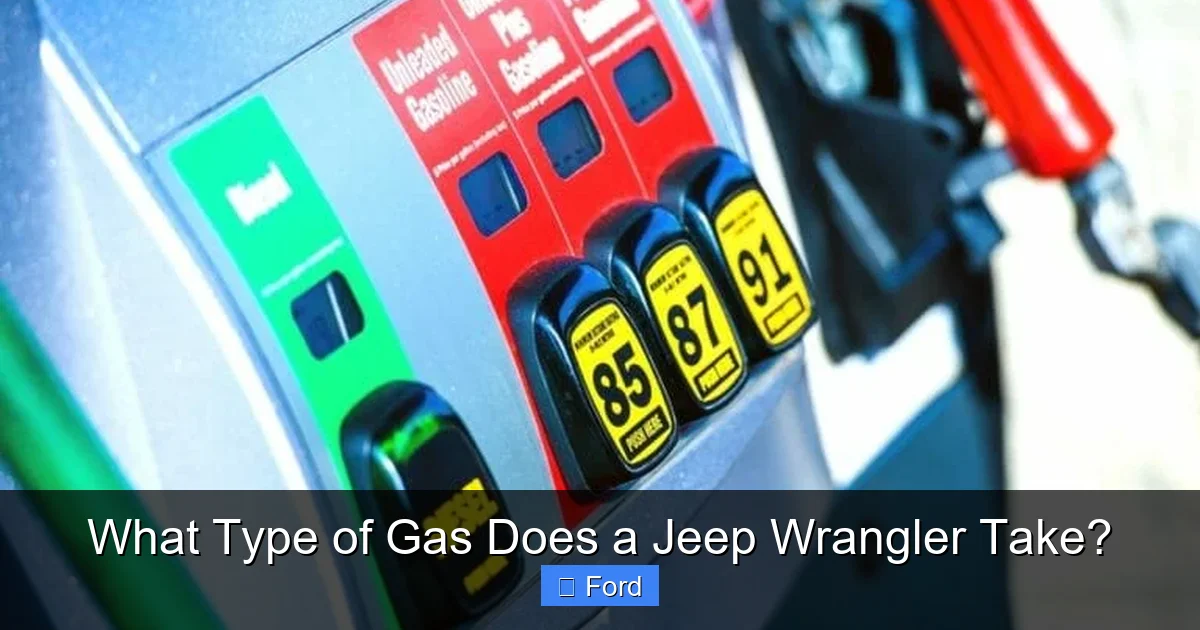
Visual guide about What Type of Gas Does a Jeep Wrangler Take?
Image source: vehiclefreak.com
What is Ethanol and Why is it Used?
Ethanol is an alcohol fuel additive. In the US, most gasoline is a blend containing up to 10% ethanol (E10). The EPA has approved E15 (15% ethanol) for use in all light-duty vehicles from the 2001 model year onward, which includes every Wrangler on the road today. Ethanol has a higher octane rating than gasoline, which is beneficial, but it also contains about 33% less energy per gallon, which can slightly reduce fuel economy. It is also hydrophilic (attracts water) and can be corrosive to certain fuel system components, though modern vehicles are designed with compatible materials.
Jeep’s Stance on Ethanol Blends
According to all official Jeep documentation for the Wrangler, the vehicle is approved for gasoline containing up to 15% ethanol (E15). This means you can safely fill up with any pump gas sold in the US without worry. There is a critical exception: Flex Fuel Vehicle (FFV) models. Some Wranglers, particularly certain market-specific models, are badged as FFV. These can safely use gasoline blends with up to 85% ethanol (E85). It is absolutely vital that you do NOT put E85 in a non-FFV Wrangler. The high ethanol content can damage fuel seals, injectors, and other components not designed for it. Your owner’s manual or a yellow gas cap (on some models) indicates FFV status.
Should You Seek Out Ethanol-Free Gas?
You might hear that ethanol-free gas (often found at marinas or some rural stations) is “better” for small engines or classic cars. For a modern, fuel-injected Wrangler, there is no practical benefit. Modern engine control units are designed to compensate for ethanol’s properties. The slight potential for better fuel economy (due to higher energy density) is usually offset by the higher cost per gallon and the environmental benefits of ethanol. Unless you have a specific, diagnosed issue related to ethanol, stick with the widely available E10 or E15. Your Wrangler was built to run on it.
The Real Cost of Using the Wrong Fuel
We’ve established the “what,” but the “why” is about consequence. Using the incorrect fuel isn’t just a minor inefficiency; it can have real, expensive repercussions.
Visual guide about What Type of Gas Does a Jeep Wrangler Take?
Image source: koala.sh
Knocking and Ping – Your Engine’s Cry for Help
The immediate symptom of using too low an octane is audible knocking or pinging, especially under acceleration or load (like climbing a steep hill in your Wrangler). This is the sound of your air-fuel mixture detonating erratically. While a single, occasional knock under heavy load might not cause instant harm, chronic knocking is destructive. It creates shockwaves that can crack piston lands, damage rod bearings, and harm valve train components. Your engine’s computer will try to compensate by retarding ignition timing, which kills performance and fuel economy.
Long-Term Damage from Chronic Low-Octane Use
If you consistently put 87 octane in a vehicle that requires 91 (like a 392 Wrangler), the protective knock sensor has its limits. Over time, the repeated stress from knock can lead to premature wear and catastrophic failure. Repairing damage from sustained engine knock often means a complete engine rebuild or replacement—a bill that runs into the thousands of dollars. This is not a risk worth taking to save a few cents per gallon. For Wranglers with the 2.0L turbo where premium is “recommended,” the damage risk is lower due to more adaptive engine management, but you’ll still suffer performance loss and poorer MPG.
Wasting Money on Unnecessary Premium
On the flip side, pouring premium into a 3.6L V6 Wrangler is simply flushing money down the drain. The fuel has the same energy content as regular. Your engine cannot extract more power from it because it lacks the high compression ratio to take advantage of the higher knock resistance. You are paying a premium price for a feature your engine doesn’t utilize. Over the life of the vehicle, this can add up to hundreds, if not thousands, of dollars in wasted fuel costs.
Practical Tips for Fueling Your Wrangler Like a Pro
Knowledge is power, but action is everything. Here’s how to apply this information in the real world.
How to Find Your Vehicle’s Exact Requirement (It’s Easier Than You Think)
Never guess. There are two foolproof methods, both located on your vehicle. First, open the fuel filler door. Inside, or on the door itself, there is almost always a sticker that explicitly states the required fuel octane. It will say “87 Octane” or “91 Octane Minimum.” Second, crack open your owner’s manual. The first few chapters on “Fueling” and “Specifications” will have a clear chart. If you’ve lost your manual, you can often find a digital PDF on the Jeep website using your VIN. This is your single source of truth.
What to Do If You’ve Used the Wrong Gas
Mistakes happen. If you accidentally put regular in a premium-required Wrangler (like a 392), do not start the engine if possible. Have the vehicle towed to a mechanic where the tank can be drained and flushed. If you did start it and drive even a short distance, you’ve likely caused some knock. The best course is to immediately fill the tank with the correct premium fuel. The new, higher-octane fuel can help dilute the lower-octane fuel. Then, drive gently, avoiding hard acceleration and high loads. If you hear persistent knocking, have it checked by a professional. For the reverse—putting premium in a regular-gas engine—do nothing. Just continue driving normally. You’ve just wasted money, but caused no harm.
Fueling Habits That Save You Money and Protect Your Engine
Beyond octane, how you fuel matters. Always use a reputable gas station. Top-tier detergents (look for the logo) help keep fuel injectors and intake valves clean. For Wranglers that live in extremely hot climates or are used for severe towing, some owners opt to use a higher-octane fuel (like 89) in their 87-octane engines as a form of “insurance” against knock under high stress, though it’s not required. For long-term storage (over 3 months), use a fuel stabilizer in a full tank to prevent ethanol separation and gum formation. These small habits complement using the right fuel type.
How the Jeep Wrangler Compares to Other Popular SUVs
To put your Wrangler’s needs in context, let’s see how it stacks up against some of its rivals. The fuel requirement is often a direct reflection of an engine’s design philosophy—efficiency versus performance.
A Quick Look at the Competition’s Fuel Needs
Most mainstream, non-performance SUVs are engineered for efficiency and cost of ownership. The Toyota Corolla (a car, but illustrative) and the Toyota RAV4 exclusively require regular 87 octane. Even many V6-powered family haulers like the Nissan Altima V6 use regular. The shift to turbocharging (like in the Ford Escape or Honda CR-V) often comes with a “premium recommended” badge for their turbo engines, similar to the Wrangler’s 2.0L. The true outlier is the performance and luxury segment. Vehicles like the Dodge Challenger with its HEMI V8s, the Porsche Macan, or the BMW X3 M require premium. Your Wrangler sits in an interesting middle ground: a rugged, off-road-capable vehicle with engine options ranging from efficient and regular-gas friendly to brutally powerful and premium-dependent.
Why the Wrangler’s Requirements Are What They Are
The story is in the engineering. The standard 3.6L V6 is a relatively low-compression, iron-block engine built for durability, low-end torque, and the ability to run on the cheapest, most widely available fuel—a perfect match for a vehicle meant for adventure anywhere. The 2.0L turbo is a high-tech, high-pressure engine where the turbocharger creates the heat and pressure that necessitate higher-octane fuel to avoid knock, hence the “premium recommended” tag. The 392 HEMI is a derivative of Chrysler’s high-performance, high-compression engines found in肌肉 cars, where every ounce of power is wrung out, demanding the highest octane to prevent destructive knock. Your choice of Wrangler engine directly dictates your fuel station decision.
Conclusion
So, what type of gas does a Jeep Wrangler take? The concise, final answer is: It depends on your engine, but it’s almost always either regular unleaded (87 octane) or premium (91 octane). For the overwhelming majority of Wranglers on the road—those with the 3.6L V6, the 2.0L turbo (where premium is just recommended), and the 4xe hybrid—regular 87 octane is perfectly acceptable and what Jeep designed them for. If you’re one of the fortunate few with a 392 or an older 5.7L HEMI, you must use premium 91 octane without exception. Always, always verify with the sticker on your fuel door or in your owner’s manual. This small act of diligence protects your engine, ensures you get the performance you paid for, and saves you from pouring money down the drain or, worse, facing a massive repair bill. Your Wrangler is built for freedom. Fuel it correctly, and it will reward you with years of reliable, capable adventure.
Frequently Asked Questions
Can I put 85 octane fuel in my Jeep Wrangler?
No. 85 octane is typically sold in high-altitude areas (like mountain towns) and is not suitable for most modern vehicles, including the Wrangler. While the lower atmospheric pressure at high altitudes can sometimes allow engines to run on lower octane, it’s not guaranteed, and you risk engine knock. Always use the minimum octane rating specified by Jeep, which is 87 or 91 depending on your engine. If you’re in a high-altitude area, consult your owner’s manual for specific guidance, but 85 is generally too low.
Is it okay to mix regular and premium gas in my Wrangler?
Occasionally mixing a gallon or two of regular into a tank of premium (in a premium-required vehicle) will likely lower the overall octane below the safe level and should be avoided. If it happens by accident, adding more premium to bring the tank’s average octane back up is the best fix. For a regular-gas engine, mixing in some premium does no harm but also provides no benefit; it just dilutes your expensive premium with cheaper regular. The best practice is to consistently use the correct, single grade of fuel.
Does using higher-octane gas than required clean my engine?
No. Octane rating and detergent quality are two separate things. All gasoline sold in the US must contain a baseline level of detergents to help keep fuel injectors clean. Some brands offer “Top Tier” gasoline with significantly higher detergent levels, which is beneficial for all engines. However, a higher octane number (like 93 vs 87) does not mean it has more or better cleaners. To keep your engine clean, choose a consistent Top Tier brand regardless of the octane you need.
My 2022 Wrangler with the 3.6L V6 says “87 Octane” on the door. Can I still use 89 or 91?
Yes, you can. Using a higher octane than required in an engine designed for 87 will not harm it. The engine simply cannot take advantage of the extra knock resistance. You will not see any power or fuel economy gains, so it’s not a cost-effective practice. The only reason to do it might be if you’re in a situation where only premium is available, or if you’re towing extremely heavy loads in very hot, high-altitude conditions and want a marginal safety margin against knock (though 87 should still suffice).
What happens if I use E85 in my standard (non-FFV) Jeep Wrangler?
You should never do this. E85 has up to 85% ethanol, which is far beyond the 15% ethanol (E15) limit for standard Wranglers. The high ethanol content can cause severe damage to fuel system components not designed for it, including rubber seals, fuel pumps, and injectors. It can also cause lean-running conditions and poor performance. Your check engine light will almost certainly come on. If you’ve accidentally filled up with E85, the tank should be drained and flushed as soon as possible to prevent costly damage.
My Wrangler has a 2.0L turbo. The manual says “premium recommended for best performance.” Will it hurt it if I only use regular?
No, it will not hurt it. The engine management system is designed to protect the engine from knock if you use regular 87 octane. It will do this by reducing boost pressure and retarding ignition timing, which results in a noticeable loss of power (perhaps 10-20 horsepower) and a drop in fuel economy. You will feel the car being slower and less responsive. For daily driving and mild off-roading, it’s perfectly safe. If you demand maximum performance for hard acceleration, towing, or driving at high elevations, then using the recommended premium 91 octane is necessary to achieve the engine’s full potential.
