
What Is the Grace Period for Toyota Finance Payments?

Navigating your Toyota Finance payment doesn’t have to be stressful. Typically, Toyota Financial Services (TFS) offers a standard grace period of 10 days after your payment due date before a late fee is assessed. However, this is not a free extension; interest continues to accrue. The exact terms, including any state-specific variations, are always defined in your original contract. Proactive communication with TFS if you anticipate a delay is the single most effective strategy to prevent negative credit reporting and additional charges.
Key Takeaways
- Standard Grace Period: Toyota Financial Services generally provides a 10-day grace period after the contractual due date before imposing a late fee.
- Interest Never Stops: Interest accrues daily on your outstanding principal balance throughout the grace period and beyond; the grace period is not an interest-free holiday.
- Contract is Final: Your signed financing or lease agreement is the ultimate source of truth. Always review it for the specific grace period and late fee structure applicable to your account.
- Late Fee Application: If payment is not received by the end of the grace period, a late fee (often a percentage of the scheduled payment or a flat fee) will be charged to your account.
- Credit Reporting Threshold: Payments more than 30 days past due are typically reported to the major credit bureaus, which can significantly damage your credit score.
- Communication is Key: Contacting Toyota Financial Services *before* you miss a payment can open dialogue about potential hardship programs or payment date adjustments, which is far preferable to simply missing a payment.
- State Laws Vary: Some states have consumer protection laws that may affect grace periods or late fee caps. Your contract must comply with the laws of the state where you purchased/leased the vehicle.
📑 Table of Contents
- Introduction: Demystifying Your Toyota Finance Payment Due Date
- The Standard Toyota Finance Grace Period: The 10-Day Rule
- The Fine Print: Late Fees, Interest, and Your Contract
- State-Specific Rules and Legal Considerations
- What Happens After the Grace Period: The Delinquency Timeline
- Proactive Strategies: What To Do If You Can’t Make Your Payment
- Beyond the Grace Period: Other Important Payment Nuances
- Conclusion: Knowledge is Your Best Financial Defense
Introduction: Demystifying Your Toyota Finance Payment Due Date
Signing the paperwork for a new Toyota is an exciting moment. That fresh car smell, the smooth ride, and the pride of ownership are all part of the experience. But alongside the thrill comes a serious financial commitment—your monthly payment to Toyota Financial Services (TFS). Life happens. An unexpected medical bill, a temporary job loss, or simply a calendar mix-up can throw your carefully planned budget off track. This is where understanding the concept of a “grace period” becomes not just helpful, but essential. It’s a term you’ve likely heard, but what does it specifically mean for your Toyota loan or lease? Is there a true, penalty-free window? This comprehensive guide will pull back the curtain on Toyota Finance’s payment policies, giving you the clarity and confidence to manage your auto financing effectively.
First, let’s establish the most critical point: a grace period is not an extension of your due date. It is a short, defined period after your due date during which the lender will accept your payment without immediately charging a late fee. However, your contractual due date is fixed. The grace period is a courtesy buffer, not a change to the agreement. For the vast majority of Toyota Finance customers, that buffer is 10 days. But the story doesn’t end there. From the mechanics of interest accrual to the severe consequences of a 30-day delinquency, we’ll cover every angle you need to know.
The Standard Toyota Finance Grace Period: The 10-Day Rule
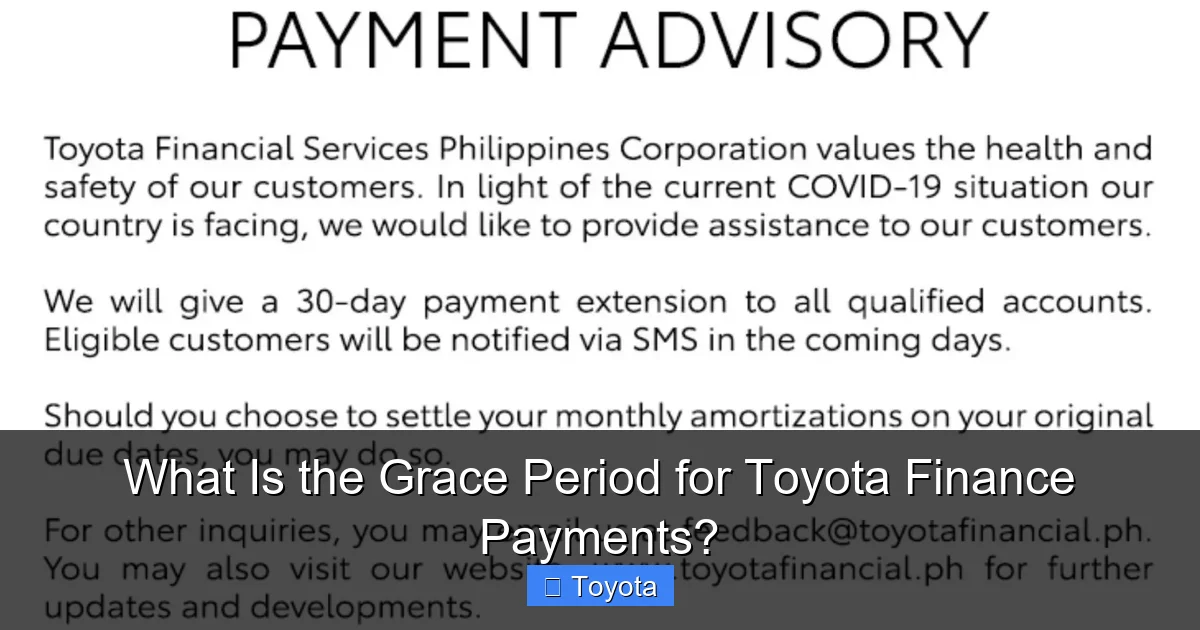
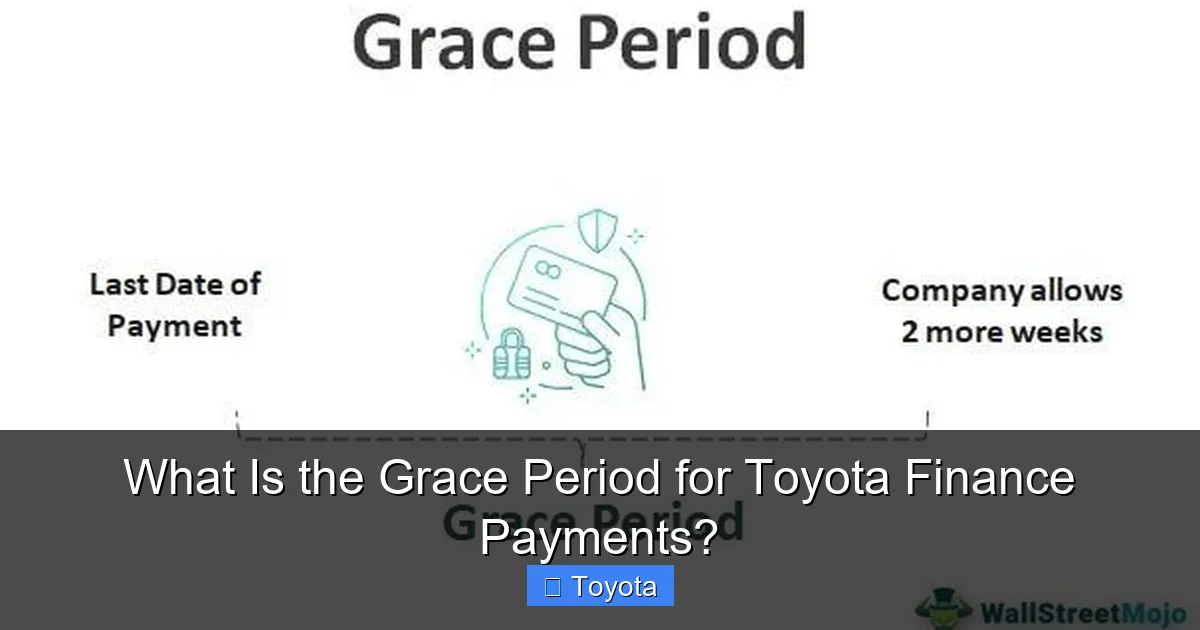
When you finance or lease a Toyota through Toyota Financial Services, your contract will list a specific monthly payment due date. This is often the same day each month, aligned with your signing date. While this date is firm, TFS almost universally includes a 10-day grace period in its standard retail installment contracts and lease agreements. This means if your payment is due on the 5th of the month, TFS will not consider it “late” or assess a late fee until after the 15th, provided the payment is posted to your account by the end of that 10th day.
Visual guide about What Is the Grace Period for Toyota Finance Payments?
Image source: i0.wp.com
How the 10-Day Clock Ticks
It’s vital to understand how this period is calculated. The grace period is based on the day the payment is received and posted by TFS, not the day you mailed it or initiated an electronic transfer. If you mail a check on the 9th for a payment due on the 5th, but it doesn’t arrive and clear until the 16th, you have likely missed the grace period. For online or phone payments made via ACH or debit card, processing times are usually faster, but you should still allow at least 2-3 business days for the transaction to complete and post to your account. The safest practice is to initiate your payment at least 3-5 days before the actual due date, ensuring it posts well within the 10-day window.
What “Posted” Means for Your Account
Your online account portal is your best friend here. After making a payment, log in and verify that your account balance has been reduced and the payment status shows as “Posted” or “Completed.” A “Pending” status does not count as payment received. Only a posted payment stops the late fee clock. This distinction is a common pitfall for many borrowers who assume a transaction is complete the moment they click “submit.”
The Fine Print: Late Fees, Interest, and Your Contract
While the 10-day grace period is standard, the consequences of missing it are spelled out in the fine print of your financing contract. This is a legally binding document, and its terms govern your relationship with TFS.
Visual guide about What Is the Grace Period for Toyota Finance Payments?
Image source: wallstreetmojocms.recurpro.in
Decoding the Late Fee Structure
Your contract will specify the exact late fee amount. It is typically either a flat fee (e.g., $25, $35, or $50) or a percentage of your scheduled monthly payment (often 4% or 5%), whichever is greater. For a $500 monthly payment, a 5% late fee would be $25. This fee is added directly to your account balance and begins accruing interest itself if not paid promptly. This fee is non-negotiable once assessed, though you can always call to request a one-time courtesy waiver if you have an otherwise perfect payment history—but there is no guarantee.
The Silent Accumulator: Daily Interest (Finance Charge)
This is the most misunderstood aspect of the grace period. Interest does not pause during the grace period. Your loan accrues interest daily based on your outstanding principal balance. If your scheduled payment is $500, and $200 of that is interest, paying on the 5th or the 15th does not change the fact that interest accrued for every single day of that month. Paying on the last day of the grace period means you have effectively carried that debt for an extra 10 days, costing you more in total interest over the life of the loan. The grace period saves you from a penalty fee, not from the cost of borrowing.
State-Specific Rules and Legal Considerations
While TFS’s standard contract is uniform, state laws can impose additional consumer protections or limits. For instance, some states cap the amount of a late fee or mandate a minimum grace period. Your contract with TFS must comply with the laws of the state in which the vehicle was purchased or leased, which is usually your state of residence. If you live in a state with more stringent rules, those will be reflected in your contract’s terms. It’s a good practice to glance at the “Governing Law” section of your agreement to confirm. However, do not assume your state law gives you more than 10 days—the 10-day period is already quite generous and compliant with most state regulations. The key takeaway is that your contract is the final authority, and it is designed to meet or exceed all state requirements.
Visual guide about What Is the Grace Period for Toyota Finance Payments?
Image source: cdn1.iconfinder.com
What Happens After the Grace Period: The Delinquency Timeline
Missing the 10-day grace period is step one. The steps that follow are progressively more serious and damaging to your financial health. Understanding this timeline is crucial for damage control.
Days 11-29: The Late Fee Era
Once your payment is past due by even one day beyond the grace period, the late fee is automatically charged to your account. Your next statement will show this fee as a separate line item. At this stage, TFS may begin contacting you via mail, email, or automated phone calls to remind you of the missed payment. Your account is now considered “delinquent,” but it has not yet been reported to credit bureaus.
Day 30: The Credit Reporting Threshold
This is the major milestone. If your payment is 30 days past due, TFS will typically report the delinquency to the three major credit bureaus (Equifax, Experian, and TransUnion). A 30-day late mark is a significant derogatory event that can drop your credit score by 60-110 points or more. This mark stays on your credit report for seven years, affecting your ability to secure future loans, mortgages, or even certain jobs. It is the single most important benchmark to avoid.
Days 60, 90, and Beyond: Repossession Risk
As delinquency continues, the severity escalates. At 60 days past due, your account is in a more serious state. By 90 days or more, you are in default under the terms of your contract. At this point, Toyota Financial Services has the legal right to initiate vehicle repossession. The exact timeline and triggers can vary, but 90 days is a common threshold. Repossession is not only a massive credit disaster (a repossession can drop a score by 200+ points) but also results in the loss of your vehicle and a potential deficiency balance (the remaining loan amount after the car is sold at auction, which you may still owe).
Proactive Strategies: What To Do If You Can’t Make Your Payment
Fearing a missed payment is one thing; facing it is another. The absolute worst thing you can do is ignore the problem and hope it goes away. It won’t. Instead, take decisive, proactive steps before your payment becomes late.
Step 1: Contact Toyota Financial Services Immediately
The moment you know a payment will be late, pick up the phone. Call the customer service number on your statement or your online account portal. Explain your situation honestly. Ask about any “hardship programs” or “payment deferral” options they may offer for customers facing temporary financial difficulty, such as a job loss or medical emergency. While not guaranteed, some lenders have temporary forbearance or modification programs. Even if a formal program isn’t available, explaining your situation might prevent some collection actions and shows good faith.
Step 2: Explore a Payment Date Change
If your hardship is a long-term shift in your pay schedule (e.g., you now get paid on the 10th instead of the 1st), ask if you can permanently change your monthly due date to align with your income. TFS may allow this after you’ve been a customer in good standing for a certain period (often 6-12 months). This is a simple fix that can prevent future stress.
Step 3: Prioritize and Rebudget
Look at your finances. Can you temporarily cut non-essential spending (subscriptions, dining out) to free up the cash for your car payment? The car payment is typically a secured, priority debt. Missing it has faster and more severe consequences than missing a credit card payment. Consider selling non-essential assets or picking up a temporary side gig to cover this critical bill.
Step 4: Understand Refinancing Options (With Caution)
If your credit is still good, you might explore refinancing your Toyota loan with a credit union or another bank to extend the term and lower the monthly payment. Extreme caution is required here: you will pay more interest over the life of the new loan. Also, refinancing a brand-new car can be difficult as you are often “upside-down” (owe more than the car is worth). This is a longer-term strategy, not a solution for a single missed payment.
Step 5: The Last Resort: Voluntary Surrender
If you determine you absolutely cannot afford the vehicle long-term, a voluntary surrender—where you arrange to return the car to TFS—is often less damaging than a forced repossession. It still devastates your credit, but it may result in a smaller deficiency balance and shows some initiative. This should be a final option after exhausting all others and consulting with a financial advisor.
Beyond the Grace Period: Other Important Payment Nuances
Your payment experience with TFS involves more than just the due date and grace period. Several other factors influence your account health and total cost.
Payment Methods and Processing Times
How you pay matters. Mailing a check is reliable but slow. Paying via the TFS online portal or mobile app using a bank account (ACH transfer) is usually free and posts within 2-3 business days. Paying by debit or credit card often incurs a convenience fee (typically $3-$10). Using a credit card for the payment can be a strategy to earn rewards, but only if you pay the credit card balance in full immediately—otherwise, the high interest negates any benefit. Never use a high-interest loan or cash advance to make a car payment.
The Impact of Rounding Up or Paying Extra
If you pay even a dollar or two more than your scheduled payment, that excess is almost always applied directly to your principal balance. This is a fantastic habit. Reducing the principal, even by a small amount, means less interest accrues the next day and can shorten your loan term. If you are consistently able to pay a little extra, you will save significant money over time. You can also set up automatic principal-only payments through your online banking.
Understanding Your Monthly Statement
Don’t just look at the “Total Payment Due.” Break it down. Your statement should show: Principal (the amount going to pay down your loan), Interest (the finance charge), and any other fees. If you have a lease, you’ll see the depreciation portion, finance charges, and any taxes or fees. Understanding this breakdown shows you exactly where your money is going and how much you’re paying in interest each month.
Conclusion: Knowledge is Your Best Financial Defense
Owning a Toyota is a privilege that comes with a clear financial responsibility. The grace period offered by Toyota Financial Services—typically 10 days—is a helpful buffer, not a free pass. It’s a short window to accommodate minor timing issues, but it does not stop the daily accumulation of interest, and crossing its threshold triggers late fees and sets a dangerous delinquency timeline in motion. The most powerful tool in your financial arsenal is not the grace period itself, but your understanding of it and the proactive management of your account. By knowing that your contract is king, that interest accrues relentlessly, and that a 30-day late payment is a credit score killer, you are empowered to make smarter decisions. Budget for your payment as if it were due on the 1st, pay it by the 5th, and never, ever ignore communication from TFS. If trouble arises, call them first. This approach protects your credit, saves you money in avoided fees and interest, and ensures your Toyota experience remains a positive one for years to come. Remember, your vehicle is a depreciating asset; don’t let a missed payment turn it into a financial liability that haunts your credit report for seven years.
Frequently Asked Questions
Does Toyota Financial Services really have a 10-day grace period?
Yes, for the vast majority of its standard retail installment contracts and leases, TFS includes a 10-day grace period after the contractual due date. This means a late fee is not charged if the payment posts within those 10 days. However, you must always verify the exact terms in your specific contract.
Will I be charged interest during the grace period?
Absolutely. Interest accrues daily on your outstanding principal balance from the first day of the billing cycle. The grace period only prevents a late fee; it does not pause the accrual of the finance charge. You will pay interest for every day you carry the balance, including all 10 days of the grace period if you pay on the last day.
What is the exact late fee for a Toyota Finance payment?
The specific late fee amount is defined in your financing contract. It is commonly either a flat fee (often $25-$50) or a percentage of your scheduled payment (typically 4% or 5%), whichever is greater. You must check your own agreement for the precise figure applicable to your account.
How many days late before Toyota Financial Services reports to the credit bureaus?
Payments that are 30 days or more past due are typically reported to the three major credit bureaus (Equifax, Experian, and TransUnion). A 30-day late mark is a serious derogatory event that can significantly damage your credit score and remains on your report for seven years.
Can I get an extension on my Toyota car payment?
Toyota Financial Services does not typically offer formal “extensions” that add missed payments to the end of your loan. However, if you are facing a temporary financial hardship, you should contact TFS immediately to discuss your situation. They may have hardship programs, payment deferral options, or may be able to adjust your due date long-term if you have a good payment history.
What happens if I miss my Toyota payment entirely?
Missing a payment triggers the late fee after the 10-day grace period. If the account remains delinquent (typically after 60-90 days), TFS can initiate vehicle repossession. A repossession results in the loss of your vehicle, a massive hit to your credit score, and you may still owe a deficiency balance if the car’s auction sale price doesn’t cover the loan amount. It is critical to communicate with TFS at the first sign of trouble to explore alternatives.
