How Many Gallons Does a Toyota Corolla Gas Tank Hold

The Toyota Corolla gas tank holds between 11.9 and 13.2 gallons, depending on the model year and trim level. This capacity provides an average driving range of 350-450 miles on a full tank, based on its combined EPA fuel economy ratings. Understanding your specific Corolla’s tank size is crucial for trip planning and maximizing fuel efficiency.
So, you’re wondering about the gas tank size in your Toyota Corolla. It’s a simple question with a slightly nuanced answer. You bought a Corolla for its legendary reliability and great gas mileage, but knowing exactly how much fuel it can hold is key to truly mastering its efficiency. Whether you’re planning a cross-country road trip, calculating your monthly fuel budget, or just curious, this guide will give you the definitive answer. We’ll break down the capacities for every recent generation, explain why it matters, and give you practical tips to get the most out of every drop.
Key Takeaways
- Capacity Varies by Generation: The tank size is not uniform; it has changed across different Corolla model years and platform generations.
- Most Common Size is 13.2 Gallons: For the current (E210) generation and many recent models, 13.2 gallons is the standard tank capacity.
- Older Models May Have 11.9-Gallon Tanks: Particularly the previous (E170/E180) generation and some earlier models feature a slightly smaller 11.9-gallon tank.
- Trim Level Can Influence Size: Within the same model year, base and hybrid trims sometimes share the same tank, while certain sport or premium trims may have slight variations.
- Reserve Fuel Exists: The “empty” gauge lights typically come on with 1-2 gallons of reserve fuel remaining, extending your usable range.
- Real-World Range is Lower Than EPA Estimates: Actual miles per tank depend heavily on driving habits, terrain, climate, and vehicle maintenance.
- Knowing Your Capacity Aids in Fuel Management: Accurate tank knowledge helps in calculating fuel costs, planning long trips, and understanding your vehicle’s fuel economy performance.
📑 Table of Contents
The Short Answer: It Depends on Your Model Year
Let’s get straight to it. The fuel tank capacity of a Toyota Corolla is not a one-size-fits-all number. While the difference is only about 1.3 gallons, that can mean an extra 30-40 miles of range in your tank. The two most common capacities you’ll encounter are 11.9 gallons and 13.2 gallons.
Current Generation (E210: 2018-Present)
For the vast majority of brand-new and recently used Corollas, the answer is 13.2 gallons. This applies to the 2018, 2019, 2020, 2021, 2022, 2023, and 2024 model years. Whether you have a base L, a sporty SE or XSE, or the efficient LE Hybrid, the tank is almost universally 13.2 gallons. This larger tank was a design choice with the current platform, likely to complement the improved fuel economy and provide a longer total driving range, which is a major selling point for compact sedans.
This consistency makes life easy. If you own a 2020 Corolla SE, a 2023 Corolla XLE, or a 2022 Corolla Hybrid, you all share the same 13.2-gallon capacity. For comparison, you might be looking at a Toyota Camry, which typically holds around 15.8 gallons, giving it a significantly longer range but in a larger, heavier vehicle class.
Previous Generation (E170/E180: 2014-2017)
If your Corolla is from the 2014, 2015, 2016, or 2017 model years, it most likely has a fuel tank that holds 11.9 gallons. This was the standard for the E170/E180 generation Corolla. It’s a perfectly reasonable size, but it’s important to know if you’re comparing fuel range between a 2017 model and a 2018 model. The jump to the 13.2-gallon tank in the 2018 redesign contributed to the impressive driving range numbers for the newer models.
There were some very rare exceptions. Certain model year/trim combinations, particularly some LE and Eco trims in the 2014-2017 range, might have been rated for 12.1 gallons. However, 11.9 gallons is by far the most prevalent specification for that generation. If you own a Corolla from this era and your owner’s manual or fuel door sticker lists a different number, that’s the correct one for your specific vehicle.
Even Older Generations (Pre-2014)
Diving further back, capacities fluctuated a bit more. For example, the 2009-2013 Corolla (E120/E140 generation) also featured an 11.9-gallon tank. Some models from the late 2000s and early 2010s had 13.2-gallon tanks as well. The most reliable way to know for sure for any vehicle, especially older ones, is to check the owner’s manual or the sticker on the inside of the fuel filler door, which often lists the tank capacity.
Why Does Tank Capacity Matter? Practical Implications
Knowing your tank’s size isn’t just trivia. It has real, practical implications for your daily driving and long-term ownership experience.

Visual guide about How Many Gallons Does a Toyota Corolla Gas Tank Hold
Image source: appgecet.co.in
Calculating Your True Driving Range
This is the biggest reason people ask about tank size. Your driving range on a full tank is a simple calculation: Tank Capacity (gallons) x Your Average MPG = Total Range (miles). Let’s use the current 13.2-gallon Corolla as an example.
- EPA Combined Rating: Most gasoline Corollas are rated around 32-35 MPG combined. The Hybrid is rated much higher, around 50 MPG combined.
- Gasoline Model Example: 13.2 gallons x 33 MPG = ~436 miles.
- Hybrid Model Example: 13.2 gallons x 50 MPG = ~660 miles.
That’s a huge difference! And remember, these are EPA estimates. Your real-world mileage will vary. Aggressive driving, heavy city traffic, using the AC constantly, and carrying extra weight will lower your actual MPG and thus your total range. For a more conservative, real-world estimate, you might use 28-30 MPG for a standard gas Corolla, which drops the range to about 370-400 miles. This is similar to what you might see in a Nissan Rogue, though the Rogue’s tank is usually larger (around 14.5 gallons) to compensate for its lower fuel economy.
Trip Planning and Fuel Stops
On a long highway drive, knowing you have 400+ miles of range is a massive confidence booster. It means you can often skip gas stations that are overpriced and wait for a more convenient or cheaper one. You can plan stops around meals or rest breaks rather than being forced to stop every 250 miles. For the hybrid owner, that 600+ mile range can sometimes mean going an entire weekend of commuting without needing a fill-up.
Understanding the “Gas Light” and Reserve Fuel
When your low fuel warning light (the little yellow gas pump icon) illuminates, you are not completely out of gas. There is a safety reserve. In a Corolla, you typically have about 1.0 to 2.0 gallons left after the light comes on. This is a deliberate design feature to prevent you from being stranded and to account for fuel slosh in the tank.
For a 13.2-gallon tank with 1.5 gallons of reserve, you have about 11.7 gallons of “usable” fuel before the light comes on. If you’re getting 33 MPG, that’s roughly 385 miles of driving after a full fill-up before the warning. It is not advisable to regularly drive until the light is on constantly, as this can stress the fuel pump (which is cooled by gasoline) and risk sediment from the tank bottom being sucked into the system. But in an emergency, that reserve gives you a buffer to find a station.
Factors That Can Affect Perceived Capacity
While the stamped capacity is fixed, a few things can influence how much fuel you actually pump and how far you go.
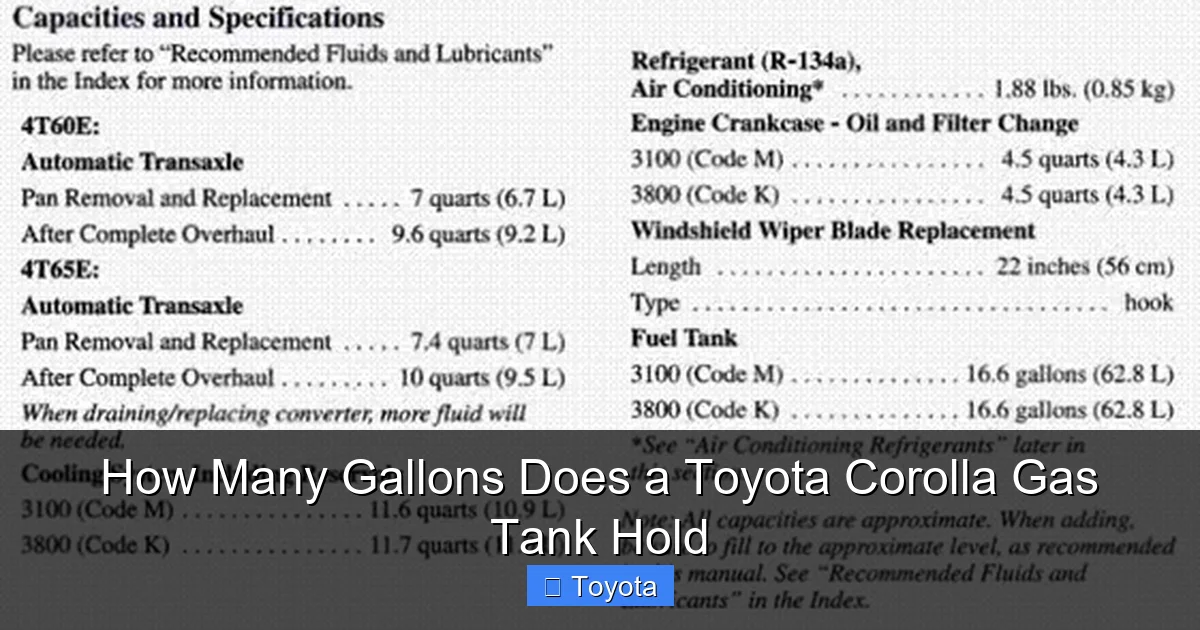
Visual guide about How Many Gallons Does a Toyota Corolla Gas Tank Hold
Image source: fixya.com
Manufacturing Tolerances and “Top-Off”
The 13.2-gallon figure is an estimate. The actual physical volume of the tank shell can vary slightly due to manufacturing tolerances. More importantly, the way you pump gas affects the amount you get. Modern pumps have an auto-shutoff nozzle that clicks when vapor pressure in the filler neck indicates the tank is full. If you try to “top off” by slowly squeezing more fuel in after the first click, you are forcing gasoline into the evaporative emissions (EVAP) system’s charcoal canister, which is designed to handle vapors, not liquid. This can cause damage and is not recommended. The amount you get when the pump clicks the first time is the true, safe capacity of your usable tank.
Temperature and Fuel Expansion
Gasoline expands with heat. If you fill up in the cool of the morning, you’ll get slightly more liquid gasoline than if you fill up in the heat of the afternoon, because the same volume of cooler, denser fuel weighs more. The difference is small, maybe a few tenths of a gallon, but it’s a real physical phenomenon. For maximum “value,” some drivers prefer to fill up when it’s cooler. However, the effect is minimal and not worth obsessing over.
Driving Style and Conditions
This is the biggest variable affecting your range. Your Corolla’s MPG is a laboratory number. Here’s what drags it down:
- City Driving: Constant stopping and starting uses more fuel than steady highway cruising. Your MPG in heavy city traffic can be 5-10 MPG lower than the highway number.
- Speed: Aerodynamic drag increases exponentially with speed. Driving 75 mph vs. 65 mph can reduce fuel economy by 10-15%.
- Climate: Using the heater has a minor impact, but the air conditioner compressor places a significant load on the engine, reducing MPG. In very cold weather, the engine also takes longer to reach optimal operating temperature, burning more fuel in the warm-up phase.
- Load: Carrying four adults and a full trunk adds weight, making the engine work harder. Roof racks and carriers add significant aerodynamic drag.
So, while your tank holds 13.2 gallons, your real-world “effective” range is a moving target based on how and where you drive. To track your true efficiency, reset your trip odometer at each fill-up, drive normally, and then divide the miles driven by the gallons you put in. That’s your real MPG.
How Does the Corolla Compare to Its Rivals?
Putting the Corolla’s tank size in context helps you make an informed decision. The compact sedan segment is highly competitive, with the Honda Civic being the perennial rival.

Visual guide about How Many Gallons Does a Toyota Corolla Gas Tank Hold
Image source: carmiddleeast.com
- Toyota Corolla (Current): 13.2 gallons. Combined range ~436 miles (gasoline).
- Honda Civic (Current): The current Civic also has a 12.4-gallon tank (for most trims). Its combined EPA ratings are similar to the Corolla (around 33-36 MPG combined). This gives it a very comparable total range of roughly 380-430 miles. You can see the exact Honda Civic gas tank size for model-specific details.
- Toyota Camry (Midsize): As mentioned, the larger family sedan has a 15.8-gallon tank. Its better highway aerodynamics and more efficient engine options (especially the hybrid) give it a much longer total range, often 600+ miles on the highway model.
- Toyota RAV4 (Compact SUV): The popular SUV has a 14.5-gallon tank. Its fuel economy is lower than the Corolla’s (around 28-30 MPG combined), so its total range is similar or slightly less than the Corolla’s, despite the bigger tank. Check the specifics for your model year on the Toyota RAV4’s tank capacity page.
- Toyota Highlander (Midsize SUV): This three-row family hauler has a 14.3-gallon tank. With its V6 engine and higher weight, its range is significantly less than a Corolla’s. See the details for the Toyota Highlander to understand the trade-off between space and efficiency.
The takeaway: The Corolla’s tank size is smartly engineered for its class. It’s large enough to provide excellent range without adding unnecessary weight or taking up space that could be used for cargo or passenger comfort. It strikes a perfect balance that is a hallmark of the model’s design philosophy.
Maintenance and Best Practices Related to Your Fuel System
Your gas tank is part of a larger system. Proper care ensures longevity, performance, and safety.
The Importance of Not Running the Tank Too Low
We touched on the reserve, but it bears repeating: don’t make a habit of driving with the gas light on. The fuel pump is located inside the tank and is submerged in gasoline, which acts as a coolant and lubricant. When the tank is consistently very low, the pump can overheat and fail prematurely. Replacing an in-tank fuel pump is an expensive and labor-intensive job. Keeping your tank at least 1/4 full is a good habit to extend the life of this critical component. It also prevents sediment from the bottom of the tank from being stirred up and clogging your fuel filter or injectors.
Using the Correct Fuel
This is critical. Your Corolla’s owner’s manual specifies the required fuel octane rating. For most modern Corollas (2018+), Toyota recommends using regular unleaded gasoline with a posted (R+M)/2 octane rating of 87. Using higher-octane “premium” fuel (91 or higher) provides no benefit and is a waste of money, as the engine is not designed for it. The engine control unit (ECU) will adjust timing for regular fuel. There is no performance or efficiency gain. However, if your manual requires premium (some older sport models might), you must use it. Using lower-octane fuel than required can cause damaging engine knock. You can find the official fuel requirement in your manual or on a sticker inside the fuel door. For more details, see our guide on what gas a Toyota Corolla takes.
Filling Up: A Few Tips
- Use Reputable Stations: Fuel from well-known, high-turnover stations is less likely to be contaminated with water or debris.
- Don’t Overfill: As mentioned, stop pumping at the first click. Overfilling can damage the EVAP system and lead to check engine lights.
- Consider Fuel Additives Sparingly: Modern gasoline already contains detergents. Unless you suspect a specific issue (like water in the tank), you generally don’t need routine fuel system additives. If you do use one, choose a reputable brand and follow the instructions.
Conclusion: Knowledge is Power (and Miles)
So, how many gallons does a Toyota Corolla gas tank hold? For the most common models on the road today—the 2018 and newer Corollas—the answer is a solid and practical 13.2 gallons. For the popular 2014-2017 models, it’s 11.9 gallons. This seemingly small detail connects directly to your vehicle’s core promise: exceptional fuel efficiency and low cost of ownership.
By knowing your exact capacity, you can accurately calculate your real-world driving range, plan trips with confidence, avoid running on fumes, and make smarter decisions at the pump. It empowers you to be a more informed and proactive car owner. The Toyota Corolla’s design, from its efficient engine to its optimally sized fuel tank, is all about delivering you reliably and inexpensively from point A to point B. Now you have one more piece of the puzzle to make that journey as smooth and predictable as possible. Keep your tank at a healthy level, use the right fuel, and enjoy the hundreds of miles that 13.2 gallons (or 11.9) will reliably take you.
Frequently Asked Questions
How many miles can I drive after the gas light comes on in my Toyota Corolla?
Once the low fuel light illuminates, you typically have between 30 and 50 miles of driving range remaining, depending on your model year’s tank size (11.9 or 13.2 gallons) and your current real-world MPG. This reserve is approximately 1.0 to 2.0 gallons of fuel. It is not recommended to rely on this reserve regularly.
Does the Toyota Corolla Hybrid have the same gas tank size as the gas model?
Yes, for the current generation (2018+), both the standard gasoline and Hybrid versions of the Corolla share the same 13.2-gallon fuel tank. The hybrid’s dramatically higher fuel economy (around 50 MPG combined) is what gives it its exceptional total driving range of over 600 miles on a single tank.
Where can I find the exact fuel tank capacity for my specific Corolla?
The most reliable sources are your vehicle’s owner’s manual and the specification sticker on the inside of the fuel filler door. These will list the exact tank capacity in gallons (and often liters) for your exact model year, trim, and engine. You can also often find it on a sticker under the hood.
Is it bad to use premium gas in a Corolla that requires regular?
Yes, it’s simply a waste of money. Using premium unleaded fuel (91+ octane) in a Corolla designed for regular 87 octane provides no performance or efficiency benefit. The engine is tuned for regular fuel. Save your money and use the fuel grade specified in your owner’s manual. For more on fuel types, see our article on what gas a Toyota Corolla uses.
How do I open the gas tank on a Toyota Corolla?
For all modern Corollas, you open the fuel filler door from inside the vehicle. Look for a lever or button on the floor near the driver’s seat or on the lower dashboard. Pressing or pulling this will release the fuel door. You then unscrew the gas cap counter-clockwise to refuel. The process is straightforward; for model-year-specific details, refer to our guide on how to open the gas tank on a Toyota Corolla.
Why does my Corolla’s actual MPG differ from the EPA estimate?
EPA estimates are achieved in controlled laboratory conditions. Your real-world MPG is affected by many factors including your driving style (aggressive acceleration and braking), your average speed, traffic conditions, climate (AC use), vehicle maintenance (tire pressure, air filter condition), and cargo/passenger weight. It is normal and expected for your actual combined MPG to be 10-20% lower than the sticker figure. Tracking your own fuel economy over several fill-ups will give you your true baseline.