
How Much Gas Does a Nissan Rogue Hold?

The Nissan Rogue has a fuel tank capacity of 14.5 gallons across most model years, offering a driving range of 350–450 miles per tank depending on driving conditions and engine type. This compact SUV balances fuel efficiency with practicality, making it a top choice for daily commuters and road-trippers alike.
Key Takeaways
- Fuel Tank Capacity: The Nissan Rogue holds 14.5 gallons of gasoline in most model years, providing a solid foundation for long-distance driving.
- Real-World Range: Depending on trim and driving habits, the Rogue can travel between 350 and 450 miles on a full tank.
- Engine Efficiency: The 1.5L turbocharged three-cylinder engine (introduced in 2021) improves fuel economy compared to older four-cylinder models.
- Fuel Type Recommendation: Nissan recommends regular unleaded gasoline (87 octane) for optimal performance and engine longevity.
- Driving Habits Matter: Smooth acceleration, proper tire pressure, and reduced idling can significantly extend your Rogue’s fuel range.
- Eco Mode Benefits: Activating Eco Mode adjusts throttle response and climate control to improve fuel efficiency during city driving.
- Maintenance Impacts Mileage: Regular oil changes, clean air filters, and timely spark plug replacements help maintain peak fuel economy.
📑 Table of Contents
- How Much Gas Does a Nissan Rogue Hold?
- Understanding the Nissan Rogue’s Fuel Tank Capacity
- Real-World Driving Range: How Far Can You Go?
- Fuel Efficiency Across Rogue Generations
- Factors That Affect Your Rogue’s Fuel Economy
- Recommended Fuel Type and Octane Rating
- Tips to Maximize Your Rogue’s Fuel Range
- Conclusion: The Nissan Rogue’s Gas Capacity in Perspective
How Much Gas Does a Nissan Rogue Hold?
If you’re considering buying a Nissan Rogue—or you already own one—you’ve probably asked yourself: *How much gas does a Nissan Rogue hold?* It’s a smart question, especially if you’re planning long road trips, managing a tight fuel budget, or simply want to know how far you can go between fill-ups. The answer isn’t just about the number on the gas pump; it’s about understanding how your driving habits, vehicle maintenance, and even the model year affect your SUV’s real-world performance.
The Nissan Rogue is one of the most popular compact SUVs on the market, praised for its comfortable ride, spacious interior, and strong fuel efficiency. But behind those appealing features lies a practical detail: its fuel tank capacity. Most Nissan Rogue models, from 2014 through the current 2024 lineup, come equipped with a 14.5-gallon fuel tank. This consistent capacity across generations makes it easy to estimate how far you can drive before needing to stop for gas.
But here’s the thing—knowing the tank size is only half the story. The real value comes from understanding how that gas translates into miles on the road. Whether you’re commuting to work, taking the family on a weekend getaway, or navigating city traffic, your Rogue’s fuel efficiency plays a major role in how often you visit the pump. In this guide, we’ll dive deep into the Nissan Rogue’s fuel system, explore how different factors affect gas mileage, and share practical tips to help you get the most out of every gallon.
Understanding the Nissan Rogue’s Fuel Tank Capacity

Visual guide about How Much Gas Does a Nissan Rogue Hold?
Image source: motorbiscuit.com
Let’s start with the basics: the Nissan Rogue’s fuel tank holds **14.5 gallons** of gasoline. This number has remained consistent across most model years, including the second-generation Rogue (2014–2020) and the third-generation model introduced in 2021. Whether you drive a front-wheel-drive (FWD) or all-wheel-drive (AWD) version, the tank size stays the same.
But why 14.5 gallons? Automakers design fuel tanks to balance vehicle weight, cargo space, and driving range. A larger tank might offer more miles per fill-up, but it also adds weight and takes up valuable underbody space. Nissan struck a smart compromise with the Rogue—enough capacity to reduce frequent stops, without compromising the SUV’s agility or interior room.
It’s also worth noting that the 14.5-gallon capacity refers to the *total* volume the tank can hold. However, you’ll rarely fill it to the absolute brim. Most gas pumps automatically stop when the tank is nearly full, and leaving a small air gap helps prevent fuel expansion and vapor lock, especially in hot weather. So, in practice, you might only pump about 13.5 to 14 gallons during a typical fill-up.
Model Year Variations and Consistency
One of the strengths of the Nissan Rogue is its design consistency. Unlike some vehicles that undergo major redesigns with each generation, the Rogue has maintained a steady fuel tank size. For example:
– **2014–2020 Nissan Rogue:** 14.5-gallon tank
– **2021–2024 Nissan Rogue:** 14.5-gallon tank
This consistency makes it easier for owners to predict fuel needs, whether they’re buying used or new. Even with the introduction of the new 1.5L turbocharged three-cylinder engine in 2021, Nissan kept the same tank size, focusing instead on improving efficiency through advanced engineering.
Front-Wheel Drive vs. All-Wheel Drive
You might wonder if the drivetrain affects fuel capacity. The short answer is no—both FWD and AWD Rogue models use the same 14.5-gallon tank. However, AWD systems do add a small amount of weight and mechanical resistance, which can slightly reduce fuel economy. But since the tank size is identical, the *potential* range remains the same—your actual mileage will depend more on driving conditions and habits.
Real-World Driving Range: How Far Can You Go?
Visual guide about How Much Gas Does a Nissan Rogue Hold?
Image source: dealerinspire-image-library-prod.s3.us-east-1.amazonaws.com
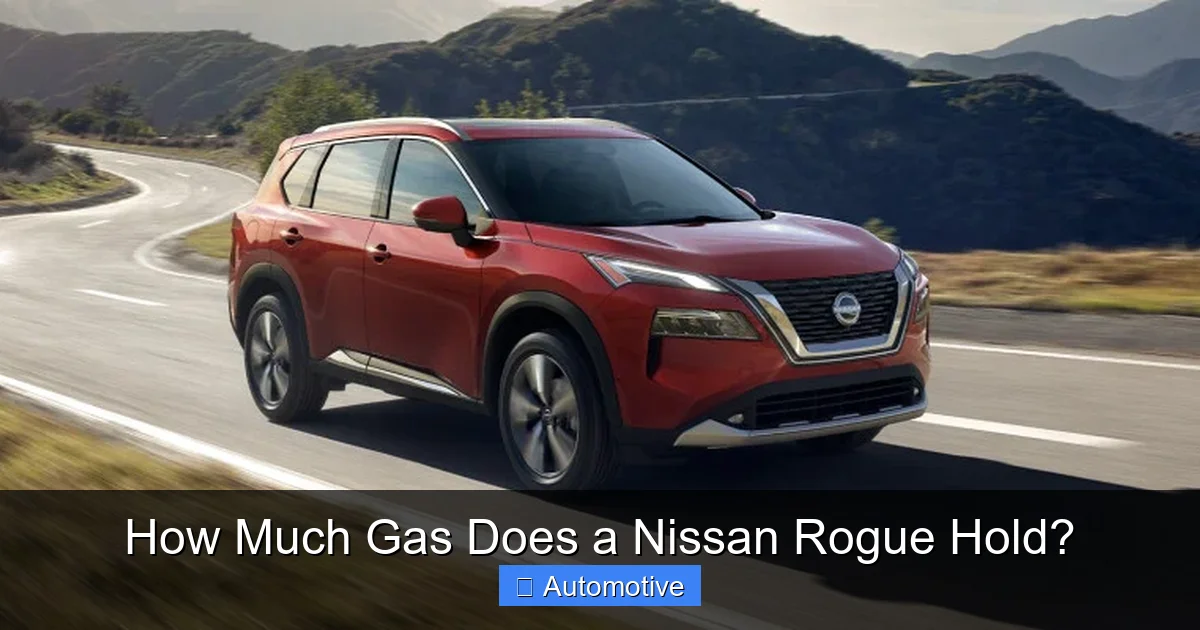
Now that we know the Rogue holds 14.5 gallons, the next question is: *How far can it actually take you?* The answer depends on fuel efficiency, which varies by model year, engine type, and driving style.
On average, the Nissan Rogue achieves between **27 and 35 miles per gallon (mpg)** combined, depending on the trim and configuration. Let’s break that down:
– **City Driving:** 26–28 mpg
– **Highway Driving:** 33–35 mpg
– **Combined (City/Highway):** 29–32 mpg
Using these numbers, we can estimate the Rogue’s real-world range:
– At 27 mpg: 14.5 gallons × 27 = **391.5 miles**
– At 32 mpg: 14.5 gallons × 32 = **464 miles**
– At 35 mpg: 14.5 gallons × 35 = **507.5 miles**
So, in ideal conditions—light traffic, steady speeds, and efficient driving—you could potentially drive over 500 miles on a single tank. More realistically, most drivers will see a range of **350 to 450 miles** per fill-up.
Example: A Weekend Road Trip
Imagine you’re driving from Los Angeles to San Francisco—a distance of about 380 miles. With a full tank and highway driving, your Rogue could make the trip without stopping for gas, especially if you’re driving a newer model with the 1.5L turbo engine. That’s a huge advantage for travelers who want to minimize stops and maximize time at their destination.
City Commuting: Stop-and-Go Realities
Now consider daily city driving. Frequent stops, traffic lights, and idling can drop your mileage into the mid-20s. In this scenario, your range might shrink to around 375 miles. But even then, you’d only need to fill up once a week if you drive about 50 miles per day.
Fuel Efficiency Across Rogue Generations

Visual guide about How Much Gas Does a Nissan Rogue Hold?
Image source: nissanusa.com
Fuel economy has improved significantly over the Rogue’s lifespan, thanks to advancements in engine technology and aerodynamics. Let’s compare key generations to see how efficiency has evolved.
Second-Generation Rogue (2014–2020)
The second-generation Rogue introduced a 2.5L four-cylinder engine paired with a continuously variable transmission (CVT). This setup delivered solid performance and decent fuel economy:
– **FWD Models:** Up to 26 mpg city / 33 mpg highway
– **AWD Models:** Slightly lower, around 25 mpg city / 32 mpg highway
While not class-leading, these numbers were competitive for the time, especially considering the Rogue’s spacious interior and comfortable ride.
Third-Generation Rogue (2021–Present)
The 2021 redesign marked a major leap forward. Nissan replaced the 2.5L engine with a **1.5L turbocharged three-cylinder engine**, which delivers more power (201 horsepower) while improving fuel efficiency. The new engine also features variable compression technology, adjusting compression ratios on the fly for optimal performance and economy.
Here’s how the latest Rogue stacks up:
– **FWD Models:** Up to 27 mpg city / 35 mpg highway
– **AWD Models:** 26 mpg city / 33 mpg highway
That’s a noticeable improvement, especially on the highway. The turbocharged engine provides better acceleration and responsiveness, while the lighter three-cylinder design reduces overall vehicle weight—another boost to efficiency.
Hybrid and Electrified Options?
As of 2024, Nissan has not released a hybrid or plug-in hybrid version of the Rogue in the U.S. market. However, the brand has hinted at electrified options in the future, possibly aligning with its global electrification strategy. For now, the 1.5L turbo engine remains the most efficient choice.
Factors That Affect Your Rogue’s Fuel Economy
While the Rogue’s tank size and engine specs set the baseline, several real-world factors can influence how much gas you actually use. Understanding these can help you drive smarter and save money.
Driving Habits
How you drive has a bigger impact on fuel economy than you might think. Aggressive acceleration, hard braking, and speeding can drop your mileage by 15–30%. For example, accelerating quickly from a stoplight might feel satisfying, but it burns more fuel than a smooth, gradual start.
**Tip:** Use cruise control on highways to maintain a steady speed and reduce fuel waste. In city driving, anticipate traffic lights and slow down gradually instead of braking hard.
Vehicle Load and Cargo
The more weight your Rogue carries, the harder the engine has to work. Carrying heavy luggage, bike racks, or towing a small trailer can reduce fuel economy by 5–20%, depending on the load.
**Tip:** Remove roof racks when not in use—they create wind resistance and can cut highway mileage by up to 10%. Also, avoid using your SUV as a permanent storage unit. Keep only essentials in the cabin and trunk.
Tire Pressure and Alignment
Underinflated tires increase rolling resistance, forcing the engine to burn more fuel. Nissan recommends checking tire pressure monthly and maintaining the psi listed on the driver’s side door jamb (usually around 33–35 psi).
**Tip:** Use a digital tire gauge for accuracy. Also, have your alignment checked annually—misaligned wheels can cause uneven wear and reduce efficiency.
Climate and Weather
Cold weather thickens engine oil and reduces battery efficiency, which can lower fuel economy by 10–20% in winter. Conversely, using the air conditioner in summer also increases fuel consumption.
**Tip:** In mild weather, roll down the windows instead of using AC. In winter, park in a garage or use a block heater to reduce warm-up time.
Use of Eco Mode
Most Rogue models come with an Eco Mode button. When activated, it adjusts throttle response, transmission shift points, and climate control to prioritize fuel savings.
**Tip:** Use Eco Mode during city driving or light traffic. It won’t make your Rogue sluggish—just smoother and more efficient.
Recommended Fuel Type and Octane Rating
Nissan recommends using **regular unleaded gasoline with an octane rating of 87** for all Rogue models. You don’t need premium fuel unless you’re driving in extreme conditions or notice engine knocking (a rare occurrence).
Using higher-octane fuel won’t improve performance or efficiency in a Rogue—it’s designed to run optimally on 87 octane. In fact, spending extra on premium gas is a waste of money unless your owner’s manual specifies otherwise.
**Tip:** Stick to reputable gas stations to ensure fuel quality. Contaminated or low-quality gasoline can harm your engine over time.
Tips to Maximize Your Rogue’s Fuel Range
Getting the most out of your 14.5-gallon tank isn’t just about driving less—it’s about driving smarter. Here are practical tips to extend your range and reduce fuel costs.
Maintain Regular Service
A well-maintained Rogue runs more efficiently. Follow the scheduled maintenance in your owner’s manual, including:
– Oil changes every 5,000–7,500 miles (use synthetic oil if recommended)
– Air filter replacement every 15,000–30,000 miles
– Spark plug inspection/replacement as needed
A dirty air filter can reduce fuel economy by up to 10%, while old spark plugs can cause misfires and wasted fuel.
Plan Efficient Routes
Use GPS apps like Google Maps or Waze to avoid traffic, construction, and hills. Even a slightly longer route with less stop-and-go traffic can save fuel.
**Tip:** Combine errands into one trip. A cold engine uses more fuel, so multiple short trips are less efficient than one longer drive.
Reduce Idling
Idling wastes gas and gets 0 mpg. If you’re waiting more than 30 seconds (except in traffic), turn off the engine.
**Tip:** Modern Rogues have start-stop systems that automatically shut off the engine at stops. Make sure it’s enabled for maximum savings.
Use the Right Oil
Nissan recommends using **0W-20 full synthetic oil** for optimal engine performance and fuel economy. Thinner oil reduces internal friction, helping the engine run more efficiently.
Monitor Your Fuel Economy
Use your Rogue’s trip computer to track your average mpg. If you notice a sudden drop, it could signal a maintenance issue—like a faulty oxygen sensor or underinflated tires.
Conclusion: The Nissan Rogue’s Gas Capacity in Perspective
So, how much gas does a Nissan Rogue hold? The answer is clear: **14.5 gallons**. But more importantly, that gas can take you **350 to 500 miles** depending on how and where you drive. With its efficient engine, practical design, and consistent fuel tank size, the Rogue strikes a great balance between performance and economy.
Whether you’re a daily commuter, a weekend adventurer, or a family road-tripper, understanding your Rogue’s fuel system helps you plan better, save money, and reduce your environmental impact. By maintaining your vehicle, driving efficiently, and using the right fuel, you can get the most out of every gallon.
The Nissan Rogue isn’t just about how much gas it holds—it’s about how far that gas can take you. And with the right habits, the journey can be longer, smoother, and more affordable than you ever imagined.
Frequently Asked Questions
How many gallons does a Nissan Rogue hold?
The Nissan Rogue has a fuel tank capacity of 14.5 gallons across most model years, from 2014 to the present. This size remains consistent whether you drive a front-wheel or all-wheel-drive version.
How far can a Nissan Rogue go on a full tank?
Depending on driving conditions and fuel efficiency, a Nissan Rogue can travel between 350 and 500 miles on a full tank. Highway driving typically yields the longest range, while city driving may reduce it slightly.
Does the 2021 Nissan Rogue have better fuel economy?
Yes, the 2021 and newer Nissan Rogue models feature a 1.5L turbocharged three-cylinder engine that improves fuel economy, offering up to 35 mpg on the highway—better than previous four-cylinder models.
Can I use premium gas in my Nissan Rogue?
Nissan recommends regular unleaded gasoline (87 octane) for all Rogue models. Using premium fuel is unnecessary and won’t improve performance or efficiency unless specified in your owner’s manual.
Does Eco Mode really save gas in the Nissan Rogue?
Yes, Eco Mode adjusts throttle response, transmission shifts, and climate control to improve fuel efficiency. It’s especially helpful in city driving and can increase your mileage by 5–10%.
How often should I fill up my Nissan Rogue?
Most drivers fill up every 7–10 days, depending on mileage. If you drive 400 miles per week and average 30 mpg, you’ll use about 13.3 gallons—so a weekly fill-up is typical.