
What Is the Life Expectancy of a Toyota Car Battery?

The average Toyota car battery lasts between 3 to 5 years, but this can vary significantly based on climate, driving habits, and vehicle technology. Factors like extreme temperatures, frequent short trips, and the use of power-hungry accessories can shorten battery life. Regular maintenance checks and understanding your specific Toyota model’s needs are key to avoiding unexpected failures and ensuring reliable performance.
You’re running late. You jump in your trusty Toyota Camry, turn the key, and all you get is a weak, sluggish crank—or worse, just a ominous click. That sinking feeling is all too familiar. The culprit is almost always the battery. But how long should you realistically expect a Toyota car battery to last before it leaves you stranded? The answer isn’t a simple number; it’s a story of chemistry, climate, and commuting patterns. Let’s dive deep into the life expectancy of a Toyota car battery, unpack the science behind it, and arm you with the knowledge to get the absolute most miles—and years—out of this critical component.
Key Takeaways
- Average Lifespan: A typical Toyota car battery lasts 3-5 years under normal conditions, with some lasting up to 6 years with perfect care.
- Warranty Clues: Toyota’s new vehicle limited warranty often covers the battery for 3 years/36,000 miles, hinting at its expected service life.
- Climate is Key: Batteries in hot climates degrade faster due to accelerated chemical reactions and fluid evaporation, while extreme cold reduces cranking power.
- Driving Habits Matter: Frequent short trips don’t allow the alternator to fully recharge the battery, leading to a gradual, permanent loss of capacity.
- Modern Loads: Toyota’s advanced safety systems, large infotainment screens, and stop-start technology put extra strain on the battery, especially in older models not designed for AGM batteries.
- Maintenance Extends Life: Simple steps like keeping terminals clean, ensuring a secure mount, and periodic voltage checks can add years to your battery’s life.
- Watch for Warning Signs: Slow engine cranking, dimming headlights, and the battery warning light are clear indicators that your Toyota battery is nearing the end of its life.
📑 Table of Contents
- Understanding the Heart of Your Toyota’s Electrical System
- The “Rule of Thumb” and Model-Specific Expectations
- The Villains of Voltage: What Kills a Toyota Battery Early?
- Proactive Care: How to Extend Your Toyota Battery’s Life
- The Science of Decline: What Happens Inside a Dying Battery
- Signs It’s Time: Diagnosing a Failing Toyota Battery
- Replacement: Choosing the Right Battery for Your Toyota
- Conclusion: A Simple Plan for Peace of Mind
Understanding the Heart of Your Toyota’s Electrical System
Before we talk lifespan, we need to understand what we’re talking about. Your Toyota’s battery isn’t just a simple box of acid. It’s a sophisticated electrochemical device designed for one primary job: delivering a massive burst of power (measured in Cold Cranking Amps, or CCA) to start the engine. Once the engine is running, the alternator takes over, powering the car’s systems and (ideally) recharging the battery. This constant cycle of discharge and recharge is what wears a battery down over time.
The Two Main Types You’ll Find in Your Toyota
Modern Toyotas use two primary battery technologies, and their lifespans differ:
- Flooded (Lead-Acid) Batteries: The traditional, maintenance-optional type. They have liquid electrolyte (sulfuric acid and water) and are generally less expensive. They are common in older Toyota models and base trims of newer ones. Their typical lifespan is 3-5 years.
- Absorbent Glass Mat (AGM) Batteries: The premium, more advanced choice. The electrolyte is suspended in a fiberglass mat, making them spill-proof, more resistant to vibration, and better at handling deep discharges. They are increasingly standard in Toyotas with start-stop systems, advanced safety features, and larger infotainment loads. AGM batteries often last 4-7 years but are more sensitive to overcharging and require a compatible charging system.
Knowing which type your Toyota has is the first step in managing its expectations. You can usually find this in your owner’s manual or on the battery label itself.
The “Rule of Thumb” and Model-Specific Expectations
So, what’s the magic number? For the vast majority of Toyota vehicles on the road today, you can plan on 3 to 5 years of reliable service from a factory-equivalent battery. However, this is a broad average. Let’s break it down by some popular models and the factors that tweak this timeline.
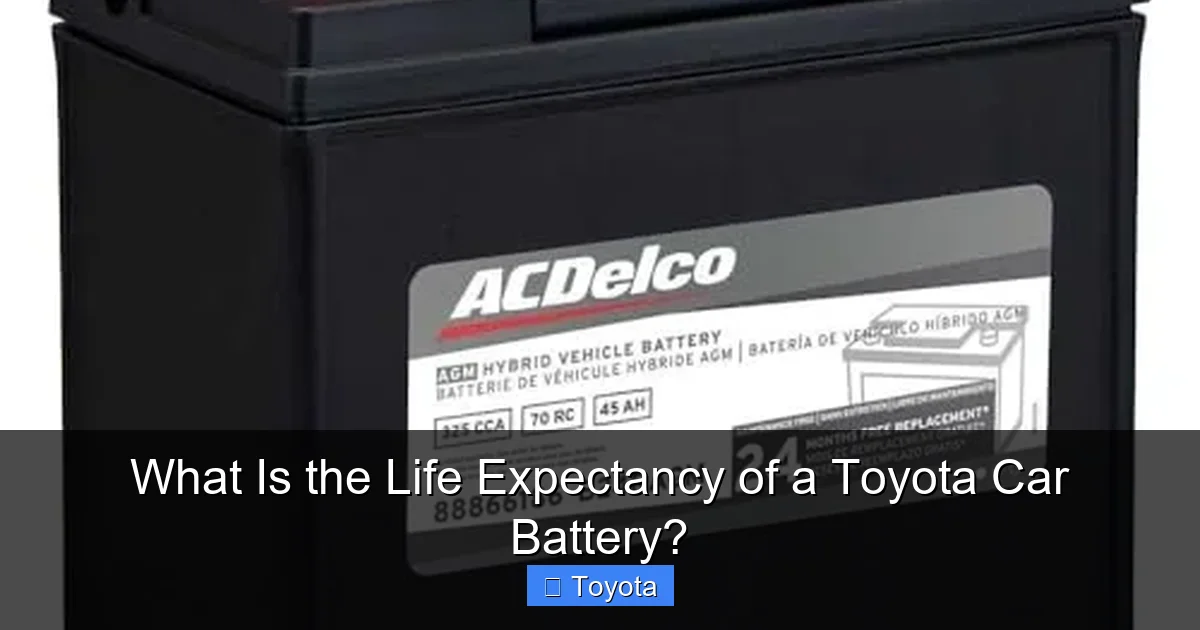
Visual guide about What Is the Life Expectancy of a Toyota Car Battery?
Image source: m.media-amazon.com
By Popular Model & Year
While individual driving conditions matter more, general trends emerge:
- Toyota Camry & Corolla (Gas, Non-Stop-Start): Often equipped with a standard flooded battery. A lifespan of 4-5 years is very common with typical commuting.
- Toyota RAV4 (Gas Hybrid): The hybrid system places unique demands. It uses a large, high-voltage traction battery for propulsion and a separate 12V battery (usually AGM) for accessories and starting. The 12V AGM battery in a hybrid can last 5-7 years because the hybrid system helps keep it charged, but it can also be stressed by constant small draws from computer modules.
- Toyota Tacoma & Tundra (Trucks): These often see more vibration, accessory use (winches, lights), and may be in harsh environments. Expect 3-4 years, sometimes less if heavily accessorized without a proper charging upgrade.
- Toyota Prius: Similar to the RAV4 Hybrid, the 12V battery (AGM) is critical. Its lifespan is closely tied to the health of the main hybrid battery. A failing hybrid battery can drain the 12V faster. 5-6 years is achievable.
- Newer Models with Start-Stop & High Tech: Models like the 2023+ Toyota Grand Highlander or upper-trim Camrys with every feature enabled are almost always equipped with AGM batteries from the factory. These are built for the extra cycling and can last 5+ years if the charging system is functioning correctly.
It’s also wise to check your manufacturing date code on the battery itself. Even a “new” battery sitting on a shelf for 12 months before installation has already begun its calendar life. You can learn how to read this date stamp by referencing our guide on what is the date on a car battery.
The Villains of Voltage: What Kills a Toyota Battery Early?
A battery’s demise is rarely sudden; it’s a slow death by a thousand cuts. Understanding these stressors helps you combat them.

Visual guide about What Is the Life Expectancy of a Toyota Car Battery?
Image source: evdepreciation.com
Climate Extremes: Heat is the Silent Killer
Contrary to popular belief, heat is worse for a battery than cold. High temperatures accelerate the chemical reaction inside the battery, causing the electrolyte to evaporate and the internal grids to corrode. This permanent damage reduces its ability to hold a charge. If you live in Arizona, Florida, or Texas, your battery’s calendar life might be cut by 25-50% compared to someone in a mild climate. Cold, on the other hand, simply reduces the battery’s available power (lower CCA) and thickens engine oil, making starting harder—but it doesn’t damage the battery’s internal structure in the same way heat does.
Driving Patterns: The “Surface Charge” Problem
This is a huge one for city drivers and those with short commutes. Your alternator needs the engine to be above a certain RPM (usually idle and higher) for 20-30 minutes to fully replenish a battery after a start. If your daily drive is a 10-minute trip to the store and back, you’re constantly taking a small chunk out of the battery (starting the car) and only putting a tiny, incomplete “surface charge” back in. This leads to a condition called sulfation, where lead sulfate crystals harden on the battery plates, permanently reducing capacity.
Parasitic Drain & Modern Car “Vampires”
Even when your Toyota is off, it’s not truly asleep. The clock, radio presets, security system, and keyless entry memory all draw a tiny amount of power—this is normal parasitic drain (usually 20-50 milliamps). Problems arise when a faulty module, an aftermarket accessory (like a dashcam hardwired incorrectly), or a glove box light that won’t shut off creates an excessive drain that can deplete a healthy battery in a week or two. Modern vehicles with dozens of control modules are more susceptible.
Vibration and Physical Stress
This is particularly relevant for truck owners. An improperly secured battery or constant heavy-duty use (off-roading, towing) can cause internal components to shake loose or plates to crack, leading to premature failure. Always ensure your battery hold-down clamp is tight and intact.
Proactive Care: How to Extend Your Toyota Battery’s Life
You can’t control the weather, but you can control how you treat your battery. A little proactive maintenance goes a very long way.

Visual guide about What Is the Life Expectancy of a Toyota Car Battery?
Image source: evdepreciation.com
Regular Visual and Terminal Inspection
Twice a year, pop the hood. Look for:
- Corrosion: A white, blue, or green crusty buildup on the terminals is a sign of acid leakage and poor connection. Clean it with a baking soda/water solution and a terminal brush. A good connection ensures efficient charging and starting. You can learn more about battery terminals and their importance by reading about which is the positive and negative on a car battery.
- Cracks, Bulges, or Leaks: Any physical damage to the battery case means immediate replacement.
- Secure Mount: Make sure the battery is firmly held in its tray. A loose battery is a recipe for internal damage.
Ensure Your Charging System is Healthy
A faulty alternator or voltage regulator can kill a good battery in months by undercharging (causing sulfation) or overcharging (causing overheating and fluid loss). If you suspect charging issues (dim lights that brighten when you rev the engine, frequent dead batteries), have the charging system output tested. A healthy system should deliver about 13.7 to 14.7 volts to the battery with the engine running. You can find more details on proper what voltage is a fully charged car battery to understand the ideal range.
Minimize Short Trips and Parasitic Drain
If your driving is exclusively short trips, consider using a small battery maintainer (a smart trickle charger) plugged in at home overnight once a week. It will safely bring the battery to full charge without overcharging. Also, be vigilant about adding aftermarket electronics. Use proper fuse taps and ensure any device completely powers down when the car is off.
Know Your Battery’s “Birthday”
When you buy a new battery, note its manufacture date. A fresh battery is a strong battery. If you’re replacing one, don’t buy one that’s been sitting on a shelf for more than 6 months. The date code is usually a letter (month) and number (year) on the case. Deciphering this is simple once you know the system, as explained in our article on what is the date on a car battery.
The Science of Decline: What Happens Inside a Dying Battery
It’s not just “it dies.” There’s a chemical process at work. The primary mechanism of failure in most lead-acid batteries is the loss of active material from the positive grid and the sulfation of the plates.
- Sulfation: When a battery sits in a partially discharged state, lead sulfate crystals form on the plates. Over time, these crystals become hard and dense, reducing the surface area available for the chemical reaction. This is irreversible and directly reduces the battery’s ability to deliver high current (CCA). This is the #1 killer of batteries in cars driven mostly on short trips.
- Grid Corrosion: Especially in hot climates, the lead alloy grid that supports the active material slowly corrodes and gets thinner. Eventually, the grid becomes too weak to hold the active material, and it flakes off into the bottom of the battery case (forming “mud”), causing an internal short.
- Loss of Water (Flooded Batteries): In non-sealed batteries, the electrolyte (water and acid) can evaporate due to heat or overcharging, exposing the plates and causing irreversible damage. This is why you never see “maintenance-free” flooded batteries with removable caps anymore.
An AGM battery resists sulfation better and doesn’t require water, but it is still susceptible to grid corrosion and can be permanently damaged by deep discharges or using a standard (not AGM-compatible) charger.
Signs It’s Time: Diagnosing a Failing Toyota Battery
Don’t wait for the complete failure. These are your warning lights (pun intended):
- The Slow, Labored Crank: The engine turns over slower than usual, especially when cold. It might sound like it’s struggling to turn over. This is the most classic sign of low CCA.
- Dimming Headlights & Slow Accessories: Headlights that noticeably dim when you come to a stop, or power windows that operate more slowly, indicate the battery can’t maintain voltage under load.
- The Battery/Charging System Warning Light: This dashboard icon (a battery shape or “ALT”/”CHG”) means the charging system voltage is out of spec. It could be a bad alternator, but a severely weak battery can also trigger it. Get it checked immediately.
- Frequent Jump-Starts: If you’re needing a jump more than once every few months, the battery is on its last legs.
- Swollen, Bulging Case: This is a serious safety hazard, usually caused by excessive internal pressure from overcharging or extreme heat. Replace the battery immediately and have the charging system checked.
- Old Age: If your battery is over 4 years old and you’re experiencing any of the above, assume it’s the battery. It’s a wear item, and proactive replacement is cheaper than a tow and lost time.
How to Test: The most accurate test is a load test performed by a professional. They apply a load equal to half the battery’s CCA rating for 15 seconds and measure the voltage. If it drops below 9.6 volts (at 70°F), the battery is bad. A simple multimeter check at rest (12.6 volts is fully charged) is a good health snapshot but doesn’t test capacity under load.
Replacement: Choosing the Right Battery for Your Toyota
When the time comes, don’t just buy the cheapest battery that fits the tray. You need the right tool for the job.
Group Size, CCA, and Reserve Capacity (RC)
These are your three critical specs, found in your owner’s manual or on the old battery’s label:
- Group Size: The physical dimensions and terminal placement (e.g., Group 24F, Group 35). Must match exactly.
- Cold Cranking Amps (CCA): This is the most important number for starting. Toyota specifies a minimum, often 600-800 CCA for larger engines. More is generally better, especially in cold climates. Never downgrade CCA.
- Reserve Capacity (RC): The number of minutes a fully charged battery can deliver 25 amps at 80°F before dropping to 10.5 volts. This indicates how long it can power accessories if the alternator fails. Higher RC is better for modern, accessory-heavy cars.
AGM vs. Flooded: Stick with What’s Designed For
If your Toyota came with an AGM battery (common in hybrids, turbo models, and high-trims with start-stop), you must replace it with an AGM battery. The charging system voltage is tuned for AGM. Using a standard flooded battery will lead to poor performance and early failure. Conversely, putting an AGM in a car designed for a flooded battery is usually fine but is often unnecessary extra cost. When in doubt, match the original type. You can learn about the differences in technology and why AGM batteries are more expensive by researching what kind of acid is in a car battery.
Brand and Warranty
Stick with reputable brands known for automotive batteries (like interstate, DieHard, Optima, AC Delco). A longer free-replacement warranty (e.g., 48-month full replacement) is a good indicator of the manufacturer’s confidence in the product’s lifespan. A pro-rated warranty for years 5-8 is less valuable.
Conclusion: A Simple Plan for Peace of Mind
The life expectancy of your Toyota car battery is not set in stone; it’s a direct result of the environment you provide for it. By understanding that the average is 3-5 years, recognizing the villains that shorten that life (heat, short trips, parasitic drain), and committing to simple, biannual maintenance checks, you can reliably push that number toward the upper limit. Think of your battery as the heart of your car’s electrical system—it needs a healthy “circulatory system” (the charging system) and shouldn’t be constantly stressed. When the signs appear—the slow crank, the dim lights—act decisively. A proactive replacement with the correct, high-quality battery specified for your model is one of the easiest and most cost-effective ways to ensure your Toyota is always ready to go when you are. Don’t let a preventable battery failure be the reason you’re late.
Frequently Asked Questions
What is the average life of a Toyota car battery?
Under normal driving conditions and climate, the average life is 3 to 5 years. Batteries in extremely hot climates or in vehicles with high electrical loads may last closer to 3 years, while those in mild climates with mostly highway driving can last 5-6 years.
Does my Toyota’s warranty cover the battery?
Yes, but with limits. Toyota’s New Vehicle Limited Warranty typically covers the 12V battery for 3 years or 36,000 miles (whichever comes first) against defects. This is a warranty, not an expected lifespan. Normal wear-and-tear replacement after this period is the owner’s responsibility.
My Toyota has a start-stop system. Do I need a special battery?
Absolutely. Vehicles with start-stop technology use an AGM (Absorbent Glass Mat) battery. It’s designed to handle the frequent deep discharges from restarting the engine. You must replace it with another AGM battery of the correct group size and CCA rating to ensure proper function and longevity.
Can I extend my battery’s life if I mostly drive short distances?
Yes. The best method is to use a quality battery maintainer (smart trickle charger) at home. Plug it in overnight once a week or every two weeks. This will safely bring the battery to a full charge without overcharging, combating the sulfation caused by never getting a full recharge from the alternator.
Can I jump-start my Toyota if the battery is dead?
Yes, you can safely jump-start a Toyota with a dead 12V battery using another vehicle or a portable jump starter. However, if the battery is more than 4-5 years old and dies repeatedly, it is likely at the end of its life and will need replacement soon. A jump is a temporary fix, not a cure.
What should I do with my old Toyota battery?
Never throw it in the trash. Car batteries are nearly 100% recyclable. You can return it to the store where you buy the new one (they often give a core charge refund), or take it to an auto parts store, a hazardous waste facility, or a scrap metal recycler. It’s the law in most places and great for the environment.
