
How Many Miles per Gallon Does a 2026 Toyota Camry Get?

The 2026 Toyota Camry delivers exceptional fuel efficiency, especially in its hybrid configuration. The gas-only 2.5L 4-cylinder achieves up to an EPA-estimated 28 mpg city / 39 mpg highway, while the popular hybrid model soars to a combined 44-47 mpg. Your actual miles per gallon will vary based on driving habits, trim, and conditions, but the Camry remains a top-tier midsize sedan for saving at the pump.
If you’re in the market for a reliable, comfortable, and fuel-efficient midsize sedan, the 2026 Toyota Camry is almost certainly on your list. For decades, the Camry has been a benchmark for practical daily driving, and a huge part of that reputation is its stellar fuel economy. But “fuel-efficient” can mean different things depending on which engine is under the hood. So, let’s cut through the marketing and get straight to the numbers you care about: how many miles per gallon does a 2026 Toyota Camry actually get?
The short answer is: it depends entirely on whether you choose the conventional gas engine or the highly acclaimed hybrid powertrain. The gap between them is significant. While the gas model is perfectly competent, the hybrid is in a class of its own for efficiency. We’re going to break down the official EPA ratings for every configuration, explain what those numbers mean in the real world, and give you actionable tips to maximize every drop of fuel. By the end, you’ll know exactly what to expect from your 2026 Camry’s MPG.
Key Takeaways
- Hybrid Dominance: The 2026 Camry Hybrid is the efficiency champion, with EPA ratings reaching up to 47 mpg highway and a combined 44-47 mpg across most trims.
- Gas Engine Still Strong: The standard 2.5L 4-cylinder gas engine offers a respectable EPA-estimated 28 mpg city and 39 mpg highway, which is competitive for its class.
- Trim Matters: Within each powertrain (gas or hybrid), fuel economy can vary slightly by trim level due to factors like wheel size and added weight.
- Real-World vs. EPA: Your actual miles per gallon will be influenced by driving style, traffic, climate, and vehicle maintenance, often differing from perfect EPA test conditions.
- Class-Leading Value: The Camry’s fuel economy, combined with its reliability and resale value, makes it a financially smart choice compared to many rivals like the Nissan Altima or Honda Accord.
- Driving Habits Are Key: Smooth acceleration, maintaining steady speeds, and proper tire inflation are the most effective ways to achieve or even exceed EPA estimates in your Camry.
[FEATURED_IMAGE_PLACEHOLDER]
📑 Table of Contents
- 2026 Toyota Camry Gas Engine Fuel Economy: The Solid Standard
- The Hybrid Powerhouse: Unmatched 2026 Camry Hybrid MPG
- Factors That Affect Your Actual 2026 Camry MPG
- 2026 Camry MPG vs. The Competition
- How to Maximize Your 2026 Camry’s Fuel Economy: Practical Tips
- Conclusion: The 2026 Camry’s MPG Verdict
2026 Toyota Camry Gas Engine Fuel Economy: The Solid Standard
Let’s start with the traditional heart of the Camry lineup: the 2.5-liter 4-cylinder gasoline engine. This engine is paired with an 8-speed automatic transmission and is available on the L, LE, SE, and XLE trims. It produces a smooth 203 horsepower (on most trims; the XLE gets 203 hp, L/LE/SE get 203 hp) and is designed for a balance of responsive power and excellent fuel savings.
Official EPA MPG Ratings for Gas Models
The Environmental Protection Agency (EPA) puts all vehicles through rigorous, standardized tests to determine their official miles per gallon estimates. For the 2026 Camry with the 2.5L gas engine and front-wheel drive, the ratings are consistent across most trims:
- City Driving: 28 mpg
- Highway Driving: 39 mpg
- Combined: 32 mpg
These numbers are identical for the L, LE, SE, and XLE gas trims. The all-wheel drive (AWD) system, available on the SE and XLE gas models, slightly impacts efficiency due to the added drivetrain weight and mechanical drag. The AWD gas models are rated at:
- City: 27 mpg
- Highway: 38 mpg
- Combined: 31 mpg
So, choosing AWD costs you about 1 mpg across the board—a typical trade-off for improved traction in slippery conditions.
What Do These Gas Engine Numbers Mean in Reality?
An EPA combined rating of 32 mpg is very good for a conventional gasoline-powered midsize sedan. In real-world driving, most owners report achieving between 30 and 34 mpg in mixed driving, with highway-only trips often hitting 38-40 mpg if they maintain a steady 65-70 mph. City driving with stop-and-go traffic will understandably pull that number closer to the 25-28 mpg range.
To put this in practical terms, let’s assume a yearly driving distance of 15,000 miles, with a 50/50 split between city and highway. Using the combined 32 mpg rating and a national average gas price of $3.50 per gallon:
- Gallons needed per year: 15,000 miles / 32 mpg = 468.75 gallons
- Estimated annual fuel cost: 468.75 gallons * $3.50 = $1,640.63
That’s a solid, predictable fuel cost for a family sedan. It’s significantly better than many older Camry models and competitive with rivals like the Nissan Altima (which also gets up to 39 mpg highway) and the Mazda6. However, as we’ll see next, the hybrid model changes the entire financial equation.
The Hybrid Powerhouse: Unmatched 2026 Camry Hybrid MPG
This is where the 2026 Camry truly shines and separates itself from the pack. The Toyota Hybrid Synergy Drive system, combining a 2.5L 4-cylinder engine with electric motor(s), is standard on the Hybrid LE, SE, XLE, and XSE trims. For 2026, Toyota continues to offer this system with excellent power (a net 208 horsepower) and, most importantly, class-leading efficiency.
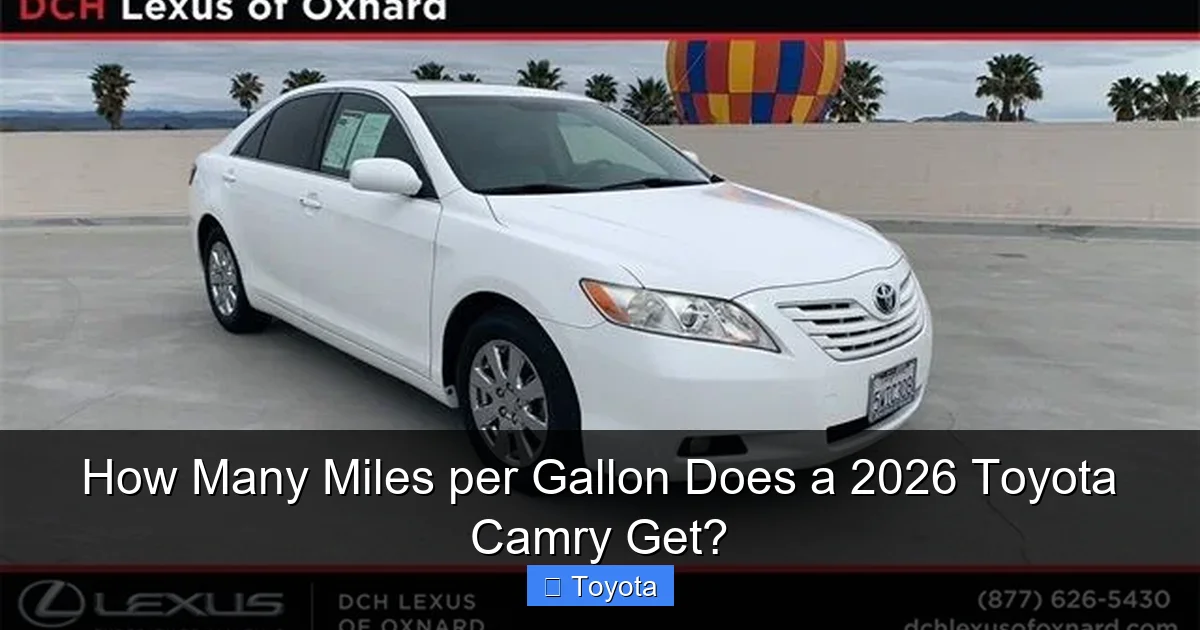
Visual guide about How Many Miles per Gallon Does a 2026 Toyota Camry Get?
Image source: i.pinimg.com
Official EPA MPG Ratings for Hybrid Models
The hybrid system’s efficiency is so high that Toyota offers two different battery setups, leading to slightly different ratings. The LE and SE trims use a standard nickel-metal hydride (NiMH) battery pack, while the XLE and XSE trims come with a slightly larger capacity battery. The difference is minimal but worth noting:
Hybrid LE & SE (Standard Battery):
- City: 47 mpg
- Highway: 46 mpg
- Combined: 47 mpg
Hybrid XLE & XSE (Larger Battery):
- City: 47 mpg
- Highway: 44 mpg
- Combined: 45 mpg
Notice that the LE/SE actually have a higher highway rating (46 vs. 44 mpg). This is because the larger battery in the XLE/XSE adds a small amount of weight, which is more noticeable at steady highway speeds. The combined number is what most people look at, and both are phenomenally efficient at 45-47 mpg combined.
The Hybrid Real-World Experience: Is 45+ MPG Achievable?
Yes, absolutely. In fact, many hybrid owners find they can meet or even slightly exceed the EPA combined number with gentle driving. The hybrid system is brilliantly designed to maximize electric-only propulsion at low speeds and during light acceleration, which is ideal for city and suburban traffic. You’ll see the “EV” mode light up on the dashboard frequently, indicating you’re driving on battery power alone with zero gasoline use.
On long highway cruises, the gas engine will run more consistently, but the system still uses the electric motors to assist and the engine operates at its most efficient RPM range thanks to the planetary gearset. Real-world reports for the 2025 model (which shares the same powertrain) commonly show 44-48 mpg in mixed driving. Using the same 15,000-mile/year calculation with a conservative 46 mpg combined and $3.50/gallon:
- Gallons needed per year: 15,000 / 46 = 326.09 gallons
- Estimated annual fuel cost: 326.09 * $3.50 = $1,141.32
That’s a savings of nearly $500 per year compared to the gas model! Over five years of ownership, that’s $2,500 back in your pocket, not to mention the potential for fewer gas station stops. This is the primary financial driver for choosing the hybrid.
It’s also worth noting that the hybrid’s fuel tank is the same size as the gas model’s (15.8 gallons). However, with nearly double the efficiency, your driving range on a single tank skyrockets. A hybrid Camry can easily achieve 600-700 miles between fill-ups under normal conditions, a massive convenience for road trips. You can learn more about the exact tank size and range specifics for the Camry in our detailed guide on how many gallons a Toyota Camry gas tank holds.
Factors That Affect Your Actual 2026 Camry MPG
EPA numbers are a fantastic baseline, but they are achieved in a controlled laboratory setting. Your personal “miles per gallon” is a living number influenced by dozens of variables. Understanding these helps you manage expectations and, more importantly, drive in a way that maximizes efficiency.
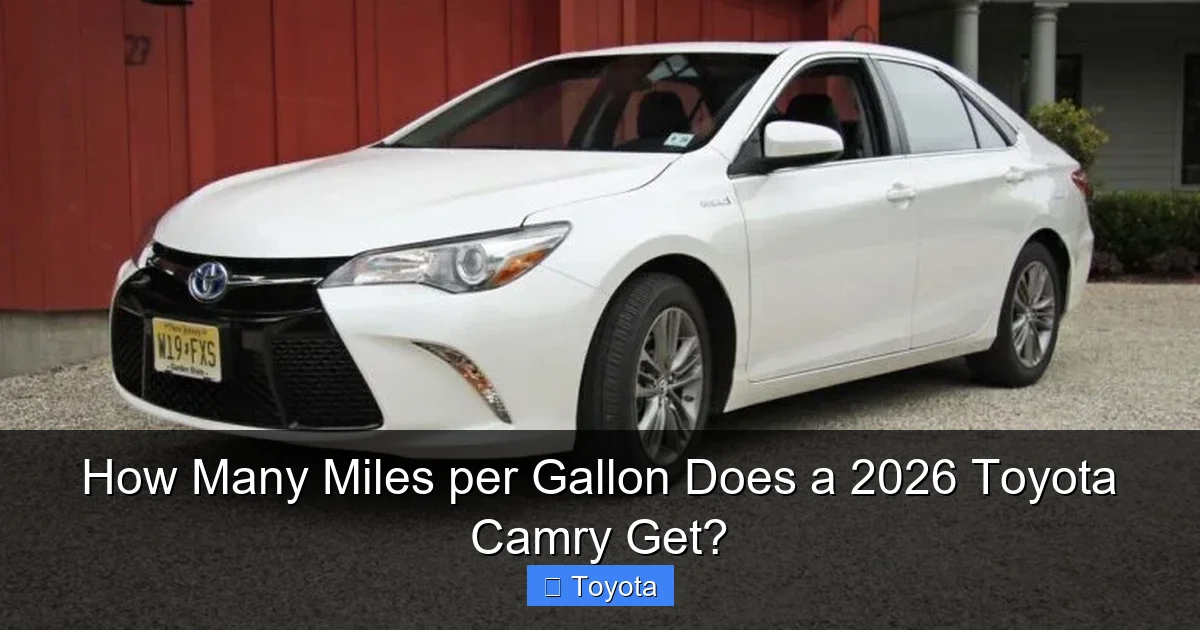
Visual guide about How Many Miles per Gallon Does a 2026 Toyota Camry Get?
Image source: bdc2020.o0bc.com
Driving Style and Environment
This is the single biggest factor. Aggressive driving—hard acceleration, speeding, and abrupt braking—can reduce fuel economy by 15-30% in city driving and 10-20% on the highway. The hybrid system is more forgiving of lead-foot tendencies because it can recapture energy during braking, but it still suffers. Conversely, a smooth, anticipatory driving style that gently accelerates and coasts will often yield numbers at or above EPA estimates.
Climate and terrain play huge roles. Using the air conditioning (A/C) can increase fuel consumption by 5-10%, especially in stop-and-go traffic. Cold weather reduces efficiency because the engine and hybrid battery take longer to reach optimal operating temperature, and winter fuel blends are less energy-dense. Driving in mountainous areas or at high elevations also hurts MPG due to increased engine workload. If you live in a hilly area or frequently drive through mountains, expect your combined average to trend toward the lower end of the EPA range.
Vehicle Load and Maintenance
Extra weight is the enemy of efficiency. Carrying 100 pounds of cargo in the trunk or having a full passenger load can reduce MPG by 1-2%. Roof racks and carriers add significant aerodynamic drag, cutting highway fuel economy by up to 5% or more even when empty. Remove them when not in use.
Proper maintenance is non-negotiable for peak MPG. Under-inflated tires increase rolling resistance. Toyota recommends 32 psi for most Camry tires; going down to 28 psi can cost you 0.3-0.5 mpg. Using the correct oil viscosity (0W-16 for most 2026 models) is critical for the engine and hybrid system to run smoothly. Dirty air filters and old spark plugs also reduce combustion efficiency. Following the scheduled maintenance in your owner’s manual is one of the best ways to protect your fuel economy. Speaking of maintenance, knowing your Camry’s oil capacity is part of that—you can find the exact specifications for your model year in our resource on how many quarts of oil a Toyota Camry takes.
Tire Type and Wheel Size
The difference between standard alloy wheels and larger, heavier premium wheels (like 19-inch vs. 17-inch) is measurable. Larger wheels often come with lower-profile tires that have higher rolling resistance. They also add unsprung weight. On hybrid models, this can be a more significant factor, as the system is finely tuned for efficiency. If maximum MPG is your top priority, the base wheel and tire package on the LE/SE trim will typically perform slightly better than the larger wheels on the XLE/XSE.
2026 Camry MPG vs. The Competition
The midsize sedan segment is fiercely competitive, with several players offering excellent hybrid options. How does the 2026 Camry stack up?
Visual guide about How Many Miles per Gallon Does a 2026 Toyota Camry Get?
Image source: tffn.net
Head-to-Head with Key Rivals
The primary competitors are the Honda Accord Hybrid, Hyundai Sonata Hybrid, and Kia K5 Hybrid. For the 2026 model year, the Camry Hybrid’s EPA combined rating of 44-47 mpg is extremely competitive.
- Honda Accord Hybrid: Typically rated at 44-48 mpg combined (varying by trim). The competition here is razor-thin, with the Accord often edging out the Camry by 1 mpg in certain trims, but the differences are negligible in real-world use.
- Hyundai Sonata Hybrid: Rated up to 47 mpg combined on its Blue trim, with other trims at 44 mpg combined. It matches the Camry’s peak efficiency.
- Kia K5 Hybrid: Offers similar ratings, around 44-45 mpg combined.
The story is similar with the gas engines. The Camry’s 32 mpg combined is very good, but rivals like the revised 2024+ Honda Accord (2.0T) and Mazda6 offer similar or slightly better highway numbers. However, where the Camry consistently wins is in its value proposition, long-term reliability, and resale value—factors that indirectly affect your “cost per mile.”
If you’re cross-shopping with SUVs, the fuel economy gap becomes stark. Even efficient compact SUVs like the Toyota RAV4 Hybrid (which is a fantastic seller) are rated at 40 mpg combined. That’s 5-7 mpg less than the Camry Hybrid. For the same driving habits, that’s a significant increase in fuel costs and more frequent fill-ups. The sedan shape simply has less aerodynamic drag. You can see this comparison play out in our article on how many miles per gallon a Toyota Venza gets, which is a hybrid crossover that slots between the RAV4 and Highlander and gets up to 39 mpg combined—still below the Camry Hybrid.
The Bottom Line on Competition
The 2026 Camry Hybrid isn’t the absolute, by-the-numbers MPG champion in every single trim comparison, but it is firmly in the top tier. Its advantage lies in the complete package: proven hybrid system reliability, a smooth and quiet ride, a spacious interior, and Toyota’s legendary predicted resale value. When you factor in the total cost of ownership, the Camry Hybrid is arguably the smartest efficiency play in the segment.
How to Maximize Your 2026 Camry’s Fuel Economy: Practical Tips
Now that you know the potential, let’s talk about how to realize it. Whether you own the gas or hybrid model, these driving and maintenance habits will help you squeeze every last mile from each gallon.
Driving Techniques for Better MPG
Your right foot is your most powerful tool. The goal is to minimize throttle input and maximize coasting.
- Accelerate Gradually: Pretend there’s an egg under your pedal. Smooth, slow acceleration uses far less fuel than slamming the gas. This is especially crucial for hybrid owners to keep the car in EV mode longer.
- Maintain Steady Speeds: Use cruise control on flat highways. Constant speed is far more efficient than fluctuating with traffic.
- Anticipate and Coast: Look far ahead. If you see a stop sign or red light, take your foot off the gas early and coast to a stop instead of braking at the last second. This saves fuel and brake wear. Hybrids excel here, generating electricity during deceleration.
- Observe Speed Limits: Aerodynamic drag increases exponentially with speed. Driving 75 mph instead of 65 mph can reduce fuel economy by 10-15%. The most efficient speed for most cars is between 45-60 mph.
Maintenance and Setup for Peak Efficiency
- Tire Pressure: Check monthly. Inflate to the door jamb sticker recommendation (usually 32-35 psi), not the max on the tire sidewall.
- Use Recommended Fluids: Always use the specified 0W-16 (or 0W-20 for some older models) synthetic oil. It’s designed for low friction.
- Reduce Weight: Clean out your trunk and back seat. Every 100 pounds costs about 1% in fuel economy.
- A/C vs. Windows: At highway speeds, use the A/C. Open windows create drag. In city traffic, try using vents and the fan instead of max A/C.
- Plan Trips: Combine errands into one trip. A warm engine is more efficient than multiple cold starts.
For hybrid owners, there’s an additional setting: the EV Mode button (on most trims). Pressing it prioritizes electric-only driving for low-speed, light-throttle situations like parking lots or neighborhood streets, as long as the battery has a sufficient charge. It’s a great way to maximize city MPG and enjoy silent, zero-fuel running.
Conclusion: The 2026 Camry’s MPG Verdict
So, how many miles per gallon does a 2026 Toyota Camry get? The answer is a story of two excellent, yet distinctly different, powertrains.
If your priority is absolute, no-compromise fuel savings and you do a lot of city or mixed driving, the Camry Hybrid is the clear winner. With EPA estimates of 44-47 mpg combined and real-world potential to match or exceed those numbers, it represents one of the most efficient non-plug-in vehicles on the market. The annual fuel savings of $400-$600 over the gas model are substantial and will likely offset much of the hybrid’s small initial price premium over the lifetime of ownership.
If you prefer the simpler mechanics of a conventional gas engine, need all-wheel drive for snowier climates, or are on a tighter upfront budget, the standard 2.5L 4-cylinder Camry is still a very efficient choice. Its 32 mpg combined rating is respectable and will deliver predictable, low fuel costs compared to older models or larger vehicles. It’s a workhorse that won’t disappoint.
Ultimately, the 2026 Toyota Camry continues its legacy as a smart, sensible choice. Its fuel economy, whether gas or hybrid, is a core strength that translates directly to lower ownership costs, fewer trips to the gas station, and a reduced environmental footprint. Your actual miles per gallon will always be a personal number, shaped by your foot and your commute. But with the Camry, you start from the highest possible baseline in the segment.
Frequently Asked Questions
Is the 2026 Toyota Camry Hybrid more efficient than the gas model?
Yes, significantly so. The Hybrid model achieves an EPA-estimated 44-47 mpg combined, while the most efficient gas model (FWD) is rated at 32 mpg combined. This is a difference of about 12-15 mpg, leading to much lower fuel costs.
Does the 2026 Camry Hybrid require premium fuel?
No. Both the gas and hybrid 2026 Camry models are designed to run on regular unleaded gasoline (87 octane). Using premium fuel will not improve fuel economy or performance and is not recommended by Toyota.
How does using the air conditioning affect Camry MPG?
Using the A/C compressor increases engine load. In city driving, it can reduce fuel economy by 5-10%. The impact is less noticeable at highway speeds. For maximum MPG, use the vents and fan when possible in mild weather.
Can I expect to get the exact EPA MPG numbers in my daily driving?
Probably not. EPA numbers are achieved in perfect lab conditions. Your real-world MPG depends on your driving style, traffic, climate, and terrain. Most drivers see 10-15% variation, with conservative drivers often meeting or exceeding estimates and aggressive drivers falling short.
Is AWD available on the 2026 Camry Hybrid?
No. For the 2026 model year, the Camry Hybrid is only offered with front-wheel drive (FWD). All-wheel drive (AWD) is available exclusively on the 2.5L 4-cylinder gas engine models (SE and XLE trims).
How does the Camry’s MPG compare to an SUV like the Toyota RAV4?
The Camry Hybrid is notably more efficient than the RAV4 Hybrid. The Camry Hybrid gets 44-47 mpg combined, while the RAV4 Hybrid is rated at 40 mpg combined. The sedan’s more aerodynamic shape and lower weight give it a clear advantage for highway and overall efficiency.
