
What Is the Best Year of the Toyota Rav4 to Buy Used?

Finding the best used Toyota RAV4 hinges on balancing reliability, features, and price. Generally, the 2019-2020 model years represent the sweet spot for the current generation, offering significant updates over previous years without the premium of the newest models. For budget buyers, well-maintained 2014-2015 models from the prior generation are exceptionally durable. Always prioritize a thorough pre-purchase inspection over any specific year.
So, you’re in the market for a used Toyota RAV4. Smart move. It’s consistently one of the best-selling SUVs in America for good reason: it’s practical, reliable, and holds its value incredibly well. But with over two decades of production and multiple generations, the big question looms: what is the best year of the Toyota RAV4 to buy used? There’s no single magic year, but there are clear winners, years to avoid, and smart strategies to find your perfect match. Let’s break it down, generation by generation, so you can drive away confident.
Key Takeaways
- 2019-2020 RAV4s are the top value pick: They feature the complete redesign for the current generation, including standard Toyota Safety Sense 2.0 and available hybrid power, but are more affordable than 2021+ models.
- 2016-2018 models have a critical flaw to avoid: The 2.5L engine in these years is prone to excessive oil consumption (burning oil), a costly issue. Verify service history meticulously.
- 2014-2015 (previous generation) are budget-friendly workhorses: Renowned for legendary reliability and simple mechanics, they are cheap to repair but lack modern safety tech and fuel efficiency.
- Hybrid models are exceptionally reliable: The RAV4 Hybrid, especially from 2019 onward, has a stellar reputation for durability and superb fuel economy, making it a smart used buy.
- Never skip a pre-purchase inspection (PPI):strong> The best year for *you* is the one with the best service history and condition. A PPI by a trusted mechanic is non-negotiable.
- Check for open recalls: Always verify if any recall repairs (like the 2016-2018 oil consumption or earlier models’ sunroof issues) have been completed on the specific vehicle.
- Your budget and needs dictate the “best” year: The ideal choice balances your desire for tech/safety with your budget for purchase price and potential repairs.
📑 Table of Contents
Understanding the RAV4 Generations
Before we dive into specific years, it’s crucial to understand the major generational shifts. Each redesign brought significant changes in size, power, efficiency, and technology. Knowing which generation you’re looking at frames everything else.
The First Generation (1994-2000)
These are the classic, compact pioneers. They’re charming, simple, and now very old. Finding one in good, reliable condition is a treasure hunt, not a practical purchase for most. Parts are scarce, and they lack even basic modern safety features. We’ll focus on more recent, practical options.
The Second Generation (2001-2005)
This generation grew the RAV4 into a more family-friendly size. They are known for being rugged and simple. The 2.0L and 2.4L four-cylinder engines are famously bulletproof. The major drawback is fuel economy—they are thirstier than anything that followed. Safety was basic, with side-curtain airbags only becoming available very late in this run. They are cheap to buy and repair, but their age means you’re buying a high-mileage vehicle with dated tech and efficiency.
The Third Generation (2006-2012)
A major step forward in refinement and power. The 2.5L engine (2AR-FE) introduced here is one of Toyota’s most reliable engines ever produced. This generation also saw the introduction of a third-row seat option (though it was tiny). The 2009-2012 models added standard stability control. These are fantastic, durable trucks. The 2006-2008 models had a known issue with the instrument cluster (speedometer/odometer failure) that was the subject of a class-action lawsuit and extended warranty coverage—always check if this repair was done. Otherwise, this is a rock-solid, if somewhat bland, used choice.
The Fourth Generation (2013-2018)
This is where things get interesting and complicated. Toyota completely redesigned the RAV4 for 2013, making it larger, more powerful, and more car-like. The new 2.5L Dynamic Force engine (2AR-FXE in hybrids) was more efficient. The big story here is the mid-cycle refresh for 2016. The 2016-2018 models received a new front fascia, updated interior, and, most importantly, the introduction of Toyota Safety Sense (TSS) as standard equipment on most trims. TSS includes Pre-Collision System with Pedestrian Detection, Lane Departure Alert, Automatic High Beams, and Dynamic Radar Cruise Control. This was a game-changer for safety.
The Fifth Generation (2019-Present)
The current, all-new RAV4 is a revelation. It’s larger, more capable off-road (especially the Adventure/TRD Off-Road trims), and more efficient than ever. The standard engine is a powerful 2.5L, and the hybrid system is even more seamless and efficient. TSS 2.0 is standard, adding Road Sign Assist and improved systems. The 2021 model year added a wireless charging pad and standard fog lights on some trims, while 2022+ models got a slightly updated infotainment screen. This generation is the pinnacle of the RAV4 formula.
The Contenders: Best Years by Generation
Now, let’s crown some champions. We’ll look at the most recent generations where the value proposition is strongest for a used buyer.
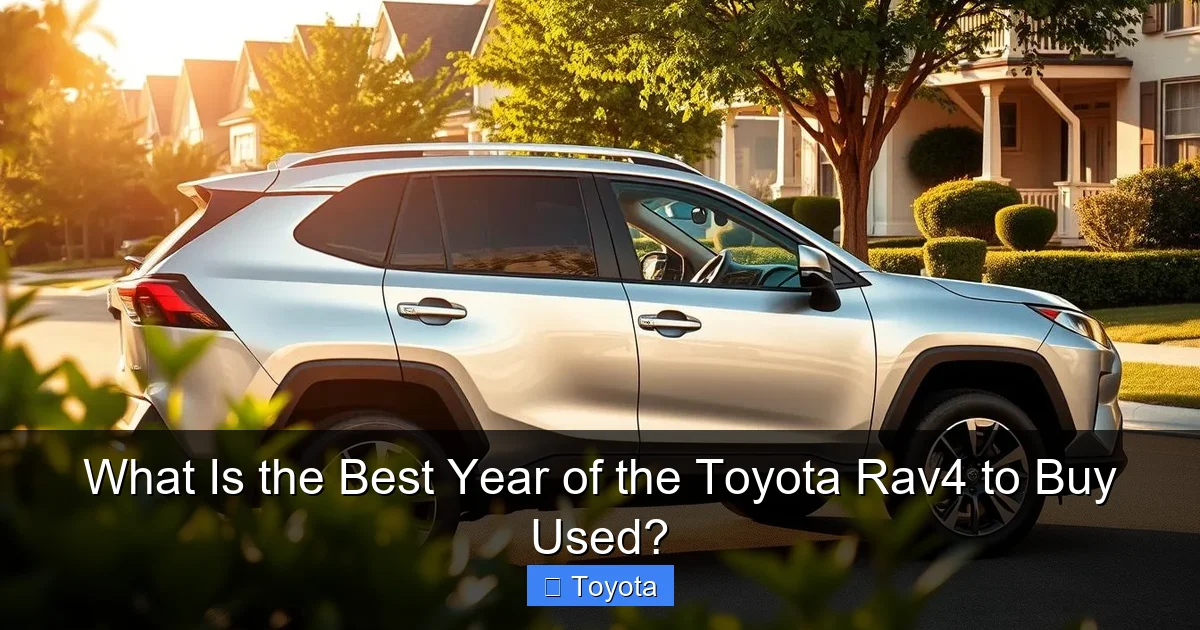
Visual guide about What Is the Best Year of the Toyota Rav4 to Buy Used?
Image source: vehiclebright.com
The Sweet Spot: 2019 & 2020 RAV4 (Fifth Generation)
If your budget allows for a newer vehicle, the 2019 and 2020 model years are arguably the absolute best value in the used RAV4 market. Here’s why they win:
- First-Year Benefits: You get the entire, all-new fifth-generation package: bolder styling, improved ride quality, more standard tech, and excellent fuel economy (up to 28 mpg city/35 highway for gas, 40 mpg combined for hybrid).
- Significant Savings Over Newer Models: A 2020 RAV4 will cost you thousands less than a 2022 or 2023 model with similar miles, yet it offers 95% of the same experience. The core architecture, safety suite, and powertrains are identical.
- Hybrid Availability: The hybrid was in full production and easier to find on dealer lots than in the very first (2019) model year.
- Fewer “New Model” Quirks: The absolute first year of any redesign (2019) can sometimes have minor teething issues or software updates. A 2020 model has had those initial kinks worked out in production, making it a slightly more proven choice.
Practical Tip: When shopping for a 2019-2020, focus on the XLE and Limited trims for the best balance of features and value. The Adventure trim adds rugged flair, but the LE is very basic. Also, knowing the invoice price of a Toyota RAV4 gives you a powerful negotiating tool when buying from a dealership, even used, as it shows you understand the underlying cost.
The Budget King: 2014-2015 RAV4 (Fourth Generation, Pre-Refresh)
If your priority is rock-bottom purchase price and mind-numbing reliability, look no further than the 2014 and 2015 models of the fourth generation. These are the last years before the major 2016 refresh that added TSS.
- Proven, Simple Technology: The infotainment system is basic (often with a small non-touch screen), which means fewer complex electronics to fail. The 2.5L engine is the same reliable unit from 2013, with none of the oil consumption issues that plagued the 2016-2018 models.
- Extreme Depreciation: They have taken the biggest value drop. You can find clean, well-maintained examples with reasonable miles for a fraction of the cost of a 2019+.
- Cheap Repairs: Parts are plentiful and inexpensive. Any mechanic knows these vehicles inside and out.
The Big Caveat: You are buying a vehicle without modern standard safety tech. No automatic emergency braking, no adaptive cruise control, no lane-keeping assist. If safety is a top priority, this is a significant compromise. Also, their fuel economy is notably worse than the post-2016 or hybrid models.
The Risky “Best” Year: 2016-2018 RAV4 (Fourth Generation, Post-Refresh)
On paper, the 2016-2018 RAV4s should be perfect. They have the valuable TSS safety suite, a refreshed interior, and the same generally reliable platform as the 2014-2015 models. But they carry a notorious, expensive problem.
The 2.5L engine (2AR-FE) in these specific years is widely documented to suffer from excessive oil consumption. Many owners report needing to add a quart of oil every 1,000 miles or less. Toyota issued extended warranty coverage and revised piston rings in some cases, but it’s a chronic, costly issue that can lead to engine failure if not addressed. Many 2016-2018 RAV4s on the used market have had this repair done under warranty, but many have not.
If you must consider a 2016-2018 model:
- Demand full, detailed service records showing oil consumption tests or the piston ring replacement.
- Have a mechanic perform a rigorous oil consumption test and compression check.
- Check for open recalls using the VIN on the NHTSA website.
- Be prepared to budget for a $3,000-$5,000 out-of-warranty engine repair if the history is unclear. For this reason, many experts advise avoiding this year range unless you get an exceptional deal with absolute proof the problem is fixed.
The Hybrid Advantage: A Class of Its Own
We need to talk about the RAV4 Hybrid separately because it’s practically a different vehicle with its own timeline and reputation.
Visual guide about What Is the Best Year of the Toyota Rav4 to Buy Used?
Image source: assets-global.website-files.com
Why the Hybrid is a Smart Used Buy
The RAV4 Hybrid debuted for the 2016 model year (fourth generation) and continued seamlessly into the fifth generation (2019+). Its system pairs the reliable 2.5L engine with two electric motors. The benefits are immense:
- Unbeatable Fuel Economy: Consistently 35-40 mpg combined, regardless of driving conditions.
- Proven Reliability: The hybrid system has a stellar track record with very few major issues reported. The battery packs are known to last the life of the vehicle.
- Smooth, Quiet Operation: The electric motors provide instant torque and seamless power delivery.
- Higher Resale Value: Hybrids hold their value even better than gas models.
Best Hybrid Years
The same generational rules apply, but with less risk.
- Best Overall (2019-2020): The fifth-gen hybrid is the peak. More power, better efficiency, and the new generation’s refined cabin. The 2019-2020 models offer the best new-to-you value.
- Great Budget Option (2016-2018): The fourth-gen hybrid does not suffer from the same widespread oil consumption issues as the gas-only 2016-2018 models. A 2016-2018 RAV4 Hybrid with a clean history is a fantastic, efficient, and reliable buy. You still get TSS and great mileage for less money than a newer hybrid.
Hybrid-Specific Tip: Always verify the hybrid battery has been checked. While rare, a failing hybrid battery can be a $3,000+ repair. A proper diagnostic scan at a dealership or specialist can confirm its state of health.
Critical Checks & Common Issues by Year
No matter what year you’re looking at, a thorough inspection is key. Here are the red flags and common problems to investigate.

Visual guide about What Is the Best Year of the Toyota Rav4 to Buy Used?
Image source: assets-global.website-files.com
The 2016-2018 Oil Consumption Nightmare
This bears repeating. It is the single biggest issue in the used RAV4 market. Ask specifically: “Has this vehicle ever been diagnosed for or repaired for excessive oil consumption?” Get it in writing.
CVT Transmission Concerns (2019+)
The 2019+ gas-only RAV4 uses a conventional 8-speed automatic, which is excellent. The hybrid uses a e-CVT, which is a different, robust design. However, some early reports (mainly 2019) mentioned occasional “shift shock” or hesitation, often resolved with a transmission control module (TCM) software update from the dealer. A test drive should reveal any harsh engagements. A 2020+ model is less likely to have this.
Sunroof/Roof Rack Issues (2006-2012)
Some third-generation models (2006-2012) have a known issue where the sunroof glass can crack or the roof rack rails can detach. Toyota had a recall/ warranty extension for this. Always check for repair history.
Infotainment Glitches
Models with touchscreen systems (starting around 2013, more so in 2019+) can suffer from lag, freezing, or Bluetooth connectivity issues. Often, a simple software update from the dealer fixes it. Test all systems—radio, navigation (if equipped), Bluetooth pairing, USB ports—during your test drive.
General Wear and Tear
Regardless of year, check for:
- Suspension: Clunks or clicks over bumps can indicate worn struts, control arm bushings, or ball joints.
- Brakes: Rotors should be smooth, pads have thickness. Squealing is normal; grinding is not.
- Tires: Uneven wear points to alignment issues. Check for dry rot on older tires.
- Interior: Seats, dash, and carpet wear. Excessive wear on a low-mileage car can indicate hard use.
- Exterior: Look for mismatched paint (indicating accident repair), rust (especially in northern states), and proper alignment of body panels.
How to Find Your Personal “Best Year”
So, with all this info, how do you decide? Follow this decision tree:
- Set Your Absolute Budget: This is the first filter. A $15,000 budget points you to 2014-2018. A $25,000+ budget opens up 2019-2021 models.
- Prioritize Your Must-Haves: Is it:
- Safety Tech (TSS)? Then you must have a 2016 or newer.
- Max Fuel Economy? The Hybrid is your only choice.
- Lowest Purchase Price? Target 2014-2015.
- Best Blend of Newness & Value? Target 2019-2020.
- Search Within Your Budget & Priority Band: Don’t just look at years; look at individual vehicles. A 2018 with a documented oil consumption repair and full history might be better than a 2019 with a shady past and missing records.
- Get a Pre-Purchase Inspection (PPI) IMMEDIATELY: For any car you’re serious about, spend $150-$250 on a PPI by an independent mechanic (not the selling dealer). This is the only way to uncover hidden problems. This is the most important step. If a seller refuses a PPI, walk away.
- Check Vehicle History Reports: Use Carfax or AutoCheck. Look for:
- Regular maintenance records.
- No major accidents (or well-documented repairs).
- Consistent mileage jumps (about 12k/year is average).
- Number of previous owners (fewer is generally better).
- Time Your Purchase: According to experts, the best time to buy a car, including used, is often at the end of the month, quarter, or year when dealerships are trying to meet sales quotas. Shopping for last-year models (like a 2020 in late 2021) can yield deals.
Conclusion: The Verdict
So, what is the best year of the Toyota RAV4 to buy used? The answer is nuanced, but we can give clear recommendations.
For Most Buyers Seeking the Best Blend of Modernity, Safety, and Value: The 2019 and 2020 Toyota RAV4 (gas or hybrid) are the undisputed champions. You get a nearly-new experience with the latest safety tech and efficient powertrains, without paying the premium for a 2022 or 2023 model. The 2020 is slightly more refined than the inaugural 2019 year.
For Budget-Conscious Buyers Prioritizing Proven Reliability Over Modern Tech: The 2014 and 2015 RAV4 are incredible bargains. They are simple, cheap to maintain, and the 2.5L engine is one of Toyota’s best ever. Just be aware of the missing safety suite.
For the Efficiency-Minded: A 2016-2018 RAV4 Hybrid or any 2019+ RAV4 Hybrid is a brilliant choice. The hybrid system’s reliability is exceptional, and the fuel savings are substantial.
Years to Approach with Extreme Caution: The 2016, 2017, and 2018 gas-only models due to the pervasive oil consumption issue. Unless you have irrefutable proof of repair and a drastically reduced price, they are not worth the potential $4,000 engine repair.
Ultimately, the best used RAV4 is the one with the most complete service history, no accidents, and a clean bill of health from a pre-purchase inspection. Use the year guidelines above to narrow your search, but let the condition and history of the specific vehicle be your final guide. The RAV4’s reputation for longevity means that even a 10-year-old model, if well-cared-for, can provide years of faithful service. Happy hunting!
Frequently Asked Questions
Is the 2019 Toyota RAV4 a good year to buy?
Yes, the 2019 RAV4 is an excellent year to buy used. It’s the first model year of the current fifth generation, offering a complete redesign with standard Toyota Safety Sense 2.0, improved fuel economy, and a more rugged look. As a first-year model, ensure it has had any software updates completed, but it represents significant value over newer models.
What years should I avoid when buying a used Toyota RAV4?
Avoid the 2016, 2017, and 2018 gas-only RAV4 models if possible. These years are notorious for a design flaw in the 2.5L engine that causes excessive oil consumption, leading to potential engine failure and costly repairs. A 2016-2018 Hybrid does not have this issue and is safe to consider.
Is a used RAV4 Hybrid more reliable than the gas model?
Yes, generally the RAV4 Hybrid is considered equally or even more reliable than the gas model. Its hybrid powertrain is simple, proven, and has fewer moving parts that wear out compared to a conventional automatic transmission. The hybrid battery packs have an excellent longevity record, making it a very safe and efficient used purchase.
What is the expected lifespan of a well-maintained Toyota RAV4?
With regular maintenance and timely repairs, a Toyota RAV4 can easily reach 200,000 to 250,000 miles or more. Many examples on the road exceed 300,000 miles, particularly from the third and fourth generations with the 2.5L engine. The hybrid system’s longevity further supports this high-mileage potential.
Does the 2019 RAV4 have Toyota Safety Sense?
Yes, absolutely. The 2019 RAV4, as the first year of the current generation, came standard with Toyota Safety Sense 2.0. This includes Pre-Collision System with Pedestrian Detection, Lane Departure Alert with Steering Assist, Full-Speed Range Dynamic Radar Cruise Control, and Automatic High Beams on all trims.
How much should I pay for a used Toyota RAV4?
Prices vary wildly by year, mileage, trim, and region. As a general guide (for the US market in 2024): a 2014-2015 model ranges from $12,000-$18,000; a 2016-2018 (high-risk gas models) from $15,000-$22,000; a 2019-2020 from $22,000-$28,000; and a 2021-2022 from $26,000-$32,000. Always check the invoice price and use pricing guides like KBB or Edmunds to negotiate a fair deal based on the specific vehicle’s condition.
