
Where Is the Tpms Reset Button on a 2016 Toyota Tacoma?

Your 2016 Toyota Tacoma does not have a traditional, dedicated “TPMS reset button.” Instead, the system is reset using the vehicle’s existing “SET” button, which is part of the multi-information display on the steering wheel. The process involves turning the ignition on, pressing and holding the SET button until the TPMS indicator blinks three times, and then driving the vehicle for about 30 minutes at speeds above 25 mph to allow the sensors to relearn. It’s a simple procedure you can do yourself, but proper tire inflation beforehand is critical for success.
So, you’re staring at that little, annoying, yellow tire pressure warning light on your 2016 Toyota Tacoma’s dashboard. It’s a steady glow, telling you something is up with your tire pressure. You’ve checked the tires, maybe even added a little air, but the light just won’t go away. Your next logical thought is, “Where is the TPMS reset button?”
Here’s the thing: for your 2016 Tacoma, there isn’t a standalone button labeled “TPMS RESET” hiding in the fuse box or under the dash. That design is common in some older vehicles. Toyota, in its wisdom for this model year, integrated the reset function into a button you already use: the SET button. This is a point of confusion for many owners, but once you know the trick, it’s incredibly straightforward. This guide will walk you through exactly where that button is, the precise steps to reset your Tacoma’s Tire Pressure Monitoring System, and what to do if the light keeps coming back. We’ll make sure you understand not just the “how,” but the “why” behind it all.
Key Takeaways
- No Dedicated Button: The 2016 Tacoma uses the “SET” button on the steering wheel for TPMS reset, not a separate, labeled reset switch.
- Prerequisite is Proper Inflation: You must adjust all four tires to the exact PSI listed on the driver’s door jamb sticker before attempting the reset.
- The Process is Simple: It’s a sequence of ignition on, pressing/holding the SET button until the dash light blinks, and then driving for sensor relearning.
- Light Behavior is Key: A slow-blinking TPMS light during the drive indicates the system is actively learning. A fast blink usually means a sensor fault.
- It’s a Relearn, Not a Clear: The reset tells the computer to start listening for the current sensor IDs. If a sensor is dead or missing, the light will return.
- Professional Help is Available: If the light persists after a correct reset and proper inflation, a tire shop can diagnose a bad sensor, weak battery, or module issue.
- This Applies to Most Base Models: This method is for standard Tacoma trims. Some higher trims with full-color multi-information displays may have a slightly different menu path.
📑 Table of Contents
- Understanding Your Tacoma’s TPMS: Direct vs. Indirect
- Finding the Elusive “Reset” Button on a 2016 Tacoma
- The Step-by-Step Reset Procedure: A Simple Sequence
- Common Issues and Troubleshooting: Why Won’t the Light Go Off?
- When to Press the Reset Button vs. When to See a Professional
- Maintaining Your TPMS for Long-Term Reliability
- Conclusion: Knowledge is Power (and a Dashboard Without Warnings)
Understanding Your Tacoma’s TPMS: Direct vs. Indirect
Before we hunt for a button that doesn’t exist in the traditional sense, let’s quickly understand what system your Tacoma uses. The 2016 Tacoma employs a Direct TPMS. This means each wheel has a small, battery-powered sensor mounted inside the valve stem. These sensors constantly radio their individual tire pressure (and often temperature) data to the vehicle’s computer.
The “SET” Button’s Dual Role
The button you’ll be using—the SET button—is primarily for cycling through the multi-information display (the small screen between your speedometer and tachometer). Its secondary, crucial function is to initiate the TPMS reset/relearn mode. When you hold it, you’re telling the Tacoma’s computer: “Hey, the tire pressures are now correct, please start listening for and memorizing the signals from these four specific sensors again.” It’s a communication reset, not a physical one.
Finding the Elusive “Reset” Button on a 2016 Tacoma
Now, for the location. This is the part everyone wants. You’re going to look at your steering wheel. Specifically, on the right-side spoke (for left-hand drive models), you’ll find a small button with the word SET on it. It’s usually right next to or below the button used to toggle the multi-information display screens.
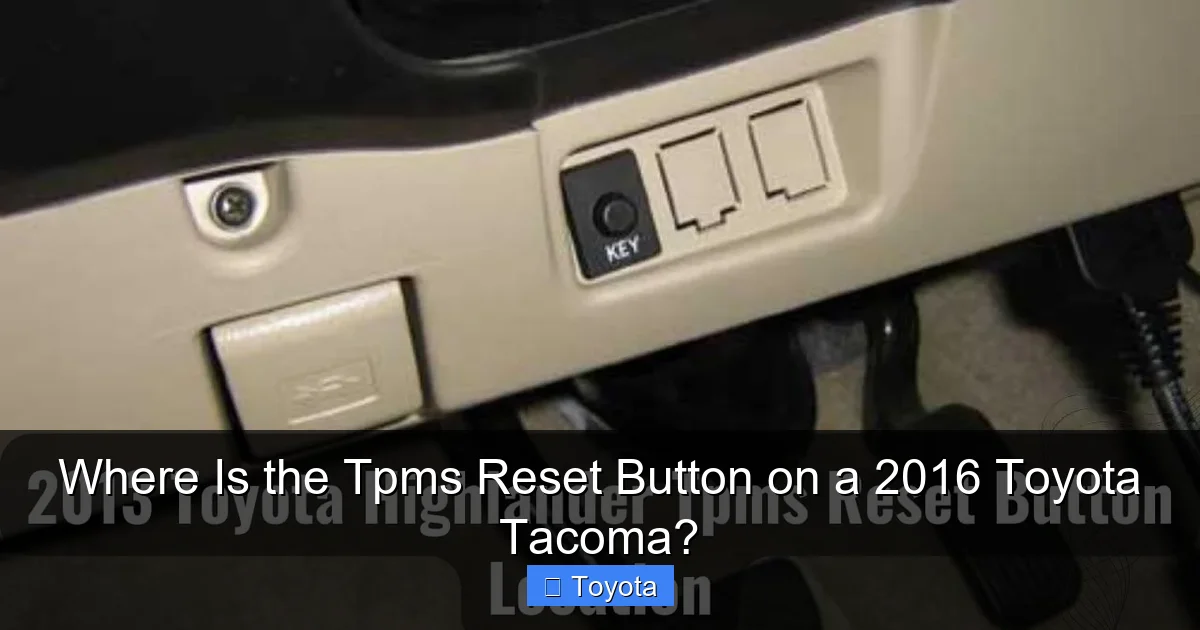
Visual guide about Where Is the Tpms Reset Button on a 2016 Toyota Tacoma?
Image source: psychoautos.com
To be absolutely clear:
- Sit in the driver’s seat.
- Look at the right-side steering wheel control stalk or the flat surface of the right spoke.
- The button is small, often black or dark gray, with white or illuminated text that says “SET.”
- On some trims, it might be a small circular button; on others, it’s a narrow rectangular one. It is not the “MODE” or “INFO” button, though they are neighbors.
Pro Tip: Turn on your parking lights or start the truck (but don’t start the engine) to see the button’s illumination, which makes it much easier to spot. If you’re still unsure, your owner’s manual will have a diagram of the steering wheel controls in the instrument cluster section. You can also find helpful visual guides online by searching for “2016 Tacoma steering wheel controls.”
The Step-by-Step Reset Procedure: A Simple Sequence
Once you’ve found the button, the process is a specific sequence. Doing it out of order won’t work. Here is the definitive guide for a 2016 Toyota Tacoma.
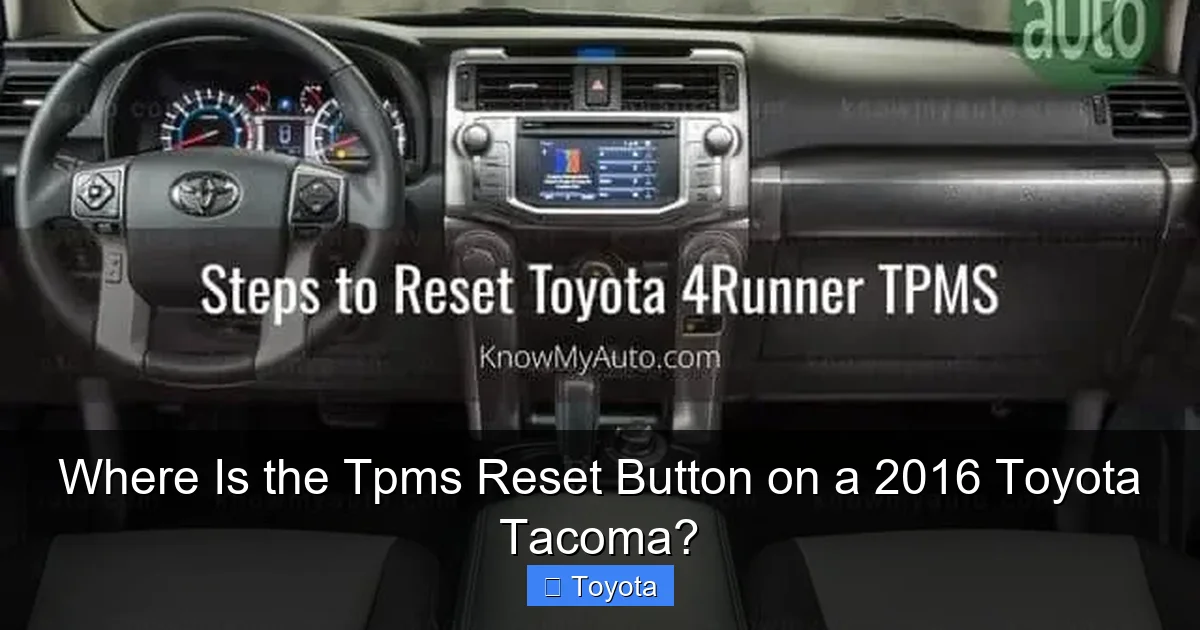
Visual guide about Where Is the Tpms Reset Button on a 2016 Toyota Tacoma?
Image source: knowmyauto.b-cdn.net
Step 1: Inflate All Tires Correctly
This is the most important step and the one people skip, leading to frustration. You must inflate all four tires to the exact pressure specified by Toyota for your specific Tacoma. This number is not on the tire sidewall (that’s the max pressure). It’s on a yellow and white sticker located on the driver’s side door jamb, on the B-pillar when you open the door. It will say something like “Tire Placard” and list pressures for the front and rear tires, often at different loads (e.g., “Normal Load” vs. “Maximum Load”). For standard driving with normal cargo, use the “Normal Load” figures. Use a reliable, high-quality tire pressure gauge. Digital gauges are great. Check the pressures when the tires are cold (driven less than a mile or so).
Step 2: Turn the Ignition to “ON”
Get into the driver’s seat. Insert your key and turn it to the “ON” position (the position right before starting the engine, where all your dash lights come on). Do not start the engine. If you have a push-button start, press the button once without touching the brake pedal. Ensure the parking brake is set.
Step 3: Press and Hold the SET Button
Locate the SET button on your steering wheel. Press and hold it firmly. You need to hold it for about 3-5 seconds. What you’re looking for is the TPMS warning light on your dashboard (the icon looks like a cross-section of a tire with an exclamation point) to blink three times.
Once it blinks three times, you can release the button. This blink is the system’s confirmation that it has entered the sensor registration/relearn mode. If the light doesn’t blink, you may not be holding it long enough, or there could be an existing fault in the system. Try again, holding for a full 5 seconds.
Step 4: The Relearning Drive
After you release the button and see the three blinks, the TPMS light will turn off. This is normal. Now, start your engine and drive the vehicle. The system needs to “hear” the unique radio signals from each of the four wheel sensors to memorize their new IDs and positions. For this to happen successfully:
- Drive at a steady speed of 25 mph (40 km/h) or higher.
- Maintain this for approximately 20-30 minutes.
- Avoid sharp turns or aggressive driving during this period, as it can sometimes confuse the positional learning.
During this drive, the TPMS light may come back on and start to blink slowly. This is normal and actually a good sign. A slow blink during the relearn process indicates the system is actively searching for and identifying the sensor signals. After the 20-30 minutes, the light should go out and stay off when you come to a stop.
Common Issues and Troubleshooting: Why Won’t the Light Go Off?
You followed all the steps perfectly, but that stubborn light is still glowing. Don’t panic. This is common and usually points to one of a few issues. Let’s diagnose.
Visual guide about Where Is the Tpms Reset Button on a 2016 Toyota Tacoma?
Image source: knowmyauto.com
Issue 1: Incorrect Tire Pressure
This is the #1 culprit. Double-check your pressures against the door jamb sticker. Use a different gauge if yours is old. Remember, pressures must be set when tires are cold. If you drove to the gas station to add air, your tires are hot, and the reading will be higher than the “cold” spec. Add 1-2 PSI to your target if you’re checking hot tires, then let them cool and re-check. The system is very sensitive to even a 1-2 PSI deviation from the target.
Issue 2: A Faulty or Dead Sensor
TPMS sensors have batteries that last 7-10 years. The 2016 Tacoma’s sensors are now approaching or exceeding that lifespan. If one sensor’s battery is dead, it won’t transmit, and the system will flag a fault. The reset process will fail because the computer can’t “hear” all four sensors. A tire shop or mechanic can use a specialized scan tool to check the status of each individual sensor and read its battery life. Replacing a sensor requires breaking the tire’s bead, so it’s a professional job unless you have the tools.
Issue 3: Sensor Damage or Replacement Needed
Did you recently have a tire changed, rotated, or repaired? Sometimes, a sensor can get nicked by a tool during a service. Also, if a sensor was replaced but not properly programmed to the vehicle’s computer, the system won’t recognize it. This is a common issue after aftermarket sensor installation. The new sensor must be “learned” by the vehicle, which often requires a professional scan tool to write the new sensor’s ID into the Tacoma’s TPMS module.
Issue 4: The Spare Tire is the Problem
This is a classic Tacoma quirk. Many Tacoma models, including the 2016, come with a full-size spare tire mounted on the rear bumper or under the truck. If your spare tire is mounted on the vehicle and is also equipped with a TPMS sensor (many are), the system expects to see five sensors (four on the ground, one on the spare). If the spare’s pressure is low or its sensor is faulty, it will trigger the warning light. Check the spare’s pressure! Inflate it to the same spec as your other tires. If the warning persists after resetting with the spare on, try removing the spare from the vehicle entirely and then performing the reset procedure. If the light goes off, you’ve found your culprit—a faulty spare tire sensor.
When to Press the Reset Button vs. When to See a Professional
Knowing when a DIY reset is appropriate and when you need expert help is key to safety and saving money.
Do It Yourself When:
- The light came on after a significant temperature drop (cold weather reduces tire pressure).
- You recently aired up your tires and the light didn’t reset automatically after driving a few miles.
- You had a tire repaired or rotated and the shop didn’t reset the system (this is their job, but it happens).
- You’ve confirmed all five tires (including the spare) are inflated to the exact correct pressure.
See a Professional When:
- The TPMS light is flashing rapidly when you start the truck (this usually indicates a system fault, not just low pressure).
- The reset procedure works, but the light returns within a day or two with no change in tire pressure.
- You’ve had a tire replaced and the new sensor wasn’t programmed.
- You suspect a sensor is damaged or its battery is dead (common in older vehicles).
- You’re not comfortable checking the spare tire pressure or accessing the valve stems.
A reputable tire shop will use a scan tool to diagnose the exact problem. They can see which sensor is faulty, check battery life, and reprogram new sensors. This is worth the cost to ensure your system is reliable, as TPMS is a critical safety feature.
Maintaining Your TPMS for Long-Term Reliability
Your Tacoma’s TPMS is there for your safety, warning you of under-inflation which can lead to poor fuel economy, uneven tire wear, and dangerous blowouts. A little maintenance goes a long way.
- Check Pressures Monthly: Don’t rely solely on the TPMS light. It often only illuminates when pressure is 25% below spec. Check all tires, including the spare, with a good gauge at least once a month and before long trips.
- Respect the Reset Process: After any tire service, ensure the shop resets the system. If you do it yourself, follow the steps precisely. Never use “fix-a-flat” or similar sealants in a sensor-equipped tire unless it’s an emergency. These products can damage the sensor.
- Be Mindful of Sensor Batteries: As your Tacoma ages, be aware that the sensor batteries will eventually die. When you replace tires, ask the shop to check the sensor battery life. Replacing sensors at the time of a tire change is often more cost-effective than doing it separately later.
- Winter is Prime Time: For every 10°F drop in temperature, tire pressure drops about 1 PSI. Be extra vigilant about checking and adjusting pressures in the fall and winter. You’ll likely need to reset the TPMS after these seasonal adjustments.
For other Toyota models, the reset procedure can vary. For instance, the process on a Toyota Camry uses a similar SET button but is located in a different spot. Always consult your specific owner’s manual.
Conclusion: Knowledge is Power (and a Dashboard Without Warnings)
Finding the “TPMS reset button” on your 2016 Toyota Tacoma is really about finding the SET button on your steering wheel and understanding the simple sequence that follows. It’s a testament to Toyota’s design that they integrated this function into an existing control, keeping the dash clean. Remember the golden rule: inflate first, reset second. The system is a communication tool, not a magic eraser. If the pressures aren’t perfect, the reset will fail.
Armed with this guide, you can confidently address that TPMS light yourself in under five minutes. However, don’t hesitate to seek professional help if the light persists after a correct reset. Your tires are your only connection to the road, and maintaining their proper pressure is one of the simplest yet most important things you can do for your safety, your fuel economy, and the longevity of your tires and your beloved Tacoma. Now, go check that door jamb sticker, air up those tires, and give that SET button a firm, confident press. That warning light doesn’t stand a chance.
Frequently Asked Questions
Can I reset the TPMS on my 2016 Tacoma without the SET button?
No. The SET button on the steering wheel is the designated control for initiating the TPMS reset/relearn sequence on the 2016 Tacoma. There is no other hidden or alternative method for a manual reset without using this button and the associated driving cycle.
Why does my TPMS light keep coming back on after I reset it?
The most common reason is that one or more tires are not inflated to the exact pressure specified on your door jamb sticker. Other reasons include a faulty or dead sensor, a damaged sensor from recent tire service, or a problem with the spare tire (if equipped with a sensor). A persistent light after a correct reset indicates a fault that needs professional diagnosis.
How often should I reset my Tacoma’s TPMS?
You should only need to reset it after you have manually corrected the tire pressures to the proper level, especially after seasonal temperature changes or after tire service (rotation, repair, replacement). It is not a regular maintenance item. If you find yourself resetting it weekly, you have a slow leak or a faulty sensor that needs repair.
Does the TPMS sensor battery ever need replacing?
Yes. The batteries inside TPMS sensors typically last 7-10 years. Since your 2016 Tacoma is now in that age range, battery failure is a common cause of TPMS warnings. When a sensor battery dies, the entire sensor assembly must be replaced, which involves removing the tire from the wheel.
How long do I need to drive after pressing the SET button?
You should drive at a steady speed of 25 mph (40 km/h) or higher for at least 20-30 minutes. This allows the vehicle’s computer to receive and memorize the unique radio signals from each of the four wheel sensors. The TPMS light may blink slowly during this period, which is normal.
Should I just have the TPMS light ignored if I check my tire pressures regularly?
No. While regular manual checks are excellent practice, the TPMS light is a federally mandated safety warning system. It indicates a problem that could be a slow leak you haven’t noticed yet. Driving on significantly under-inflated tires is dangerous, causes excessive wear, and reduces fuel efficiency. Always address the light promptly.
