
Can I Get My Bmw Oil Change at Jiffy Lube?

While Jiffy Lube can technically perform an oil change on a BMW, it is generally not recommended due to the specific oil requirements, potential warranty issues, and the nuanced service needs of German-engineered vehicles. BMWs often require specific high-performance synthetic oils meeting factory specifications, and using the incorrect product can cause long-term engine damage. For optimal performance, longevity, and warranty protection, prioritizing a BMW-certified technician or a reputable independent European auto specialist is the safer choice.
You’re staring at that little service light on your BMW’s dashboard. It’s time for an oil change. Your eyes then drift to the familiar red and white sign of Jiffy Lube, promising a quick, affordable, and convenient service. It’s a logical thought: an oil change is an oil change, right? For most everyday cars, that’s often a safe bet. But for a precision-engineered vehicle like a BMW, that assumption can be a costly mistake. This article dives deep into the question: Can I get my BMW oil change at Jiffy Lube? We’ll separate the marketing slogans from the mechanical realities, exploring oil specifications, warranty implications, and the true cost of convenience.
Key Takeaways
- BMW Oil Specifications Are Unique: BMW engines are designed for specific high-performance oils, often requiring approvals like BMW LL-04 or LL-17 FE+. Generic “synthetic” oil from a quick-lube chain may not meet these precise standards.
- Warranty Concerns Are Real: If an improper oil change leads to engine damage, BMW may deny warranty coverage. Documented service history through BMW or certified specialists is the safest way to maintain your factory warranty.
- Jiffy Lube Technicians Lack BMW-Specific Training: Their technicians are trained on common makes/models but may not understand the particularities of BMW engine designs, filtration systems, or service procedures.
- Oil Filter Quality Matters: BMW often recommends or specifies filters from brands like Mann, Mahle, or OEM. Jiffy Lube’s standard filter may not offer the same level of filtration or fitment precision.
- Convenience vs. Long-Term Cost: While cheaper and faster upfront, an improper BMW oil change at Jiffy Lube can lead to expensive repairs, negating any initial savings.
- The “Top-Off” Dilemma: In a pinch, adding the correct BMW-spec oil to low levels is acceptable, but a full change with the wrong oil/process is a different risk. Understanding when and how to add oil is crucial.
- Better Alternatives Exist: Specialized independent European repair shops and BMW dealerships offer the correct expertise, parts, and documentation for a fair price, providing better long-term value.
📑 Table of Contents
- Why a BMW Is Not Just Another Car: The Engineering Factor
- Jiffy Lube’s Business Model: Standardization vs. Specialization
- The Warranty Wild Card: Will BMW Deny a Claim?
- The Practical Reality: What Could Go Wrong?
- Where Should You *Actually* Take Your BMW for an Oil Change?
- The Bottom Line: Making the Right Choice for Your BMW
Why a BMW Is Not Just Another Car: The Engineering Factor
To understand the answer, you must first understand the subject. BMW, like other German luxury brands (Audi, Mercedes-Benz, Porsche), builds its engines to exacting standards. These are not simple, low-compression powerplants designed for maximum durability with minimal fuss. They are high-revving, turbocharged (in most modern models), and often feature complex variable valve timing and direct injection systems. The engineering philosophy prioritizes performance, efficiency, and longevity under high-stress conditions.
The Critical Role of Engine Oil in a BMW
In a BMW engine, oil does far more than just lubricate. It is a critical component of the engine’s operational system. It must:
- Withstand Extreme Temperatures: From cold starts to sustained high-load operation, the oil must maintain its viscosity and protective film.
- Handle Turbocharger Demands: Turbochargers spin at over 100,000 RPM and require a constant, cool supply of oil for lubrication and cooling. Oil breakdown here is catastrophic.
- Combat Low-Speed Pre-Ignition (LSPI): A specific risk in modern turbocharged gasoline engines, requiring specific additive packages in the oil to prevent destructive engine knock.
- Work with Variable Valve Timing: The oil pressure directly actuates these systems. The wrong oil viscosity or quality can cause sluggish performance, erratic idling, and premature wear.
Because of these demands, BMW does not simply say “use 5W-30 synthetic oil.” They certify oils to their own rigorous specifications, most notably the BMW Longlife (LL) series. Current and recent standards include BMW LL-04 (for most diesel and many gasoline engines) and BMW LL-17 FE+ (for newer engines focused on fuel economy). These specs dictate not just viscosity but also the exact chemistry of the base stocks and additive package. An oil meeting the generic API SP or ILSAC GF-6 standard is a baseline; a BMW LL-04 is a specialized, higher-performance product.
Jiffy Lube’s Business Model: Standardization vs. Specialization
Jiffy Lube’s entire operation is built on one principle: speed and standardization. Their technicians are cross-trained to perform the same basic service—drain, filter replacement, refill—on thousands of different vehicle makes and models. Their inventory is stocked with a limited range of bulk oils and filters designed to cover the vast majority of vehicles on the road.
Visual guide about Can I Get My Bmw Oil Change at Jiffy Lube?
Image source: cdn.thedailyautomotive.com
The “One-Size-Fits-Most” Oil Approach
When you pull into a Jiffy Lube, the technician will look up your vehicle in a database. For a 2018 BMW 330i, this might recommend a specific viscosity, like 0W-20 or 5W-30. The critical flaw is the specification gap. The database will list a viscosity, but it often does not, and cannot, verify that the bulk oil in their tanks meets the BMW LL-04 or LL-17 FE+ specification. They are selling “synthetic oil” that meets a general standard, not a BMW-exclusive one. The difference in chemistry, while subtle, can be the difference between optimal protection and accelerated wear over time. For a car with a simple, non-turbocharged engine, this might be negligible. For a high-strung BMW turbo, it matters.
The Filter Question: Cost vs. Precision
Similarly, Jiffy Lube uses a handful of filter brands (often Fram or their house brand) that are designed to fit many applications. BMW, however, specifies filtration requirements that match its engine’s precise tolerances. OEM BMW filters or premium brands like Mann Filter or Mahle are engineered specifically for BMW’s oiling circuits. A generic filter might have a different filtration media, bypass valve setting, or seal design. While it will likely screw on and keep large particles out, it may not provide the same level of microscopic filtration or ensure the correct oil pressure characteristics that a BMW’s sensitive systems expect. This is a point where cutting corners on a simple part like an oil filter can have outsized consequences.
The Warranty Wild Card: Will BMW Deny a Claim?
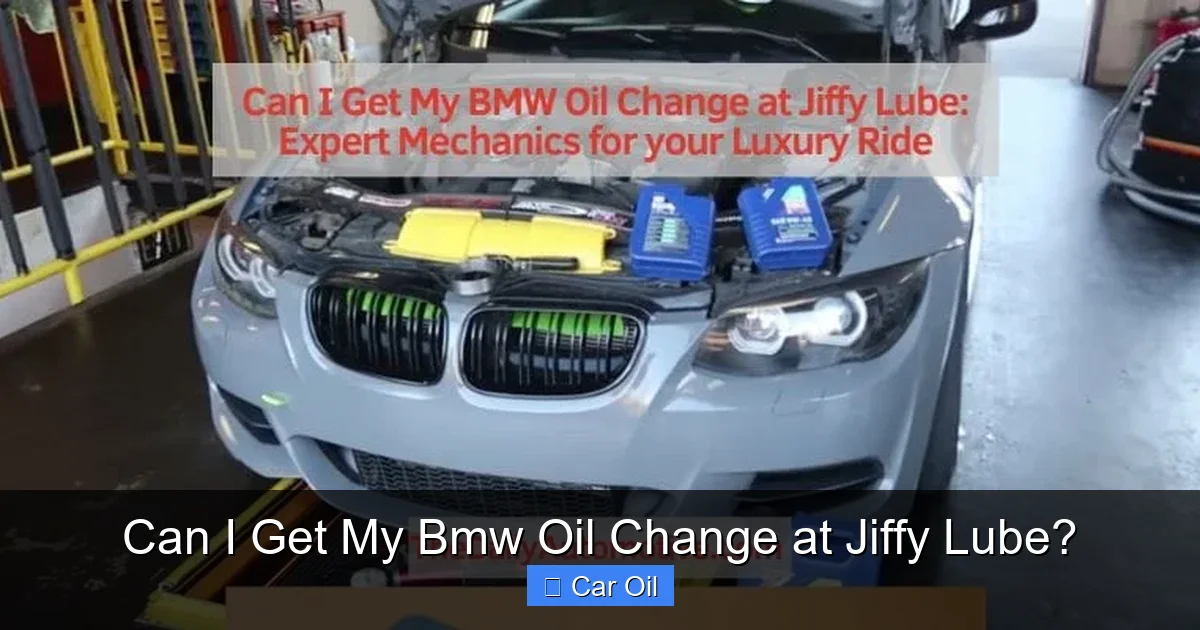
This is the most significant and often overlooked risk. Your BMW’s factory warranty (the New Vehicle Limited Warranty, typically 4 years/50,000 miles) and any extended Certified Pre-Owned (CPO) warranty are contingent on following the manufacturer’s maintenance schedule and using approved parts and fluids.
Visual guide about Can I Get My Bmw Oil Change at Jiffy Lube?
Image source: thedailyautomotive.com
What Does the Warranty Actually Say?
Perusing your BMW owner’s manual, you’ll find language stating that maintenance must be performed using “genuine BMW parts or equivalent” and that “failure to use the correct oil may cause engine damage not covered by the warranty.” The term “equivalent” is where Jiffy Lube will hang its hat, arguing that an API SP oil is “equivalent.” BMW’s legal and engineering teams would argue that only an oil meeting their specific LL-04 or LL-17 FE+ specification is equivalent. In the event of an engine failure, BMW North America would receive a repair invoice and a sample of the oil used (if available). If the oil does not meet their certified list, they have a very strong, documentable reason to deny the claim, citing improper maintenance as the cause or a contributing factor.
The Paper Trail Problem
Even if you use the correct oil and filter, Jiffy Lube’s service receipt is a generic form. It will say “Synthetic Oil, 5W-30” and “Standard Filter.” A BMW dealership service record, or even a reputable European specialist’s record, will list the exact oil brand and specification (e.g., “Pennzoil Platinum Euro L 0W-30, meets BMW LL-04”) and the exact filter part number (e.g., “Mann HU 8001 X”). This detailed record is your best evidence of compliance. A generic receipt provides no such proof and can be a red flag during a warranty review. This is a key reason why many BMW owners, even those who change their own oil, meticulously document the exact products used.
The Practical Reality: What Could Go Wrong?
Let’s move from theory to the garage floor. What are the tangible risks of taking your BMW to a quick-lube chain?
Visual guide about Can I Get My Bmw Oil Change at Jiffy Lube?
Image source: cdn.thedailyautomotive.com
1. Oil Sludge and Varnish Formation
Using an oil not formulated for the extended drain intervals (often 10,000+ miles) recommended for BMWs can lead to sludge and varnish buildup. The oil may break down prematurely under the high heat of a turbocharger, losing its ability to suspend combustion byproducts. This gunk can clog oil passages, restrict turbo oiling, and lead to premature wear on camshafts and other精密 components. The cleanup is a costly engine teardown.
2. Turbocharger Failure
The turbo is one of the most expensive components on your engine. It relies on a constant, cool, clean oil supply. Oil that is too thin (incorrect viscosity) at operating temperature can fail to maintain an adequate film under the extreme pressures of the turbine shaft. Oil with poor high-temperature stability (HTHS viscosity) will shear down and lose its protective qualities. Either scenario leads to turbo bearing wear, noise, and eventual catastrophic failure. Replacing a BMW turbocharger can easily exceed $3,000.
3. Variable Valve Timing (VANOS) Issues
BMW’s VANOS system uses engine oil pressure to adjust camshaft timing. If the oil is too thick when cold, it may not flow quickly enough to the VANOS solenoids on startup, causing delays, rough running, and warning lights. If the oil shears down and becomes too thin under heat, it may not generate enough pressure to hold the adjustment under load, causing performance loss and potential damage to the VANOS gears and hubs. Symptoms range from poor performance to check engine lights.
4. Voided CPO Warranty and Resale Value Hit
As discussed, a denied warranty claim leaves you on the hook for a massive repair bill. Furthermore, a vehicle history report (like Carfax) may note the service at a non-specialist facility. A savvy BMW buyer or dealership will see this and may discount the car’s value, assuming less attentive care. A complete service history with BMW-specific records is a selling point.
Where Should You *Actually* Take Your BMW for an Oil Change?
So, if Jiffy Lube is a gamble, where are the safe, smart bets? You have three primary options, each with its own pros and cons.
Option 1: The BMW Dealership
Pros: Unquestionable warranty compliance. Technicians are BMW-trained, using factory scan tools and BMW-specific procedures (like resetting service intervals correctly). They use genuine BMW parts and fluids, and your service history is automatically logged in BMW’s global system. This is the path of zero worry regarding warranty or specification.
Cons: The most expensive option. Dealership labor rates are the highest. You are also paying for the prestige and overhead of the brand name.
Option 2: An Independent European Auto Specialist
Pros: Often the sweet spot. These shops exist to service BMW, Mercedes, Audi, etc. Their technicians are either former dealership techs or have dedicated themselves to these brands. They use high-quality, brand-specific parts (Mann, Mahle, Febi Bilstein, OEM) and the correct, specified oils (often carrying brands like Liqui Moly, Ravenol, or Motul that are BMW-approved). Prices are typically 30-50% lower than the dealership. They understand the systems intimately and will reset your service lights correctly. They provide detailed invoices listing exact oil specs and filter part numbers.
Cons: You must vet the shop. Look for certifications (ASE, especially with L1 Advanced Engine Performance), positive reviews from BMW owners, and a clean, organized facility. They are not connected to BMW’s central service database, so you must keep your own records (though they will provide them).
Option 3: DIY (Do-It-Yourself)
Pros: Maximum control and potential cost savings. You choose the exact oil (purchasing a case of BMW-approved LL-04) and filter (Mann or Mahle). You know the job is done correctly. It can be a rewarding connection to your vehicle.
Cons: Requires tools, a safe workspace, knowledge of proper disposal, and time. You must be meticulous about procedure and torque specs. You also bear all responsibility for any mistake. For some, the hassle outweighs the savings. If you choose this path, thorough research is non-negotiable. You can learn a lot from reliable DIY guides.
The Bottom Line: Making the Right Choice for Your BMW
So, can you get your BMW oil change at Jiffy Lube? Technically, yes. They will drain the old oil, spin on a filter, and pour new oil into the filler hole. But the question isn’t one of capability; it’s one of wisdom and risk management. You are entrusting a complex, expensive machine to a system designed for commodity vehicles.
Think of it this way: if you had a rare, precision timepiece, would you take it to a mall kiosk that changes batteries on all watches, or to a certified watchmaker? The BMW engine is your automotive timepiece. The oil is its lifeblood. Using the correct specification is not a suggestion; it’s a requirement written into the design.
The initial savings of a $69.99 Jiffy Lube special versus a $120-$180 service at a European specialist is a false economy. The potential cost of a turbocharger replacement ($3,000+), VANOS repair ($1,500+), or a denied engine warranty claim (totaling $10,000+) dwarfs any perceived upfront savings. The peace of mind that comes from knowing your BMW was serviced by someone who understands its engineering is priceless.
For routine maintenance, build a relationship with a trusted independent European shop. Use them for oil changes, inspections, and minor repairs. Reserve the dealership for warranty work, complex diagnostics, and major repairs covered under warranty. This hybrid approach delivers the best balance of expertise, cost, and warranty security. Your BMW is an investment in driving pleasure and engineering excellence. Protecting that investment starts with choosing the right place for its most fundamental maintenance need: clean, specification-correct oil.
Frequently Asked Questions
Will getting an oil change at Jiffy Lube void my BMW’s warranty?
It potentially could, if an engine failure occurs and BMW determines that the incorrect oil specification or a non-compliant filter was used. A generic service receipt provides no proof of using BMW LL-04 or LL-17 FE+ certified oil, which is a key warranty requirement. Using a BMW dealer or certified specialist provides documented proof of compliance.
What specific oil does my BMW need?
Your BMW requires oil that meets a specific BMW Longlife (LL) specification, most commonly BMW LL-04 or the newer BMW LL-17 FE+. The exact spec is listed in your owner’s manual and often on the oil cap. You must use an oil that explicitly states it meets this BMW standard, not just a generic “synthetic” oil.
Can I just tell Jiffy Lube to put in “BMW-approved oil”?
No. Jiffy Lube’s inventory is standardized and they likely do not carry oils certified to BMW’s exclusive specifications. They may offer a “European car” oil, but unless it specifically lists “BMW LL-04” or “BMW LL-17 FE+” on the bottle, it is not the correct product. You would be relying on their staff to have and use a product they almost certainly do not stock.
Is it okay to just add oil to my BMW between changes if it’s low?
Yes, in an emergency, adding the correct BMW-spec oil to top off a low level is acceptable to prevent damage. However, this is a temporary fix, not a substitute for a proper oil change. The priority should be getting a full service with the correct oil and filter as soon as possible. For more on this, see our guide on adding oil safely.
Are there any quick-lube chains that are safe for BMWs?
Most major national quick-lube chains (Jiffy Lube, Valvoline Instant Oil Change, etc.) operate on a standardized model and do not stock the specific, certified oils required for BMWs. Some local independent shops that focus on quick lube services might, but you must verify their oil brands and specifications before allowing them to service your vehicle. Never assume.
What’s the single biggest risk of a improper BMW oil change?
The single biggest financial risk is damage to the turbocharger(s). Turbochargers operate at extreme speeds and temperatures and rely entirely on the oil’s quality and viscosity for lubrication and cooling. Oil that is not formulated for this duty can break down, leading to turbo bearing failure. Turbo replacement is one of the most costly repairs on a modern BMW.