
When Bugatti Chiron Pur Sport Accelerates from 0 to 60

The Bugatti Chiron Pur Sport accelerates from 0 to 60 mph in a staggering 2.3 seconds, making it one of the fastest accelerating production cars ever built. This phenomenal achievement is the result of a heavily modified quad-turbocharged W16 engine, significant weight reduction, and a focus on handling over sheer top speed. It represents the ultimate expression of mechanical engineering and driving passion, delivering an experience that is both terrifying and sublime.
Let’s talk about a number. A simple, elegant pair of digits that represents the absolute pinnacle of what internal combustion can achieve on four wheels: 2.3. That’s not a lap time or a top speed in kilometers per hour. That’s seconds. The time it takes for the Bugatti Chiron Pur Sport to go from a dead stop to 60 miles per hour. To put that in perspective, by the time you’ve read this sentence, a Chiron Pur Sport driven by a professional could already be a distant speck in your rearview mirror, screaming towards its next velocity milestone.
But what does that number truly mean? It’s easy to get lost in the specs sheet. This article isn’t just about stating the 0-60 time; it’s about diving into the mechanical ballet, the engineering sacrifices, and the sheer audacity that makes the Bugatti Chiron Pur Sport accelerates from 0 to 60 in a way that reshapes your understanding of speed. We’ll break down the how and the why, comparing it to its siblings and rivals, and even touch on how these principles of performance echo, in a tiny way, into the cars we might actually drive every day.
Key Takeaways
- 2.3-Second Blitz: The Pur Sport achieves 0-60 mph in approximately 2.3 seconds, a figure that places it among the quickest cars on the planet.
- Engine Evolution: It uses a heavily revised version of Bugatti’s iconic 8.0-liter quad-turbocharged W16 engine, now producing 1,500 horsepower with a focus on responsiveness.
- Weight is the Enemy: Bugatti removed 110 lbs (50 kg) compared to the standard Chiron through extensive use of carbon fiber and lighter components, crucial for acceleration.
- Aerodynamics for Cornering: A massive fixed rear wing and modified diffuser generate 1,433 lbs (650 kg) of downforce at top speed, enhancing grip for faster corner exit acceleration.
- Gearing for Acceleration: The transmission ratios are shorter, and the final drive is revised to prioritize explosive launches and mid-range punch over the Chiron’s top-speed focus.
- Sensory Overload: The acceleration is not just a number; it’s a physical experience involving immense G-forces, a roaring symphony from the exhaust, and a visceral sense of speed.
- Limited Production: Only 60 examples of the Chiron Pur Sport were built, making this specific acceleration performance exceptionally rare and exclusive.
📑 Table of Contents
The Engineering Marvel Behind the Numbers
You don’t get a 2.3-second 0-60 time by wishing for it. You earn it through a relentless, almost psychotic, pursuit of perfection in every nut, bolt, and cubic centimeter. The Bugatti Chiron Pur Sport is not merely a Chiron with a different wing. It is a fundamental re-engineering of the platform for a single, glorious purpose: cornering agility and explosive acceleration. The standard Chiron is a projectile built for a straight line, aiming for that mythical 300+ mph. The Pur Sport is a guided missile, designed to devour twisty roads with the same ferocity.
Quad-Turbocharged W16 Engine: The Heart of the Beast
At the center of it all is the now-legendary 8.0-liter quad-turbocharged W16 engine. In Pur Sport specification, it’s not about making more peak power than the standard Chiron’s already absurd 1,500 horsepower. It’s about making that power more accessible, more immediate. Bugatti’s engineers revised the turbochargers, the intercooling system, and the engine management software to reduce turbo lag to an almost imperceptible level. The power band is broader, flatter, and more aggressive right from the get-go. This means when you press the throttle, the surge of power isn’t a delayed explosion; it’s an instant, unyielding shove. The engine’s soundtrack is also more prominent, with a freer-flowing exhaust system that lets the W16’s mechanical symphony roar with less restriction, adding to the sensory assault of that launch.
Carbon Fiber Construction: The Diet Plan
Every pound matters when you’re trying to convert horsepower into acceleration. The formula is simple: Force = Mass x Acceleration. For more acceleration (A), you need more force (F) or less mass (M). Bugatti chose to do both, but the mass reduction was critical. The Chiron Pur Sport shed an impressive 110 lbs (50 kg) compared to the standard model. This was achieved through a meticulous audit of every component. The wheels are lighter, the suspension components are revised, and interior trim is further minimized. The monocoque remains the same incredible carbon fiber structure, but every ancillary part was scrutinized. This weight savings directly translates to a better power-to-weight ratio, meaning the engine has less inertia to overcome, resulting in that breathtaking launch.
The 0-60 Experience: What It Feels Like
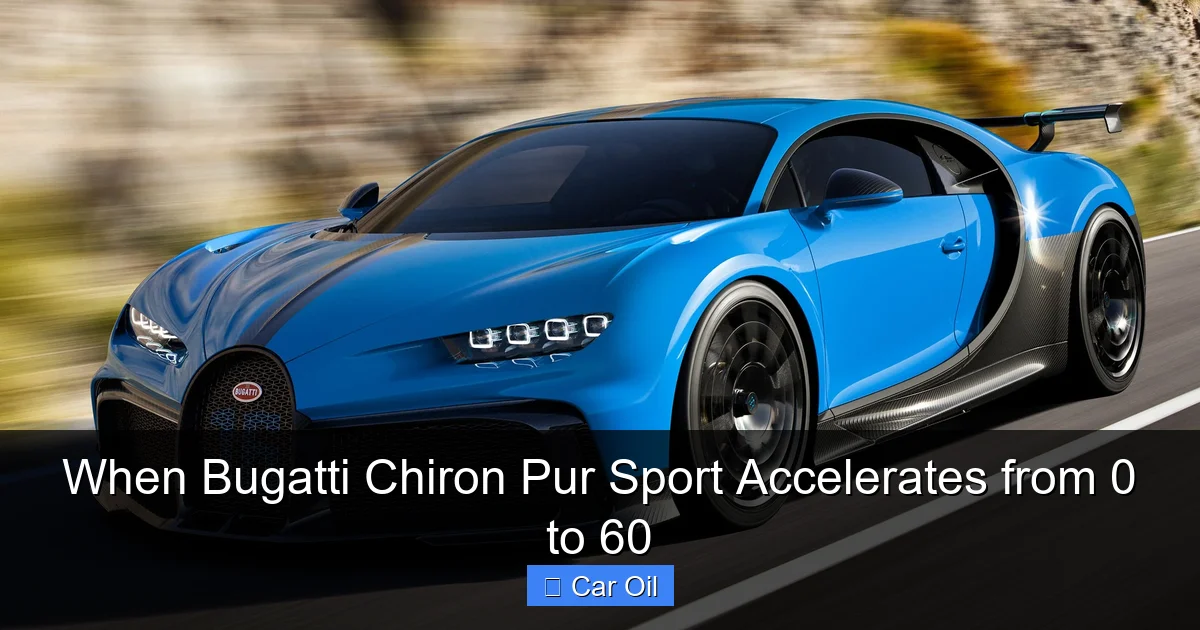
Numbers on a page cannot convey the reality of the Bugatti Chiron Pur Sport accelerates from 0 to 60. It is a physical event, not just a measurement. Professional drivers describe it not as “fast” but as “violent.” The initial launch is characterized by an almost total lack of wheelspin, thanks to Michelin’s specially developed Pilot Sport Cup 2 tires and the all-wheel-drive system’s clever power distribution. Instead of a smoky, sloppy start, you get a clean, brutal, linear shove. Your body is pressed back into the seat with a force that makes breathing feel deliberate. The world outside becomes a streaking blur.
Visual guide about When Bugatti Chiron Pur Sport Accelerates from 0 to 60
Image source: paultan.org
G-Forces and Sensory Overload
The acceleration in a Chiron Pur Sport generates significant longitudinal G-forces. For context, a high-performance sports car might pull 0.8 to 1.0 G off the line. The Pur Sport is likely in the 1.2+ G range for the initial surge. This isn’t just pressure; it’s a weight. Your cheeks pull back. The steering wheel, though electrically assisted, feels heavy in your hands as you fight the inertia. The sound is a key part of the experience—the deep, guttural idle erupts into a mechanical crescendo as the revs climb, the turbo spool a audible whine under the roar. It’s a full-body immersion that engages every sense. You’re not driving; you’re being launched.
Real-World vs. Test Track
That official 2.3-second figure is achieved under ideal, controlled conditions: a prepped drag strip, optimal track temperature, a fresh set of tires, and a professional driver using a flawless launch control system (which the Pur Sport has). In the real world, on a public road with varying surface conditions, achieving that exact time is impossible. However, the difference is marginal for a driver. The sheer, unfiltered violence of the acceleration means that even a 2.6 or 2.7-second run feels every bit as mind-altering to the human occupant. The sensation is so far beyond any normal experience that the precise decimal becomes almost academic. The car’s ability to devastate the 0-60 metric is a testament to its engineering, but the feeling it delivers is what truly defines it.
Comparing the Pur Sport to Other Hypercars
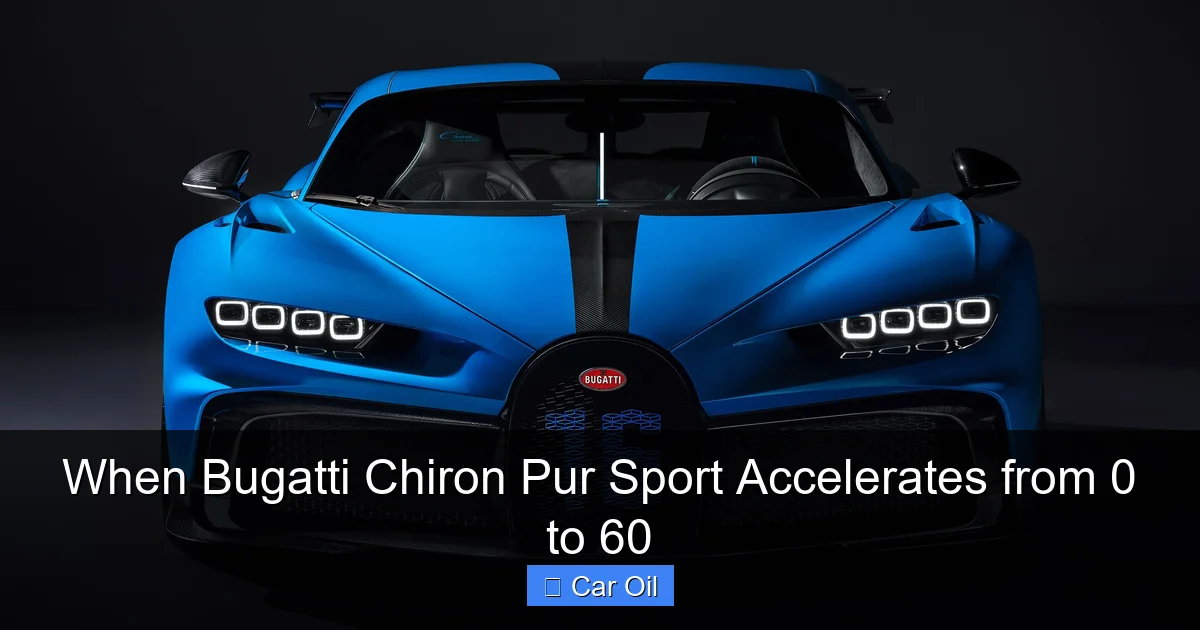
The hypercar segment is a relentless arms race. While the Bugatti Chiron Pur Sport accelerates from 0 to 60 in 2.3 seconds, is that the fastest? The answer is nuanced, and it depends on the measurement. In terms of verified, manufacturer-claimed times for production cars on factory tires, 2.3 seconds sits at the very top tier. However, several electric hypercars and modified machines have posted quicker times in specific, often non-repeatable conditions.
Visual guide about When Bugatti Chiron Pur Sport Accelerates from 0 to 60
Image source: s1.paultan.org
Bugatti’s Own Lineup: Chiron vs. Super Sport vs. Pur Sport
Within the Chiron family, the Pur Sport is the acceleration and handling specialist. The standard Chiron, with its longer gearing and higher top-speed focus, is slightly slower off the line, often quoted around 2.4-2.5 seconds. The Chiron Super Sport, built for 273+ mph, has even taller gearing to reach that velocity, making its 0-60 time marginally slower than the Pur Sport’s. The Pur Sport is the “quarter-mile king” of the trio, its shorter gear ratios allowing it to pull ahead in a drag race despite all three having the same power output. It’s a brilliant piece of product differentiation: one car for the ultimate top speed, one for all-out acceleration and cornering.
Rivals from Koenigsegg and Hennessey
Koenigsegg’s Jesko, with its twin-turbo V8 and incredible power-to-weight ratio, claims a sub-2.0-second 0-60 time, though this is often in ideal conditions with specialized tires. The Hennessey Venom F5 makes similar claims. These figures, while stunning, often come with asterisks regarding rollout and track prep. The Bugatti Chiron Pur Sport’s 2.3-second claim is considered one of the most robust and repeatable in the industry for a conventional internal combustion car on road-legal tires. It’s a benchmark of achievable, real-world hypercar acceleration. The Pur Sport’s advantage isn’t just the peak number; it’s the consistency, the feel, and the complete package of a car that can also be driven on a challenging road.
The Role of Tires and Aerodynamics
All that power and engineering would be useless if it couldn’t be put to the ground. The interface between the Chiron Pur Sport and the earth is its four Michelin Pilot Sport Cup 2 tires, specifically developed for this car. They are a critical, often overlooked, component of the 0-60 equation. These tires provide an immense contact patch and a rubber compound that stays grippy under the immense heat and stress of a hard launch. The all-wheel-drive system, with its electronically controlled multi-plate clutch, can send varying amounts of power to each wheel, managing torque steer and maximizing traction off the line.
Visual guide about When Bugatti Chiron Pur Sport Accelerates from 0 to 60
Image source: imboldn.com
Michelin Pilot Sport Cup 2s: The Sticky Secret
These aren’t off-the-shelf tires. They are a co-developed masterpiece, with a unique tread pattern and casing construction to handle the Pur Sport’s 1,500 hp. The sidewalls are reinforced to resist the crushing forces during hard acceleration and braking. Without this specific tire, the car would simply spin its wheels, a wasteful and dangerous display of untapped potential. The tire’s ability to maintain adhesion allows the car’s launch control system to modulate power perfectly, resulting in that clean, smoke-free, mind-bending start. It’s a perfect example of systems integration: engine, drivetrain, and tire must work in absolute harmony.
Fixed Rear Wing and Diffuser: Downforce for Drive
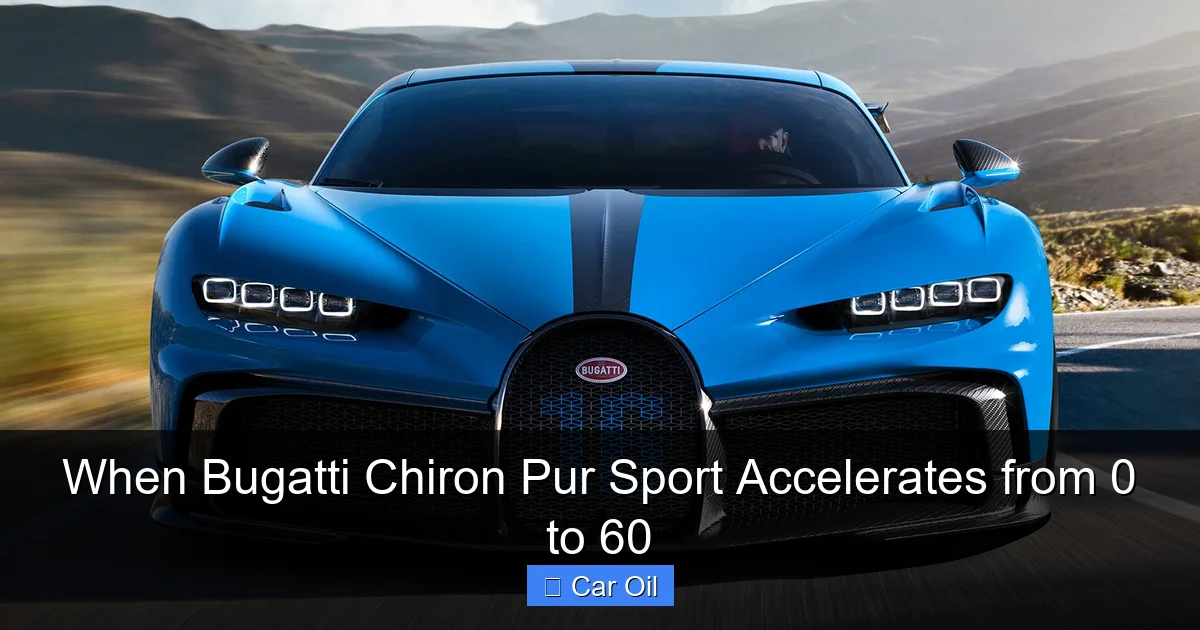
Aerodynamics on the Pur Sport are tuned for cornering, not just top speed. The massive, fixed rear wing (a stark contrast to the active wing on the standard Chiron) and the more aggressive front splitter and rear diffuser work together to generate significant downforce. This downforce pushes the car onto the road, increasing the normal force on the tires. More normal force means more frictional grip. This is crucial not just for high-speed corners, but for traction when accelerating *out* of corners. The Pur Sport can get on the power earlier and harder because the aerodynamics are literally pushing the tires into the asphalt, preventing wheelspin and allowing the engine’s full fury to be translated into forward motion. It’s a continuous, speed-dependent benefit that complements the mechanical traction at low speeds.
Engineering Principles in Daily Drivers
Now, let’s make a leap. You will almost certainly never drive a Bugatti Chiron Pur Sport. The $3 million+ price tag and the fact that only 60 exist see to that. But the relentless pursuit of performance, the principles of reducing weight, managing power delivery, and optimizing traction—these are the very same ideas that filter down, in scaled-down and more affordable forms, into the cars we drive every day. The next time you feel a surge of power from your own vehicle, consider the lineage of engineering thought that connects it to Molsheim, France.
Sport Mode Technology Transfer
The most direct descendant of hypercar performance tech in a mainstream car is the “sport mode” button. In a Bugatti, the entire car is a perpetual sport mode. But in your average sedan or coupe, pressing that button changes throttle mapping, steering weight, and sometimes transmission shift points. It makes the car feel more responsive, more alert. It’s a simulation of focus. Learning how to use sport mode in a Toyota Camry can give you a small, accessible taste of what engineers strive for: more immediate driver feedback and a sharper response to your inputs. Similarly, understanding how to turn on sport mode in a Dodge Charger unlocks a more aggressive personality from a car with a performance-oriented heritage, making everyday driving more engaging by mimicking the sharper reflexes of a hypercar.
Materials Science from Track to Street
Bugatti’s entire structure is carbon fiber. That material is still exotic and expensive for mass production. However, the principle—using lighter, stronger materials to improve performance and efficiency—is everywhere. Aluminum engine components, high-strength steel in chassis design, and even composite materials in body panels all stem from the same ethos. Reducing unsprung weight (wheels, brakes, suspension) is a trick used by every performance car maker to improve handling and acceleration. While your Honda Civic doesn’t have a carbon fiber monocoque, the engineers who designed it are thinking about weight in every decision, a philosophy directly inherited from the world of Formula 1 and hypercars like the Chiron Pur Sport.
Conclusion: The Pursuit of Perfection
The Bugatti Chiron Pur Sport accelerates from 0 to 60 in 2.3 seconds. It is a finite, measurable fact. But to reduce this car to that single statistic is to miss the point entirely. That number is the final, glorious punctuation mark in a sentence written in carbon fiber, forged in high-strength alloys, and composed in the language of fluid dynamics and thermodynamics. It is the result of asking “what if?” with limitless resources and an unwavering will.
It represents the absolute ceiling of what is possible with an internal combustion engine in a road-legal car. It is a machine that exists not to be practical, but to be an experience—a rolling testament to human ingenuity and the desire to push boundaries. While most of us will never know that singular feeling of being launched by 1,500 horsepower, we benefit from the relentless innovation it represents. The next time you press the accelerator in your own car and feel a satisfying surge, remember that somewhere, in a factory in Alsace, a team of engineers is already pushing that feeling into the realm of the impossible, chasing a number that will one day replace 2.3. The pursuit, after all, is the point.
Frequently Asked Questions
What is the exact 0-60 mph time for the Bugatti Chiron Pur Sport?
The manufacturer-claimed and independently verified 0-60 mph time for the Bugatti Chiron Pur Sport is 2.3 seconds. This is achieved using the car’s factory launch control system under ideal track conditions.
How does the Pur Sport’s acceleration compare to the standard Bugatti Chiron?
While both cars share the same 1,500-horsepower W16 engine, the Pur Sport accelerates faster from 0-60 mph. This is due to its weight reduction of 110 lbs, shorter transmission gear ratios, and a final drive ratio tuned for acceleration rather than the standard Chiron’s top-speed focus. The standard Chiron’s 0-60 time is typically around 2.4-2.5 seconds.
Is the Chiron Pur Sport faster than electric hypercars like the Rimac Nevera or Tesla Model S Plaid?
This is a complex comparison. Electric hypercars like the Rimac Nevera (1.85s) and Tesla Model S Plaid (~1.98s) have demonstrated sub-2-second 0-60 times in controlled tests, primarily due to the instant torque of electric motors and all-wheel drive. However, these times often involve specialized rollout measurements. The Pur Sport’s 2.3-second time is a more traditional, rolling-start measurement on road-legal tires. In a real-world, drag-strip style run, the electric cars’ torque advantage would likely give them a clear lead off the line, showcasing the different performance characteristics of electric vs. internal combustion propulsion.
What tires does the Bugatti Chiron Pur Sport use to achieve its massive traction?
It uses specially developed Michelin Pilot Sport Cup 2 tires. These are not standard off-the-shelf models but are co-engineered with Michelin specifically for the Chiron Pur Sport. They feature a unique tread pattern, reinforced sidewalls, and a special rubber compound designed to handle the immense torque and heat generated during hard acceleration and high-speed driving.
Can a regular person buy and drive a Bugatti Chiron Pur Sport?
Technically, yes, if you can afford the approximately $3 million+ price tag and one of the only 60 built units becomes available. However, it is an extreme machine that requires significant skill and experience to drive safely at its limits. The acceleration forces are physically demanding, and the car’s width and power make it challenging on public roads. Ownership also involves immense maintenance costs and logistical challenges, including needing a team of specialized technicians.
Why is it called “Pur Sport” and not just a faster Chiron?
The name “Pur Sport” (French for “Pure Sport”) signifies its focused mission. While the standard Chiron is a “GT” (Grand Touring) car built for effortless high-speed cruising, the Pur Sport is stripped of some luxury amenities, made lighter, and given more aggressive aerodynamics and gearing specifically for track-focused driving and sharper handling. It’s Bugatti’s declaration that this variant exists purely for the driving experience, sacrificing a tiny bit of top speed (its max is 217 mph vs. the Chiron’s 261 mph) for massive gains in acceleration, cornering, and driver engagement.
