
What Is the Towing Capacity of a Ford F150

The towing capacity of a Ford F150 is not a single number—it varies dramatically based on model year, engine choice, cab and bed configuration, drivetrain, and optional towing packages. Modern F150s can range from as low as 5,000 pounds to a maximum of 14,000 pounds when properly equipped. Understanding these variables is crucial for safe and effective towing, as exceeding your truck’s rated capacity can lead to dangerous handling, brake failure, and severe mechanical damage. Always consult your vehicle’s specific door jamb sticker and owner’s manual for the definitive rating for your unique truck.
So, you’re eyeing a boat, a massive RV, or a heavy piece of equipment, and you’ve got your sights set on America’s favorite truck: the Ford F150. The first, most critical question is: “Can it actually pull this?” The answer, as you’ll soon learn, is a classic mechanic’s reply: “It depends.” The towing capacity of a Ford F150 is one of the most variable specs in the automotive world, a sliding scale shaped by dozens of factory decisions made when your specific truck rolled off the line. Understanding this isn’t just about bragging rights; it’s the foundation of safe, responsible, and enjoyable towing. Pushing your truck beyond its limits is a recipe for disaster, causing premature wear on the transmission, overheating the engine, compromising braking distances, and creating a hazardous, uncontrolled driving situation. Let’s break down the mystery and give you the tools to find the exact number for your truck and maximize its potential.
Key Takeaways
- There is no universal “F150 towing capacity.” Your truck’s specific rating depends on a complex combination of its engine, transmission, axle ratio, drivetrain (2WD vs 4WD), cab style (Regular, SuperCab, SuperCrew), bed length, and whether it has the factory Max Trailer Tow Package.
- The maximum factory-rated capacity for recent model years (2021-2024) is 14,000 lbs, but this is only achievable on select 2WD, Regular Cab, 6.5-foot bed models with the 3.5L EcoBoost V6 or 5.0L V8 and the Max Trailer Tow Package.
- Payload and towing capacity are NOT the same. Payload is what you can carry *in* the truck (passengers, cargo, tongue weight). Towing capacity is what you can pull *behind* it. The tongue weight of your trailer counts against your payload rating.
- Gross Combined Weight Rating (GCWR) is the ultimate limit. This is the total weight of the loaded truck plus the loaded trailer. Your actual towed weight must be less than both the GCWR and the truck’s specific tow rating.
- Proper setup is non-negotiable for safety. This includes a correctly rated hitch, functioning trailer brakes, proper weight distribution, and correctly configured trailer brake controller and tow/haul mode.
- Your truck’s door jamb sticker is the final authority. It lists the official GVWR, GCWR, and often the max tow/payload for that exact vehicle’s VIN. Never guess; always look there first.
📑 Table of Contents
- The Golden Rule: Your Truck’s VIN is the Bible
- Model Year Matters: The Evolution of Power
- Engine & Powertrain: The Heart of the Matter
- Configuration is Everything: Cab, Bed, and Drivetrain
- The Max Trailer Tow Package: Your Ticket to the Top
- Real-World Examples: Putting Numbers to Scenarios
- Practical Tips for Safe & Effective Towing
- Conclusion: Knowledge is the Ultimate Towing Tool
The Golden Rule: Your Truck’s VIN is the Bible
Before we dive into ranges and options, let’s establish the one unbreakable rule. The only towing capacity that matters is the one stamped on your specific vehicle. Ford engineers a dizzying array of F150 configurations, and each one has its own unique structural and mechanical limits. The single source of truth is the yellow and white certification label on the driver’s side door jamb. On this sticker, you will find the Gross Vehicle Weight Rating (GVWR) and the Gross Combined Weight Rating (GCWR). The GCWR is the maximum allowable total mass of your loaded truck plus your loaded trailer. Your actual, legal, and safe towing capacity is the lower of two numbers: the GCWR minus the actual weight of your loaded truck, or the specific max tow rating listed for your configuration (which Ford calculates based on the GCWR and truck weight). Never rely on a generic brochure number or a friend’s identical-looking truck. Your VIN determines your destiny.
Why the Huge Range? A Symphony of Variables
Why can two 2023 F150s sitting next to each other have towing capacities that differ by 4,000 pounds? It’s because towing capacity is an equation, not a fixed output. Every component is a variable. Weaker axles, smaller brakes, a less powerful engine, or a different transmission cooler can all lower the ceiling. Conversely, upgrading any of these systems raises it. Think of it like building a chain: the towing capacity is only as strong as its weakest link.
Model Year Matters: The Evolution of Power
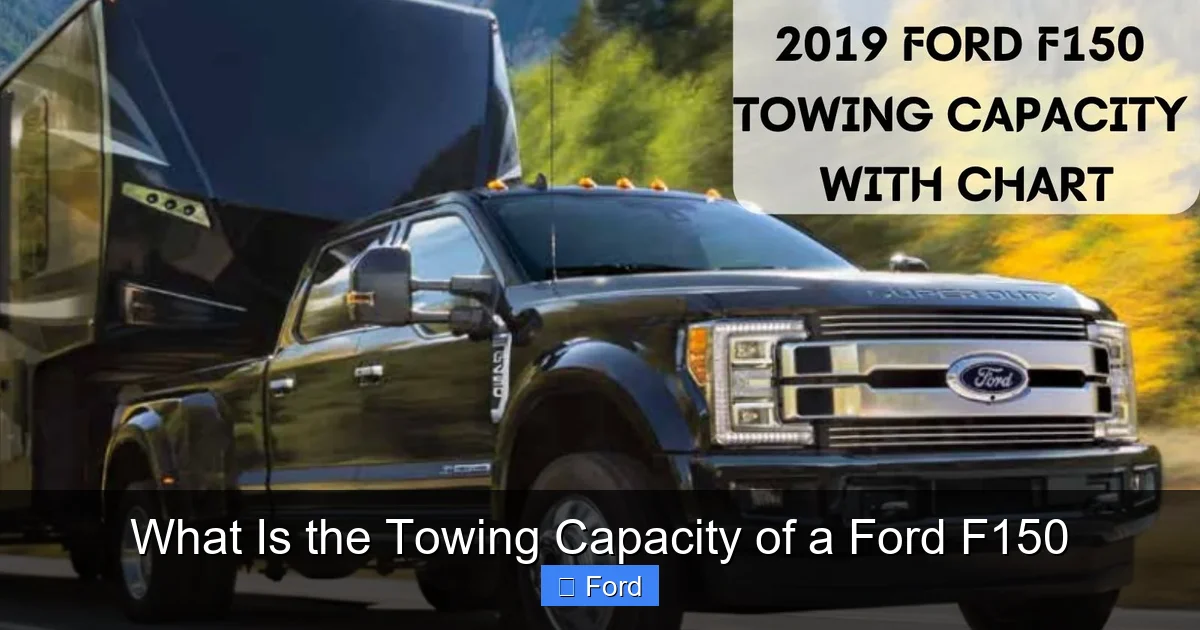
The F150’s towing prowess has grown significantly over the last decade, primarily driven by engine innovation and frame material changes. The shift to a high-strength steel frame in the 2015 model year (the 13th generation) was a monumental leap, allowing for higher ratings without a major weight penalty. The introduction of the 3.5L EcoBoost V6 twin-turbo engine in 2011 (and its subsequent power increases) and the 10-speed automatic transmission in 2017 further expanded the envelope.
Visual guide about What Is the Towing Capacity of a Ford F150
Image source: thecartowing.com
- 2013-2014 (12th Gen): Max tow was around 11,300 lbs with the 6.2L V8 (rare) or 6.8L V10. The 5.0L V8 and 3.7L V6 were significantly lower.
- 2015-2020 (13th Gen): The high-strength steel frame arrived. The 3.5L EcoBoost became the towing king, with max ratings climbing to 12,000 – 13,200 lbs depending on year and package. The 5.0L V8 and 2.7L EcoBoost offered strong but lower ratings (around 9,000-11,000 lbs).
- 2021-Present (14th Gen): The current generation pushed the ceiling to 14,000 lbs (for 2021-2023) with the 3.5L EcoBoost or 5.0L V8, 2WD, Regular Cab, 6.5′ bed, and the Max Trailer Tow Package. The 2024 model maintains this peak. The hybrid 3.5L PowerBoost V6 also achieves this 14,000 lb max in the same configuration. The 2.7L EcoBoost maxes out around 10,000 lbs in its best configuration.
If you’re shopping used, knowing the generational changes is your first filter. A 2018 F150 with the right setup will tow circles around a 2012 with a similar engine on paper.
Engine & Powertrain: The Heart of the Matter
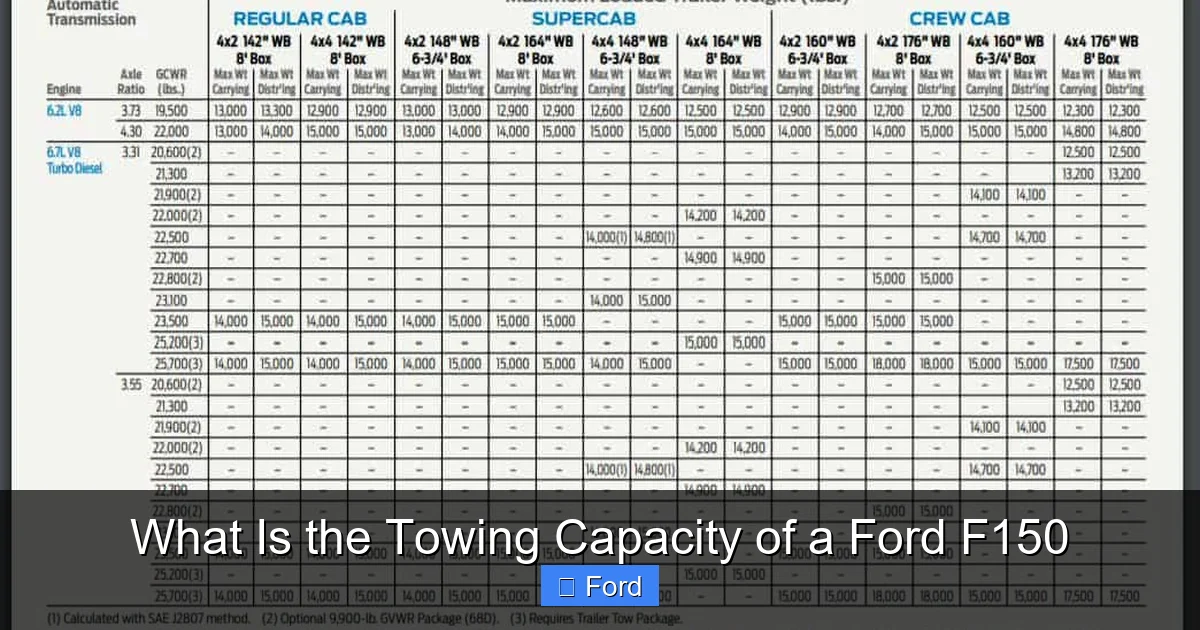
This is the most obvious factor. More torque and horsepower, paired with a robust transmission, mean more towing muscle. Here’s the current lineup’s approximate peak capabilities when in the ideal, lightweight configuration (2WD, Regular Cab, 6.5′ bed, Max Trailer Tow Package). Remember, your actual number will be lower if you have a heavier cab or bed.
Visual guide about What Is the Towing Capacity of a Ford F150
Image source: vehq.com
The 3.5L EcoBoost V6 Twin-Turbo
The perennial towing champion for the F150. This engine provides massive low-end torque (up to 470 lb-ft in recent years) that gets heavy loads moving without strain. When paired with the 10-speed transmission and the Max Trailer Tow Package (which includes a heavy-duty transmission cooler, upgraded rear axle, and integrated trailer brake controller), it achieves the absolute maximum 14,000 lb rating for the 2021-2024 models. Its turbocharged nature means it breathes well at high altitudes, a key advantage for mountain towing. For those who prioritize maximum tow numbers, this is often the default choice.
The 5.0L V8 “Coyote”
Ford’s legendary V8 offers a different kind of experience. While its peak torque (around 410 lb-ft) is less than the EcoBoost’s, it delivers it in a smooth, linear fashion that many traditional truck buyers prefer. With the same Max Trailer Tow Package, the 5.0L also hits the 14,000 lb ceiling in the 2021-2024 model years. The sound and feel are unmistakable. However, the V8 typically has a lower maximum payload than the EcoBoost due to its heavier iron block, a nuance that matters for weight distribution.
The 3.5L PowerBoost Hybrid V6
A fascinating engineering feat, this combines the 3.5L EcoBoost with a hybrid electric system. The result is more total system horsepower and torque than the standard EcoBoost, with the added benefit of electric torque fill right off the line. In the optimal configuration, it too is rated for 14,000 lbs. The hybrid system can also help manage power demand when climbing steep grades with a heavy trailer, though real-world fuel economy benefits while towing are often minimal compared to the standard EcoBoost.
The 2.7L EcoBoost V6
The “efficiency” engine in the lineup. It’s lighter, more fuel-efficient for daily driving, and still very capable. However, its maximum tow rating in the best configuration (with Max Trailer Tow) is approximately 10,000 lbs for recent models. It’s a fantastic choice for medium-duty towing (boats, medium campers) where the absolute maximum isn’t required, and you want a more nimble, economical daily driver.
The 5.2L V8 (Raptor R & Limited)
Found only in the high-performance Raptor R and certain Limited trims, this supercharged monster is built for speed, not maximum static trailer weight. Its towing capacity is actually lower than the standard 5.0L or 3.5L, typically around 8,000-8,500 lbs, because its cooling systems, gearing, and suspension are tuned for desert racing, not steady-state trailer hauling. It’s a specialist tool.
Configuration is Everything: Cab, Bed, and Drivetrain
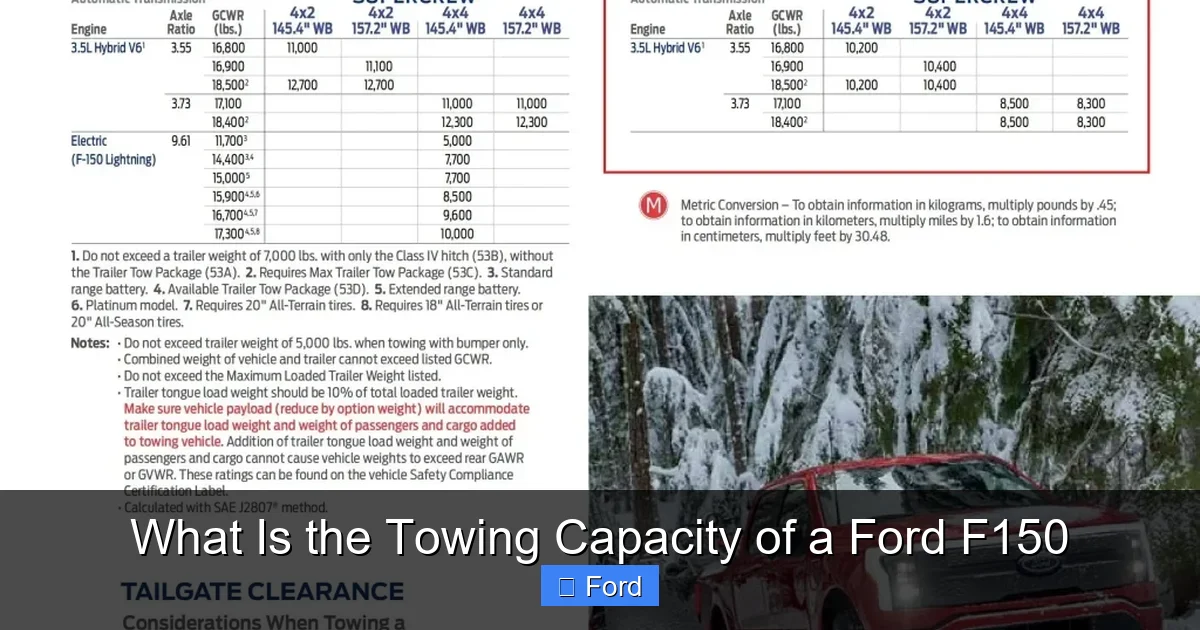
Here’s where the numbers splinter. Every inch of added length and every pound of extra structure chips away at your available capacity. This is why the “max tow” numbers you see are always for the sparest, lightest configuration.
Visual guide about What Is the Towing Capacity of a Ford F150
Image source: towengine.com
Cab and Bed Length
A Regular Cab with a 6.5-foot bed is the lightest, shortest wheelbase configuration. It has the highest tow ratings. Adding a SuperCab (extended cab) or a SuperCrew (full four-door cab) adds significant weight and length, lowering the max tow rating by 500 to 1,500 pounds depending on the model year. Similarly, the longer 8-foot bed adds weight over the 6.5-foot bed, further reducing capacity. The rule of thumb: more passenger and cargo space inside the truck means less room for trailer weight behind it.
Two-Wheel Drive vs. Four-Wheel Drive
4WD systems add substantial weight (the transfer case, front axle, and associated components). This weight directly eats into your payload and, by extension, your effective towing capacity. In almost every configuration, an otherwise identical 4WD F150 will have a max tow rating 500-1,000 pounds lower than its 2WD counterpart. The trade-off is, of course, off-road capability and traction in slippery conditions. If maximum tow number is your sole goal, 2WD is the answer. If you need 4WD for your lifestyle, you must accept a slightly lower ceiling.
The Critical Role of Axle Ratio
The rear axle gear ratio (e.g., 3.31, 3.55, 3.73) is a multiplier for engine torque. A numerically higher ratio (like 3.73) gives you more “grunt” to get a heavy load moving and maintain speed on grades but reduces fuel economy and top speed. A lower ratio (like 3.31) is better for unloaded fuel economy and higher highway speeds. For maximum towing, you almost always want the highest available axle ratio offered for your engine. The Max Trailer Tow Package typically includes the optimal axle ratio for that engine’s peak towing performance. Checking the axle code on your door jamb sticker is a must for precise specs.
The Max Trailer Tow Package: Your Ticket to the Top
This isn’t just a marketing badge; it’s a collection of hard-duty hardware that transforms a standard F150 into a towing beast. For any engine that qualifies for the top tow rating, this package is almost always mandatory. It typically includes:
- Heavy-Duty Transmission Cooler: The #1 killer of transmissions while towing is heat. This cooler is significantly larger and more robust than the standard unit.
- Integrated Trailer Brake Controller: A factory-installed unit that syncs perfectly with the truck’s systems, allowing you to adjust trailer braking force from the dash.
- Upgraded Rear Axle & Differential: Often a heavier-duty unit with a limited-slip or locking differential (e.g., 3.73 or 4.10 gear) to manage torque.
- Tow/Haul Mode in the Transmission: This software mode holds gears longer, provides engine braking on descents, and reduces shift cycling to keep the transmission cooler.
- Pro Trailer Backup Assist: A fantastic system that lets you steer a trailer by turning a knob on the dash instead of the steering wheel, making backing up much easier.
- Often includes: Upgraded radiator, specific tire pressure recommendations, and trailer wiring harness.
Without this package, your truck’s tow rating could be 2,000-4,000 pounds LOWER than the maximum for its engine. It is the single most important option to look for on a used F150 if you plan to tow near its limits.
Real-World Examples: Putting Numbers to Scenarios
Let’s make this concrete. Here are approximate, representative maximums for 2021-2024 F150s. These are for illustration; ALWAYS VERIFY WITH YOUR DOOR JAMB STICKER.
- Scenario 1 (Peak Tow): 2023 F150, 2WD, Regular Cab, 6.5′ bed, 3.5L EcoBoost, Max Trailer Tow Package, 3.73 axle. ~14,000 lbs. This is your boat-hauling, large RV-pulling champion. It’s a dedicated work truck.
- Scenario 2 (Popular Family Truck): 2023 F150, 4WD, SuperCrew, 5.5′ bed, 5.0L V8, Max Trailer Tow Package, 3.73 axle. ~11,000 – 11,500 lbs. This is a very common configuration. It can still handle a substantial travel trailer or large car trailer but gives up about 2,500 lbs compared to the bare-bones model.
- Scenario 3 (Efficient Daily Driver): 2023 F150, 2WD, SuperCrew, 5.5′ bed, 2.7L EcoBoost, Max Trailer Tow Package. ~9,500 – 10,000 lbs. Perfect for a mid-size boat or a well-appointed camper. The trade-off for great daily driving manners is a lower max tow.
- Scenario 4 (No Tow Package): 2023 F150, 2WD, Regular Cab, 6.5′ bed, 3.5L EcoBoost, NO Max Trailer Tow Package. ~8,000 – 9,000 lbs. A stark demonstration of the package’s importance. The engine is the same, but the cooling, axle, and software are not up to the task of the maximum load.
When comparing to other vehicles, the F150’s versatility is clear. For context, a midsize SUV like a Toyota RAV4 might max out around 3,500 lbs, while a dedicated off-roader like a Subaru Crosstrek is rated for a mere 1,500 lbs. The F150 operates in a completely different league. Even among full-sizers, its range is vast, which is why knowing your specific configuration is everything.
Practical Tips for Safe & Effective Towing
Knowing your number is step one. Here’s how to operate within it safely.
Weigh Everything
Never guess. The weight printed on a boat or RV brochure is the “dry weight” or “unloaded weight.” Your actual loaded weight—with fuel, gear, water, food, and people—is always higher. Use a public scale (truck stops like Pilot/Flying J are perfect) to get the actual Gross Trailer Weight (GTW). Weigh your truck separately to get its actual loaded weight (with all your gear, fuel, and passengers). The sum must be under your GCWR.
Tongue Weight is Part of Your Payload
The downward force the trailer exerts on the hitch is tongue weight. For a conventional hitch, it should be 10-15% of the trailer’s total weight. For a gooseneck or fifth-wheel, it’s 15-25%. This weight sits directly on the truck’s rear axle and counts against your truck’s Payload Capacity (also on your door jamb sticker). A common mistake is filling the truck’s bed with cargo and then adding a heavy tongue weight, which can easily overload the rear axle and cause dangerous sag or brake failure.
Use the Right Hitch and Setup
For weights over 5,000 lbs, a weight-distributing hitch is almost always required by the manufacturer and is a safety necessity. It uses spring bars to spread the trailer’s weight across both the truck’s front and rear axles, improving steering and braking. For very heavy fifth-wheels or goosenecks (common with the F150’s high capacity), a bed-mounted hitch is needed to keep the weight centered over the truck’s axle. Never use a simple bumper-pull hitch for a 10,000+ lb trailer.
Configure Your Truck for Towing
Always engage the Tow/Haul mode. This changes the transmission shift points and enables engine braking. For diesels (not in F150, but good to know) or turbos, let the engine warm up fully before heading out. Check your tire pressures—the F150’s door jamb sticker often has a “MAX TOW” pressure listed for the rear tires (often 70-80 PSI). Inflate to that pressure for heavy loads. Also, ensure your IWE (Integrated Wheel End) system is functioning properly if you have a 4×4, as it disconnects the front axle when not in use to improve fuel economy, but it must engage correctly for 4WD towing if needed.
Drive Like You’re Towing
This means leaving massive following distances. Your stopping distance has increased exponentially. Accelerate gradually. Use lower gears on long descents to avoid overheating your brakes. Anticipate wind gusts and the “sway” effect from passing trucks. A good trailer brake controller adjustment is key—the trailer brakes should do most of the work, not the truck’s brakes.
Conclusion: Knowledge is the Ultimate Towing Tool
The towing capacity of a Ford F150 is a spectrum, not a single figure. It ranges from a respectable 5,000 lbs in a base, heavy-configuration model to a class-leading 14,000 lbs in a strategically optioned, lightweight work truck. The power under the hood—whether it’s the twin-turbo might of the 3.5L EcoBoost, the smooth authority of the 5.0L V8, or the hybrid innovation of the PowerBoost—sets the potential ceiling. But that potential is only realized when it’s married to the right hardware: the Max Trailer Tow Package, an appropriate axle ratio, and a lightweight cab/bed combination. Your truck’s door jamb sticker is the final, unarguable word on what it can safely handle. Towing is a serious responsibility that demands respect for the machine’s limits. By understanding the “why” behind the number on your sticker, you equip yourself to make smart decisions, choose the right trailer, and hit the road with confidence, not concern. The F150’s legendary capability is real, but it’s a capability you must consciously unlock with the right configuration and always operate within the hard limits stamped into your truck’s very identity.
Frequently Asked Questions
What is the absolute maximum towing capacity for a new Ford F150?
For the 2021-2024 models, the maximum factory-rated towing capacity is 14,000 pounds. This is only achievable on 2WD models with a Regular Cab and 6.5-foot bed, equipped with either the 3.5L EcoBoost V6, 5.0L V8, or 3.5L PowerBoost Hybrid V6 engine, and the mandatory Max Trailer Tow Package with a 3.73 rear axle ratio.
Does a 4WD F150 tow less than a 2WD?
Yes, almost always. The added weight of the 4WD system (transfer case, front axle, etc.) reduces the available payload and towing capacity. In otherwise identical configurations (same cab, bed, engine, package), a 4WD model will typically have a max tow rating 500 to 1,000 pounds lower than the 2WD version.
How does the Max Trailer Tow Package affect capacity?
It is transformative. For many engine configurations, choosing the Max Trailer Tow Package is what *enables* the highest published tow rating. Without it, the same truck’s rating can be 2,000 to 4,000 pounds lower because it lacks the heavy-duty transmission cooler, upgraded rear axle, integrated brake controller, and Tow/Haul mode software necessary for sustained heavy loads.
What’s the difference between payload and towing capacity?
Towing capacity is the maximum weight you can pull *behind* the truck with a trailer. Payload is the maximum weight you can carry *inside* the truck (passengers, cargo, bed load). Crucially, the tongue weight of your trailer—the downward force on the hitch—counts against your truck’s payload rating. You must stay under both ratings simultaneously.
Can I tow more than my door jamb sticker says if I add aftermarket parts?
No. The ratings on the door jamb sticker are the legal, manufacturer-certified limits for that specific vehicle’s VIN. Aftermarket hitches, coolers, or suspension parts do not legally increase the truck’s structural or drivetrain capacity. They may help you *operate more safely* at your existing limit, but they do not raise the limit itself. Exceeding the factory rating is unsafe and voids warranties.
How do model year changes impact towing capacity?
Significantly. Major updates like the switch to a high-strength steel frame (2015) or the introduction of the 10-speed transmission (2017) allowed for substantial increases in max tow ratings. For example, a 2014 F150 with a 5.0L V8 maxed out around 9,000 lbs, while a 2024 with the same engine in a comparable configuration can reach 14,000 lbs. Always compare ratings within the same generation for accuracy.
