
What Type of Oil Does an Infiniti Qx60 Use?

Using the correct oil in your Infiniti QX60 is non-negotiable for its longevity and performance. Most modern QX60 models require a full synthetic 0W-20 oil that meets Nissan’s stringent NS-3 specification. Always verify your exact requirement with your owner’s manual or oil cap, as recommendations can differ slightly between model years and engine types. When in doubt, choosing a high-quality synthetic that meets the specified standard is the safest path to a healthy, efficient engine.
Key Takeaways
- Viscosity is Critical: The vast majority of Infiniti QX60 models, especially from 2014 onward, require 0W-20 synthetic oil. Older models or specific fleet versions may differ.
- Synthetic is Standard: Infiniti/Nissan strongly recommends, and for newer models effectively requires, full synthetic oil due to tight engine tolerances and turbocharger technology.
- Specification Matters More Than Brand: Look for oils that meet the Nissan NS-2 or NS-3 specification. This is more important than the brand name on the bottle.
- Your Manual is the Final Authority: The owner’s manual for your specific VIN and model year is the only definitive source. The oil cap is also a reliable, quick-reference guide.
- Wrong Oil Can Cause Damage: Using oil with incorrect viscosity or that doesn’t meet specifications can lead to reduced fuel economy, increased wear, sludge formation, and potentially void your warranty.
- Change Intervals are Stretchable with Synthetic: While conventional oil might need changes every 3,000-5,000 miles, full synthetic in the QX60 can often go 7,500-10,000 miles, but always follow your manual’s schedule.
- Check the Dipstick Regularly: Even with the correct oil, monitoring the level between changes is essential. Low oil level is a leading cause of engine failure.
📑 Table of Contents
Why the Right Oil is Your QX60’s Lifeline
Let’s be real: when you pop the hood of your Infiniti QX60, you’re not just looking at an engine; you’re looking at a complex piece of precision engineering. Under that sleek, luxurious shell lies a powerplant—whether a V6 or a turbocharged four-cylinder—designed for smooth, efficient, and powerful performance. And what keeps this intricate ballet of metal, fire, and motion from turning into a violent, grinding mess? A thin, slippery film of liquid: engine oil.
Choosing the right oil isn’t about brand loyalty or what’s on sale. It’s about matching a specific set of chemical and physical properties to your engine’s exact design needs. The Infiniti QX60, sharing its DNA with the Nissan Pathfinder, uses engines with very tight tolerances and, in many cases, a turbocharger spinning at tens of thousands of RPM. These engines demand oil that can flow instantly at cold starts (to protect against wear), withstand extreme heat without breaking down (to protect turbo bearings), and keep internal surfaces scrupulously clean (to prevent sludge). Using the wrong oil is like feeding a finely-tuned athlete a diet of junk food—it might run for a while, but performance will suffer, and breakdowns become inevitable.
The Corporate Blueprint: Nissan/Infiniti Oil Standards
Infiniti, as Nissan’s luxury division, doesn’t develop its lubricant standards in a vacuum. They rely on rigorous internal testing and specifications that oils must meet. For modern QX60s, you’ll primarily see two key specs:
- Nissan NS-2: An earlier standard, still excellent, required for many pre-2017 models. It ensures good wear protection and cleanliness.
- Nissan NS-3: The current, more stringent standard. It demands superior fuel economy benefits (lower friction), enhanced turbocharger protection, and better longevity against high-temperature deposits. This is the spec you want to find on the oil bottle for best results in a 2017+ QX60.
Think of NS-3 as the “premium fuel” of engine oils for your Infiniti. While you can use an NS-2 oil in a pinch in an NS-3 engine, you’re not getting the optimized performance the engineers intended. For a deep dive into how these corporate specifications work across different brands, our guide on what kind of oil does my car need explains the universal principles of decoding these requirements.
Decoding the Sticker: What Your QX60 Actually Says
Before we get into model-year specifics, let’s talk about the two most reliable sources of information sitting right on your vehicle. No internet search required.

Visual guide about What Type of Oil Does an Infiniti Qx60 Use?
Image source: oilreset.com
The Owner’s Manual: Your Bible
The glove compartment holds the ultimate truth. In the “Capacities and Specifications” or “Maintenance” section, you will find a chart. It will list your engine code (e.g., VQ35DE, VQ37VHR, or KR20DDET) and directly state the recommended oil viscosity (like 0W-20) and the required specification (API SN, GF-6, and crucially, Nissan NS-2 or NS-3). This document accounts for any special manufacturing variances or regional requirements. If you’ve lost your manual, Infiniti still offers digital copies on their owner’s portal.
The Oil Cap: Your Quickest Cheat Sheet
Crawl under the hood and look at the engine’s oil filler cap. On virtually every modern QX60, it’s printed right there: “0W-20” or “5W-30” and often “NS-3” or “API SN.” This is the manufacturer’s at-a-glance reminder. It’s there for a reason—to prevent accidental mis-fills. If your cap says 0W-20, that’s what you put in, full stop. This simple check is the first step in any oil change procedure and a great habit to develop.
For those who find this process daunting, our beginner-friendly article on how to know what type of oil your car needs walks you through these very steps, using common vehicles as examples.
Model-Year Breakdown: What to Use and When
The Infiniti QX60 has had two distinct generations, and the engine oil requirement changed significantly with the second generation’s complete redesign. Here’s the breakdown.
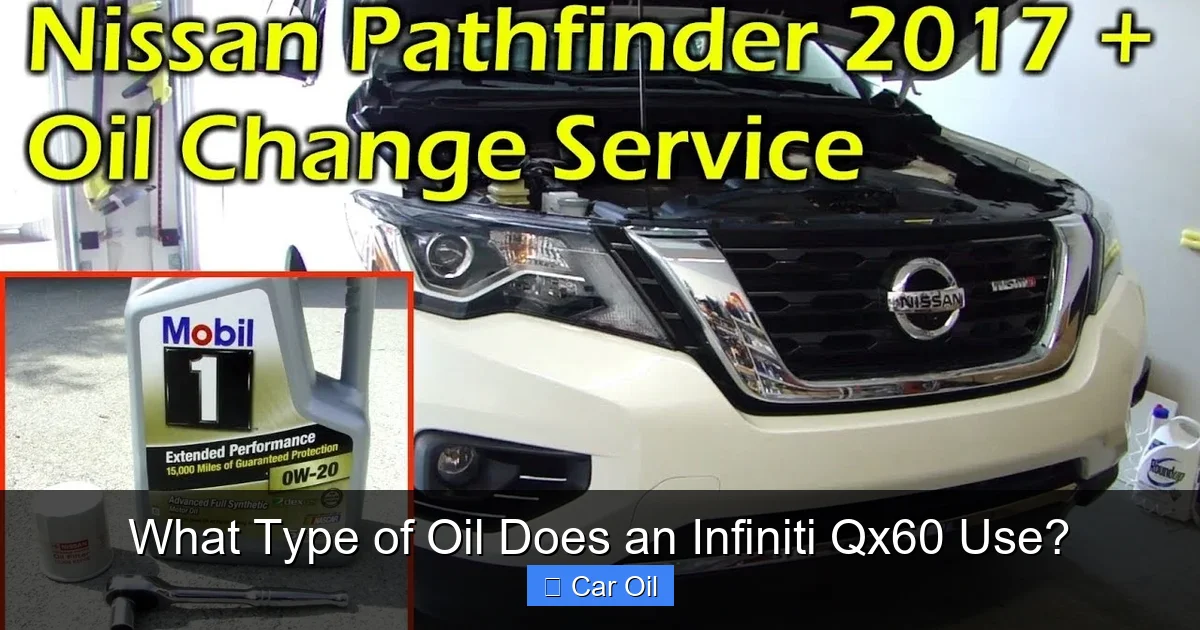
Visual guide about What Type of Oil Does an Infiniti Qx60 Use?
Image source: i.ytimg.com
First Generation (2014-2016): The V6 Era
These models are powered by the legendary 3.5L V6 VQ35DE engine (in earlier years) or the potent 3.5L VQ37VHR (in 2016). This is a naturally aspirated engine, but it still benefits greatly from modern synthetic oil.
- Recommended Viscosity: 5W-30. This is the specified oil for these model years. You will see this on the oil cap and in the manual.
- Required Specification: Must meet or exceed API SN/Resource Conserving and Nissan NS-2. An oil meeting the newer NS-3 spec is also perfectly suitable and often superior.
- Oil Capacity: Approximately 5.1 quarts (4.8 liters) with filter change.
While 5W-30 is the standard, using a high-quality full synthetic that meets NS-2 is crucial. These engines are durable, but they will last longer and run smoother with the correct lubricant. If you own a first-gen QX60 and are considering a switch, it’s generally safe to use a 0W-20 that meets NS-3 only if Infiniti/Nissan has explicitly approved it for your specific engine code in a technical service bulletin—which for these V6s, they typically have not. Stick to 5W-30.
Second Generation (2017-Present): The Turbo 4-Cylinder Shift
For 2017, Infiniti completely redesigned the QX60. The most significant change under the hood was the switch to a 2.0L turbocharged inline-4 cylinder engine (KR20DDET). This engine is all about efficiency and torque, but the turbocharger adds a new layer of demand to the oil.
- Recommended Viscosity: 0W-20. This is the key change. The lower “0W” winter viscosity ensures the oil reaches critical turbo bearings and cylinder walls almost instantly on a cold start, preventing the majority of engine wear that happens in the first few minutes.
- Required Specification: This is non-negotiable: Nissan NS-3. The NS-3 spec was developed specifically with turbocharger protection and fuel economy in mind. Using an oil that only meets older specs (or worse, no spec) in this engine is asking for trouble. Look for the “NS-3” logo on the oil bottle.
- Oil Capacity: Approximately 5.3 quarts (5.0 liters) with filter change.
The 0W-20 requirement for the turbo engine is a trend across the industry. For comparison, the similar 2016 Nissan Rogue with the same turbo engine also requires 0W-20 NS-3. You can see the parallel in our specific guide for what kind of oil does a 2016 Nissan Rogue use. The principles are identical because the powertrain is fundamentally the same.
Synthetic vs. Conventional: There’s No Contest
Let’s clear the air right now: for your Infiniti QX60, you must use full synthetic oil. This isn’t a premium upsell; it’s an engineering requirement.

Visual guide about What Type of Oil Does an Infiniti Qx60 Use?
Image source: torquenews.com
Why Your QX60 Demands Synthetic
Conventional mineral oil is refined from crude oil. It has a wide mix of molecule sizes. Under heat and stress, these molecules break down (shear) at different rates, leading to viscosity loss and sludge. Full synthetic oil is built in a lab from base stocks like Group III, IV, or V. Its molecules are uniform, designed to resist shear, oxidation, and thermal breakdown.
For your QX60’s V6, synthetic provides better high-temperature protection and longer drain intervals. For the turbocharged 4-cylinder, it’s even more critical. The turbo’s shaft spins at over 200,000 RPM, relying on a constant, clean supply of oil for lubrication and cooling. Synthetic oil’s superior high-temperature stability (higher HTHS viscosity) ensures it doesn’t turn to varnish on those scorching-hot bearing surfaces. It also flows better when cold, protecting that turbo during the cold-start period when 90% of engine wear occurs.
Using conventional oil in a modern QX60 is a false economy. You might save $15 an oil change, but you risk thousands in turbo or engine repair. If you’re unsure about the benefits and science behind synthetic oil, our article does my car use synthetic oil breaks it down in simple terms.
What About Synthetic Blends?
Synthetic blends (part conventional, part synthetic) are a middle ground. While they offer better protection than pure conventional, they do not meet the performance ceiling of full synthetics, especially for long drain intervals and extreme turbo protection. Infiniti’s specifications are written for full synthetic. To be safe and to honor your warranty, always choose a 100% full synthetic oil that meets the NS-2 or NS-3 spec.
Practical Tips: Changing Oil and Avoiding Common Pitfalls
Knowing the right oil is one thing. Doing the change correctly is another. Here’s how to get it right.
The Golden Rules of an Oil Change
- Always Replace the Filter: The oil filter is your engine’s kidney. A cheap filter with a cardboard bypass valve can ruin even the best oil. Use a high-quality filter that meets or exceeds Infiniti’s specifications. Brands like OEM (Nissan/Infiniti), Mobil 1, Wix XP, and K&N are excellent choices.
- Use the Correct Capacity: After draining, pour in about 90% of the specified capacity (e.g., 4.8 quarts for a 5.1-quart V6). Then, start the engine, let it run for 30 seconds, shut it off, wait a minute, and check the dipstick. Top off as needed. This prevents overfilling, which can cause aeration (foaming) and damage.
- Torque the Drain Plug and Cap: Use a torque wrench. The drain plug on an aluminum oil pan is easy to strip or over-tighten. The manual will specify the torque (often around 25-30 ft-lbs). The oil cap just needs to be snug, not gorilla-tight.
Can I Mix Oils or Brands?
In a pinch, adding a quart of a different but specification-compliant oil (e.g., topping off 0W-20 NS-3 with another 0W-20 NS-3) is generally fine. The base stocks and additive packages in modern quality synthetics are compatible. However, do not mix different viscosity oils (like adding 5W-30 to a 0W-20 engine). The blended viscosity will not be what the engine is calibrated for. For consistency and to maintain the additive package integrity, it’s best to stick to one brand and spec for all top-offs and changes.
Signs You Might Be Using the Wrong Oil
Your QX60 will give you clues if the oil is unsuitable. Be alert for:
- Unusual Engine Noise: Ticking or tapping on cold start that doesn’t go away quickly can indicate oil that’s too thick (high first number) isn’t reaching the top of the engine (valve train) fast enough.
- Excessive Oil Consumption: Turbocharged engines can use a little oil, but if you’re adding a quart between regular changes, it could be a sign of oil that’s too thin (low second number) being burned in the combustion chamber or leaking past seals.
- Check Engine Light with Codes: P0520 (Oil Pressure Sensor) or even misfire codes can sometimes be linked to oil viscosity issues affecting variable valve timing systems.
- Dark, Sludgey Oil on the Dipstick: If the oil looks like tar after just 3,000 miles, it’s likely breaking down due to heat or being the wrong type for your engine’s operating conditions.
If you suspect a problem, switch to the correct, specified oil immediately and monitor. For a broader look at oil’s role, our piece on what does an oil change do for your car details how clean oil protects every moving part.
The Bottom Line: Your Action Plan
So, what type of oil does an Infiniti QX60 use? The answer is simple, but it depends on your tailpipe.
- For 2014-2016 QX60 (3.5L V6): Use a full synthetic 5W-30 that meets API SN and Nissan NS-2 (or the superior NS-3).
- For 2017-Present QX60 (2.0L Turbo 4-Cyl): Use a full synthetic 0W-20 that explicitly meets the Nissan NS-3 specification.
Your final, most reliable step is to check your owner’s manual and your oil cap. When buying oil, look for the NS-2 or NS-3 logo on the bottle. Brands like Mobil 1 Extended Performance, Pennzoil Platinum, and Valvoline SynPower all make NS-3-compliant 0W-20. For the older V6, any high-quality full synthetic 5W-30 from a reputable brand that meets the API SN/Resource Conserving standard will serve you well.
Stick to the schedule in your manual (typically 5,000-7,500 miles for severe service, up to 10,000 for normal with full synthetic). And remember, the oil is just one part of the system. Using the correct oil filter for your car is its essential partner in crime prevention.
Frequently Asked Questions
Can I use 5W-30 in a 2018 Infiniti QX60 that calls for 0W-20?
No. The 2018 QX60 with the turbo engine is specifically designed for 0W-20. Using 5W-30, even if it’s synthetic, can cause slower oil flow on cold starts, potentially leading to increased turbocharger and valvetrain wear. It may also negatively affect fuel economy and could trigger variable valve timing issues. Always use the specified viscosity.
What does “NS-3” mean on the oil bottle, and is it really necessary?
NS-3 is Nissan’s own specification for engine oil. It means the oil has passed a battery of tests specifically designed for Nissan and Infiniti engines, with a heavy focus on turbocharger protection, fuel economy, and high-temperature stability. For any QX60 with the turbo engine (2017+), it is absolutely necessary. Using an oil without this spec risks voiding your warranty and compromising engine life.
Is it okay to use a store-brand synthetic oil if it meets the NS-3 spec?
Yes, absolutely. The specification (NS-3) is what matters, not the brand name. Many reputable store brands (like Walmart’s SuperTech, Costco’s Kirkland Signature) formulate oils to meet industry and OEM specifications. As long as the bottle clearly states it meets Nissan NS-3 and the correct viscosity (0W-20), it is a perfectly acceptable choice for your QX60.
How often should I really change the oil in my QX60?
Follow the interval in your owner’s manual, which is based on your driving conditions (normal vs. severe). For most QX60s using full synthetic, the “normal” schedule is typically 7,500-10,000 miles or 12 months. If you have a turbo model and do a lot of short trips, towing, or drive in extreme heat/cold, use the “severe” schedule (often 5,000-7,500 miles). When in doubt, change it sooner.
My QX60 has 150,000 miles. Should I switch to high-mileage oil?
High-mileage oils contain seal conditioners and slightly different additive packages. They can be beneficial if you notice minor oil leaks or consumption. However, the primary rule remains: use the correct viscosity (0W-20 or 5W-30) and specification (NS-3/NS-2). Many full synthetic oils are formulated for high-mileage engines while still meeting OEM specs. Look for products like “Mobil 1 Extended Performance High Mileage” that state compliance with NS-3.
I accidentally added one quart of regular 5W-30 to my 2019 QX60 that needs 0W-20. Is it ruined?
One quart in a 5.3-quart system is not a disaster, but it’s not ideal. The blended oil will have a slightly higher viscosity than pure 0W-20, especially when cold. Your plan should be: 1) Drive minimally. 2) At your next oil change (sooner than scheduled), have the oil and filter changed with the correct 0W-20 NS-3 oil. This will dilute and remove the incorrect oil. Do not try to drain just the added quart. The system needs to be flushed by the change process.
