Can I Service My Mazda at Any Dealer?

Yes, you can generally service your Mazda at any authorized Mazda dealer in the U.S., but critical warranty work should be done at the selling dealer to avoid coverage issues. For routine maintenance, you have flexibility with independent shops, but maintaining detailed records is essential for warranty claims. Understanding the distinction between warranty repairs and general maintenance is key to protecting your investment and ensuring your Mazda stays in top condition.
So, you’ve got a sleek Mazda CX-50 or a sporty Mazda MX-5, and you love every minute behind the wheel. But when the service light comes on, a question pops up: “Can I service my Mazda at any dealer?” It’s a common worry, especially if you’ve moved cities, are on a long road trip, or just found a dealer with a more convenient location or better reviews. The answer is more flexible than you might think, but with some very important caveats that directly impact your wallet and your vehicle’s warranty. In 2026, with Mazda’s lineup evolving and technology deepening, understanding your service options is crucial. Let’s break it down, friend-to-friend.
First, take a breath. Mazda, unlike some luxury brands that restrict servicing to the selling dealer, generally allows you to visit any authorized Mazda dealership in the United States for warranty work. However, “authorized” is the key word. You cannot roll into a random mechanic’s shop expecting Mazda to pay for a covered repair. The freedom you have mostly applies to non-warranty, routine maintenance. But here’s the twist: even for warranty work, while you can choose any Mazda dealer, there are strategic reasons why returning to the selling dealer is often the smartest move. We’ll dive into the “why” in a second. For now, know that your Mazda’s health isn’t hostage to one specific location, but your warranty paperwork is a lot cleaner when you build a relationship with one primary dealer.
Key Takeaways
- Any Authorized Dealer: You can take your Mazda to any franchised Mazda dealer in the United States for both warranty and non-warranty work, but the selling dealer is best for complex warranty claims.
- Warranty Protection: To keep your factory warranty intact, all warranty-covered repairs must be performed by a Mazda dealer or a certified independent shop using OEM parts; improper repairs can void coverage.
- Maintenance Freedom: Routine, non-warranty maintenance (oil changes, tire rotations) can be done at any reputable independent shop, but you must keep meticulous records.
- The 2026 Tech Factor: New Mazda models with advanced software (like the updated Mazda Connect) may require dealer-specific diagnostics, making some services dealer-centric.
- Certified Independent Shops: Some independent shops are Mazda-certified and can perform warranty work; always verify their certification before authorizing repairs.
- Recall & Service Bulletins: Safety recalls and technical service bulletins (TSBs) are always free at any Mazda dealer, regardless of where you bought the car.
- Plan Ahead: Before a road trip, check your owner’s manual for any location-specific service requirements and locate authorized dealers along your route using Mazda’s online dealer finder.
📑 Table of Contents
- Understanding the Mazda Dealer Network: Authorized vs. Independent
- Warranty Coverage: The Non-Negotiable Rules
- Maintenance vs. Warranty Repairs: Where to Go for What
- The 2026 Landscape: Technology and Servicing
- Making the Smart Choice: A Practical Decision Tree
- Conclusion: Your Mazda, Your Choice (With Wisdom)
Understanding the Mazda Dealer Network: Authorized vs. Independent
Let’s define our playing field. Mazda’s service network is built on its franchised dealers. These are businesses that have signed contracts with Mazda North American Operations to sell and service vehicles. They have factory-trained technicians, access to proprietary diagnostic software (like the latest Mazda IDS systems), and genuine Mazda parts. When you buy a new Mazda, that selling dealer’s name is on your warranty paperwork. But the warranty itself is a promise from Mazda the manufacturer, not from that individual dealer. This is the cornerstone of your freedom.
What “Any Dealer” Really Means
In practice, “any dealer” means any franchised Mazda dealership in the 50 states. If you buy your CX-90 in California and then move to Florida, you can absolutely take it to a Mazda dealer in Miami for warranty service. The Florida dealer will honor the warranty because it’s backed by Mazda. They will submit the claim to Mazda corporate and get reimbursed. You, the customer, typically pay nothing out of pocket for a covered repair (besides any deductible). The system is designed to be portable. This is great news for military families, relocating professionals, or anyone who buys a used Mazda from out of state.
However, there’s a practical layer. The selling dealer has your complete sales history, your original financing details (if applicable), and often a digital record of every service visit since day one. When you bring your car to a different dealer for a complex, intermittent problem under warranty, that new dealer starts with a blank slate on their system. They have to verify your warranty status with Mazda, which is usually instantaneous, but they lack the intimate knowledge of your specific vehicle’s history. This can sometimes lead to longer diagnostic times or miscommunication if there’s a prior unresolved issue. Building a relationship with one primary service department creates a continuous, seamless history for your car.
The Independent Shop Question
Here’s where things get nuanced. Independent repair shops—the local garages you’ve trusted for years—are not part of Mazda’s authorized network unless they have specifically sought and obtained certification. You can take your Mazda to any independent mechanic for oil changes, brake jobs, tire rotations, and even major repairs like transmission work. No one is stopping you. But if the issue is under the factory warranty, Mazda will only reimburse you (or pay the shop directly) if the shop is a certified Mazda independent service provider and they use genuine Mazda parts. Most independent shops are not certified. So, for warranty work, you must use a Mazda dealer or a certified indie.
For maintenance outside the warranty period, you have total freedom. Many Mazda owners swear by independent specialists who know Mazda’s quirks—like the unique feel of a Skyactiv-Drive transmission or the common carbon build-up issues in some older direct-injection engines. The trade-off is that these shops may not have the latest software updates from Mazda, which is becoming increasingly important with modern vehicles. A 2026 Mazda will likely have over-the-air update capabilities, but many chassis and safety system calibrations still require dealer-grade tools. We’ll explore this tech shift more later.
For a deeper look at how other brands handle service flexibility, you might compare Mazda’s policy to that of Toyota and Lexus. Our articles on servicing a Toyota at any dealer and whether a Lexus can be serviced at a Toyota dealer show how corporate relationships can blur the lines between brands. Mazda, as a standalone company, doesn’t have that same intra-brand sharing network, which makes its authorized dealer policy more straightforward but less geographically forgiving in rural areas.
Warranty Coverage: The Non-Negotiable Rules
This is the most critical section. Your Mazda’s warranty is a legal contract between you and the manufacturer. Voiding it is easy and expensive. The Mazda New Vehicle Limited Warranty typically covers 3 years/36,000 miles (whichever comes first) for most components, with a 5-year/60,000-mile powertrain warranty. There’s also a 7-year/100,000-mile corrosion warranty. To keep these active, you must follow the rules.

Visual guide about Can I Service My Mazda at Any Dealer?
Image source: i.redd.it
What Voiding a Warranty Actually Looks Like
Mazda cannot deny warranty coverage simply because you had an oil change at a non-dealer shop. That’s a myth. The Magnuson-Moss Warranty Act, a federal law, prohibits manufacturers from requiring that maintenance be done at their dealerships to maintain warranty coverage. However, Mazda can deny a warranty claim if they can prove that the failure was caused by improper maintenance, misuse, or an unapproved modification. For example:
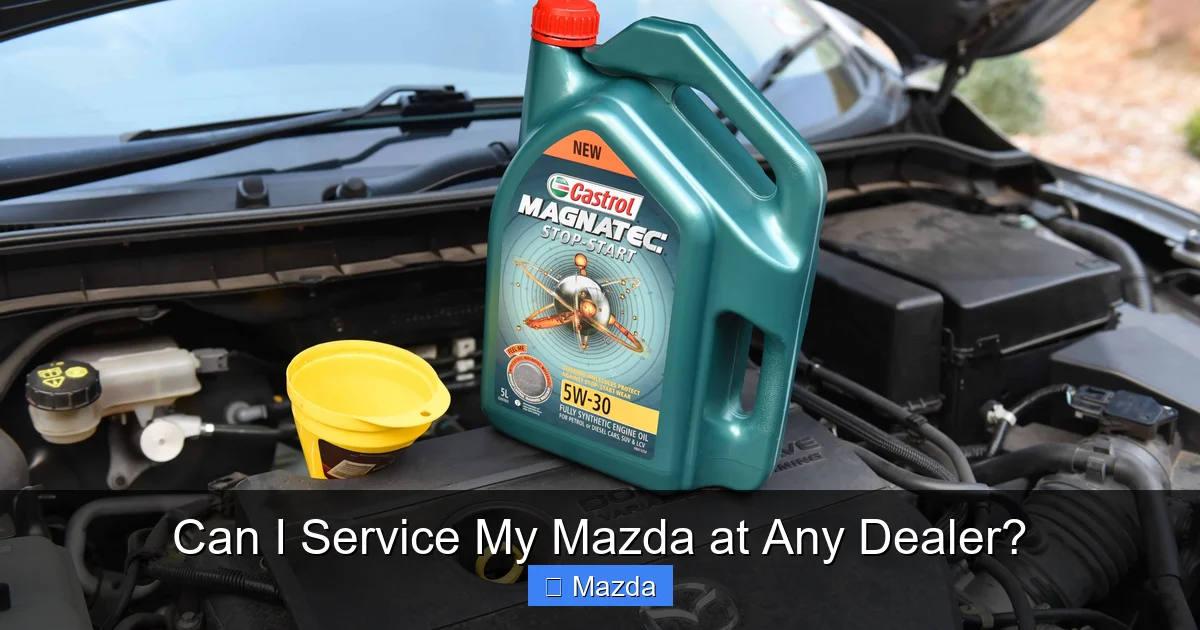
- Using the wrong oil: If you or your independent shop uses oil that doesn’t meet Mazda’s specification (like using 5W-20 when 0W-20 is required for your turbocharged engine), and an engine fails, Mazda can deny the claim.
- Failing to change the oil on time: If your oil change receipts show you went 10,000 miles between changes in a car that requires 5,000-mile intervals, and the engine seizes, that’s on you.
- Aftermarket parts causing damage: Installing a cheap, non-OEM catalytic converter that fails and triggers a check engine light might lead Mazda to investigate. If they find the aftermarket part caused a sensor failure, they can deny coverage for that sensor.
The burden of proof is on you. You must show receipts, logs, and records that demonstrate you followed the maintenance schedule in your owner’s manual. This is why using the Mazda Connect app or keeping a dedicated service booklet (even for independent work) is so vital. A dealer has an electronic record of everything they do. An independent shop gives you a paper or digital receipt. You are the historian of your car.
The “Selling Dealer Advantage” for Warranty Work
While you can go to any dealer, the selling dealer has a vested interest in your satisfaction. They sold you the car and want you to be a lifelong customer. If you have a persistent, complicated problem under warranty, the selling dealer’s service manager and technicians have a direct line to the regional Mazda technical support team. They’ve likely seen your VIN before and know if there are any common issues for that production batch. A dealer in another state might treat it as a new, isolated case, which can lead to longer repair times as they go through standard diagnostic protocols. For major warranty replacements—like a new engine or transmission—the selling dealer often handles the logistics more smoothly.
Think of it like a family doctor versus an urgent care clinic. The urgent care (any dealer) is perfectly capable and will fix the problem. But the family doctor (selling dealer) has your full medical history and can spot connections you might not mention. For simple warranty repairs like a faulty window switch or a bad sensor, any dealer is fine. For complex, recurring issues, the selling dealer’s institutional memory is an asset.
Maintenance vs. Warranty Repairs: Where to Go for What
Let’s categorize your service needs. This clarity will save you time and money.

Visual guide about Can I Service My Mazda at Any Dealer?
Image source: dealerimages.dealereprocess.com
Routine Maintenance (Your Choice)
These are the scheduled services outlined in your Mazda’s maintenance schedule: oil and filter changes, tire rotations, multi-point inspections, cabin air filter replacements, brake fluid flushes, etc. For these, you have complete freedom. You can use:
- Any Mazda dealer: They’ll stamp your maintenance booklet and update Mazda Connect. Convenient, but often the most expensive option.
- A certified independent Mazda shop: These shops have met Mazda’s criteria for tools, training, and parts usage. They can perform warranty work too. Ask your dealer for a list or check Mazda’s website.
- Any reputable independent mechanic: This is where you save significant money. Just ensure they use the correct oil (Mazda Genuine Oil or an exact equivalent meeting Mazda’s specification, like one meeting API SP and ILSAC GF-6 standards) and quality parts. For a 2026 model, verify they have the software to reset maintenance lights and access any new service procedures.
Pro Tip: For tire rotations and inspections, many national chain stores (like Discount Tire, Pep Boys) offer free rotations with purchase and can perform basic inspections. This is a great cost-saver. Just get a detailed receipt.
Warranty Repairs (Stick to Mazda Dealers or Certified Indies)
When a component fails prematurely and is covered by the factory warranty, you should take your car to a Mazda dealer. Why? Because they handle the claim directly with Mazda. You pay nothing (or just a deductible if applicable). If you take it to an uncertified independent shop first, two bad things can happen:
- The shop diagnoses it as a non-warranty issue (like “user damage”) and you pay the bill, only to later discover it was covered.
- The shop does the repair but isn’t certified, so Mazda refuses to pay. You’re stuck between the shop and Mazda in a billing dispute.
Always call your selling dealer’s service department first for a suspected warranty issue. They can often give you a loaner car (if your warranty includes it) and handle everything. If you’re traveling, any Mazda dealer will do, but call ahead to explain the situation and confirm they can provide a loaner if needed, as policies vary by dealer.
Recalls and Technical Service Bulletins (TSBs)
This is the easiest category. Safety recalls are always performed free of charge at any Mazda dealer, regardless of ownership history. You’ll get a notice in the mail. TSBs are manufacturer-recommended fixes for known, non-safety issues (e.g., a software update for infotainment glitches). Dealers often perform these for free if the car is under warranty, but sometimes charge a nominal fee if out of warranty. You can request a TSB at any dealer. For maximum convenience, use the Mazda Recall Lookup tool on their website.
For comparison, the rules around recalls are universal, but the process for brands like Subaru can differ slightly in how they notify owners. Our piece on Subaru service flexibility highlights similar principles: recalls are free everywhere, but warranty work should follow the authorized network.
The 2026 Landscape: Technology and Servicing
Looking ahead to 2026 model year vehicles, Mazda is doubling down on connectivity and software. The updated Mazda Connect infotainment system, with more integrated vehicle health monitoring, will change the servicing dynamic. Here’s what’s coming.
Visual guide about Can I Service My Mazda at Any Dealer?
Image source: autoinstruct.com.au
Over-the-Air (OTA) Updates: The Double-Edged Sword
Starting with recent models, Mazda can push software updates for infotainment, some engine calibrations, and safety features wirelessly, just like your smartphone. This is fantastic—it fixes bugs without a trip to the dealer. However, for major software updates, especially those involving powertrain control modules (PCM) or advanced driver-assistance systems (ADAS), Mazda may still require a dealer connection to ensure the update is applied correctly and all systems are recalibrated. A failed OTA update could, in rare cases, require a dealer visit to recover the system. This creates a new dependency: while you might avoid oil changes at the dealer, you might not be able to avoid software updates.
Advanced Diagnostics and Calibration
Mazda’s i-ACTIVSENSE safety suite (adaptive cruise, lane-keep assist, etc.) relies on precise camera and radar alignment. After a windshield replacement or even a major suspension repair, these systems often need recalibration using specialized targets and equipment that only Mazda dealers (and a few very advanced independent shops) possess. In 2026, as these systems become more sophisticated, this calibration will be even more critical. An independent shop might replace your windshield, but if they don’t recalibrate the radar, your adaptive cruise could malfunction. This is a service that effectively must be done at a Mazda dealer or a certified shop with the right tools. Always ask: “Does this repair require a safety system recalibration?” before authorizing work anywhere.
Battery Electric Vehicles (BEVs)
While Mazda’s full EV push is ramping up, by 2026 we may see more battery-electric models in the U.S., potentially alongside the MX-30. Servicing an EV is fundamentally different. High-voltage system diagnostics and battery pack maintenance are exclusively dealer or certified specialist territory due to safety risks and proprietary technology. If you buy a Mazda EV, your “any dealer” freedom will be even more restricted, as only dealers with EV-certified technicians and equipment should touch the battery. This is a trend across the industry; see our article on where to get your car serviced for a general overview of how EV servicing is consolidating at dealerships.
Making the Smart Choice: A Practical Decision Tree
So, what do you do when the service light illuminates? Here’s a simple flowchart for your next move.
Step 1: Is it a Safety Recall?
If yes, call any Mazda dealer immediately. Schedule it. It’s free. Do not delay.
Step 2: Is it a Warranty Concern (Unusual Noise, Vibration, Check Engine Light Under 36k Miles)?
If yes, call your selling dealer first. Describe the symptom. They may ask you to bring it in for a diagnosis. If you’re far away, they can often transfer your case to a local dealer and ensure warranty coverage is seamless. Do not take it to an independent shop for “diagnosis” first, as they may charge you a diagnostic fee that Mazda won’t reimburse if it turns out to be a warranty issue.
Step 3: Is it Scheduled Maintenance (Oil Change, Tire Rotation, 30k Mile Service)?
If yes, you have choices. Get quotes from your dealer, a certified independent Mazda shop, and a trusted local mechanic. Compare price, convenience, and the shop’s familiarity with your specific model year. For a 2024+ Mazda with complex electronics, a shop that uses the latest diagnostic software (like Bosch or Snap-on tools with Mazda subscriptions) is ideal. Ask if they reset the maintenance reminder correctly.
Step 4: Is it an Out-of-Warranty Repair (Major Component Failure After 60k Miles)?
Here, you have the most freedom. Get multiple estimates. A Mazda dealer will use genuine parts and have the best expertise but at a premium cost. A certified independent shop may offer better value with OEM parts. A general independent shop might be cheapest but use aftermarket parts, which could affect longevity and resale value. For a transmission rebuild, the dealer’s remanufactured unit with a warranty might be worth the extra cost. For a brake job, quality aftermarket pads from a reputable brand are often fine.
Step 5: Always Document Everything
No matter where you go, get a detailed invoice that lists:
- Vehicle mileage
- Date of service
- Specific work performed (e.g., “Replaced engine oil and filter with Mazda Genuine 0W-20, 4.2 quarts”)
- Parts used (part numbers if possible, specify “OEM” or “genuine Mazda”)
- Labor hours
- Technician name or ID (some shops provide this)
File these digitally in a folder on your phone or cloud storage, organized by year. If you ever need to make a warranty claim years later, this paper trail is your best defense. The selling dealer will have their records, but if you used an independent shop, that receipt is your proof of proper maintenance.
Conclusion: Your Mazda, Your Choice (With Wisdom)
So, can you service your Mazda at any dealer? The clear answer is yes, for most situations at any authorized Mazda dealership in the U.S. For routine maintenance, you have the freedom to choose any reputable shop, independent or dealer. The key to navigating this landscape is understanding the stakes: warranty work is safest at the selling dealer or a certified independent shop, while maintenance is where you can save money. As vehicles like the 2026 Mazda CX-70 and potential EV models become more software-defined, the dealer’s role in complex diagnostics and calibration will only grow, but basic upkeep will remain flexible.
Your best strategy is to build a relationship with one primary Mazda dealer for warranty and complex work—think of them as your car’s specialist hospital. For oil changes and tire rotations, use a trusted local shop and keep flawless records. This hybrid approach gives you convenience, cost savings, and maximum warranty protection. Remember, your owner’s manual is your bible, and your service receipts are your evidence. Follow the schedule, choose wisely where to take your car, and your Mazda will reward you with years of driving joy.
Frequently Asked Questions
Can I take my Mazda to a non-Mazda dealer for warranty work?
No. Warranty work must be performed by an authorized Mazda dealer or a certified independent Mazda shop. A Toyota or Honda dealer, even if skilled, cannot submit warranty claims to Mazda and using them will void your warranty coverage for that repair.
Will using an independent shop for oil changes void my Mazda’s warranty?
No, as long as you use the correct oil grade and type specified in your owner’s manual and keep detailed receipts. The Magnuson-Moss Warranty Act protects your right to choose where routine maintenance is done. However, using the wrong oil could void an engine warranty claim if it causes damage.
What happens if I have a warranty issue while traveling far from my selling dealer?
You can take it to any Mazda dealer in the U.S. They will verify your warranty and perform the repair. While you may miss the personal history of your selling dealer, the network is designed for portability. Call your selling dealer’s service department afterward to update your service history.
Does Mazda offer loaner cars for warranty repairs?
Many, but not all, Mazda dealers participate in a loaner program. This is a dealer-specific policy, not a Mazda corporate guarantee. It’s typically offered for warranty repairs that take several hours or overnight. Always call your preferred dealer ahead of time to ask about their loaner availability and policy.
How do I find a certified independent Mazda repair shop?
Use the “Find a Dealer” tool on the official Mazda USA website. Some listings will indicate if a dealer has a certified independent program. You can also call your local Mazda dealer and ask for recommendations—they often know the reputable independent shops in their area that are certified or have a good reputation for working on Mazdas.
For a 2026 Mazda with new software, is dealer servicing mandatory for all updates?
Not for all updates. Many will be over-the-air (OTA) and happen automatically. However, for major software revisions, calibrations for safety systems after repairs, or updates to critical drivetrain modules, a dealer connection using proprietary Mazda diagnostic tools will likely still be required. Your owner’s manual and in-vehicle notifications will specify the required method.