
How Many Catalytic Converters Does a Toyota Camry Have?

The number of catalytic converters in a Toyota Camry is not a one-size-fits-all answer. The vast majority of modern, gasoline-powered Camrys from the last 15 years are equipped with two catalytic converters. However, specific model years, engine configurations (like V6 vs. 4-cylinder), and stringent emissions standards (such as California’s) can alter this number, with some configurations using three. Knowing your specific setup is crucial for repairs, emissions testing, and understanding your vehicle’s exhaust system.
Key Takeaways
- Standard is Two: Most post-2007 Toyota Camrys with 4-cylinder and V6 gasoline engines use a dual catalytic converter system (one near the engine, one further down).
- Engine Type is Key: While 4-cylinder models typically have two, certain high-performance V6 models from specific years may utilize a third converter to meet stricter emissions standards.
- Location Matters: Converters are part of the exhaust system. The “primary” or “front” converter is closest to the engine and works immediately. The “secondary” or “rear” converter is located closer to the muffler and further cleans the exhaust.
- Hybrid Models Differ: Toyota Camry Hybrids often have a more complex system that may integrate converter functions with the engine’s exhaust aftertreatment, but they still rely on catalytic conversion technology.
- Failure Symptoms are Clear: A failing converter triggers a Check Engine Light, causes poor engine performance, rattling noises, and will cause a vehicle to fail an emissions smog test.
- Replacement is Expensive: Due to precious metal content, catalytic converters are costly to replace. Always get a proper diagnosis, as other issues like faulty O2 sensors can mimic converter failure.
- VIN is Your Best Friend: The only surefire way to know the exact number and type for your specific Camry is to check your Vehicle Identification Number (VIN) with a dealer or use an online parts lookup tool.
📑 Table of Contents
- Introduction: Decoding Your Camry’s Exhaust System
- The Evolution: How Camry Converter Counts Changed Over Time
- Engine Type: 4-Cylinder vs. V6 vs. Hybrid
- Where to Find Them: A Visual Guide to Your Camry’s Underside
- Symptoms of a Failing Catalytic Converter
- Replacement Costs and Process: What to Expect
- Frequently Asked Questions (FAQs)
Introduction: Decoding Your Camry’s Exhaust System
If you own or are looking at a Toyota Camry, you might be asking a very smart question: “How many catalytic converters does this car have?” It’s not just trivia. This knowledge is vital for anyone facing an emissions test, a mysterious Check Engine Light, or a hefty repair bill. The catalytic converter is your car’s environmental guardian, a metal canister packed with precious metals that transforms harmful exhaust gases into less harmful substances. But how many of these guardians does your specific Camry need?
The simple, most common answer is two. But the real answer lives in the details of your model year, engine size, and where you live. A 2012 Camry LE with a 2.5L 4-cylinder and a 2015 Camry XSE with a 3.5L V6 might both have two, but the placement and design can differ. Meanwhile, a California-compliant 2018 Camry might have a third, smaller converter tucked away. Let’s pop the hood, or rather, crawl under the car, and break down everything you need to know about the catalytic converters in a Toyota Camry.
The Evolution: How Camry Converter Counts Changed Over Time
Understanding the “why” behind the number helps make sense of the “how many.” Emissions regulations have tightened dramatically over the decades, forcing automakers like Toyota to continuously refine exhaust aftertreatment systems. The Camry, as America’s perennial best-selling sedan, has been at the forefront of this evolution.
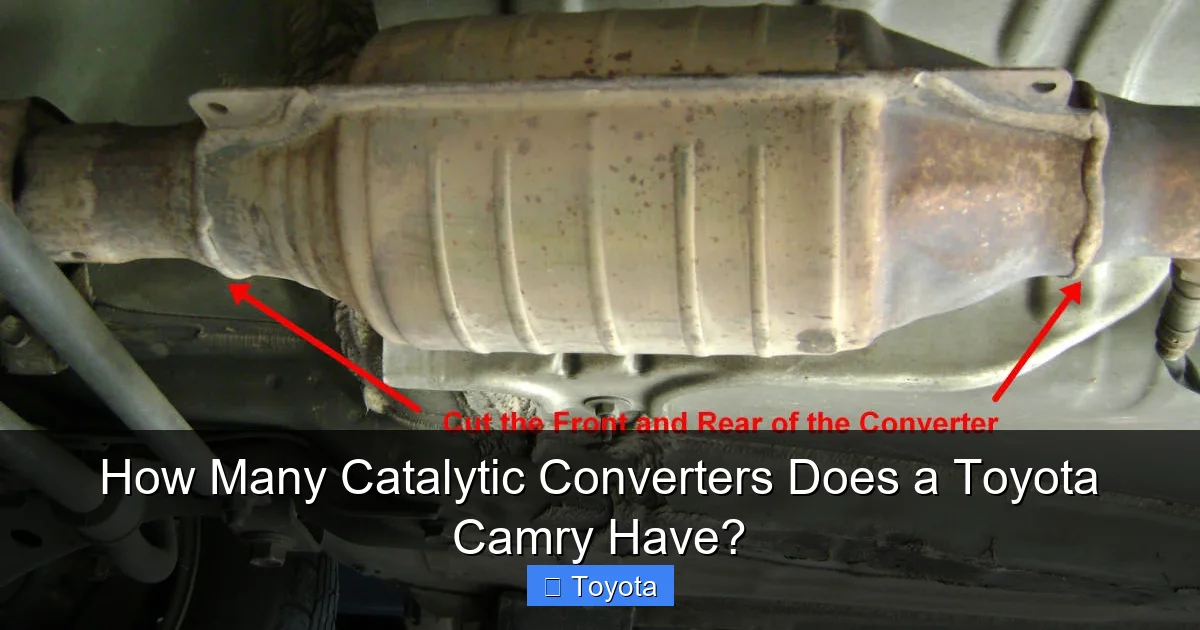
Visual guide about How Many Catalytic Converters Does a Toyota Camry Have?
Image source: usercontent2.hubstatic.com
Pre-2004 Models: The Era of One
For older enthusiasts, if you’re looking at a Camry from the early 2000s or late 1990s (like the XV20 generation), you’ll typically find a single catalytic converter. This was standard for the era—one main unit located in the exhaust system. These were often more straightforward to replace but were less efficient at cleaning exhaust than modern multi-stage systems.
2004-2017: The Dual-Converter Standard Emerges
Starting around the 2004 model year (XV30 generation) and becoming the firm standard through the XV40 (2007-2011) and XV50 (2012-2017) generations, Toyota widely adopted a two-converter system for most Camry models. This “dual cat” setup dramatically improved emissions reduction.
- The Front/Primary Converter: Located immediately after the exhaust manifold(s). It handles the brunt of converting carbon monoxide (CO) and hydrocarbons (HC) and starts working on nitrogen oxides (NOx) almost immediately as hot exhaust gases hit it.
- The Rear/Secondary Converter: Positioned further downstream, usually after the muffler or resonator. Its job is to “polish” the exhaust, further reducing any remaining pollutants that the front converter missed, especially NOx. This two-stage process is far more effective.
For the vast majority of 4-cylinder (2.4L, 2.5L) and standard V6 (3.5L) Camrys from 2007 to 2017, you can confidently expect two catalytic converters.
2018-Present: Complexity Increases with Standards
The current generation (XV70, 2018+) introduced to meet the most stringent Tier 3 and LEV III standards, particularly in states that follow California’s stricter Air Resources Board (CARB) rules. This led to some variations:
- Most Models Still Have Two: The standard gasoline 4-cylinder (2.5L) and V6 (3.5L) models sold in most states retain the efficient two-converter system.
- California & CARB States Often Have Three: To achieve the near-zero emission levels required, some Camry models (often specific trims or when ordered with certain packages) incorporate a third, smaller “underbody” or “tunnel” converter. This third converter targets final polishing of NOx and hydrocarbons. The exact configuration can depend on the exact engine and emissions certification for that specific vehicle.
Pro Tip: If you need to know for sure, your VIN is the ultimate source of truth. A Toyota parts department can decode it to tell you the exact exhaust system part numbers and quantity.
Engine Type: 4-Cylinder vs. V6 vs. Hybrid
Your Camry’s engine is the single biggest factor determining its catalytic converter setup.
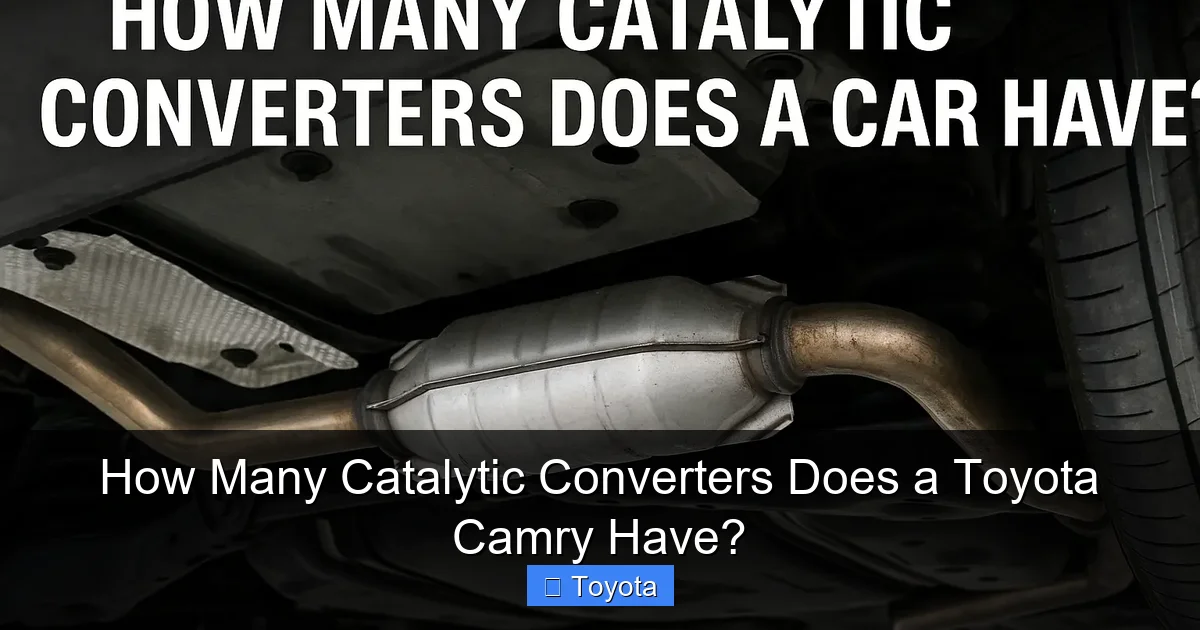
Visual guide about How Many Catalytic Converters Does a Toyota Camry Have?
Image source: thecatalyticconverter.com
The Workhorse: 2.5L 4-Cylinder (AR Series)
This is the engine found in the overwhelming majority of Camrys. Across nearly all model years from 2012 onward, it uses a two-converter system. The design is optimized for fuel efficiency and low emissions, with the converters integrated into a manifold-front pipe assembly. The engine’s oil capacity and maintenance are separate, but a well-maintained engine (proper oil level, no Rich/Lean conditions) is critical for converter longevity, as oil or fuel contamination can quickly foul a cat.
The V6: 3.5L (2GR-FE/2GR-FKS)
The V6 Camry, while less common, follows a similar pattern but with a twist due to its dual exhaust paths. From the 2007 model year onward, the V6 almost universally uses a two-converter system. However, because the V6 has two separate exhaust manifolds (one per cylinder bank), it often has a more complex setup:
- Each bank may have its own “front” section that merges into a single pipe.
- The catalytic converters are typically located after these merge points. You might see one large converter or two smaller ones in a “Y-pipe” configuration before the muffler.
- For some later, stricter-emissions V6 models (especially in California), a third converter may be added downstream.
So, while the count is usually two, the physical layout is more intricate than the 4-cylinder’s.
The Efficient Choice: Camry Hybrid
The Camry Hybrid (using the 2.5L 4-cylinder Atkinson-cycle engine paired with an electric motor) has a unique system. It still uses a traditional catalytic converter, but its placement and thermal management are critical because the engine can shut off frequently. The converter must stay hot enough to work efficiently even when the engine is off. Most Hybrids use a single, highly efficient converter located very close to the engine manifold to ensure rapid light-off (reaching operating temperature). Some later Hybrid models may use a secondary converter for extra cleaning. The count is typically one or two, depending on the model year and emissions package.
Where to Find Them: A Visual Guide to Your Camry’s Underside
Knowing how many you have is one thing; finding them is another. If you’re looking to inspect or replace them, here’s a roadmap.
Visual guide about How Many Catalytic Converters Does a Toyota Camry Have?
Image source: workmanseuropeanauto.com
The General Location
All catalytic converters are part of the exhaust system, which runs from the engine to the rear of the car. You’ll find them on the underside, between the engine’s exhaust manifolds and the muffler(s).
For a Standard 4-Cylinder Camry (Most Common)
1. Primary Converter: Look directly under the engine, near the firewall (the wall between the engine and passenger compartment). It’s bolted to the exhaust manifold(s) and is often part of a cast-iron or stainless steel “front pipe.” It will be the hottest part of the exhaust system right after startup.
2. Secondary Converter: Follow the exhaust pipe back from the primary converter. It will be located somewhere between the front of the car and the muffler, often just before or just after a resonator (a chamber that reduces exhaust drone). It’s usually a bit smaller in diameter than the primary.
For a V6 Camry
The path is similar but starts with two exhaust pipes from the cylinder banks. These merge into a single pipe, often with a “Y-pipe” or “H-pipe.” The catalytic converter(s) will be located shortly after this merge point. You might see one larger converter or two smaller ones welded together in this section. Then, the pipe continues to the muffler. A third converter, if present, will be further back, closer to the muffler outlet.
Important Safety Note:
Never attempt to work on a hot exhaust system. Let the car cool completely. The converters operate at extremely high temperatures (often over 1,000°F / 538°C) and can cause severe burns. Use proper jack stands and safety equipment if inspecting underneath.
Symptoms of a Failing Catalytic Converter
Catalytic converters don’t usually fail on their own without a preceding problem. They are often the victim of unburned fuel, oil consumption, or coolant leaks. Here are the classic signs your Camry’s converter is failing or has failed:
The Check Engine Light (CEL) Illuminates
This is the most common and first sign. The vehicle’s oxygen (O2) sensors, located before and after the converter(s), monitor its efficiency. When the sensor data shows the converter is not cleaning the exhaust properly, it triggers a diagnostic trouble code (DTC), like P0420 (Catalyst System Efficiency Below Threshold). A professional scan tool is needed to read these codes accurately.
Poor Performance and Fuel Economy
A clogged converter acts like a kink in a hose, creating excessive backpressure. The engine has to work harder to push exhaust out. Symptoms include:
– Hesitation or stalling when accelerating.
– Significant loss of power, especially at higher RPMs.
– Noticeably worse fuel economy (MPG drops).
Unusual Noises
If the internal honeycomb substrate breaks apart (often from overheating), you’ll hear a loud rattling sound coming from under the car, especially when starting the engine or revving it. This sound usually comes from the primary converter, as it takes the most abuse.
Failed Emissions Test (Smog Test)
This is the inevitable outcome of a poorly functioning converter. Your Camry will not pass the tailpipe emissions portion of a state or local smog check. The test measures the exact pollutants the converter is supposed to eliminate.
Rotten Egg Smell
A failing converter may not properly convert hydrogen sulfide (which has a rotten egg odor) into odorless sulfur dioxide. If you smell this consistently from the exhaust, it’s a red flag.
Replacement Costs and Process: What to Expect
If your diagnosis confirms a bad catalytic converter, brace yourself for the cost. It’s one of the most expensive “wear” items on your Camry.
Parts Cost: The Precious Metal Price Tag
The cost is high because converters contain platinum, palladium, and rhodium. For a Toyota Camry:
– OEM (Original Equipment Manufacturer): A genuine Toyota front converter for a 4-cylinder can range from $1,200 to $2,500+ for the part alone. A rear converter is less, often $800 – $1,800.
– Aftermarket: High-quality aftermarket converters (from brands like Bosal, MagnaFlow, or AP Exhaust) that meet EPA standards can be 30-50% cheaper, typically $600 – $1,500 for a front unit. Be wary of extremely cheap “universal” converters; they often don’t meet emissions standards for your state and may not fit correctly.
Labor Cost: The Physical Challenge
Labor is significant because converters are often welded or heavily rusted in place. Access can be difficult, especially on the front converter which is tucked up near the engine. Expect 2-5 hours of labor at a shop rate of $80-$150/hour. Total replacement cost (parts + labor) for a single converter can easily run $1,500 to $4,000+.
The Replacement Process
- Diagnosis: Confirm it’s the converter and not an O2 sensor, exhaust leak, or engine misfire (which can dump unburned fuel into the cat and destroy it).
- Parts Acquisition: Source the correct converter(s) for your specific VIN, model year, and emissions state.
- Removal: This involves cutting off old welds, using penetrating oil for rusted bolts, and carefully unbolting or cutting out the old unit.
- Installation: The new converter(s) are welded or clamped in place. All new gaskets and hardware are used.
- Post-Repair: The mechanic will clear codes and may need to perform a drive cycle to reset the O2 sensor monitors. You must then pass an emissions test.
Critical: Always fix the root cause that destroyed the old converter. If you had an engine misfire, bad spark plugs, or an oil consumption issue, those must be repaired first, or your new converter will fail prematurely. Keeping up with regular maintenance like timely oil changes helps prevent such issues.
Frequently Asked Questions (FAQs)
Does a 2020 Toyota Camry have a catalytic converter?
Yes, absolutely. All modern gasoline-powered vehicles, including the 2020 Camry, are equipped with at least one catalytic converter as a mandatory emissions control device. The 2020 model typically has two, but specific California-compliant versions may have three.
Can I drive my Toyota Camry with a bad catalytic converter?
You can drive it for a short period, but it’s not advisable. A severely clogged converter can eventually cause the engine to stall or not start. More immediately, you’ll fail any emissions test, and the underlying cause (like a misfire) can damage the engine or the new converter if you eventually replace it. It’s best to diagnose and address the issue promptly.
How much does it cost to replace a catalytic converter on a Toyota Camry?
As mentioned, the total cost is high. For a single converter on a common 4-cylinder model, you should budget between $1,800 and $3,500 at a reputable independent repair shop. Dealership prices can be higher. The final number depends entirely on your specific model year, whether you need one or two replaced, and if it’s an OEM or aftermarket part.
Will a Toyota Camry pass a smog test without a catalytic converter?
No. Removing the catalytic converter is illegal in all 50 states under the Clean Air Act. A vehicle without its required catalytic converters will fail a smog test instantly and cannot be legally registered or driven on public roads in areas that require testing.
Do all Toyota Camry Hybrids have catalytic converters?
Yes, they do. While they use an electric motor, the gasoline engine still produces exhaust that must be treated. They use a highly efficient converter, often a single unit integrated closely with the exhaust manifold to ensure it heats up quickly even when the engine starts and stops frequently.
How can I check how many catalytic converters my Camry has?
The best way is to look up your 17-digit VIN on an online parts catalog (like Toyota’s own site or a major auto parts retailer) or call a Toyota parts department. You can also do a visual inspection underneath the car, following the exhaust from the engine back to the muffler, counting the distinct canister-like structures. You’ll typically find one near the engine and one further back.
Frequently Asked Questions
What is How Many Catalytic Converters Does a Toyota Camry Have??
How Many Catalytic Converters Does a Toyota Camry Have? is an important topic with many practical applications.
