
Why Does a Toyota Tundra Shut Off After Remote Start

Your Toyota Tundra’s remote start system is designed to shut off after a set time or when certain conditions are met, primarily as a safety and emissions feature. Common reasons include the 20-minute runtime limit, an open hood or door, an unfastened seatbelt, or a low battery. Troubleshooting involves checking these simple items first before diagnosing deeper electrical or programming faults.
Key Takeaways
- It’s Usually By Design: The 20-minute automatic shut-off is a standard emissions and safety feature, not a malfunction.
- Safety Interlocks Are Primary: Opening a door, the hood, or unfastening a seatbelt often triggers an immediate shut-off for safety.
- Battery Health is Critical: A weak or failing battery is a top culprit for remote start failure and premature shutdowns.
- Model Year Matters: Features and programming vary significantly between generations (e.g., 2014-2021 vs. 2022+).
- Start with Simple Checks: Always verify hood latch, door sensors, and seatbelt connections before assuming a complex problem.
- Professional Diagnostics May Be Needed: Issues with the remote start module, immobilizer, or body control module require a dealer or specialist.
📑 Table of Contents
Understanding Your Toyota Tundra’s Remote Start System
You press the button on your key fob, the Tundra’s engine roars to life, and you smile thinking about the pre-warmed cabin waiting for you. Then, before you can even get to the truck, the engine cuts off. Annoying? Absolutely. Mysterious? Not really. This behavior is a core part of how Toyota engineers its remote start systems for safety, efficiency, and regulatory compliance. To solve the puzzle, we need to understand what the system is supposed to do and the clever, sometimes frustrating, safeguards built into it.
The remote start feature, often part of the Toyota Security/Convenience package or a factory-installed option, is more than just a “start button.” It’s a sequence of checks and commands managed by your Tundra’s Body Control Module (BCM) and Engine Control Module (ECM). When you activate remote start, the BCM verifies a long list of pre-conditions are met. If they are, it signals the ECM to start the engine and run the climate controls. However, once running, the system remains in a constant state of conditional monitoring. A single triggered sensor can send a “kill switch” signal, stopping the engine immediately. This isn’t a flaw; it’s a feature designed to prevent theft, accidents, and unnecessary emissions.
How Remote Start is Supposed to Work (The Ideal Scenario)
In a perfect world, here’s the sequence: You lock all doors, ensure the transmission is in “Park,” and press the remote start button (usually a lock button pressed three times or a dedicated icon). The truck’s lights flash, the engine starts, and the climate system turns on to your last set temperature. The engine then runs for a pre-programmed period—typically 10, 15, or 20 minutes—or until you perform a valid “takeover” action, like pressing the brake and pushing the start button. This allows the cabin to heat or cool efficiently without you having to wait inside. The system is designed to be a convenience, not a substitute for being physically present with your running vehicle.
The Usual Suspects: Why Your Tundra Shuts Off Prematurely
When the remote start session ends unexpectedly, it falls into one of two categories: it shuts off after the full, intended cycle (which is normal), or it shuts off way too soon (which indicates a problem). We’re focusing on the latter. The causes are almost always related to the system’s safety interlocks or its power source. Let’s break down the most common reasons, starting with the simplest and most frequent.
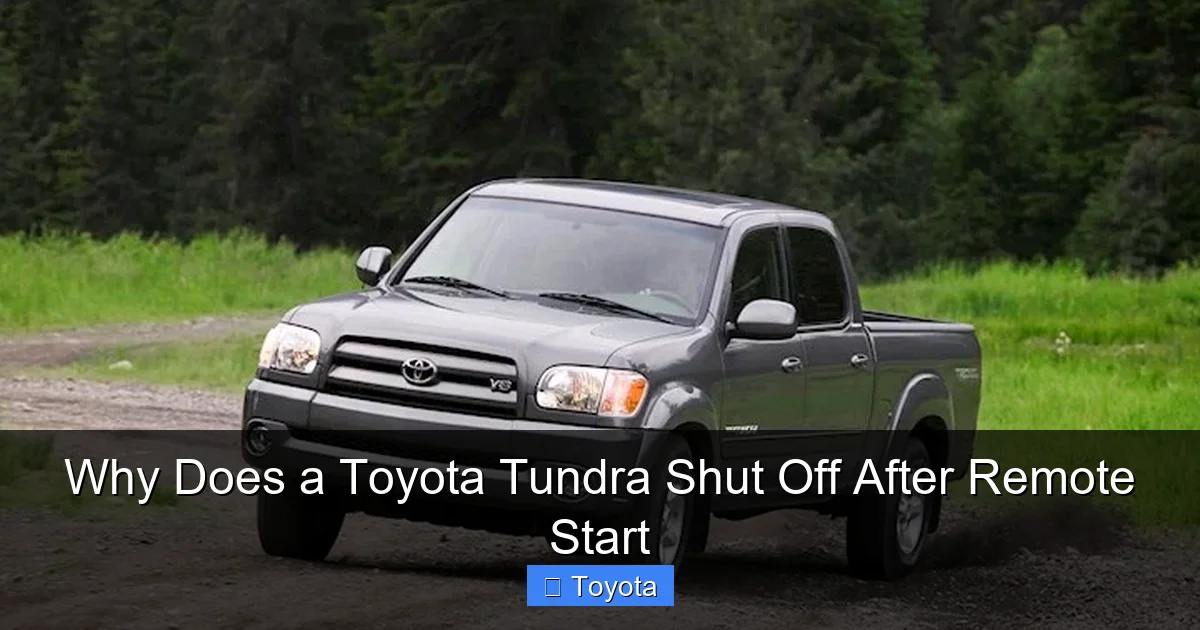
Visual guide about Why Does a Toyota Tundra Shut Off After Remote Start
Image source: drivingline.com
The 20-Minute Runtime Limit (The Most Common “Normal” Shut-Off)
This is the #1 reason people think their remote start is broken. Federal emissions regulations limit the amount of time a vehicle can idle without a driver present. Toyota programs this limit into the BCM. For most modern Tundras (2014+), that limit is 20 minutes. After exactly 20 minutes, the engine will shut off, regardless of any other conditions. If you’re testing remote start from inside your house and it shuts off after about 20 minutes, the system is working perfectly. There is no user setting to extend this; it’s hard-coded. Some older models or specific trims might have a 10 or 15-minute cycle, so checking your owner’s manual is always wise.
Safety Interlock Triggers: The Instant Kill Switches
These are designed to stop the engine the moment a potentially unsafe condition is detected. They override the timer. If your Tundra shuts off in under 5 minutes, one of these is almost certainly the culprit:
- The Hood Latch is Not Fully Latched: This is incredibly common. The hood ajar sensor is a sensitive switch. If the hood isn’t slammed shut with a solid *click*, the sensor may read as “open.” The remote start system interprets an open hood as a potential danger (someone could be working in the engine bay) and kills the engine instantly. Always listen for that latch click.
- Any Door is Opened: Once remote start is activated, opening any door—driver, passenger, or rear—will cause an immediate shutdown. The system assumes the person approaching is the authorized driver and wants to take control. Opening a door to grab something from the back seat will kill it.
- The Driver’s Seatbelt is Unfastened: This is a critical safety feature. During remote start, the system expects the driver to be outside the vehicle. If the driver’s door is opened and the seatbelt is not buckled, the engine will shut off. It’s a safeguard against someone getting in and driving off without buckling up. If you open the door and reach in to grab your wallet, make sure you’re buckled first, or it will die.
- The Brake Pedal is Pressed: While this is the correct “takeover” procedure when you’re ready to drive (brake + push start button), pressing the brake pedal while outside the vehicle* can sometimes trigger a shutdown if the system detects an input it doesn’t expect. This is less common but possible.
Battery Voltage and Health
A healthy 12-volt battery is non-negotiable for remote start. The process requires a significant burst of power: the BCM must wake up, communicate with the ECM, engage the starter solenoid, and then power all accessories (fans, heater, etc.). If the battery is weak, old, or has corroded terminals:
- The initial start might be sluggish or fail.
- The system might start but then immediately shut off because the voltage drops below the minimum threshold the BCM requires to keep the engine running. The ECM may interpret this as a fault and shut down to protect itself.
- Extreme cold exacerbates this, as battery capacity plummets.
Pro Tip: A battery can read 12.6V at rest but still fail under load. A proper load test at an auto parts store is free and definitive.
Key Fob Battery and Signal Issues
While a dead key fob battery will prevent the initial signal from being sent, a weak battery can cause a corrupted signal. The BCM might receive a partial “start” command but then fail to receive the continuous “keep-alive” signal or might misinterpret subsequent signals, leading to an immediate or erratic shutdown. Replacing the coin cell battery in your fob is a cheap and easy first step.
Faulty Sensors or Wiring
The safety interlocks rely on simple switches and sensors. A failing hood latch switch, a door ajar switch that’s stuck “on,” or damaged wiring in the door harness (a common issue in trucks with heavy use) can send a constant “open” signal to the BCM. The system then believes a door or hood is open even when it’s not, and it refuses to keep the engine running. Diagnosing this requires checking for diagnostic trouble codes (DTCs) in the BCM.
Model Year and Trim Level Variations
Not all Tundras are created equal. The behavior and programming of remote start can change significantly between generations and even between trims within the same generation.

Visual guide about Why Does a Toyota Tundra Shut Off After Remote Start
Image source: i.ytimg.com
Pre-2014 (XK50 Generation)
These models often have a simpler remote start system. The runtime limit might be 10 or 15 minutes. They may not have the sophisticated seatbelt interlock integration of later models. Issues are more likely related to basic wiring or the aftermarket remote start module if one was installed. The factory system on these older trucks is less common.
2014-2021 (XK70 Generation – The Most Common on the Road)
This is the generation where remote start became widely available as a factory option. The 20-minute limit is standard. The integration with the seatbelt and door sensors is very tight. A very common issue on these models is a failing hood latch assembly. The internal switch wears out, and even with the hood firmly closed, it may not signal “closed” to the BCM. Replacing the entire hood latch (a $50-$100 part) often solves the problem. Also, check for any aftermarket alarms or remote starters; poor installation can interfere with factory signals.
2022+ (XK70 Facelift & i-Force Max Hybrid)
The newest Tundras have even more complex software. The remote start is now fully integrated into the Toyota app for many models (Remote Connect). The same physical safety rules apply, but the control is digital. A software glitch or an outdated vehicle software version (TSB) could potentially cause issues. For the i-Force Max hybrid models, the start-stop behavior might feel slightly different due to the hybrid system’s management, but the safety shut-off principles are identical.
Troubleshooting: A Step-by-Step Guide
Before you call a dealer and spend money, work through this logical checklist. Start with the fastest, freeest checks.
Visual guide about Why Does a Toyota Tundra Shut Off After Remote Start
Image source: s.yimg.com
Step 1: The User-Error and Simple Check Phase
- Confirm the Runtime: Did it run for a full 20 minutes? If yes, it’s working as intended. Use a stopwatch.
- Perform The “Perfect Start”: Sit in the driver’s seat. Lock the doors. Ensure the transmission is in Park. Fasten your seatbelt. Close the hood firmly (listen for the click). Now, use the remote start. Does it stay on? If yes, you’ve isolated the problem to one of the interlocks (hood, door, seatbelt). Now test them one by one: with it running, carefully open a door—does it shut off? Unbuckle—does it shut off? This identifies the trigger.
- Inspect the Hood Latch: Visually examine the primary latch (the one you pull to open). Is the plastic cover cracked? Can you see the metal switch lever? Have someone inside the truck operate the hood release while you watch the latch mechanism. It should move definitively. A lack of movement or a loose feel indicates a worn latch.
- Check Key Fob Battery: Replace it. It’s a CR2032 coin cell. Costs $5.
- Check 12V Battery: Take the truck to any major auto parts store (AutoZone, Advance, O’Reilly) for a free load and conductance test. They’ll tell you if it’s weak.
Step 2: The Diagnostic Phase
If the simple checks don’t reveal the issue, you need to read the truck’s computer. You’ll need an OBD2 scanner that can access the Body Control Module (BCM), not just engine codes. Many inexpensive Bluetooth scanners with the right app (like Torque Pro) can do this for Toyotas.
- Scan for Codes: Look for any stored or pending codes in the BCM. Common ones might relate to “Hood Ajar Switch Circuit,” “Door Switch Circuit,” or “Remote Start Inhibit.” The code will point you to the circuit or component at fault.
- Test Switches: Using the scanner’s live data function, you can monitor the status of the hood, door, and seatbelt switches. Have a helper operate each while you watch the data stream. Does the “Hood” status flip from “Closed” to “Open” when you slam the hood? If it’s stuck on “Open,” the switch or its wiring is bad.
- Check for Aftermarket Interference: If your Tundra has an aftermarket alarm, stereo, or remote starter, disconnect it temporarily. These devices can sometimes send conflicting signals or drain the battery in a way that disrupts the factory system.
Step 3: The Professional Repair Phase
If you’ve found a faulty hood latch or door switch, replacement is usually straightforward. However, if the wiring is damaged (chafed in the door hinge area) or the BCM itself is faulty, professional help is needed. A Toyota dealer can perform advanced diagnostics, reflash software, and replace the BCM if necessary. For wiring repairs, a reputable auto electrician is often more affordable than a dealer.
Note on Aftermarket Systems: If your Tundra did not come with factory remote start and has an aftermarket unit, the troubleshooting principles are similar (battery, safety hook-ups), but the programming and failure points are specific to that brand. Consult its manual or installer.
Comparing to Other Trucks: It’s Not Just a Toyota Thing
This behavior isn’t unique to the Tundra. Almost all modern vehicles with remote start have identical safety interlocks and runtime limits. For instance, if you search for why does my Dodge Ram shut off when I stop or why does my Dodge Ram shut off while driving, you’ll find similar discussions about battery issues, sensor failures, and the auto stop-start system (which is different but also causes shutdowns). The core engineering philosophy is universal: a remotely started vehicle is a potential liability, so manufacturers build in multiple layers of automatic shutdown to mitigate risk. Understanding this helps you realize your Tundra is acting as intended by its designers, not as a random malfunction.
Conclusion: Knowledge is Power (and a Warm Truck)
Your Toyota Tundra shutting off after a remote start is almost never a mysterious, unfixable curse. It’s a communication from the vehicle’s sophisticated computer network, telling you that a safety rule has been broken or a limit has been reached. By methodically checking the hood latch, door sensors, seatbelts, and battery health, you can diagnose and fix 90% of these issues yourself. Remember the golden rule: a firmly latched hood and a buckled seatbelt are the two most common keys to a successful remote start. Treat these checks as part of your pre-remote-start ritual. For the remaining complex electrical or software faults, a professional with the right scanner is your best ally. Once you understand the “why,” you can confidently enjoy the convenience of a pre-warmed Tundra on cold mornings or a cooled cabin on scorching afternoons, every single time.
Frequently Asked Questions
Does my Toyota Tundra have a remote start feature?
Most Tundras from the 2014 model year onward have factory remote start available, either standard on higher trims or as part of a package. You can confirm by looking for a dedicated remote start button on your key fob or checking your owner’s manual. If your vehicle didn’t come with it, an aftermarket system can be installed.
How long is my Tundra supposed to run on remote start?
For virtually all modern Tundra models with factory remote start, the engine will run for exactly 20 minutes before automatically shutting off. This is a federally mandated emissions limit and cannot be extended or disabled through vehicle settings.
Can I disable the safety shut-off features like the door or hood sensor?
No. These are critical safety interlocks mandated by Toyota and regulatory bodies. They are hard-coded into the vehicle’s computer systems and cannot be legally or safely disabled. Tampering with these circuits would likely trigger a security lockout and is strongly discouraged.
My Tundra starts but shuts off immediately. What is the most likely cause?
The most common cause is a faulty hood latch switch. The hood may appear closed, but the internal switch is worn or misaligned, telling the computer the hood is “open.” The second most common cause is a weak or failing 12-volt battery that cannot sustain the engine’s electrical load after start-up.
Will a remote start work if I leave the key fob inside the truck?
Yes, but only if you activate remote start before placing the fob inside and closing the doors. Once the engine is running, the presence of the key fob inside the locked vehicle does not affect the remote start cycle. However, if you open a door, the engine will shut off as per normal safety protocol.
Is it bad for my engine to remote start it and let it warm up?
Modern engines, including the Tundra’s, do not require extended warm-up. A 1-2 minute warm-up is sufficient for oil circulation. Remote start for 5-10 minutes in very cold weather is fine and helps with cabin comfort. However, letting it run for the full 20 minutes daily is unnecessary and wastes fuel. The system is designed for this duration, so it’s not harmful, just inefficient.
