
What Are the 5 Steps of the Toyota Production System?

The Toyota Production System (TPS) is the legendary manufacturing philosophy behind Toyota’s reputation for quality and efficiency. Its power comes from five interconnected steps: Just-in-Time (producing only what is needed), Jidoka (automation with human intelligence), Heijunka (production leveling), Kaizen (continuous improvement), and Respect for People. Together, they eliminate waste, empower workers, and create a culture of relentless problem-solving, making TPS a model studied by industries worldwide.
Key Takeaways
- Just-in-Time (JIT): This step focuses on producing parts and products only as they are needed in the next process, dramatically reducing inventory costs and waste from overproduction.
- Jidoka (Automation with a Human Touch): It means building in quality at the source by equipping machines and processes to stop automatically when a problem occurs, preventing defects from moving forward.
- Heijunka (Production Leveling): This step smooths out production volume and mix over time to avoid peaks and valleys, making workflows predictable and reducing strain on people and equipment.
- Kaizen (Continuous Improvement): A daily practice where everyone, from executives to line workers, is encouraged to identify small, incremental improvements to processes.
- Respect for People: The foundational pillar that values and develops every team member, fostering trust, teamwork, and a safe environment where people can solve problems.
- They Are Interconnected: These five steps do not work in isolation; they form a synergistic system where a weakness in one area undermines the strength of the others.
- Beyond Manufacturing: While born on the factory floor, the principles of TPS are successfully applied in healthcare, software development, logistics, and office administration.
📑 Table of Contents
- The Unbeatable Engine: An Introduction to the Toyota Production System
- Step 1: Just-in-Time (JIT) – Only What’s Needed, When It’s Needed
- Step 2: Jidoka – Automating with a Human Mind
- Step 3: Heijunka – The Art of Production Leveling
- Step 4: Kaizen – The Relentless Pursuit of Improvement
- Step 5: Respect for People – The Unshakable Foundation
- How the Five Steps Interlock: The TPS House
- Conclusion: More Than a Manufacturing System
The Unbeatable Engine: An Introduction to the Toyota Production System
Imagine a business philosophy so powerful it became the gold standard for manufacturing worldwide. A system so effective that its name is whispered with reverence in boardrooms and factory floors from Kentucky to Kyoto. That’s the Toyota Production System, or TPS. It’s not just a set of tools; it’s a complete way of thinking about work, value, and people. For decades, it has been the secret sauce behind Toyota’s legendary reputation for building reliable vehicles with astonishing efficiency.
But what exactly is TPS? At its heart, it’s a framework designed to do two things perfectly: deliver the highest quality to the customer and eliminate every form of waste (known as muda) from the process. It achieves this through a beautiful, logical sequence of five core steps. These steps aren’t a linear checklist; they are a dynamic, interconnected cycle that feeds on itself, creating a self-improving organization. Understanding these five steps isn’t just for auto engineers. It’s for anyone who manages a process, leads a team, or wants to understand how world-class operational excellence is built, brick by careful brick.
Step 1: Just-in-Time (JIT) – Only What’s Needed, When It’s Needed
This is the most famous and visible element of TPS. Just-in-Time is the relentless pursuit of producing and delivering exactly what the customer wants, in the exact quantity they want, at the exact moment they want it. The goal? To have zero inventory. No piles of unused parts gathering dust. No half-finished cars sitting in a parking lot. Everything flows like a smooth, calm river from supplier to customer.
Visual guide about What Are the 5 Steps of the Toyota Production System?
Image source: etextzone.com
The Pull System: The Heartbeat of JIT
JIT is powered by a “pull” system, the opposite of a “push” system. In a push system, a central plan forecasts demand and tells each department to produce a certain amount, pushing work ahead regardless of actual need. This often leads to overproduction—the worst form of waste, as it consumes materials, space, and capital for no immediate value.
In a pull system, the downstream process (e.g., the assembly line) signals its need to the upstream process (e.g., the parts supplier). This signal is often a simple tool: the Kanban. A Kanban is a card, a bin, or a digital signal that says, “I need one of these.” When a worker on the line uses a part, they pass the empty container and its Kanban to the supplier station. That station then produces only one part to refill the container. This creates a direct, demand-driven chain reaction. It’s simple, visual, and brilliantly effective at preventing overproduction.
Practical Application & Tip
A classic example is the Toyota dealership. Instead of every dealership carrying every possible combination of color, engine, and trim for a Camry, they operate on a build-to-order model for many configurations. The dealer’s order triggers the factory, which then pulls parts from its suppliers. This massively reduces the capital tied up in unsold inventory sitting on dealer lots. For a business looking to adopt this, start by mapping one simple material flow and implementing a visual Kanban signal between two connected processes. You can learn about the specific different Toyota Camry models to see how this variety is managed without massive stockpiles.
Step 2: Jidoka – Automating with a Human Mind
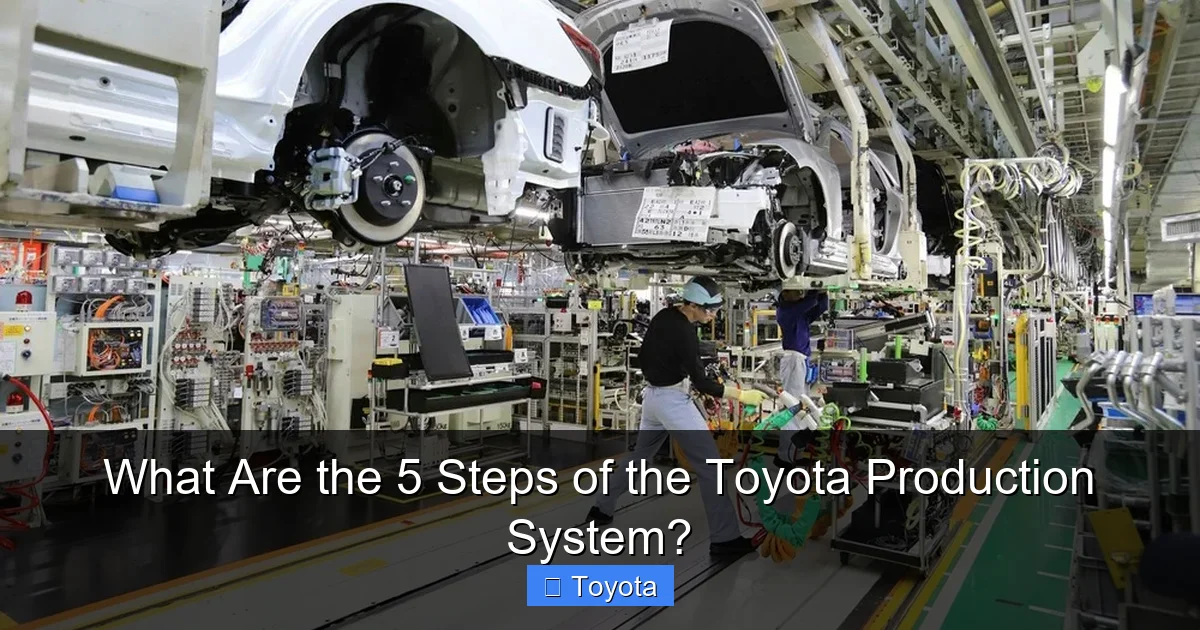
If JIT is about flow, Jidoka is about quality. The term translates to “automation,” but in the Toyota sense, it means “automation with a human touch.” It’s the principle of building machines and processes that are intelligent enough to detect a problem and stop immediately when something goes wrong. The goal is to force a problem into the open where it can be solved at its root, preventing defective products from ever moving to the next station.
Visual guide about What Are the 5 Steps of the Toyota Production System?
Image source: getit.blog
The Andon Cord: Giving Voice to the Problem
The most iconic symbol of Jidoka is the Andon—a lit display board that shows the status of each workstation. But the true power lies in the Andon cord. On every Toyota assembly line, any worker can pull a cord (or press a button) to stop the entire line the moment they detect an abnormality, defect, or safety issue. This is not a failure; it’s a sacred act of problem-solving. The team leader then rushes to that station to understand and fix the issue before production resumes. This stops the creation of hundreds of new defects and forces the organization to address the root cause.
Poka-Yoke: Mistake-Proofing
Jidoka is also implemented through poka-yoke (mistake-proofing) devices. These are simple, often inexpensive fixtures or sensors that make it impossible to make an error. For example, a fixture that only allows a part to be installed in the correct orientation, or a sensor that won’t let a machine start unless all components are present. It’s quality designed into the process, not inspected in at the end.
Practical Application & Tip
This step flips the traditional mindset. Instead of rewarding speed over perfection, TPS rewards stopping to fix problems. The cultural shift is huge. To apply Jidoka, empower your team to stop work without fear. Install simple visual controls that indicate status. Ask, “How can we make it impossible to do this wrong?” A great example is in how Toyota ensures parts compatibility; you can explore the specifics of Toyota lug nut sizes to see how standardized, mistake-proof design is applied even to small components.
Step 3: Heijunka – The Art of Production Leveling
A smooth, predictable rhythm is the dream of every manager. Heijunka is the step that creates that rhythm by leveling both the volume (how many) and mix (which models) of production over a set period. Without Heijunka, a factory is a rollercoaster: one week it’s screaming to build 1000 red sedans, the next week it’s struggling to build 500 hybrids and 200 SUVs. This whiplash causes stress, overtime, poor quality, and inefficient use of machinery.
Visual guide about What Are the 5 Steps of the Toyota Production System?
Image source: leansixsigmacanada.com
Leveling Volume and Mix
Heijunka asks: “What is the average demand?” Then it schedules a repeating, fixed sequence of production that averages out that demand. Instead of building all A models on Monday and all B models on Tuesday, you build a little of A, then a little of B, then a little of C, repeating this sequence throughout the day. This is called mix leveling. It means every process must be capable of handling all model variations quickly, which in turn forces simplification and standardization.
Volume leveling means avoiding large batch sizes. Producing in small batches (ideally one at a time) aligns perfectly with JIT and reduces the lead time from customer order to delivery.
The Heijunka Box: Visual Leveling
The tool for this is often a Heijunka box—a wall-mounted schedule with slots for Kanban cards. Each slot represents a time interval (e.g., every 15 minutes). Cards for different models are placed in the box in the predetermined leveled sequence. Workers pull cards from the box to know exactly what to build next. It’s a simple, visual production schedule that anyone can understand.
Practical Application & Tip
Heijunka is why you can walk into a Toyota dealership and often find a good mix of vehicles on the lot without extreme shortages or surpluses. It requires stable demand forecasting and flexible processes. For a business, start by analyzing your sales data to find a stable average. Then, create a repeating daily or weekly sequence that mixes your product variants. This will expose bottlenecks in your changeover processes, pushing you to make those faster—a key benefit. Understanding the range of Toyota trim levels shows the challenge and solution of mix leveling in the automotive world.
Step 4: Kaizen – The Relentless Pursuit of Improvement
Kaizen means “change for better” or “continuous improvement.” It is the engine that keeps TPS alive. The first three steps (JIT, Jidoka, Heijunka) establish an ideal state—a smooth, waste-free, high-quality flow. But reality constantly drifts away from that ideal. Kaizen is the daily, never-ending activity of closing that gap. It’s not a special event or a project led by experts; it’s the responsibility of every single person in the organization.
PDCA Cycle: The Scientific Method of Improvement
Kaizen is structured around the PDCA cycle (Plan-Do-Check-Act), also known as the Deming Cycle.
- Plan: Identify a small, specific problem or opportunity. Develop a hypothesis and a simple plan to test it.
- Do: Implement the plan on a small scale, in a controlled way.
- Check: Study the results. Did the change improve the process? What did you learn?
- Act: If successful, standardize the new method. If not, learn from the failure and plan the next experiment.
This cycle is repeated thousands of times a year at all levels. A team on the line might use PDCA to reduce the time to install a seat. A manager might use it to improve the parts ordering process.
Gemba Walks: Going to the Real Place
A key practice is the Gemba walk. “Gemba” means “the real place”—where the actual work happens. Leaders and managers regularly go to the factory floor, not to criticize, but to observe, ask questions (“What is the problem? What is the root cause?”), and learn from the people doing the work. It shows respect and grounds improvement efforts in reality.
Practical Application & Tip
To foster Kaizen, create a culture where small suggestions are celebrated. Toyota employees submit millions of improvement ideas annually. Start small: hold a weekly 15-minute meeting with your team to ask, “What annoyed you this week? How can we fix it?” Empower them to experiment. Focus on process improvement, not blaming people. Remember, the goal is not a one-time revolution, but a million small evolutions.
Step 5: Respect for People – The Unshakable Foundation
This is the most critical and often misunderstood step. Respect for People is not about being nice. It is a profound operational philosophy that recognizes your employees are your greatest asset for solving problems and creating value. Without this pillar, the other four steps become mere mechanical tools that will eventually break down under pressure. It has two core aspects: Respect and Teamwork.
Respect: Seeing and Developing Potential
Respect means taking the time to understand your colleagues, listening to their ideas, and trusting their judgment. It means providing them with the training, tools, and environment to succeed and grow. It’s the reason a worker on the line is expected to stop the production line (Jidoka) and is not punished for it. It’s why leaders do Gemba walks (Kaizen) to learn from them. It’s about valuing the person more than the short-term output.
Teamwork: Leveraging Collective Intelligence
Teamwork in TPS means breaking down silos. Engineers, production staff, quality control, and suppliers work together as a single unit to solve problems. The famous “Toyota Way” slogan is “Genchi Genbutsu” – “Go and see for yourself.” The solution to a problem is found at the Gemba with the team that does the work. Decisions are made through consensus (nemawashi), ensuring everyone understands and supports the plan, leading to faster, more effective implementation.
Practical Application & Tip
This step is the hardest to copy because it’s cultural. It requires leaders to model vulnerability, admit mistakes, and genuinely seek input. It means investing in training (like understanding what is on the Toyota assessment test to find people who fit this mindset). Start by asking for ideas and acting on the good ones, publicly crediting the source. Protect your team from blame when problems arise and focus the discussion on “What can we fix in the process?” A company that truly respects its people creates an unstoppable problem-solving machine.
How the Five Steps Interlock: The TPS House
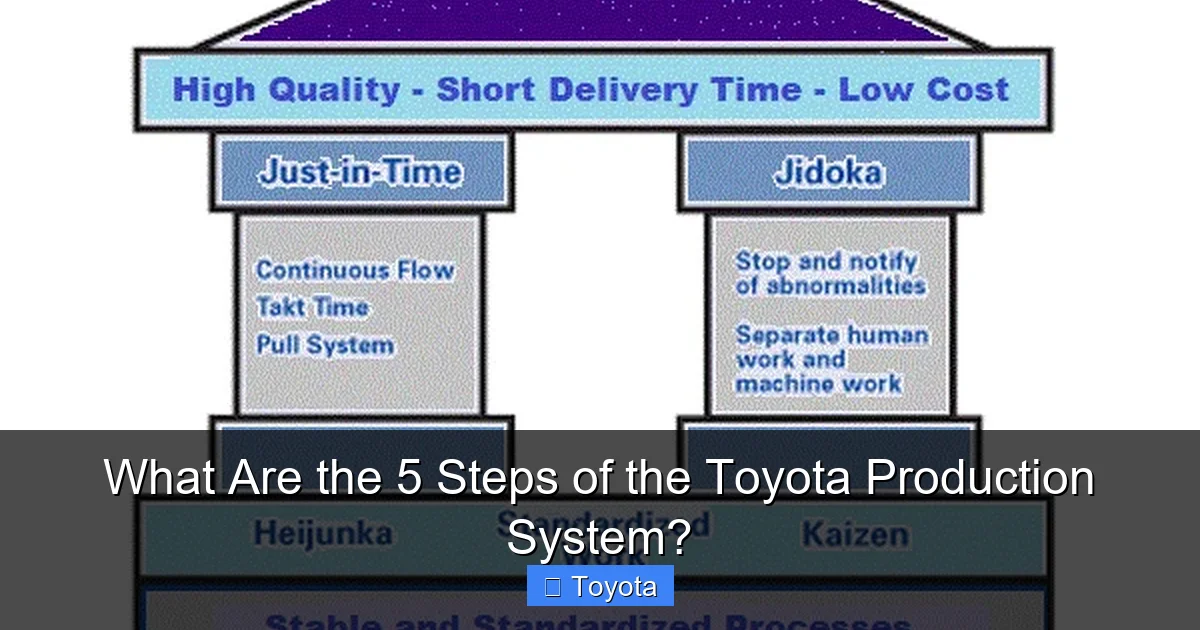
Visualize TPS as a house. The roof is the goal: Highest Quality, Lowest Cost, Shortest Lead Time, Best Safety, and Highest Morale. The two main pillars supporting the roof are Just-in-Time (the right pillar) and Jidoka (the left pillar). These are the primary operational engines. The foundation of the house is Heijunka—without a leveled schedule, JIT and Jidoka are impossible to sustain. Running through the entire house are the threads of Kaizen and Respect for People. Kaizen is the continuous effort to improve every part of the house. Respect for People is the solid, unshakeable foundation upon which everything else is built. If you weaken the foundation (disrespect people), the pillars will crumble. If you have no leveling (Heijunka), the pillars will shake under uneven load. They are a complete, interdependent system.
Conclusion: More Than a Manufacturing System
The five steps of the Toyota Production System—Just-in-Time, Jidoka, Heijunka, Kaizen, and Respect for People—form a brilliant, self-reinforcing framework for creating value with minimal waste. It’s a system born from real-world problem-solving on the shop floor, not from theoretical textbooks. Its genius lies in its simplicity and its profound respect for human ingenuity. While it revolutionized auto manufacturing, its principles are universal. Any organization that deals with processes, people, and customer demand can learn from TPS. It teaches us that excellence isn’t about a single heroic effort; it’s about the daily, disciplined practice of stopping to fix problems, smoothing out workflows, and, above all, trusting and developing the people who do the work. That is the enduring legacy of the Toyota Production System.
Frequently Asked Questions
Are the Toyota Production System and Lean Manufacturing the same thing?
They are closely related. Lean Manufacturing is essentially a Western interpretation and adaptation of TPS principles. TPS is the original, holistic system developed by Toyota, with its unique cultural foundations like Respect for People. Lean often focuses more on the tools (like Kanban, 5S) but may sometimes miss the deeper people-centric philosophy.
Can the Toyota Production System be applied to industries outside of manufacturing?
Absolutely. The core principles of eliminating waste, improving flow, and empowering people are universal. TPS concepts are successfully applied in healthcare (to improve patient flow), software development (in Agile and DevOps methodologies), logistics, retail, and even office administration.
What is the single most important step in the Toyota Production System?
>Most Toyota veterans would argue that Respect for People is the most critical. Without a foundation of trust, psychological safety, and team-based problem-solving, the other tools (Kanban, Andon) become mechanisms of control and blame, which ultimately fail. People are the system’s engine.
How long does it take for a company to fully implement TPS?
There is no “finish line.” TPS is a continuous journey, not a destination. Toyota has been refining it for over 70 years. For another company, significant cultural and operational changes can begin showing results in 1-3 years with committed leadership, but true mastery is a decades-long pursuit of Kaizen.
Does implementing TPS mean I have to stop all production to fix problems?
Not necessarily stop all production, but Jidoka (Step 2) does empower and encourage stopping a localized process when a problem is found. The goal is to fix the problem at its source immediately, which often prevents much larger, costlier stops and rework later. It’s about stopping the creation of defects, not just stopping for the sake of stopping.
Is TPS only for large corporations?
No. The principles scale beautifully. A small business or startup can implement JIT by ordering materials in smaller batches, use simple visual management (like a whiteboard Kanban), and foster a culture of Kaizen by holding short, daily team huddles to identify small improvements. The key is starting where you are with what you have.
