
What Is the Towing Capacity of a Ford F-150?

The Ford F-150’s towing capacity ranges dramatically from about 5,000 pounds to a class-leading 14,000 pounds, depending entirely on your specific configuration. This isn’t a one-number-fits-all answer; your engine choice, drivetrain, axle ratio, and towing package all play a crucial role. Understanding these variables is key to safely utilizing your truck’s full potential for everything from a small utility trailer to a large boat or RV. Always consult your official door jamb sticker for your truck’s certified ratings.
Key Takeaways
- Massive Range: Towing capacity spans from ~5,000 lbs (base V6) to 14,000 lbs (max configured), making the F-150 versatile for many needs.
- Configuration is Everything: Engine, cab/bed size, 2WD/4WD, and axle ratio combine to create your truck’s unique rating.
- Payload vs. Towing: These are separate ratings. Towing is what the truck can pull; payload is what it can carry in the bed/cabin.
- Max Capacity Requires Specific Setup: The highest ratings typically require the 3.5L EcoBoost V6, Max Trailer Tow Package, and specific axle/gvwr combos.
- Your Door Jamb Sticker is Law: The official, certified capacities for your specific VIN are on the manufacturer’s sticker inside the driver’s door.
- Real-World Capacity is Lower: Factors like passenger weight, cargo, terrain, and wind reduce your usable, safe towing capacity below the maximum.
- Safety First: Proper weight distribution, a quality hitch, and trailer brakes are non-negotiable for safe towing near any capacity limit.
📑 Table of Contents
Unlocking the Numbers: Why There’s No Single Answer
You bought, or are considering, a Ford F-150. It’s America’s best-selling truck for a reason. One of its most celebrated talents is towing. But you ask, “What is the towing capacity?” and the answer you get is frustratingly vague: “It depends.”
That’s actually the most important and honest answer. Unlike some competitors who advertise a single max number, Ford builds the F-150 in hundreds of configurations. Your truck’s ability to pull is a direct result of the exact options on your specific vehicle. Think of it like a recipe: the 3.5L EcoBoost V6 engine is a powerful ingredient, but you need the right “spices” (axle ratio, drivetrain, package) to create the highest-rated dish. A base-model XL regular cab with the smallest engine has a much different capacity than a Platinum crew cab with the high-output version of that same engine and the Max Trailer Tow Package. Our goal here is to give you the blueprint to read your own truck’s recipe and understand what it can truly do.
Decoding the Door Jamb Sticker: Your Truck’s Birth Certificate
Before we dive into general ranges, you must know where to find the definitive answer for your truck. Open the driver’s side door and look at the B-pillar or the door edge itself. You’ll find a yellow and white sticker from Ford Motor Company. This is the Vehicle Certification Label.
On this sticker, look for lines labeled GAWR (Gross Axle Weight Rating) for front and rear axles, and most importantly, GCWR (Gross Combined Weight Rating). The GCWR is the maximum allowable combined weight of your loaded truck (including passengers, fuel, and cargo) plus the loaded trailer. Your truck’s maximum towing capacity is calculated by subtracting the actual weight of your loaded truck from the GCWR. This sticker is the legal, certified limit for your specific VIN. All general charts and online figures are estimates based on common configurations; your door jamb is the final word.
The Engine Lineup: Heart of the Towing Beast
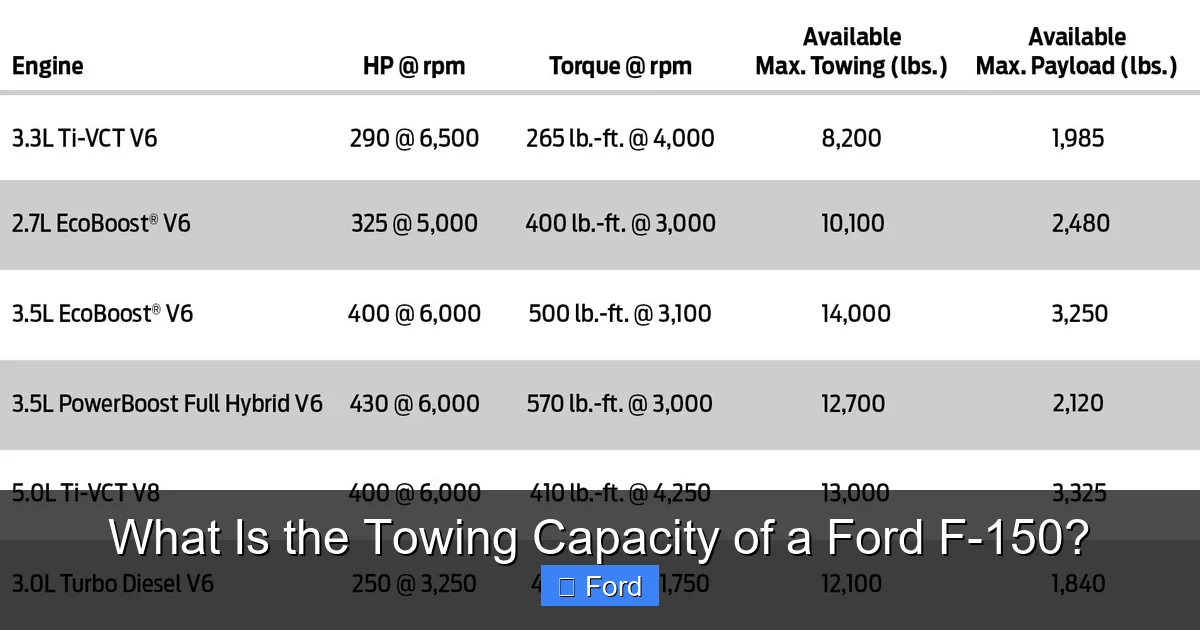
The engine under the hood is the starting point for any towing conversation. The F-150 offers several powertrains, each with a different character and ceiling. For the 2023-2024 models, the lineup looks like this:
Visual guide about What Is the Towing Capacity of a Ford F-150?
Image source: cdn.dlron.us
- 3.3L V6: The standard workhorse. Reliable and capable for light-duty tasks, with a max towing capacity typically in the 7,000-8,000 lb range when properly configured.
- 2.7L EcoBoost V6: A fantastic all-around engine. It offers strong, low-end torque and good fuel economy. With the right package, it can tow up to 9,000-10,000 lbs.
- 5.0L V8: The iconic Coyote V8 provides smooth power and a traditional feel. Its maximum towing generally lands between 10,000-13,000 lbs, especially when paired with the Max Trailer Tow Package.
- 3.5L EcoBoost V6: This is the towing leader for most model years. Its twin-turbo setup delivers massive torque. When equipped with the Max Trailer Tow Package and the correct axle, it achieves the F-150’s highest published ratings, reaching up to 14,000 lbs.
- 3.5L PowerBoost® Hybrid V6: This system combines the 3.5L EcoBoost with a hybrid electric motor. It’s incredibly efficient and, crucially, the electric motor provides instant torque for getting a heavy load moving. Its max towing is nearly identical to the non-hybrid 3.5L EcoBoost, often 12,000-13,500 lbs, with a slight edge in low-speed control and fuel economy while towing.
- 5.2L V8 (Raptor R): The supercharged monster in the Raptor R. While its focus is high-speed desert running, it’s still rated to tow around 8,700 lbs—more than enough for a toy hauler.
Pro Tip: Don’t just look at peak horsepower. For towing, torque—especially at low RPMs—is king. That’s why the turbocharged and hybrid engines excel. If you frequently tow heavy loads, test drive the different engines with a trailer to feel the torque curve.
Configuration Matters: Beyond the Engine
Choosing the right engine is step one. Step two is configuring the rest of the truck to unlock that engine’s potential. Ford uses specific packages and options to unlock higher ratings.

Visual guide about What Is the Towing Capacity of a Ford F-150?
Image source: f150lightningforum.com
The Max Trailer Tow Package: Your Golden Ticket
This isn’t just a hitch and wiring. The Max Trailer Tow Package (availability varies by engine) is a comprehensive bundle that includes:
- Heavy-duty frame and rear bumper.
- Upgraded transmission cooler.
- Engine oil cooler (on some models/years).
- Integrated trailer brake controller.
- Pro Trailer Hitch Assist (guides the hitch).
- Often, a higher numerical rear axle ratio (e.g., 3.73 or 4.10) for more pulling power.
You must select this package to achieve the published maximum towing capacities for most engines. It’s a critical upgrade that addresses cooling and drivetrain stress under heavy load. If you see a truck advertised with a high tow rating, scrutinize the window sticker to confirm this package is installed.
Cab, Bed, and Drivetrain: The Ripple Effect
Your choice of cab (Regular, SuperCab, SuperCrew) and bed (5.5′, 6.5′, 8′) affects weight distribution and overall vehicle weight. A spacious SuperCrew with a long bed is heavier than a Regular Cab with a short bed. This extra weight eats into your available payload and, by extension, your safe towing capacity (since GCWR is fixed). A heavier truck leaves less room for trailer weight before hitting the combined limit.
Drivetrain also plays a role. 4×4 models are typically about 200-300 lbs heavier than their 2WD counterparts due to the transfer case and front drivetrain components. This small weight penalty can reduce your maximum allowable trailer weight by a similar amount. For the absolute highest number, a 2WD model with a short bed and single cab is the lightest starting point.
Payload vs. Towing: The Critical Distinction
This is the most common point of confusion. Towing capacity is how much weight you can pull behind the truck. Payload capacity is how much weight you can carry in the truck—in the bed and cabin (passengers, fuel, cargo).
Visual guide about What Is the Towing Capacity of a Ford F-150?
Image source: thecartowing.com
They share a common ceiling: the Gross Combined Weight Rating (GCWR). Here’s the simple formula:
(Loaded Truck Weight) + (Loaded Trailer Weight) ≤ GCWR
Let’s say your truck’s GCWR is 20,000 lbs. Your loaded truck (with you, family, fuel, and a toolbox) weighs 6,000 lbs. Your maximum trailer weight is 14,000 lbs (20,000 – 6,000). But if you load five people and a full bed of gear, your truck weight jumps to 7,500 lbs. Now your max trailer drops to 12,500 lbs, even though the truck’s “towing capacity” on the spec sheet might say 14,000 lbs.
This is why the door jamb sticker is vital. It has the GAWR (how much each axle can hold) and GCWR. You must weigh your loaded truck (truck stops have scales) to know your true, usable towing capacity for any given trip. Overloading your truck’s payload can lead to poor handling, brake failure, and transmission damage, even if the trailer weight is under the max tow rating.
Real-World Towing: It’s Not Just a Number
The published maximum is a laboratory condition. The real world introduces variables that demand you operate well below that ceiling for safety and vehicle longevity.
The Weight of Your Actual Trailer
The spec sheet lists “trailer weight.” You must know your actual, loaded trailer weight (GTW – Gross Trailer Weight), not its empty or “dry” weight. A boat trailer with the boat, fuel, and gear on it; an RV with water, propane, and supplies; a car hauler with the vehicle—all weigh significantly more than the base trailer. Use a public scale to get this number accurately. Guessing leads to dangerous overloading.
Tongue Weight and Distribution
Tongue Weight (TW) is the downward force the trailer exerts on the hitch. It should be 10-15% of the total trailer weight for a conventional ball mount. Too little tongue weight causes trailer sway. Too much (over 15%) overloads your truck’s rear axle and reduces steering control. The Max Trailer Tow Package often includes a weight-distributing hitch setup for heavier trailers, which spreads the load across both truck axles.
Environmental and Road Factors
Mountainous terrain, high altitudes (which reduce engine power), strong headwinds, and steep grades all dramatically increase the effort required to tow. Your safe, comfortable towing capacity on a flat Texas highway at sea level is much higher than what you should attempt in the Rocky Mountains. Always derate your expectations for challenging conditions. For example, if your max is 10,000 lbs, towing 8,000 lbs up a 7% grade might feel like you’re at your limit. Speed limits while towing also vary by jurisdiction and are often lower for safety.
Practical Tips for Safe and Effective Towing
Armed with your truck’s true numbers and your trailer’s real weight, here’s how to put it all together safely.
- Use the Right Hitch: Match the hitch class to your trailer weight. A Class IV hitch is standard with the Max Trailer Tow Package for capacities over 10,000 lbs. Never use a bumper-pull hitch for a heavy trailer.
- Brake Controller is Essential: For trailers over 1,500-3,000 lbs (varies by state), electric brakes are required. The integrated controller in the Max Trailer Tow Package is excellent. Learn to adjust it properly so the trailer brakes work in harmony with the truck’s brakes.
- Check Your Mirrors and Camera: You need full visibility. Consider extended tow mirrors. The F-150’s trailer camera system (if equipped) is a game-changer for backing up.
- Perform the “Tongue Weight Test”: After hitching, push down on the rear of the truck’s bed. The rear suspension should compress slightly. If it squats dramatically, your tongue weight is too high. If the rear tires have no weight on them, it’s too low.
- Drive Smart: Allow significantly more stopping distance. Take corners wider to avoid the trailer’s “off-tracking.” Use a lower gear (like “L” or “T”) on long descents to avoid brake fade. Accelerate gently and plan passes far in advance.
- Regular Maintenance is Critical: Towing is hard on a vehicle. Adhere strictly to oil change intervals (consider more frequent changes if towing often). Check transmission fluid, coolant, and tire pressures (including the trailer’s) before every long trip.
Remember, a Ford F-150 is a powerful tool, but it has limits. Respecting those limits—by knowing your truck’s certified ratings, your trailer’s actual weight, and the conditions—is what separates a confident, safe tow from a risky one. If you’re new to towing, start with a lighter load and practice in an empty parking lot. The capability is there, but wisdom is knowing how much to use.
Frequently Asked Questions
What is the absolute maximum towing capacity for a current Ford F-150?
For the 2023 and 2024 model years, the maximum published towing capacity is 14,000 pounds. This is achieved only with the 3.5L EcoBoost V6 engine, the Max Trailer Tow Package, a 4×2 drivetrain, a Regular or SuperCab configuration with a 6.5′ or 8′ bed, and the 3.73 electronic locking rear axle. This is a best-case scenario configuration; most common crew cab setups max out between 12,000-13,000 lbs with the same engine.
How does the Ford F-150’s max towing compare to a Nissan Frontier?
The Ford F-150’s maximum towing capacity (up to 14,000 lbs) is significantly higher than that of a midsize truck like the Nissan Frontier, which maxes out around 6,720 lbs. The F-150 is a full-size truck with larger engine options and heavy-duty frames designed for serious towing, while the Frontier is a capable midsize for lighter trailers and boats.
My F-150 has the 5.0L V8. What’s a realistic max trailer weight I should plan for?
>While the 5.0L V8 can be rated up to 13,000 lbs with the Max Trailer Tow Package, a realistic and comfortable maximum for a typical daily-driven crew cab would be in the 9,000 to 11,000 lb range. This accounts for the weight of passengers, cargo, and a safety margin. Always calculate based on your loaded truck’s weight subtracted from your GCWR, not just the published max.
Does a shorter bed give me more towing capacity?
Indirectly, yes. A shorter bed (like 5.5′ on a SuperCrew) makes the truck lighter than the same cab with a long bed (6.5′ or 8′). Since your Gross Combined Weight Rating (GCWR) is fixed, a lighter starting truck weight allows for a heavier trailer. So, for the absolute highest number, a short-bed configuration is beneficial. The difference is usually a few hundred pounds of potential trailer weight.
What’s the single most important thing to check before buying a used F-150 for towing?
Find the door jamb sticker and verify the truck has the Max Trailer Tow Package (look for the trailer brake controller and hitch). Also, check the GVWR and GCWR numbers. A used truck may have aftermarket parts or modifications that don’t change the legal ratings. The sticker tells you the truck’s certified limits, regardless of what the previous owner claimed. You can also check values for older models like a 2007 F-150 to see if the price aligns with the towing package and overall condition.
Can my F-150 with the base V6 tow a large RV or boat?
It depends entirely on the weight. A base 3.3L V6 F-150 might be rated to tow around 7,000 lbs. Many large travel trailers and boats exceed 10,000 lbs. You must know the loaded weight of your specific trailer. If it’s over your truck’s certified capacity, you cannot legally or safely tow it, regardless of how “easy” it seems to pull on flat ground. Overloading strains the engine, transmission, and brakes and is extremely dangerous.