
How Long Will a Toyota Corolla Cvt Transmission Last?

The Toyota Corolla CVT transmission is designed for longevity, with many owners reporting 150,000 to 200,000 miles of reliable service with proper maintenance. Its durability stems from Toyota’s engineering and robust cooling systems, but neglecting fluid changes or aggressive driving can significantly shorten its life. Understanding its unique mechanics and adhering to a strict service schedule is key to maximizing its lifespan.
If you own a Toyota Corolla with a Continuously Variable Transmission (CVT), or you’re considering buying one, one question is likely top of mind: “How long will this transmission actually last?” It’s a valid concern. The CVT, with its stepless design, is different from the traditional automatic transmissions many of us grew up with. This difference has sparked debates, rumors, and worries about long-term durability. Let’s cut through the noise. This isn’t about speculation; it’s about real-world engineering, owner experiences, and the concrete steps you can take to ensure your Corolla’s CVT serves you faithfully for the long haul.
The short answer is encouraging: a well-maintained Toyota Corolla CVT transmission can easily last 150,000 to 200,000 miles or more. Many owners report even higher figures. But that “well-maintained” part is the crucial key that unlocks that potential. To understand why this is achievable, we need to peel back the layers and see what makes this transmission tick, what its weak points are, and exactly what you must do to protect your investment.
Key Takeaways
- Designed for Longevity: Toyota engineers the Corolla’s CVT for high reliability, targeting 150,000+ miles under normal use with proper care.
- Fluid is Critical: Regular CVT fluid changes (every 60,000-100,000 miles) are the single most important factor for preventing premature wear and failure.
- Driving Style Matters: Aggressive driving, constant high RPMs, and frequent towing place excessive stress on the CVT’s belt/pulley system.
- Cooling is Key: An efficient transmission cooler prevents fluid breakdown; issues here are a common root cause of CVT problems.
- Not Inherently Flawed: While early CVTs had concerns, Toyota’s K120/K310 series in modern Corollas has a solid reliability track record compared to some competitors.
- Listen for Warning Signs: Symptoms like slipping, shuddering, delayed acceleration, or unusual noises warrant immediate professional diagnosis.
- Maintenance Trumps Mileage: A well-maintained 200,000-mile CVT can outlast a neglected 100,000-mile unit; consistent service is everything.
📑 Table of Contents
- How a CVT Actually Works: It’s Not Magic, It’s Mechanics
- Real-World Longevity: What the Data and Owners Say
- The #1 Longevity Factor: Aggressive and Consistent Maintenance
- Driving Habits That Kill a CVT (And How to Avoid Them)
- Common CVT Concerns: Separating Myth from Reality
- How Does Toyota’s CVT Compare to Others? (Honda, Nissan, Subaru)
- Maximizing Your Corolla CVT’s Life: Your Action Plan
How a CVT Actually Works: It’s Not Magic, It’s Mechanics
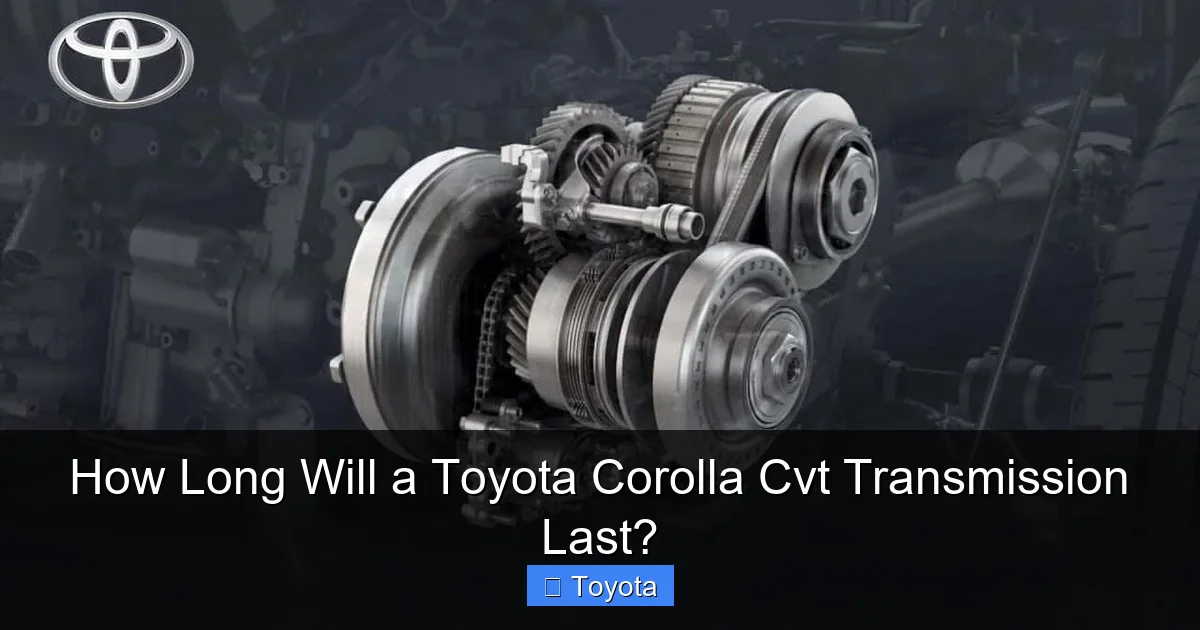
First, a quick primer. A traditional automatic transmission uses a set of fixed gears (1st, 2nd, 3rd, etc.) to change ratios. A CVT, used in Corollas since the 2014 model year (with the K310/K120 series), uses a pair of variable-width pulleys connected by a high-strength steel push belt or chain. One pulley connects to the engine, the other to the wheels. As the pulleys change their diameter, the effective gear ratio changes seamlessly, keeping the engine in its optimal power band. This design eliminates gear shifts, leading to smoother acceleration and, theoretically, better fuel efficiency.
The Heart of the System: The Push Belt and Pulleys
The genius—and the perceived vulnerability—lies in that push belt. It’s not a traditional set of gears meshing; it’s a system of metal segments riding on a set of pulleys with movable cones. The entire system operates under immense hydraulic pressure. The longevity of this system depends on one thing above all else: the condition of the CVT fluid. This specialized fluid does more than lubricate; it creates the hydraulic pressure that moves the pulleys and provides the necessary friction between the belt segments and the pulley surfaces. If the fluid degrades, loses its viscosity, or becomes contaminated, the entire system is at risk.
Real-World Longevity: What the Data and Owners Say
So, what do the numbers and real people actually show? Unlike some early adopters of CVT technology from other brands, Toyota took a cautious, engineering-heavy approach. They didn’t rush a half-baked design to market. The result is a transmission with a proven track record.

Visual guide about How Long Will a Toyota Corolla Cvt Transmission Last?
Image source: carcarehacks.com
Mileage Expectations from the Trenches
On owner forums, reliability studies, and from mechanics who see these cars daily, a clear pattern emerges:
- 150,000-200,000 Miles: This is the commonly cited, achievable range for a Corolla CVT with documented, on-schedule maintenance. Many owners on high-mileage Corolla forums proudly display their 200k+ mile odometers with the original CVT still functioning perfectly.
- 200,000+ Miles: It’s not unheard of. These are typically vehicles with exemplary maintenance histories, gentle driving, and perhaps a bit of luck. They represent the upper tier of what’s possible.
- Under 100,000 Miles (Failure): When failures happen early, the almost universal culprit is a lack of maintenance. Skipped fluid changes, using the wrong fluid, or ignoring early warning signs are the primary causes. This is not a “manufacturing defect” trend; it’s a “neglect” trend.
For comparison, the traditional 4-speed automatic in older Corollas was famously bulletproof, often exceeding 300,000 miles. The CVT’s target is slightly lower, but still exceptionally high for a modern, complex transmission. Its real competitor isn’t the old Toyota automatic; it’s its own maintenance schedule.
The #1 Longevity Factor: Aggressive and Consistent Maintenance
Let’s be blunt: your transmission’s lifespan is a direct reflection of your maintenance discipline. There is no other factor with a greater impact. The fluid is the lifeblood of the CVT system.
Visual guide about How Long Will a Toyota Corolla Cvt Transmission Last?
Image source: carbuyingandselling.com
The Sacred Fluid Change Interval
Toyota’s official recommendation for the Corolla CVT fluid is to inspect it every 30,000 miles and change it every 60,000 miles under “severe” driving conditions. “Severe” is a misleading term; for most people, it means anything short of constant highway cruising in mild weather. Stop-and-go traffic, short trips (where the fluid never fully warms up and burns off condensation), dusty environments, and towing all qualify. In practice, many independent Toyota specialists and long-term owners advocate for a 60,000-mile fluid change interval as a standard rule, regardless of driving style. Some even recommend 40,000 miles for ultimate safety, especially in hot climates.
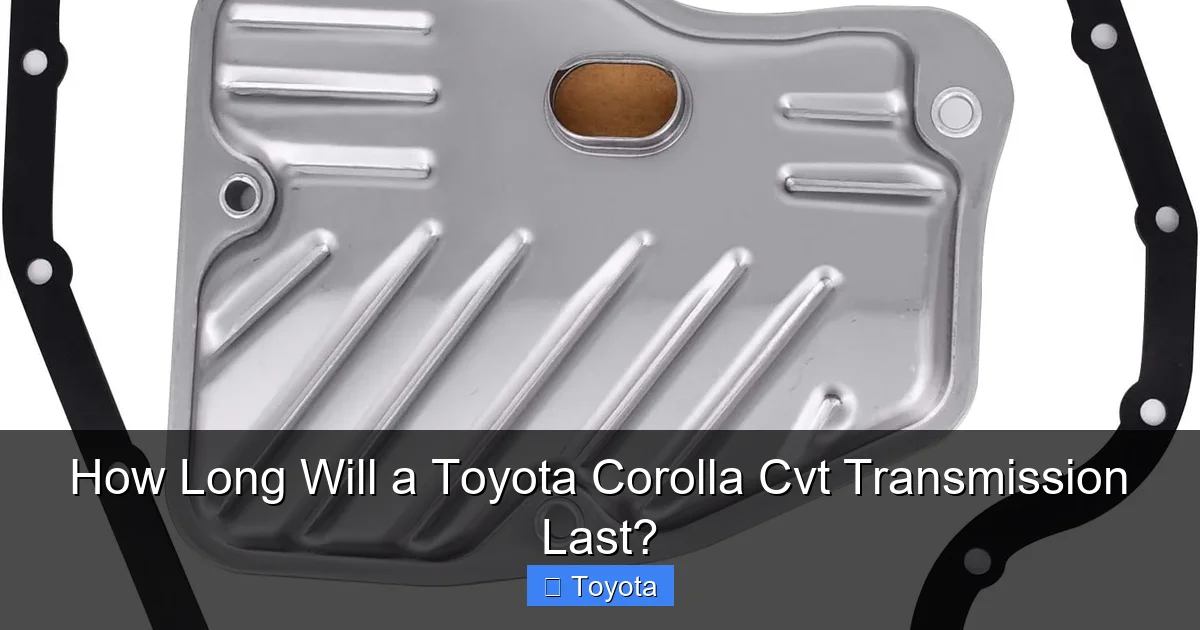
Why is this so critical? CVT fluid degrades faster than conventional automatic transmission fluid (ATF). It’s subjected to higher temperatures and shear forces within the pulleys. As it ages, its ability to maintain the precise friction coefficients needed for the belt to grip the pulleys diminishes. This leads to slippage, heat, and ultimately, catastrophic wear.
- Use ONLY Toyota Genuine CVT Fluid (WS): This is non-negotiable. Aftermarket fluids may not have the exact friction modifiers and thermal properties required. Using the wrong fluid is a fast track to destruction.
- Consider a Fluid Flush vs. Drain & Fill: A true fluid flush (using a machine to exchange nearly 100% of the old fluid) is more effective than a simple drain and fill (which only replaces about 40-50%). However, ensure the shop has specific experience with Toyota CVTs, as improper flushing techniques can introduce air or damage valves.
Driving Habits That Kill a CVT (And How to Avoid Them)
How you drive is almost as important as what you maintain. The CVT is a sophisticated piece of engineering that thrives on smoothness and hates abuse.
Visual guide about How Long Will a Toyota Corolla Cvt Transmission Last?
Image source: m.media-amazon.com
Cold-Weather and Short-Trip Abuse
Cold fluid is thick fluid. When you start your Corolla on a cold morning and immediately drive a mile to the store, the CVT fluid is still cold and viscous. It doesn’t lubricate or create hydraulic pressure as effectively. This causes increased wear during the most critical warm-up period. The solution? Let the car idle for 30-60 seconds after a cold start (not for engine warm-up, but for transmission fluid circulation), then drive gently for the first few minutes until the transmission temperature gauge (if equipped) or normal driving feel returns.
The “Manual Mode” and High-RPM Misconception
Many Corollas have a simulated “sequential shift” mode or paddle shifters. This does NOT make it a manual transmission. You are not selecting physical gears; you are telling the CVT’s computer to hold a specific ratio range. Constantly revving the engine to high RPMs (4,000-5,000 RPM) in this mode to “simulate gears” is one of the worst things you can do. It forces the belt and pulleys to operate at their extreme limits of friction and heat, accelerating wear. Use the simulated gears for engine braking on long descents or for a more responsive feel during passing, not for constant high-RPM driving.
Towing and Heavy Loads
Check your owner’s manual. Most Corolla CVT models are not rated for towing. Exceeding the maximum tow capacity (often zero or very low) is a guaranteed way to overheat the transmission and destroy it quickly. The CVT’s cooling system is designed for the car’s weight, not the additional strain of a trailer. This is a hard limit.
Common CVT Concerns: Separating Myth from Reality
You’ve probably heard the horror stories: “CVTs are all failures,” “they shudder constantly,” “they’re expensive to replace.” Let’s address these head-on in the context of the Toyota Corolla.
The Infamous “Shudder”
A vibration or shudder, particularly at low, steady speeds (like 30-40 mph on level ground), is the most commonly reported issue. This is often caused by the belt/pulley system hunting for the optimal ratio under light load, or by slight contamination/degradation of the fluid affecting friction. Important: A mild, occasional shudder is often normal. A severe, constant shudder that feels like you’re driving over rumble strips is not. The first and most effective fix is a CVT fluid change with the genuine Toyota WS fluid. In many cases, this resolves the issue completely. If it persists after a fluid change, there may be a deeper issue with a solenoid or the valve body.
Slipping and Delayed Acceleration
Feeling like the car is slow to respond or the engine revs freely without a corresponding increase in speed? This is slipping. In a CVT, this is almost always a symptom of low fluid pressure, which points directly to either critically low fluid level (leak) or severely degraded fluid. This is a red flag requiring immediate service. Ignoring it will lead to belt destruction.
Replacement Costs: The Financial Reality
Yes, replacing a CVT transmission is expensive. A factory-rebuilt unit from Toyota, including labor, can easily run $4,000 to $6,000 or more. This is a valid concern. However, this cost argument must be balanced against the statistical likelihood. For the vast majority of Corolla owners who follow the maintenance schedule, the transmission will never need replacement. The cost of preventive maintenance (a $200-$300 fluid change every 60k miles) is a fraction of a replacement cost and is the true investment in longevity. Think of it as cheap insurance.
How Does Toyota’s CVT Compare to Others? (Honda, Nissan, Subaru)
Not all CVTs are created equal. Toyota’s approach has been notably more conservative and reliability-focused than some competitors, which is great news for you.
- vs. Nissan: Nissan, particularly in the 2010s, faced widespread issues with their Jatco-sourced CVTs, especially in models like the Altima and Sentra. Failures before 100,000 miles were not uncommon due to design flaws and inadequate cooling. Toyota’s design is generally considered more robust.
- vs. Honda: Honda’s CVTs are also quite reliable, using a steel chain instead of a push belt (theoretically stronger). Their longevity is similar to Toyota’s when maintained. You can see a detailed comparison in our article on how long a Honda Civic transmission lasts.
- vs. Subaru: Subaru’s CVTs have had a more mixed reliability record, with some model years showing higher failure rates, particularly in earlier versions. Their design also relies heavily on fluid quality. For more on that, you can read about Subaru CVT longevity.
The key takeaway from these comparisons is that Toyota’s CVT has earned its reputation for reliability through a combination of robust design and a strong emphasis on prescribed maintenance. The failure stories you hear are disproportionately from brands with known design issues or from owners who skipped service.
Maximizing Your Corolla CVT’s Life: Your Action Plan
You now know the “what” and “why.” Here is the concrete “how.” Follow this checklist to give your CVT the best possible chance to reach 200,000 miles and beyond.
The Non-Negotiable Maintenance Schedule
- CVT Fluid Change: Every 60,000 miles (or every 4-5 years). Use only Toyota Genuine CVT Fluid WS. Consider a full flush at a specialist.
- Engine Coolant: Change every 100,000 miles. The transmission cooler is often integrated into the radiator. Overheated engine coolant can lead to an overheated transmission.
- Overall Vehicle Health: A neglected engine (dirty oil, failing alternator, bad spark plugs) can create excessive vibration and strain that is transmitted to the transmission. Keeping the entire powertrain healthy protects the CVT. For example, a failing serpentine belt can affect the water pump and cooling system, indirectly impacting transmission temps.
Driving Discipline
- Avoid “jackrabbit” starts and hard acceleration.
- Be gentle on the throttle when the transmission is cold.
- Use the “Sport” or manual shift mode only for tactical passing or engine braking, not for constant high-RPM driving.
- Never exceed the vehicle’s towing capacity (consult your manual).
Pre-Purchase Inspection (If Buying Used)
If you’re looking at a used Corolla with a CVT, this is critical:
- Obtain a full vehicle history report (Carfax/AutoCheck). Look for any transmission-related service records or, heaven forbid, claims.
- Have a specialist mechanic perform a pre-purchase inspection. They can check the transmission fluid condition (color, smell), scan for any stored CVT-related trouble codes, and perform a road test for shudder or slippage.
- Ask the seller directly for proof of CVT fluid changes. No paperwork? Assume it’s never been done and factor the cost of an immediate fluid change (and potential issues) into your offer.
Frequently Asked Questions
What is the average lifespan of a Toyota Corolla CVT transmission?
With proper maintenance, the average lifespan is 150,000 to 200,000 miles. Many well-maintained examples exceed this, while neglected units can fail well before 100,000 miles.
What is the most important maintenance for a Corolla CVT?
Regular CVT fluid changes are paramount. Toyota recommends inspecting every 30,000 miles and changing every 60,000 miles under severe conditions, which most drivers should follow. Using only genuine Toyota CVT Fluid WS is critical.
What are the first signs of a failing Corolla CVT?
Early signs include a noticeable shudder or vibration at steady speeds, delayed acceleration (the engine revs but the car doesn’t respond immediately), unusual whining or grinding noises, and warning lights like the “check engine” or a specific transmission warning. A burning smell can indicate overheating fluid.
Is it expensive to replace a Toyota Corolla CVT?
Yes, it is a major repair. A factory-rebuilt transmission with labor typically costs between $4,000 and $6,500. This high cost underscores why strict adherence to the fluid change schedule is the most cost-effective “insurance” policy you can buy.
Does using manual mode or paddle shifters damage the CVT?
Occasional use for engine braking or responsive passing is fine. However, constantly driving in manual mode and holding high RPMs (4,000+) to simulate traditional gear shifts forces the belt/pulley system to operate under extreme stress and heat, accelerating wear and potential damage.
How does the Toyota Corolla CVT compare to Honda’s CVT for reliability?
Both brands’ CVTs are considered among the most reliable on the market when maintained. Honda uses a steel chain design, while Toyota uses a push belt. Real-world longevity and failure rates are very similar, with both significantly outperforming earlier CVTs from brands like Nissan or some Subaru models when serviced correctly.
