
Where to Add Transmission Fluid in a Ford F-150

Adding transmission fluid to your Ford F-150 is a critical maintenance task that varies by model year and transmission type. For trucks with a dipstick, you’ll add fluid through the tube after checking the level with the engine warm and running. For newer sealed models, fluid is added via a service plug under the truck, often requiring a professional mechanic. Always use the correct fluid type—Mercon or Mercon LV—to prevent catastrophic damage.
Let’s talk about your Ford F-150’s lifeblood: transmission fluid. You know you need to check the oil, maybe even the coolant, but transmission fluid? That’s often the forgotten fluid until a problem screams for attention. Your F-150 is a workhorse, built to haul and tow, and its transmission takes a brutal beating. Keeping the fluid at the perfect level and using the right type is arguably more important than engine oil for the long-term health of that expensive gearbox. But here’s the kicker: where to add transmission fluid in a Ford F-150 isn’t a one-size-fits-all answer. The location changed dramatically over the years, and getting it wrong can mean pouring money down the drain—or directly into your transmission. This guide will walk you through exactly where to find it for your specific model year, what to put in it, and how to do it without turning your driveway into a disaster zone.
Key Takeaways
- Location Varies Drastically: Pre-2017 F-150s typically use a dipstick under the hood, while 2018+ models with 10-speed transmissions use a sealed system with a service plug underneath the vehicle.
- Fluid Type is Non-Negotiable: Using the wrong fluid (e.g., Dexron, generic “universal” fluid) can destroy your transmission. Older F-150s need Mercon; newer ones require Mercon LV.
- Never Overfill: Overfilling is as dangerous as running low. It causes aeration, foaming, and can lead to erratic shifting and internal damage. Add slowly and check frequently.
- Sealed ≠ Maintenance-Free: “Lifetime” sealed transmissions still require fluid checks and changes at high mileage. The service plug method is for adding fluid, not routine checking.
- Check for Leaks First: If fluid is low, you have a leak. Adding fluid is a temporary fix. Inspect the pan gasket, seals, and cooler lines immediately.
- Warm Engine, Level Ground: Always check and add fluid with the engine at operating temperature and the truck parked on a perfectly level surface for an accurate reading.
- When in Doubt, Seek Help: If you cannot locate the dipstick/service plug, are unsure of the fluid type, or lack the tools, consult a professional. Transmission repairs are extremely costly.
📑 Table of Contents
- Understanding Your F-150’s Transmission: It’s Not All the Same
- Locating the Dipstick or Fill Plug: A Model Year Treasure Hunt
- Step-by-Step: Adding Fluid Through the Dipstick (The “Easy” Way)
- The Service Plug Method: Dealing with a “Sealed” Transmission
- Fluid Type and Capacity: What to Put In Your F-150
- Common Mistakes That Cost Thousands
- Signs Your F-150 Needs Transmission Fluid Attention
- Conclusion: Proactive Care for Your Powertrain
Understanding Your F-150’s Transmission: It’s Not All the Same
Before we hunt for a dipstick or a plug, you need to know what you’re dealing with. Ford has used a wide array of transmissions in the F-150 over the last two decades, and the design philosophy around fluid maintenance changed with them. The biggest dividing line is the model year.
The Great Dipstick Divide (Pre-2018)
If your F-150 is a 2017 model or older, chances are high it has a traditional transmission fluid dipstick. This is the familiar, yellow or red-handled stick you pull, wipe, reinsert, and pull again to check the level. These transmissions, like the 4R75E, 4R70W, or the 6-speed 6R80, were designed for owner service. The dipstick tube is also your fill point. You simply add fluid through it with a funnel. This system is straightforward and user-friendly.
The Sealed Revolution (2018 and Onward)
Starting with the 2018 model year, Ford introduced the 10-speed 10R80 transmission as the primary option in most F-150s. With it came a major shift: the elimination of the traditional dipstick. Ford termed these “sealed for life” transmissions, meaning there is no under-hood dipstick for routine checks. Fluid level is checked and adjusted via a service plug on the transmission pan itself, located underneath the truck. This is a massive shift. While Ford’s “sealed for life” claim is debated by mechanics (many recommend fluid changes at 100k-150k miles), the method for adding fluid is completely different and often requires the truck to be lifted and the transmission brought to a specific temperature.
It’s crucial to identify your transmission. You can find the exact model on a sticker on the driver’s door jamb or in your owner’s manual. This single piece of information dictates your entire process for adding fluid.
Locating the Dipstick or Fill Plug: A Model Year Treasure Hunt
Now, let’s get our hands dirty—or at least our eyes. Where exactly is this thing? The location depends entirely on your truck’s generation and transmission type.
Visual guide about Where to Add Transmission Fluid in a Ford F-150
Image source: i.ytimg.com
For Trucks WITH a Dipstick (Generally 2017 and Older)
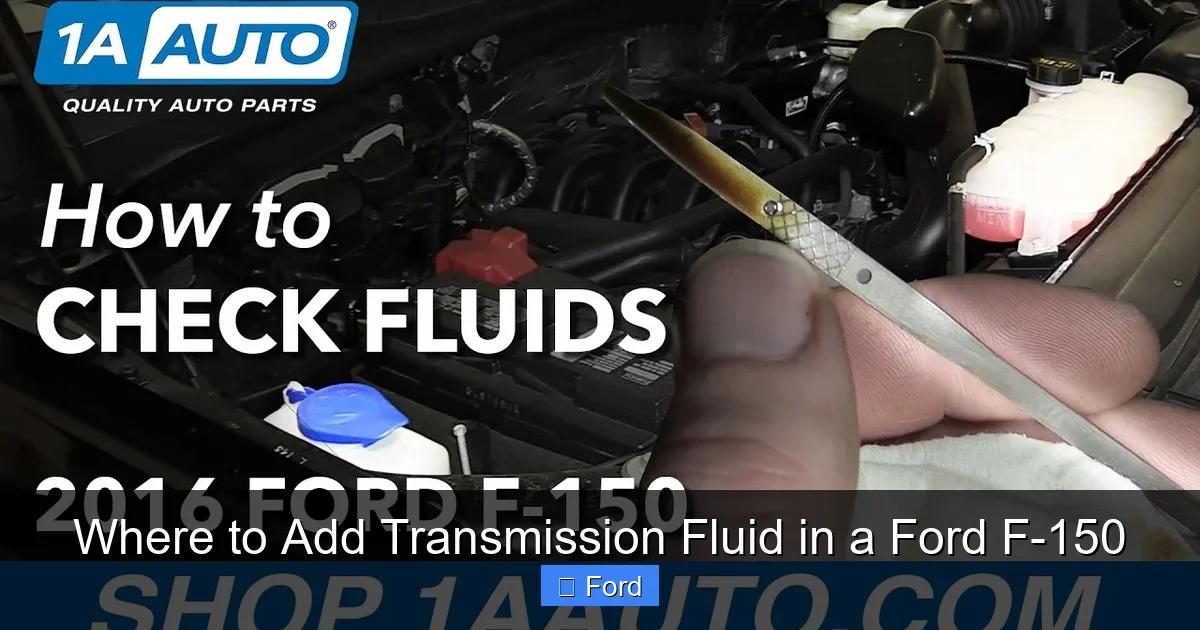
Open the hood and look toward the back of the engine bay, near the firewall. The dipstick is usually a bright color—often red, yellow, or orange—and has a handle that says “Transmission” or is labeled with an icon. On many F-150s, it’s on the passenger side, tucked in near the bellhousing of the transmission. It’s a single tube, separate from the engine oil dipstick (which is usually yellow). Pro Tip: With the engine running and warmed up, the dipstick will be hot. Use a rag and be careful. If you’re struggling, a quick search for “[Your Year] F-150 transmission dipstick location” will yield countless photos and videos. Knowing where to add transmission fluid in a Ford F-150 with a dipstick is the easy part; the hard part is doing it correctly.
For Trucks WITHOUT a Dipstick (2018+ with 10-Speed)
You will not find a dipstick under the hood. The fill point is a plug on the transmission pan itself. To access it, you’ll need to get under the truck. The 10R80 transmission pan is large and rectangular, located directly below the engine’s rear. On the pan, there is a small, square-headed plug (often a 8mm or 10mm bolt) that is the level check/fill plug. There is also a larger drain plug. Do not confuse the two. The fill plug is typically on the side or rear of the pan, not the bottom. You will likely need ramps, jack stands, or a lift to safely access it. This is not a job for a flat, urban driveway without proper equipment.
This fundamental difference means the answer to “where to add transmission fluid in a Ford F-150” splits into two completely different procedures. You must know your truck’s transmission before proceeding.
Step-by-Step: Adding Fluid Through the Dipstick (The “Easy” Way)
For the lucky owners of pre-2018 models, this is a simple DIY task. But “simple” doesn’t mean you can be careless.

Visual guide about Where to Add Transmission Fluid in a Ford F-150
Image source: helpfulfix.com
Preparation is 90% of the Job
First, park your F-150 on a perfectly level surface. Engage the parking brake. Start the engine and let it idle until it reaches normal operating temperature—this means the temperature gauge is at its normal running position, usually after 10-15 minutes of driving or idling. With the engine still running, shift through all the gears (P, R, N, D, 2, 1) and finally back to Park. This ensures the transmission is cycled and the fluid is distributed. This step is critical for an accurate reading. Now, with the engine at idle, pull the dipstick, wipe it clean with a lint-free rag, fully reinsert it until it seats, and then pull it out again to read the level.
Reading the Dipstick and Adding Fluid
The dipstick will have markings for “Cold” and “Hot” or “ADD” and “FULL.” Since you checked it hot, use the hot marks. The fluid should be between the two notches or lines, with the “Full” mark being the absolute maximum. If it’s below the “Add” line, you need to add fluid. Do not overfill. Use a long-neck funnel that fits snugly into the dipstick tube. Pour in the recommended fluid (see next section) in small increments—half a quart at a time. After each addition, start the engine, cycle the gears as before, and re-check the dipstick. It can take a moment for the fluid to settle in the pan. Patience prevents disaster. Stop as soon as the level reaches the “Hot Full” mark. Replace the dipstick firmly.
This process is straightforward, but the margin for error is small. Overfilling by even a quart can cause severe problems.
The Service Plug Method: Dealing with a “Sealed” Transmission
For 2018+ F-150 owners, the process is entirely different and significantly more involved. This is often considered a professional job, but with the right tools and extreme caution, it can be done at home.
Visual guide about Where to Add Transmission Fluid in a Ford F-150
Image source: helpfulfix.com
The Critical Importance of Temperature
The 10R80 transmission fluid level is extremely sensitive to temperature. The fluid expands as it heats. The standard procedure requires the transmission fluid to be at a specific temperature, usually between 104°F and 122°F (40-50°C), for an accurate fill. This means you cannot just check it cold. You must drive the truck to get the fluid hot, but not scorching. Some advanced DIYers use an OBD2 scanner that reads transmission temperature (PID 0x0A or similar). Without this tool, you’re guessing, which is risky. The official procedure involves a “fill and check” method where you add fluid via the service plug until it just begins to drip out, then re-check after a short drive cycle.
The Physical Process
1. Safety First: Secure the truck on level ground using jack stands on solid frame rails. Never work under a vehicle supported only by a jack. Chock the wheels.
2. Locate the Service Plug: Find the square-headed plug on the side of the transmission pan. It’s often a 8mm or 10mm bolt. The drain plug is in the center/bottom of the pan.
3. Remove the Plug: Place a drain pan underneath. Carefully remove the service plug with a socket. Fluid may drip immediately if the transmission is overfull or at temperature.
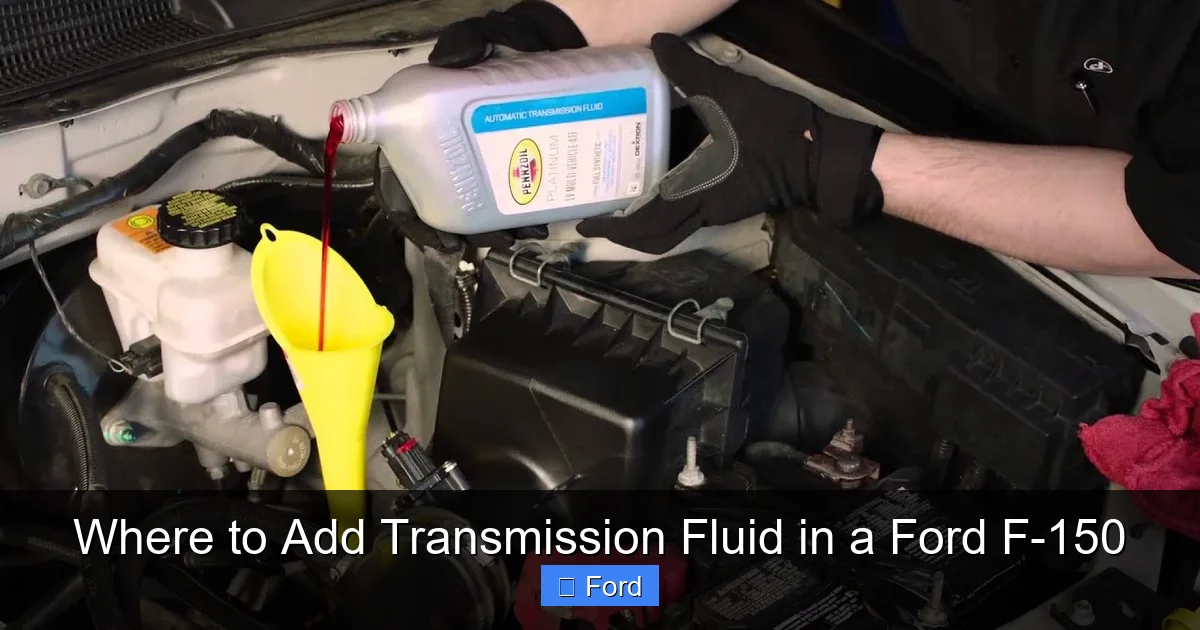
4. Add Fluid: Using a specialized transmission fluid pump or a squeeze bottle with a long nozzle, slowly add the correct Mercon LV fluid through the hole. Add until fluid begins to seep out steadily from the hole. This indicates the transmission is full.
5. Reinstall the Plug: Clean the plug and threads, apply a thin layer of sealer if required (consult manual), and torque it to specification (usually 20-30 lb-ft).
6. Test and Re-check: Lower the truck, start the engine, and perform a drive cycle. After a short drive, bring the transmission up to temperature again (using your scanner if possible), return to level ground, and re-check the plug. It may need a small top-off.
This is complex. A mistake in torque, temperature, or fluid type can lead to slippage or failure. For most owners, this is a job for a transmission shop. They have lifts, scanners, and experience. If you attempt it, invest in a quality fluid temperature scanner and follow a verified guide for your specific year and cab configuration.
Fluid Type and Capacity: What to Put In Your F-150
Using the wrong fluid is a silent killer. It’s not like engine oil where “any 5W-30” might work in a pinch. Transmission fluids are chemically engineered for specific materials and clutch packs.
Decoding Mercon: It’s Not All the Same
Ford’s specification is called Mercon. However, there are different generations. For F-150s from 2004-2017 (with 4-speed, 5-speed, or 6-speed automatics), you need Mercon ATF. This is the red, Dexron-compatible fluid. For the 2018+ models with the 10-speed 10R80, you must use Mercon LV ATF. LV stands for “Low Viscosity.” It is a different formulation. Do not use Mercon in a 10R80, and do not use Mercon LV in older transmissions. The two are not interchangeable. If you have a 2017 F-150 with the 6-speed 6R80, it still uses standard Mercon, not LV. Your owner’s manual is the final authority. When in doubt, check the dipstick tube or service plug cap—it often lists the specification. Using the wrong fluid will cause slipping, harsh shifts, and eventual failure. This is non-negotiable.
How Much Fluid Does It Hold?
Capacity varies by transmission and whether you’re doing a simple top-off or a full drain-and-fill. For a simple “add to correct level” job, you’ll rarely need more than 1-2 quarts. A complete drain and refill (which involves dropping the pan) typically requires:
– 4R70W/4R75E (4-speed): ~10-12 quarts
– 6R80 (6-speed): ~13-14 quarts
– 10R80 (10-speed): ~13-14 quarts
Remember, when adding via dipstick or service plug, you are not draining the old fluid. You are simply bringing the level back to spec. A full fluid change is a separate, more involved process that requires a new filter and pan gasket for most models.
Common Mistakes That Cost Thousands
We’ve all been there: a little low, so we top it off. But transmission fluid is unforgiving. Here are the pitfalls to avoid.
Overfilling: The Silent Killer
This is the #1 mistake. Transmission fluid does not compress. When the transmission’s internal parts (pump, gears, clutch packs) churn through an overfilled sump, they aerate the fluid, creating foam. Foamy fluid cannot maintain hydraulic pressure. The result? Slipping gears, delayed shifts, erratic behavior, and ultimately, overheating and destruction. Add fluid in half-quart increments, checking constantly. It’s better to be slightly low than overfull.
Using the Wrong Fluid or “Universal” Fluid
As stressed, Mercon vs. Mercon LV is a hard line. “Universal” ATF is a gamble. It might work for a while, but it will likely degrade the specific friction materials in your Ford clutches, leading to slippage. Stick to genuine Ford Mercon or a high-quality equivalent from brands like Castrol or Pennzoil that explicitly states “For Ford Mercon” or “For Ford Mercon LV” applications.
Ignoring the Root Cause: Leaks
If your fluid is low, you have a leak. Common leak points on F-150s include the transmission pan gasket (especially on high-mileage trucks), the input/output shaft seals, and the cooler lines where they connect to the radiator. Adding fluid is a temporary band-aid. You must find and repair the leak, or you’ll be back in the same spot in weeks, and running low on fluid will destroy the transmission.
Checking Cold or on a Slope
Checking fluid with a cold engine or on an incline gives a falsely high reading. You might think it’s full, drive away, and be two quarts low. Always, always follow the warm, level, engine-running procedure for dipstick models. For sealed models, temperature control is even more critical.
Signs Your F-150 Needs Transmission Fluid Attention
You shouldn’t wait until you’re hunting for the dipstick to think about fluid. These symptoms mean you should check the level immediately.
Slipping, Hesitation, or Hard Shifts
Does the engine rev high before the truck accelerates (slipping)? Does it shift with a bang or delay? Low fluid or degraded fluid is a prime suspect. Hydraulic pressure is too low to hold clutches firmly.
Transmission Whine or Clunk Noises
A new whining or howling noise that changes with engine speed can indicate low fluid. A clunk when shifting into gear can also be fluid-related.
Transmission Fluid Leak
Spotting reddish or brownish fluid under the center of your truck is a clear sign. Get it checked. A small leak can become a catastrophic failure quickly.
Burnt Smell or Dark Fluid
If your fluid smells burnt (like toasty oil) or is very dark brown/black instead of bright red, it has overheated and broken down. This requires a fluid and filter service, not just a top-off.
If you experience any of these, check the fluid level first. For sealed models, a trip to a shop for a diagnosis is the first step.
Conclusion: Proactive Care for Your Powertrain
Knowing where to add transmission fluid in a Ford F-150 is a fundamental piece of ownership knowledge that can save you from a $5,000+ transmission rebuild. For pre-2018 models, it’s a simple DIY task that should be part of your regular fluid check routine (every 3-6 months or with oil changes). For 2018+ models, understand that the “sealed” system is not a “set and forget” system. It requires professional attention for level checks and fluid changes at recommended intervals. The single most important rule is this: use only the exact fluid specified for your transmission model and year. Combine that with the correct procedure, a level surface, and a warm engine, and you’ll keep your F-150’s transmission shifting smoothly for hundreds of thousands of miles. When in doubt, consult your owner’s manual or a trusted mechanic. Your transmission will thank you.
Frequently Asked Questions
Where is the transmission fluid dipstick on a 2015 Ford F-150?
On a 2015 F-150 (and most 2009-2017 models), the dipstick is located in the engine bay on the passenger side, near the firewall. It’s typically a red or yellow handled dipstick separate from the engine oil dipstick. The engine must be running and warmed up to check the level accurately.
Can I add transmission fluid to a 2020 Ford F-150 at home?
Technically yes, but it’s very difficult and risky. The 2020 F-150 uses a sealed 10-speed transmission. Fluid must be added via a service plug underneath the truck, and the fluid must be at a precise temperature (around 110°F). Without a scan tool to read transmission temperature and a lift to safely access the plug, you can easily overfill or underfill, causing damage. Most owners should have a professional shop perform this service.
What happens if I overfill transmission fluid in my F-150?
Overfilling causes the fluid to aerate (turn to foam) as the transmission’s internal parts churn through it. Aerated fluid cannot maintain hydraulic pressure, leading to slipping gears, harsh or delayed shifts, and overheating. This can cause rapid internal wear and eventual transmission failure. Always add fluid slowly and in small increments.
How do I know if my F-150 needs more transmission fluid?
First, check the level properly (warm engine, level ground, correct procedure for your model year). Low fluid may cause symptoms like slipping, delayed engagement, a burning smell, or visible leaks. However, a low level means there is a leak that must be repaired. Simply adding fluid is a temporary fix.
Is transmission fluid the same as engine oil or power steering fluid?
Absolutely not. They are chemically different fluids designed for specific systems. Transmission fluid is an hydraulic oil with special friction modifiers. Engine oil is designed for lubricating metal-on-metal contact in an engine. Power steering fluid is a different hydraulic fluid. Using the wrong fluid in your transmission will cause immediate and severe damage.
Can I use Dexron or other “universal” ATF in my Ford F-150?
No. Ford transmissions require fluids meeting the Mercon specification. Older F-150s (pre-2018) need Mercon ATF. Newer models (2018+ with 10-speed) require Mercon LV ATF. Dexron is a General Motors specification and is not compatible with Ford’s clutch materials. Universal ATFs are a gamble and often lead to slippage. Always use fluid that specifically states it meets Ford’s Mercon or Mercon LV specification.
