
Why Doesn’t Toyota Recommend Transmission Fluid Changes?

Toyota often states that its transmission fluid is “lifetime” and doesn’t require changing, a policy based on engineering for warranty-period reliability under ideal conditions. However, this “lifetime” typically aligns with the vehicle’s warranty term (e.g., 60k-100k miles), not the engine’s full lifespan. In reality, severe driving, towing, and extreme temperatures degrade fluid over time, meaning proactive changes beyond the warranty period can prevent costly transmission repairs and extend service life significantly.
You bought your Toyota. It’s the reliable one, right? The car that promises trouble-free motoring for years. Then you crack open the owner’s manual, ready to be a diligent owner, and you see it: the transmission fluid is listed as “lifetime.” No miles. No years. Just… lifetime. What gives? Why would the company famous for reliability tell you to ignore one of the most critical fluids in your car? It sounds like a dream—set it and forget it. But is it too good to be true? The answer is a firm “yes” and “no,” wrapped in engineering jargon, warranty definitions, and a dash of marketing savvy. Let’s pop the hood and see what’s really going on with Toyota’s controversial “no-change” transmission fluid policy.
Key Takeaways
- The “Lifetime” Myth: “Lifetime” fluid refers to the warranty period (often 60k-100k miles), not the literal lifetime of the car. It’s a warranty coverage term, not a maintenance-free guarantee.
- Engineering for the Average: Toyota designs its transmissions and fluid to withstand typical, non-severe driving conditions for the warranty duration, prioritizing reliability within that specific timeframe.
- Sealed = No Dipstick, Not No Maintenance: Many modern Toyotas have sealed transmissions without a dipstick, which complicates checking but does not mean the fluid never degrades or needs service.
- Severe Service Shortens Fluid Life: Frequent short trips, extreme heat/cold, mountain driving, and towing dramatically increase thermal stress and oxidation, making fluid changes necessary long before a failure.
- Prevention is Cheaper Than Repair: A transmission fluid change (often $150-$300) is a fraction of the cost of a transmission rebuild or replacement ($3,000-$5,000+), making it a smart long-term investment.
- Check Your Manual, Then Think Beyond It: Your owner’s manual is the final authority for warranty compliance, but for keeping a car past 150,000 miles, independent research and mechanic advice are crucial for informed decisions.
- Not All Toyotas Are the Same: Models like the Camry and RAV4 with traditional automatics may have different longevity characteristics than early CVTs or heavy-duty trucks like the Tundra, which face different stresses.
📑 Table of Contents
- The “Lifetime” Label: A Warranty Term, Not a Magic Spell
- The Engineering Philosophy: Toyota’s Bet on Quality and Sealed Systems
- Warranty Period vs. Real-World Lifespan: The Great Divide
- Signs It’s Time to Ignore the Manual and Change the Fluid Anyway
- Practical Recommendations: A Middle Path for Smart Owners
- Conclusion: A Partnership Between You and Your Toyota
The “Lifetime” Label: A Warranty Term, Not a Magic Spell
The confusion starts with that single, powerful word: “lifetime.” When Toyota (and other manufacturers) says its transmission fluid is “lifetime,” it is not referring to the lifetime of your 200,000-mile dream. It is a specific, legally defined term tied to the vehicle’s warranty. In most cases, that “lifetime” is the power train warranty period—typically 60 months or 60,000 miles, whichever comes first, and sometimes extended to 100,000 miles for the original owner. The manufacturer is essentially saying: “We have engineered this transmission and filled it with a specially formulated fluid that, under normal operating conditions, will not fail due to fluid degradation within the warranty period. If it does, it’s on us.”
What “Normal Operating Conditions” Really Means
This is the critical, often overlooked, fine print. “Normal” in engineering terms is a controlled laboratory scenario. Think: constant highway speeds, ambient temperatures around 70°F (21°C), no heavy loads, no stop-and-go traffic. The real world is nothing like this. Your daily commute with 20 red lights, a summer road trip through the desert towing a trailer, or shuttling kids in winter with the heater blasting and the transmission working harder to warm up—all of this is “severe” or “heavy-duty” service by the manual’s definition. If you operate your Toyota in these common, real-world conditions, the fluid is oxidizing, breaking down, and losing its protective properties long before the warranty expires. The “lifetime” guarantee evaporates the moment you drive off the lot under anything less than ideal conditions.
The Engineering Philosophy: Toyota’s Bet on Quality and Sealed Systems
To understand Toyota’s stance, you have to think like an engineer. Their goal is to create a product that meets a target: 100,000 miles of trouble-free operation for the average user. To hit that target, they employ two key strategies: superlative fluid and a sealed system.
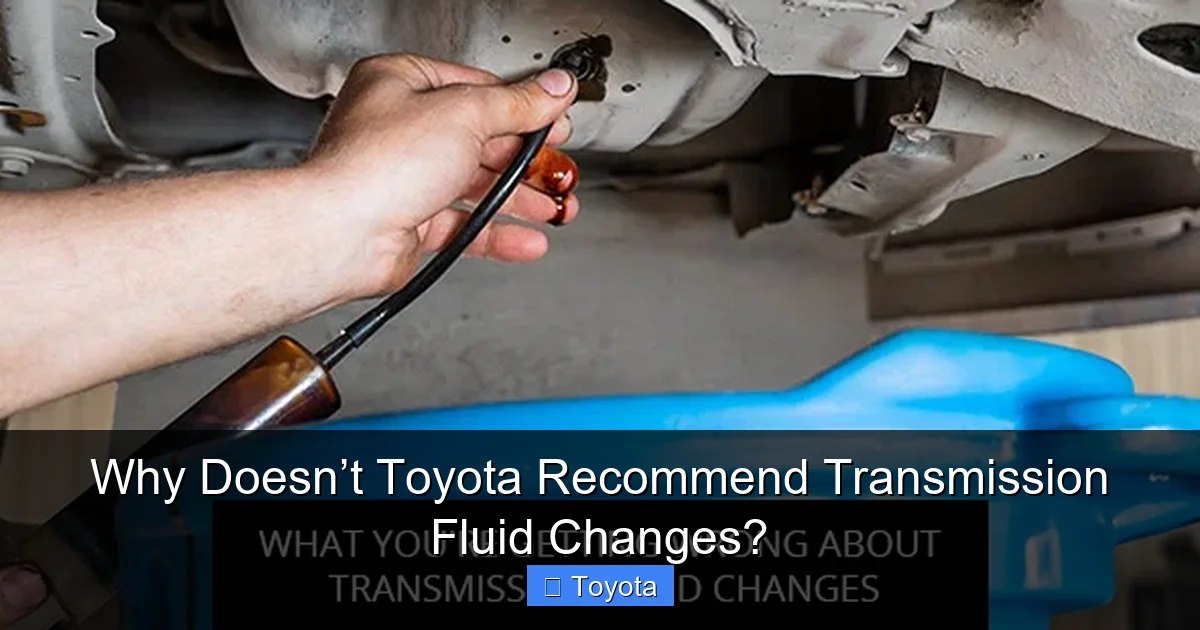
Visual guide about Why Doesn’t Toyota Recommend Transmission Fluid Changes?
Image source: mistertransmission.com
1. Superior Synthetic Fluid Formulations
Toyota doesn’t use generic, off-the-shelf transmission fluid. They work closely with suppliers like Idemitsu (a major partner, as detailed in our article on who makes Toyota transmission fluid) to develop proprietary fluids like Toyota WS (World Standard) for most automatics and CVT FE for their Continuously Variable Transmissions. These fluids are engineered for exceptional shear stability (resistance to thinning under friction), high oxidation resistance, and precise frictional properties required by their specific clutch packs and gears. The initial fill is a high-grade product designed to last a long time under the “normal” conditions defined above.
2. The “Sealed for Life” Transmission
To complement the long-life fluid, Toyota (and the industry trend) moved to sealed transmissions. By eliminating the dipstick and fill tube, they accomplish several things: it prevents accidental overfilling or contamination by well-meaning owners using the wrong fluid; it reduces potential leak points; and it creates a closed, controlled environment. From a manufacturing and warranty perspective, a sealed system with no user-serviceable parts is simpler. If nothing can be tampered with or incorrectly serviced, there’s one less variable for them to troubleshoot under warranty. It’s a design that pushes responsibility for long-term maintenance squarely onto the manufacturer for the warranty period, after which the design philosophy assumes the vehicle may be retired or sold.
This combination—top-tier fluid and a closed system—is a powerful bet. For the first 60,000-100,000 miles, for many drivers, it will likely be fine. And that’s the number that matters for their warranty statistics and reliability ratings. But is it the optimal strategy for a vehicle you plan to drive for 200,000 miles? That’s where the debate begins.
Warranty Period vs. Real-World Lifespan: The Great Divide
Here is the fundamental disconnect. Toyota’s engineering target and warranty obligation align at the 100,000-mile mark. The average new car ownership in the U.S. is about 6-8 years, often covering that distance. For that use case, the “lifetime fluid” policy works brilliantly from a cost-saving and hassle-reduction perspective for both Toyota and the first owner.
Visual guide about Why Doesn’t Toyota Recommend Transmission Fluid Changes?
Image source: mechanicbase.com
However, Toyota’s legendary reliability is built on the reputation of its vehicles outliving their warranties by decades and hundreds of thousands of miles. This is where the factory fill strategy starts to show its limits. Transmission fluid, even the best synthetic, has a finite lifespan. Its primary enemies are heat and time.
The Science of Fluid Degradation
Transmission fluid is not just a lubricant; it’s a hydraulic fluid that transmits force to shift clutches, a coolant that carries heat away from the torque converter and gears, and a detergent that keeps internal surfaces clean. Over time and with heat cycles:
- Oxidation: Oxygen reacts with the fluid, turning it dark and creating acidic byproducts and varnish that coat valves and clutches, causing slippage.
- Shear Breakdown: The long molecular chains that give the fluid its viscosity and lubricating film strength are physically broken by the extreme pressures between clutch plates, thinning the fluid.
- Contamination: Microscopic metal particles from normal wear, clutch material, and seal debris circulate in the fluid, acting as an abrasive slurry. The fluid’s detergents are designed to suspend these particles, but they become saturated.
- Additive Depletion: The special anti-wear, anti-foam, and friction-modifying additives are consumed over time.
Once this degradation reaches a critical point, the fluid can no longer protect the transmission. Shifts become harsh or sloppy, clutch packs slip (causing overheating and accelerated wear), and the potential for catastrophic failure skyrockets.
Model-Specific Realities
Not all Toyota transmissions are created equal, which affects fluid longevity:
- Traditional Automatics (e.g., Aisin-built 6-speed in Camry, RAV4): These are robust, proven designs. The fluid in these can often exceed 150,000 miles if not subjected to severe service. For a owner of a Toyota Highlander with this transmission, a change at 100k-120k miles is a common, prudent recommendation from independent mechanics.
- Early CVTs (Continuously Variable Transmissions): Toyota’s early CVTs, particularly in the Corolla and RAV4 of the early 2010s, have a more contentious reputation. The metal push-belt or chain and high-pressure hydraulic system are more sensitive to fluid condition. For these, many experts strongly recommend fluid changes every 60,000-80,000 miles as a preventive measure, regardless of the “lifetime” label. The cost of a CVT rebuild is exceptionally high, making fluid maintenance a critical insurance policy.
- Heavy-Duty Applications (Tundra, Sequoia with 8-speed): These transmissions handle massive torque, often while towing. The thermal stress is immense. Even with “lifetime” fluid, a change every 80,000-100,000 miles is widely advised for anyone who tows more than occasionally.
Signs It’s Time to Ignore the Manual and Change the Fluid Anyway
If your Toyota is out of warranty, has over 100,000 miles, or you use it for anything beyond gentle, all-highway commuting, you should seriously consider a transmission fluid change. But don’t wait for symptoms. By the time you notice problems, internal damage is often already done. However, if you see any of these, service is urgent:
Visual guide about Why Doesn’t Toyota Recommend Transmission Fluid Changes?
Image source: thedailyautomotive.com
1. Shift Quality Changes
Do shifts feel harder, jerkier, or have a noticeable delay (a “neutral to drive” hesitation)? In automatics, this can be a sign of worn fluid causing clutch pack slippage. In CVTs, a “rubber band” feeling or sudden, violent simulated shift points (in a car that’s normally smooth) indicate the transmission control module is compensating for slipping by increasing line pressure.
2. Hesitation or Slipping
Under acceleration, does the engine rev higher than expected without a corresponding increase in speed? This is classic clutch or belt slippage. The fluid can no longer hold the frictional force needed. This is a red flag requiring immediate diagnosis.
3. Unusual Noises
A whining, humming, or grinding noise that changes with engine speed and vehicle speed (not just when in neutral) can point to low fluid level, contaminated fluid, or failing bearings/pumps. Since sealed systems don’t leak easily, a drop in fluid level usually indicates an internal seal leak, which is a major problem.
4. Fluid Condition (If You Can Check It)
This is tricky with sealed systems. Some models, like certain 4Runners or older Camrys, still have a dipstick. If you can check it, the fluid should be a clear, bright red (or pink) and smell slightly sweet. If it’s dark brown/black, smells burnt, or has a gritty texture when rubbed between fingers, it’s overdue. For sealed cars, a mechanic can often perform a “cold pit check” by removing a plug to sample the fluid, or you can observe the fluid during a pan drop (if applicable).
Practical Recommendations: A Middle Path for Smart Owners
So, what should you, the pragmatic Toyota owner, do? You don’t want to waste money on an unnecessary service, but you also don’t want a $4,000 transmission repair. Here is a balanced, practical framework:
Step 1: Know Your Transmission and Your Driving
First, identify your exact transmission model. This is in your owner’s manual or on a sticker under the hood. Then, honestly assess your driving. Do you live in a very hot climate? Do you frequently sit in stop-and-go traffic for 45+ minutes? Do you tow a trailer or camper? Do you make lots of short trips where the transmission never fully warms up? If you answered “yes” to any of these, you are in “severe service” and should plan for earlier fluid changes.
Step 2: The 100,000-Mile Benchmark
For most Toyota models with traditional automatics, a transmission fluid change at 100,000 miles is a widely accepted, conservative best practice that balances cost and protection. It’s a “reset” for the system, replacing the degraded factory fill with fresh fluid and filters (if your model has a serviceable filter). For models with known CVT sensitivities or for severe service, move that number down to 60,000-80,000 miles.
Step 3: Understand the Service Process
A proper transmission service is not just a “drain and fill” from the pan plug (which only replaces about 1/3 of the fluid). A true fluid exchange, often called a “power flush” or “transmission fluid machine service,” replaces 90-100% of the old fluid by circulating new fluid through the torque converter and cooler lines. This is the recommended procedure. Ensure the shop uses the exact, specified Toyota fluid—using the wrong fluid can cause immediate damage. For many models, like the RAV4, knowing how many quarts of transmission fluid a Toyota RAV4 needs is essential for a complete service.
Step 4: For Sealed Transmissions, Be Proactive
If your Toyota has no dipstick, you can’t monitor fluid level or condition yourself. This makes proactive, scheduled service even more important. At 100,000 miles, budget for a professional fluid exchange. It’s an investment in a system you cannot easily monitor. While you’re there, have the mechanic inspect the transmission pan (if removable) for excessive metal shavings, which would indicate internal wear.
In essence, treat the “lifetime fluid” policy as a warranty period guideline, not a maintenance schedule for a vehicle you intend to keep long-term. Your Toyota’s legendary reliability was built on a foundation of over-engineering, but even the best engineering has limits when faced with the relentless heat and shear of a decade of real-world driving.
Conclusion: A Partnership Between You and Your Toyota
Toyota’s recommendation against transmission fluid changes is a logical, if sometimes misleading, outcome of their focus on warranty performance and initial quality. It makes their ownership experience simpler and cheaper in the first 5-8 years. But for the thousands of Toyota owners who fall in love with their car and drive it into the 200,000-mile club, that policy is only the beginning of the story.
True long-term reliability is a partnership. The factory provides an excellent, robust platform. You, the owner, provide informed, realistic maintenance that accounts for your actual driving environment. Ignoring a fluid that, by its very nature, degrades over time is a gamble with very high stakes. A scheduled transmission fluid change is one of the most cost-effective forms of insurance you can buy for your vehicle’s future. It’s not about distrusting Toyota’s engineering; it’s about respecting the physics of heat and friction that affect every mechanical system on the planet. So, check your manual, know your driving, and make a smart plan. Your future self, facing a $4,000 repair bill or enjoying another 100,000 miles of smooth shifts, will thank you.
Frequently Asked Questions
Is it really okay to never change transmission fluid in my Toyota if the manual says “lifetime”?
Technically, it may be “okay” if you strictly follow the warranty period and only drive in ideal, “normal” conditions. However, for any real-world driving—which is almost always “severe”—the fluid will degrade long before the transmission fails. Never changing it significantly increases the risk of premature wear and catastrophic failure after 100,000 miles.
What happens if I ignore the “lifetime” fluid and change it at high mileage?
Changing high-mileage fluid can sometimes cause issues if the transmission has already been operating with degraded fluid for a long time. The new fluid’s different friction properties can cause clutch slippage. However, this is a calculated risk many mechanics and owners take, as the alternative of not changing it is a near-certain eventual failure. A fluid change at 120,000 miles is still far better than none at 200,000 miles.
How can I check my transmission fluid if my Toyota has no dipstick?
You cannot check it yourself. A sealed system requires a professional mechanic to perform a “cold pit check” by removing a level plug on the transmission pan, or to inspect the fluid during a service. Your only practical option is to schedule a fluid exchange based on mileage and time rather than fluid condition.
Does changing the transmission fluid really improve shifting?
Yes, often dramatically. Fresh fluid restores proper viscosity and frictional properties, which can eliminate delayed shifts, harsh engagements, and轻微的 slipping that developed as the old fluid broke down. You’ll likely notice smoother, more responsive shifts immediately after a service.
What is the typical cost for a proper transmission fluid change on a Toyota?
A professional transmission fluid exchange using the correct Toyota fluid and a machine to fully replace the old fluid typically costs between $200 and $400 at a dealership or reputable independent shop. A simple drain-and-fill is cheaper ($100-$200) but only replaces about 1/3 of the fluid and is not recommended for high-mileage or neglected systems.
Should I change the fluid in my high-mileage Toyota with over 150,000 miles if it’s never been done?
This is a common dilemma. While there is a small risk of the new fluid causing slippage in a transmission that has adapted to worn fluid, the risk of not changing it is far greater. Many mechanics will still perform the service, sometimes adding a transmission additive to help the transition. The potential for a $300 service to prevent a $4,000 failure makes it a worthwhile consideration, especially if the transmission is shifting well now—it’s a preventive measure to keep it that way.
