
How Do You Reset the Check Engine Light on a 2016 Toyota Camry?

Resetting the check engine light on a 2016 Toyota Camry is a simple process, but it’s critical to understand it’s not a repair. You must first diagnose and fix the underlying issue that triggered the light. The two primary methods are disconnecting the vehicle’s battery or using an OBD2 scanner to clear the fault codes. Never ignore a persistent check engine light, as it indicates a problem that could cause serious damage if left unaddressed.
Key Takeaways
- The light is a warning, not a fix: Resetting the light only turns off the warning; it does not repair the mechanical or electrical problem that caused it.
- Diagnosis is mandatory first: Always use an OBD2 scanner to read the specific diagnostic trouble codes (DTCs) before attempting any reset.
- Two main reset methods: You can reset the light by disconnecting the negative battery terminal for 15+ minutes or by using an OBD2 scanner’s “Clear Codes” function.
- A “soft reset” may work: Some 2016 Camry models allow a reset via the odometer/trip meter button sequence, but this is not guaranteed for all codes.
- The light may return: If the underlying issue isn’t fixed, the check engine light will illuminate again, often after a few drive cycles.
- Professional help is often wise: For complex codes or if you’re uncomfortable, a mechanic can diagnose and reset the light correctly, ensuring your safety.
- Other lights need attention: A check engine light is different from a maintenance required light or other warning lights like the airbag light, each requiring specific actions.
📑 Table of Contents
- Understanding the Check Engine Light: Your Car’s Cry for Help
- Why You Should Never Just “Reset and Forget” the Check Engine Light
- Method 1: The Battery Disconnect Reset (The “Hard Reset”)
- Method 2: The OBD2 Scanner Reset (The “Clean & Precise” Method)
- What About That Odometer Button Trick? (The “Toyota-Specific” Method)
- After the Reset: Driving and Monitoring
- When to Seek Professional Help: Knowing Your Limits
Understanding the Check Engine Light: Your Car’s Cry for Help
That little, glowing orange engine icon on your 2016 Toyota Camry’s dashboard isn’t just a nuisance. It’s your vehicle’s primary way of communicating that something under the hood needs attention. When it illuminates—solid or, worse, flashing—it means the car’s onboard computer, the Engine Control Module (ECM), has detected a problem outside of acceptable parameters. This could range from a loose gas cap (seriously!) to a failing catalytic converter or a misfiring cylinder. Before you even think about how to reset the check engine light on a 2016 Toyota Camry, you must understand this fundamental rule: the reset is the last step, not the first.
The process of resetting is essentially telling the ECM, “I’ve seen the message, now please turn off the warning.” But if you hit the reset button without addressing the root cause, you’re simply putting a piece of tape over a leak. The problem persists, potentially causing more expensive damage down the road. This guide will walk you through the entire process, from proper diagnosis to the actual reset methods, ensuring you handle this common issue safely and effectively.
Why You Should Never Just “Reset and Forget” the Check Engine Light
The Danger of a Flashing Light
First, assess the light’s behavior. A solid, steady check engine light indicates a non-emergency issue that should be diagnosed soon. However, a flashing check engine light is a severe, urgent warning. It typically means a cylinder misfire is occurring that is dumping unburned fuel into your exhaust system. This can overheat and destroy the catalytic converter in minutes. If your light is flashing, you should safely pull over, shut off the engine, and call for roadside assistance or a tow truck. Do not attempt to drive or reset it in this state.
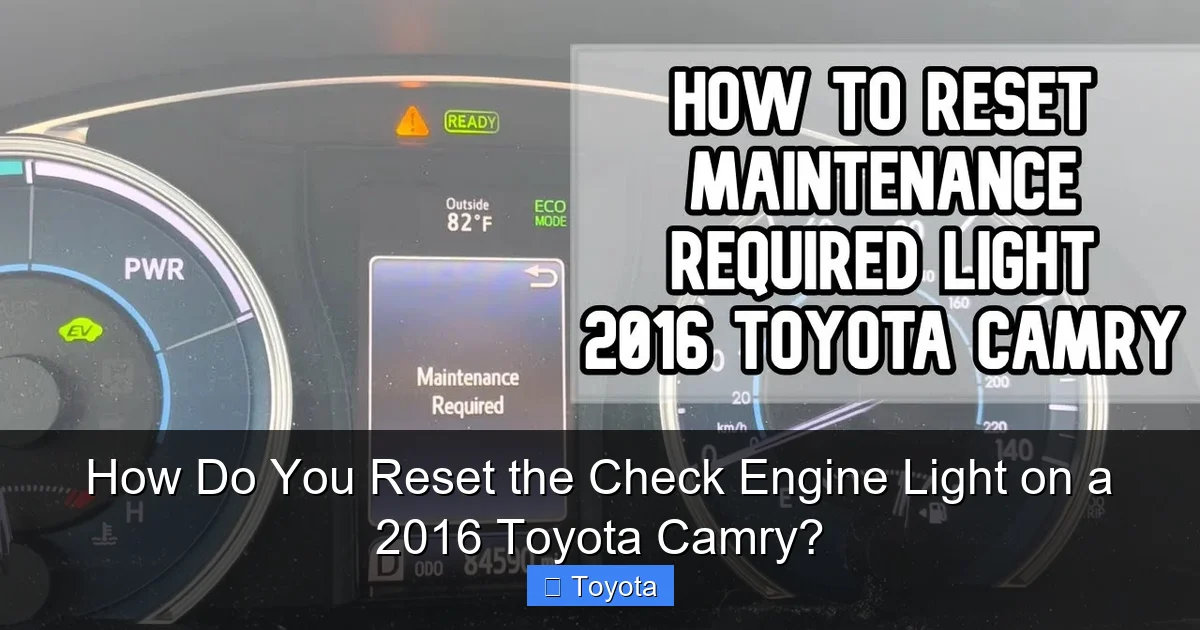
Visual guide about How Do You Reset the Check Engine Light on a 2016 Toyota Camry?
Image source: i.ytimg.com
Reading the Codes is Non-Negotiable
Modern vehicles like your 2016 Camry store specific Diagnostic Trouble Codes (DTCs) when a fault is detected. These are alphanumeric codes like P0171 (System Too Lean) or P0302 (Cylinder 2 Misfire Detected). To find out what’s wrong, you need to read these codes. The easiest way is with an inexpensive OBD2 scanner, which plugs into the port under your driver’s side dashboard (the same port used for emissions testing). Many auto parts stores will also scan your car for free. Writing down these codes is your roadmap to the actual repair. Without this step, resetting the light is a complete guess.
Method 1: The Battery Disconnect Reset (The “Hard Reset”)
This is the most universal method for resetting the ECM and clearing its learned data, including check engine codes. It works by fully powering down the computer, forcing it to reboot with no stored fault memories. However, it also erases all other learned data, like radio presets and climate control settings, and may cause your Camry to idle or drive slightly differently for a short time as the ECM relearns optimal fuel trims.
Step-by-Step Safety and Procedure
What you’ll need: A 10mm socket or wrench, and optionally, a battery terminal puller and safety glasses.
- Safety First: Ensure the car is parked on a level surface, the engine is off, and the keys are removed from the ignition. Open the hood and locate the battery. The 2016 Camry’s battery is typically in the engine bay on the driver’s side.
- Identify Terminals: The negative terminal is marked with a black cap and a “-” symbol. The positive is red with a “+”. You will only disconnect the NEGATIVE terminal.
- Disconnect the Negative Cable: Loosen the nut on the negative terminal clamp with your 10mm wrench. Once loose, carefully lift the clamp off the terminal post and tuck the cable away so it cannot accidentally touch the post.
- Wait for the Reset: This is the crucial part. You must wait at least 15-20 minutes. This allows all residual electrical current (and the ECM’s capacitors) to fully discharge. Some sources recommend waiting up to an hour for a complete reset.
- Reconnect and Start: Re-secure the negative cable clamp tightly to the terminal. Reconnect the positive terminal if you disconnected it (usually not necessary). Close the hood, insert the key, and start the engine. The check engine light should be off. However, it may reappear if the fault code was not fixed, as the ECM will quickly redetect the problem.
Important Note: On some newer vehicles, a simple battery disconnect may not clear all codes. The ECM might have a non-volatile memory that retains certain faults. In these cases, an OBD2 scanner is required.
Method 2: The OBD2 Scanner Reset (The “Clean & Precise” Method)
This is the preferred method for technicians and savvy DIYers. It targets only the fault codes you choose to clear, leaving other vehicle settings intact. It’s faster, cleaner, and more precise than the battery disconnect.
Choosing and Using Your Scanner
You can use anything from a basic $20 code reader to a high-end professional scanner like a Bosch or Snap-on tool. For a 2016 Camry, a basic ELM327-compatible scanner (often Bluetooth to a smartphone app) is perfectly sufficient for reading and clearing generic OBD2 codes. Ensure your scanner has the “Clear Codes” or “Erase DTCs” function.
- Connect: Plug the scanner’s OBD2 connector firmly into the port under your driver’s dash. This port is standardized and easily accessible.
- Power On: Turn your Camry’s ignition to the “ON” position (the position right before starting the engine, where dashboard lights come on). Do not start the engine.
- Navigate and Read: Follow your scanner’s menu to select “Read Codes” or “Diagnostics.” Note down all the codes it displays, along with their descriptions (e.g., P0420 = Catalyst System Efficiency Below Threshold). This step is vital for diagnosis.
- Clear the Codes: After noting the codes, navigate to the “Clear Codes,” “Erase DTCs,” or “Reset MIL” (Malfunction Indicator Lamp) function. Confirm the action. The scanner will communicate with the ECM and command it to clear its stored fault memory and turn off the light.
- Verify: The check engine light should go out immediately. Start the engine and let it idle. The light should remain off. Drive the car normally. If the problem was truly fixed, the light will stay off. If it returns, the issue persists or a new one has occurred.
What About That Odometer Button Trick? (The “Toyota-Specific” Method)
You may have heard of a method involving the odometer/trip meter reset button on many Toyotas. For some model years and specific faults, this can work. However, for a 2016 Camry, its reliability is inconsistent. It often works for resetting the Maintenance Required light (the wrench symbol) but is not guaranteed to clear all check engine (MIL) codes. The procedure is: turn the ignition to “ON” (do not start), ensure the odometer is displayed (not trip A or B), then turn the key off. Press and hold the trip meter reset button while turning the key back to “ON.” Continue holding until the odometer display shows dashes or a reset message, then release. The light may blink and go out. If it doesn’t, you’ll need one of the two primary methods above. For maintenance lights, a dedicated guide on resetting maintenance lights on Toyotas is more appropriate, as the process differs by model year.
After the Reset: Driving and Monitoring
Once you’ve successfully turned off the light, your journey isn’t over. You must now monitor the vehicle’s behavior and the light itself.
The Drive Cycle and “Readiness Monitors”
After clearing codes, the ECM’s “readiness monitors” (which track the emissions system’s health) are reset. These monitors must complete a specific “drive cycle” of varied speeds, temperatures, and engine loads to set themselves to “Ready.” This is why, after resetting, you might not pass an emissions test immediately—you need to drive the car for 50-100 miles under varied conditions (highway and city) to allow the monitors to reset. If you take it for an emissions test too soon, it will fail because the system hasn’t had time to verify all components are working.
When the Light Comes Back On
If the check engine light reappears after a reset, it means the original fault was not repaired, or a new, related fault has developed. The ECM has re-detected the out-of-spec condition. This is your definitive sign to stop resetting and start repairing. Retrieve the new codes. They may be the same as before (confirming the incomplete repair) or different (indicating a secondary problem). At this point, consulting a professional mechanic is highly recommended to avoid costly mistakes.
When to Seek Professional Help: Knowing Your Limits
Resetting the light is easy. Diagnosing and fixing the cause is where expertise is needed. Certain codes, especially those related to the transmission (P07xx series), ABS, airbag systems, or severe engine misfires (P03xx), often require advanced diagnostic tools and professional knowledge. If you are not comfortable using a scanner, interpreting codes, or performing mechanical repairs, it’s time to call a pro. A trustworthy mechanic will not only reset the light after fixing the problem but will also perform a thorough inspection to ensure no other issues are lurking. Remember, a properly functioning check engine light system is a critical part of your Camry’s emissions and overall health. Ignoring it or masking it without repair is a false economy that can lead to a stranded vehicle or a failed state inspection.
Frequently Asked Questions
Can I drive my 2016 Toyota Camry with the check engine light on?
You can drive with a solid check engine light if the car seems to be running normally, but you should diagnose the issue promptly. However, if the light is flashing, you must stop driving immediately as it indicates a severe misfire that can destroy the catalytic converter.
Will disconnecting the battery reset all error codes on my Camry?
Disconnecting the negative battery terminal will usually reset the ECM and clear most stored check engine codes. However, some manufacturer-specific or permanent codes may require a professional scan tool to clear. It also erases all learned data and radio presets.
How much does it cost to have a professional reset the check engine light?
The reset itself is often free if you’re already having diagnostics done. The cost comes from the diagnostic fee (typically $80-$150) to identify the problem. Simply paying someone to clear the light without fixing the issue is a waste of money and dangerous for your vehicle.
Why did my check engine light come back on right after I reset it?
The light returned because the underlying problem that triggered the original code was not repaired. The ECM continuously monitors sensors and systems; when it detects the fault condition again, it immediately illuminates the light and stores a new code.
Is the process for resetting the check engine light the same on all Toyota Camry models?
The core principles are the same, but specific procedures can vary slightly by model year. A 2016 Camry will respond to both the battery disconnect and OBD2 scanner methods. Always consult your owner’s manual for any model-specific warnings or procedures.
Can I use any OBD2 scanner to reset the light on my 2016 Camry?
Yes, any standard OBD2 scanner (SAE J1962 compliant) can connect to your 2016 Camry’s OBD2 port and should be able to read and clear generic powertrain codes. For more complex manufacturer-specific codes, a higher-end scanner may be required, but a basic reader is sufficient for most common reset tasks.
