
How Many Miles Can a 2024 Toyota Corolla Go on a Full Tank?

The 2024 Toyota Corolla typically travels between 400 and 500 miles on a full tank, depending on model, driving conditions, and habits. Its combined EPA rating of up to 35 MPG and a 13.2-gallon tank provide solid efficiency, but real-world results vary. Understanding your specific Corolla’s setup and maintaining it properly is key to hitting the top end of that range.
Key Takeaways
- EPA Estimates Are a Starting Point: The 2024 Corolla’s official range is based on lab-tested MPG figures (up to 31 city/40 highway/35 combined) multiplied by its 13.2-gallon tank capacity.
- Real-World Range Varies Significantly: Your actual miles per tank can drop 15-25% from EPA estimates due to driving style, weather, traffic, and cargo weight.
- Model Matters: The hybrid version offers dramatically better range (up to 50 MPG combined) than the gas-only models, easily exceeding 500 miles per fill-up.
- The Gas Light Means Reserve: When the low-fuel indicator illuminates, you typically have 1-2 gallons (30-70 miles) left, but it’s best to refuel promptly to avoid fuel pump damage.
- Maintenance is Non-Negotiable: Regular oil changes, proper tire inflation, and a clean air filter are critical for achieving the advertised fuel economy and maximum range.
- Driving Habits Directly Impact Range: Aggressive acceleration, high speeds, and excessive idling can reduce your fuel efficiency by 20% or more, shrinking your miles per tank.
📑 Table of Contents
- So, How Far Can You Really Go?
- Understanding the Numbers: EPA Ratings vs. Your Reality
- The 2024 Corolla’s Fuel System: Tank Size and Powertrain Details
- Calculating Your Real-World Range: The Practical Formula
- The Gas Light: Your Final Warning (and How Far You Can Still Go)
- Maximizing Every Gallon: How to Get the Most Miles
- Long-Distance Journey Planning: Going the Extra Mile
- Conclusion: Your Corolla’s Range is What You Make It
So, How Far Can You Really Go?
You’re staring at the gas pump, watching the numbers climb. You’ve just filled up your brand-new 2024 Toyota Corolla. The digital display clicks over to “Full.” A natural question pops into your head: “How many miles can this thing actually go before I have to do this again?” It’s a practical question every driver thinks about, whether you’re planning a road trip or just want to minimize weekly gas station stops. The answer isn’t a single, simple number. It’s a range influenced by engineering, environment, and your own right foot. Let’s break it down, from the optimistic EPA sticker to the gritty reality of your daily commute.
For the 2024 model year, Toyota has refined the Corolla to be a paragon of efficiency without sacrificing its renowned reliability. The standard gas-powered models use a 2.0-liter four-cylinder engine paired with a Continuously Variable Transmission (CVT). The hybrid variant pairs a 1.8-liter engine with an electric motor system. These powertrains are designed for one primary goal: moving you as far as possible on each drop of gasoline. But “as far as possible” is a moving target. We’ll explore the math, the variables, and the strategies to help you understand and maximize your Corolla’s true range.
Understanding the Numbers: EPA Ratings vs. Your Reality
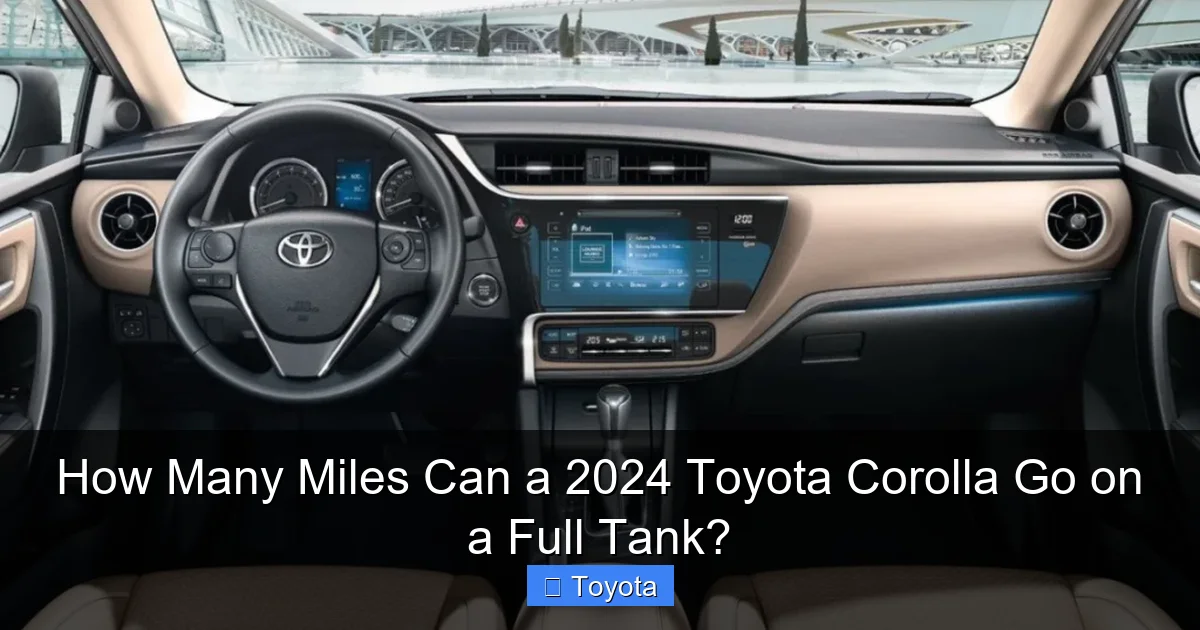
The first number everyone looks at is the EPA fuel economy estimate. It’s on the window sticker, in the brochures, and all over Toyota’s website. For a 2024 Toyota Corolla L (base gas model), the EPA rates it at 31 MPG in the city, 40 MPG on the highway, and 35 MPG combined. The LE and XLE trims with the same 2.0L engine share these figures. The SE and XSE trims, which often include a slight performance tune and different wheels, are rated at 30 city/38 highway/33 combined. The Corolla Hybrid, with its Atkinson-cycle engine and electric assist, soars to 50 MPG combined (53 city/52 hwy).
Visual guide about How Many Miles Can a 2024 Toyota Corolla Go on a Full Tank?
Image source: 2024toyota.com
The Simple Math of Maximum Range
To get a theoretical maximum range, you multiply the combined MPG figure by the fuel tank capacity. Every 2024 Corolla gas model comes with a 13.2-gallon tank. Let’s do the quick math for the highest-rated gas model:
- Model: Corolla LE/XLE (35 MPG combined)
- Tank Size: 13.2 gallons
- Theoretical Max Range: 35 MPG x 13.2 gallons = 462 miles
For the hybrid, with its 50 MPG combined rating and a slightly smaller 11.4-gallon tank, the math looks even better: 50 MPG x 11.4 gallons = 570 miles. On paper, the hybrid is the clear range champion. But here’s the crucial part: these are best-case, lab-simulated scenarios. They represent an ideal mix of driving that rarely exists in the real world. Your actual “miles per tank” will almost always be lower than this simple calculation.
Why Your Real-World MPG Will Be Different
Think of the EPA number as a standardized benchmark, like a nutrition label for your car. It gives you a consistent basis for comparison, but your actual “caloric intake”—or in this case, fuel consumption—depends on dozens of daily factors. These variables can easily knock 10-25% off your expected range. A 25% drop from that 462-mile theoretical max for a gas Corolla would land you around 346 miles per tank. That’s a significant difference! The key factors fall into a few categories:
- Driving Style: Are you a calm, anticipating driver who gently accelerates and coasts to stop lights? Or do you treat every green light as a drag race start and brake at the last second? Aggressive driving is the single biggest killer of fuel economy. Jackrabbit starts and hard braking can waste up to 30% of your potential efficiency.
- Environment & Geography: Cold weather thickens oil and increases engine friction. Winter blend gasoline has less energy content. Using the heater, defroster, and heated seats draws significant power. Driving uphill? Your engine works much harder. Even constant headwinds create aerodynamic drag that reduces efficiency. A flat, warm, windless highway is your fuel economy sweet spot.
- Traffic Conditions: The EPA’s combined rating includes a portion for city driving, but stop-and-go traffic is far worse. The constant acceleration from a dead stop is incredibly inefficient. A commute stuck in bumper-to-bumper traffic might yield only 25-28 MPG in a Corolla rated for 31 city MPG.
- Vehicle Load & Configuration: Carrying four adults and a roof-top cargo carrier adds weight and massive aerodynamic drag. Under-inflated tires increase rolling resistance. Even using the wrong motor oil (too thick) can reduce MPG by a few percent. Every 100 pounds of extra weight can reduce efficiency by about 1%.
So, while the math gives us a ceiling, the floor is determined by how, where, and what you drive. For a realistic expectation, most owners of the 2024 gas Corolla report seeing 32-38 MPG in mixed driving, which translates to roughly 420 to 500 miles on a full tank under normal conditions. Hybrid owners consistently report 45-52 MPG, leading to 500 to 590 miles per fill-up.
The 2024 Corolla’s Fuel System: Tank Size and Powertrain Details
To understand range, you must know your tools. The 2024 Corolla’s fuel delivery system is straightforward and reliable, but specifics matter.
Visual guide about How Many Miles Can a 2024 Toyota Corolla Go on a Full Tank?
Image source: 2024toyota.com
Gas Tank Capacity: It’s Consistent (For Now)
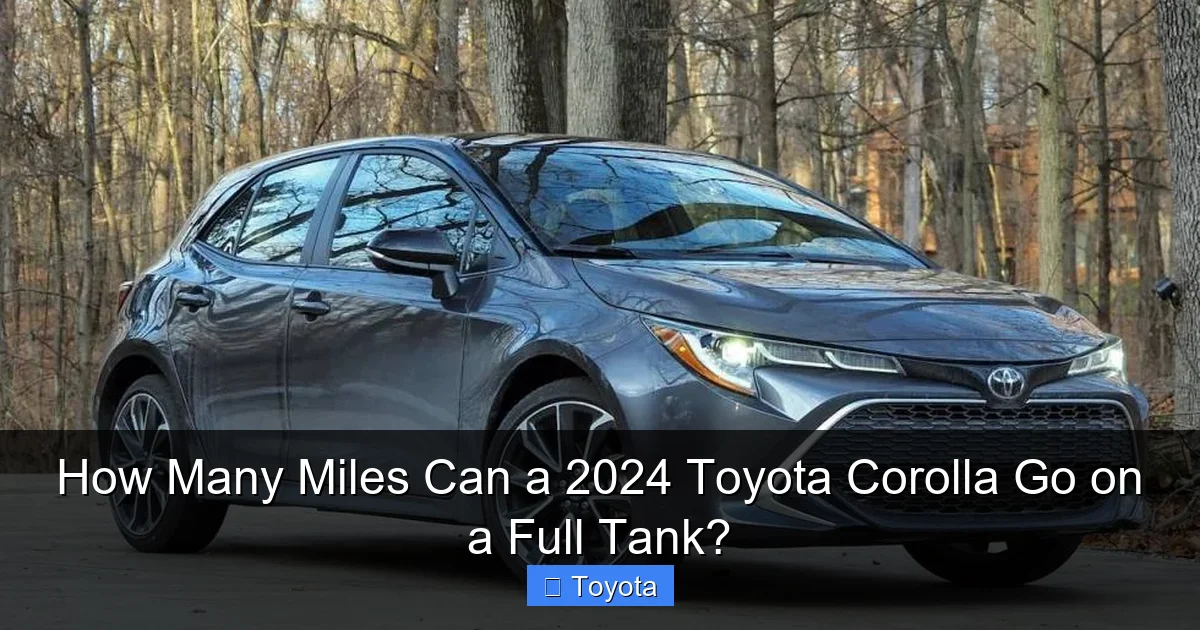
For the 2024 model year, all gasoline-powered Corolla trims (L, LE, SE, XLE, XSE) are equipped with the same 13.2-gallon (50-liter) fuel tank. This is a slight increase from some previous years and provides a good balance of space and range. You won’t find a “long-range” or “extended” tank option from the factory. The Corolla Hybrid, because its battery pack takes up more space, has a slightly smaller 11.4-gallon (43-liter) tank. Despite holding less raw fuel, its stellar efficiency means it still often goes farther between fill-ups than the gas models. If you’re comparing the Corolla to its platform sibling, the Toyota Camry, you’ll find the Camry’s tank is larger (around 15.8 gallons), giving it a theoretical advantage in raw range despite similar or slightly lower MPG ratings.
Powertrain Options: Gas vs. Hybrid
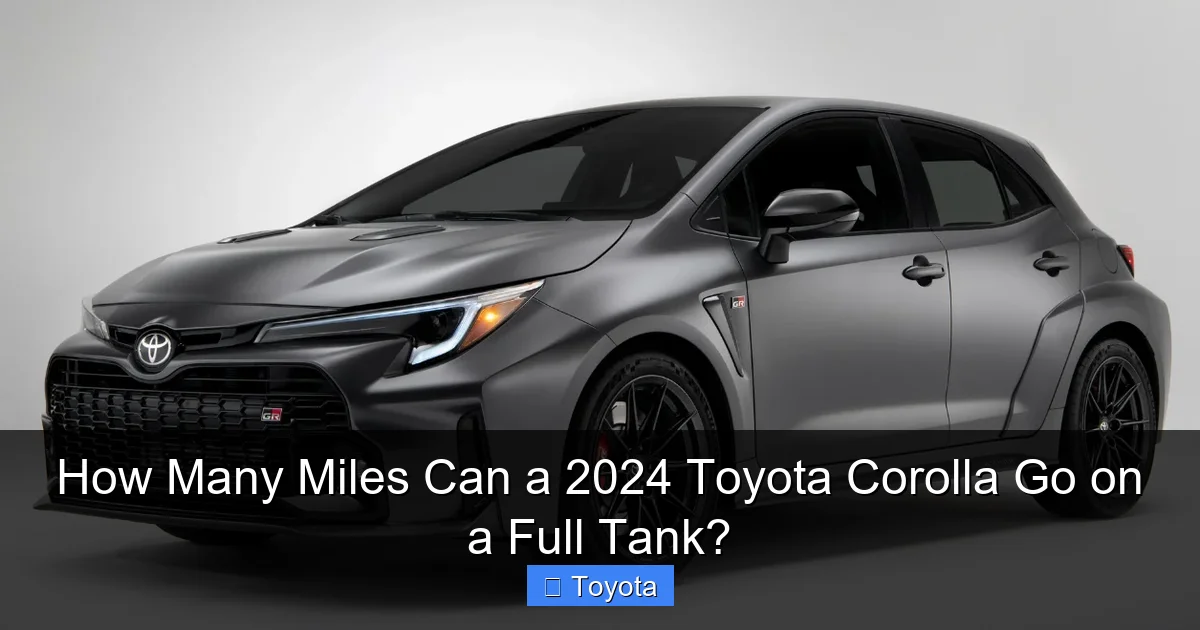
The choice between the 2.0L gas engine and the 1.8L hybrid system is the biggest decision affecting your range. The gas engine (M20A-FKS) produces 169 horsepower and is paired with a CVT designed for smooth, efficient power delivery. It’s peppy enough for merging and feels more traditional. The hybrid system (2ZR-FXE engine + electric motor) produces a net 134 horsepower but delivers its torque instantly from the electric motor, making it feel surprisingly responsive in city traffic. The hybrid’s advantage is most pronounced in stop-and-go conditions, where the electric motor does more work and the engine shuts off at lights. On steady highway cruises, the efficiency gap narrows, but the hybrid still holds an edge. Your driving environment should heavily influence this choice. If your commute is 90% highway, the gas model’s range is excellent. If it’s 70% city, the hybrid’s advantage in miles per tank becomes very clear.
Calculating Your Real-World Range: The Practical Formula
Forget the EPA sticker for a second. To know your car’s true capability, you need to do a little detective work. This is the method used by hypermilers and efficient drivers everywhere.
Visual guide about How Many Miles Can a 2024 Toyota Corolla Go on a Full Tank?
Image source: 2024toyota.com
Step 1: The Reset and Fill Method
This is the gold standard for measuring your actual fuel economy.
- Fill Up Completely: Pull into your regular gas station. Fill the tank until the pump clicks off automatically. Do not top it off; this can cause vapor recovery issues and inaccurate readings.
- Reset the Trip Meter: Immediately after filling, reset your car’s “Trip A” or “Trip B” odometer to zero. This is your baseline.
- Drive Normally: Go about your business for several fill-ups. Drive as you normally would. Try to use at least 3/4 of a tank before refilling again for a more accurate average.
- Fill Up Again & Record: When you next fill up, note the number of gallons it takes to fill the tank (again, let it click off). Also, write down the miles shown on your trip meter.
- Do the Math: Divide the miles driven by the gallons added. Miles Driven ÷ Gallons = Your Actual MPG.
Do this 3-4 times and average the results. That number is your real-world combined MPG for your specific car, driving habits, and typical conditions. This is the number you should use for range calculations.
Step 2: Apply Your Personal MPG to the Tank
Now, take your personal MPG figure and multiply it by your tank’s effective capacity. But remember, you generally shouldn’t run the tank completely dry. A safe, practical usable capacity is about 90-95% of the total. So for a 13.2-gallon tank, plan on about 12-12.5 gallons of usable fuel before you should refuel.
- For a Gas Corolla: Your Real MPG x 12 gallons = Your Practical Range.
- Example: You calculate your average is 36 MPG. 36 x 12 = 432 miles.
- For a Hybrid Corolla: Your Real MPG x 10.5 gallons (90% of 11.4) = Your Practical Range.
- Example: You calculate your average is 48 MPG. 48 x 10.5 = 504 miles.
This gives you a realistic, conservative estimate of how far you can go before you should start looking for a gas station. It accounts for not running on fumes and provides a buffer.
The Gas Light: Your Final Warning (and How Far You Can Still Go)
That little amber fuel pump icon that illuminates on your dashboard is not a suggestion—it’s a warning. But it’s not an immediate “stop now” signal. Toyota engineers build in a safety reserve. So, how many miles can you drive after the gas light comes on in a 2024 Toyota Corolla?
The Size of the Reserve
While the exact reserve volume can vary slightly, most modern Toyotas, including the Corolla, illuminate the low-fuel warning when there is approximately 1.0 to 1.5 gallons of fuel remaining in the tank. This reserve is sometimes called “the buffer” or “the unusable volume.” It’s there to ensure you never run the fuel pump completely dry, as the pump is cooled by being submerged in gasoline. Running consistently on low fuel can overheat and prematurely fail the pump.
Using our range formula, that reserve represents:
- Gas Model (35 MPG est): 1.2 gallons avg x 35 MPG = 42 miles (a realistic range of 30-50 miles depending on conditions).
- Hybrid Model (50 MPG est): 1.2 gallons avg x 50 MPG = 60 miles (a realistic range of 45-75 miles).
For a more precise figure specific to your Corolla, you can search for how many miles you can drive after the gas light comes on in a Toyota Corolla. Community forums and owner tests often provide real-world data from actual drivers.
Why You Shouldn’t Test Your Luck
Even with a 40-60 mile reserve, regularly driving until the gas light comes on is a terrible habit. Here’s why:
- Fuel Pump Damage: As mentioned, the fuel pump is cooled by gasoline. Constantly running low starves it of this cooling, leading to overheating and a costly replacement job. Fuel pumps are inside the tank; replacing one often requires dropping the tank.
- Sediment Ingestion: Over time, tiny particles of rust and debris settle at the bottom of the tank. This is the last fuel to be drawn from the tank. Running on the reserve increases the chance of sucking this sediment into your fuel system, clogging filters and potentially damaging expensive injectors.
- Increased Stress: You’re adding unnecessary anxiety to your drive. Do you really want to be hunting for a gas station in an unfamiliar area because you pushed your luck?
- Risk of Stranding: Your estimate might be wrong. A sudden detour, traffic jam, or miscalculation can leave you stranded on the side of the road, which is dangerous and inconvenient.
The Rule: When the gas light comes on, plan to refuel within the next 20-30 miles. Don’t treat it as a starting gun for a race to the nearest station.
Maximizing Every Gallon: How to Get the Most Miles
Want to consistently hit the higher end of your Corolla’s range? It’s not magic; it’s method. These are proven techniques used by drivers to squeeze the most distance from each tank.
Driving Habits That Save Fuel
- Drive Smoothly: This is rule number one. Accelerate gradually. Imagine there’s an egg between your foot and the pedal. Brake early and gently. Look far ahead at traffic to anticipate stops and coast more. Smooth driving can improve your MPG by 15-25% compared to aggressive driving.
- Observe Speed Limits: Aerodynamic drag increases exponentially with speed. Driving 75 mph instead of 65 mph can increase fuel consumption by 10-15%. The Corolla is quiet and stable at highway speeds, but there’s a significant efficiency penalty for speeding.
- Use Cruise Control on Flats: On long, flat highways, cruise control maintains a constant speed, preventing the small speed fluctuations that waste fuel. However, on hilly terrain, it’s often better to drive manually, allowing the car to gain a little momentum downhill to help with the next uphill.
- Reduce Idling: If you’re stopped for more than 60 seconds (not in traffic), turn the engine off. Modern starters are designed for frequent use. Idling gets zero MPG. Also, don’t “warm up” the engine for more than 30 seconds on cold mornings; driving gently warms it faster.
- Plan Trips and Combine Errands: A cold engine is inefficient. Combine multiple short trips into one longer trip. A single, warm-engine journey is far more efficient than several short, cold-engine starts.
Maintenance That Directly Impacts MPG
- Tire Pressure: This is the easiest and most overlooked factor. Under-inflated tires increase rolling resistance. Check your tire pressure monthly and when the temperature changes significantly. The recommended PSI is on a sticker inside the driver’s door jamb, not the number on the tire sidewall. Proper inflation can improve MPG by 3-5%.
- Motor Oil: Use the exact viscosity grade specified in your owner’s manual (likely 0W-16 or 0W-20 for the 2024 Corolla). Using a thicker oil creates more internal engine friction. Also, stick to the recommended oil change interval. Old, sludge-y oil reduces efficiency.
- Air Filter: A clogged air filter chokes the engine, forcing it to work harder and burn more fuel. Check it at every oil change; replace it if it’s dirty. It’s a cheap and easy DIY job.
- Spark Plugs: Worn spark plugs misfire, wasting fuel. The 2024 Corolla’s plugs are designed to last a long time (up to 120,000 miles), but if you’re experiencing poor fuel economy, it’s a diagnostic item. You can learn how many spark plugs are in a Toyota Corolla (it’s one per cylinder, so 4 for the 2.0L, 3 for the 1.8L hybrid) and their service interval in your manual.
- Wheel Alignment: Misaligned wheels “scrub” against the road, creating drag. If your car pulls to one side or the steering wheel is off-center, get an alignment. It saves tires and fuel.
Long-Distance Journey Planning: Going the Extra Mile
When you’re planning a road trip, “range anxiety” can set in. But with a Corolla, you have a solid foundation. Here’s how to plan for a worry-free, fuel-efficient journey.
Route Optimization for Efficiency
Don’t just trust the GPS’s “fastest route.” Use your navigation app’s “eco-friendly” or “most efficient” route option. These routes often prioritize steady speeds on highways over winding backroads with constant stops. Plan your departure time to avoid rush hour in major cities. Sitting in traffic is the enemy of range. If possible, schedule your drive through sprawling metro areas during off-peak hours. Also, consider the terrain. A route through the mountains will hurt your fuel economy more than a flat, direct interstate route, even if it’s slightly longer in miles.
Fueling Strategy and Emergency Prep
On a long trip, don’t wait for the gas light. Adopt the “half-tank rule.” When you hit half a tank (around 200-250 miles for a gas Corolla), start looking for a convenient, well-reviewed gas station to fill up. This prevents you from getting into situations where the next station is 50 miles away and your range is uncertain. It also gives you a mental buffer. Before you leave on a long trip, ensure your car is in top shape: tires properly inflated, oil changed, air filter clean. Pack an emergency kit with water, snacks, a blanket, and basic tools. While the Corolla is incredibly reliable, being prepared is always smart. For more general advice on how vehicles behave when very low on fuel, you can read how far can a car go on empty, which covers the universal risks and reserves across makes and models.
Conclusion: Your Corolla’s Range is What You Make It
So, how many miles can a 2024 Toyota Corolla go on a full tank? The concrete answer is: approximately 400 to 500 miles for the gas models, and 500 to 590 miles for the hybrid, under mixed driving conditions. That theoretical maximum of 462 miles (gas) or 570 miles (hybrid) is achievable only under perfect, steady-state conditions. Your real, reliable, day-to-day range will be slightly less.
The true power lies in your hands. By understanding your car’s specific MPG through careful tracking, practicing smooth and efficient driving habits, and staying on top of basic maintenance, you can consistently land at the top end of that range. The Corolla’s design gives you an excellent, efficient platform. Your job is to be the steward of that efficiency. Remember, it’s not about squeezing the last possible drop from the tank at the risk of your fuel pump; it’s about maximizing the value of every gallon you put in, ensuring your Corolla delivers on its promise of economical, reliable transportation for years and hundreds of thousands of miles to come.
Frequently Asked Questions
What is the official EPA estimated range for a 2024 Toyota Corolla?
The EPA doesn’t publish a single “range” number. You calculate it by multiplying the combined MPG rating by the tank size. For the most efficient gas model (35 MPG combined, 13.2-gallon tank), the theoretical max is about 462 miles. For the hybrid (50 MPG combined, 11.4-gallon tank), it’s about 570 miles.
How many miles can I realistically expect to get on a single tank?
Realistically, most drivers of the gas-powered 2024 Corolla see 32-38 MPG in real-world mixed driving. With a 13.2-gallon tank, this translates to a practical range of roughly 420 to 500 miles before you should refuel. Hybrid owners typically see 45-52 MPG, yielding 500-590 miles per tank.
When the gas light comes on, how many miles do I have left?
When the low-fuel warning light illuminates, you typically have about 1.0 to 1.5 gallons remaining. In a gas Corolla, this is a reserve of roughly 30-50 miles. In a hybrid, it’s about 45-75 miles. You should plan to refuel within 20-30 miles of the light coming on to avoid potential fuel pump damage.
Does using the air conditioning significantly reduce my Corolla’s range?
Yes, the A/C compressor places a substantial load on the engine, reducing fuel efficiency. The impact is most noticeable in city driving and in very hot weather. You can expect a drop of 1-3 MPG with the A/C on, which could reduce your total range by 15-40 miles per tank depending on your driving.
Is the hybrid or gas Corolla better for maximum range?
The Corolla Hybrid is unequivocally better for maximum range. Despite having a smaller fuel tank (11.4 vs. 13.2 gallons), its significantly higher MPG (up to 50 combined vs. 35) means it can travel much farther between fill-ups, often exceeding 500 miles and sometimes approaching 600 miles on a single tank.
What is the single most important thing I can do to improve my miles per tank?
Adopt smooth, anticipatory driving habits. This means gentle acceleration, early braking, and maintaining steady speeds. This one change can improve your fuel economy by 15-25% compared to aggressive driving, which has a larger impact on your range than any other single factor, including minor maintenance issues.
