
How Many Miles Can You Get Out of an Empty Toyota Highlander

When the fuel light comes on in your Toyota Highlander, you typically have between 30 to 50 miles left before the tank is truly empty, though this varies by model year and driving conditions. Pushing this range is risky, as it can damage your fuel pump and leave you stranded. The safest practice is to refuel when your gauge reaches a quarter tank to maintain your vehicle’s health and reliability.
Key Takeaways
- The “empty” range is limited: Most Toyota Highlanders offer roughly 30-50 miles after the low fuel light illuminates, but treat this as an emergency buffer, not a standard driving range.
- Your mileage varies significantly: Factors like model year, engine size, driving style, terrain, and cargo load directly impact how many miles you can squeeze out of the last bit of fuel.
- Driving on empty causes damage: Consistently running your Highlander dry forces the fuel pump to overheat and suck up sediment from the tank bottom, leading to premature and expensive failure.
- It’s a major safety hazard: Running out of gas can cause sudden loss of power steering and brakes, creating a dangerous situation for you and others on the road.
- The fuel light is your earliest warning: Modern Highlanders are designed to alert you with plenty of reserve. Heed this warning immediately and find a gas station.
- Fuel level sensors aren’t perfect: The gauge and light are estimates. A steep hill or aggressive acceleration can deplete the reserve faster than indicated.
- Prevention is the best strategy: Make it a habit to refuel when your tank is at or below 1/4 full to avoid stress, damage, and risk.
📑 Table of Contents
- The Dreaded Fuel Light Moment: A Universal Driver’s Panic
- How the Fuel Light Works and What “Empty” Really Means
- Real-World Mileage: What the Numbers Actually Look Like
- What Factors Change Your “Empty” Range? It’s Not Just Math
- The Real Risks: Why “Empty” is a Dangerous Game
- What to Do the Moment That Light Comes On: An Action Plan
- Long-Term Care: Protecting Your Highlander’s Fuel System
- Final Thoughts: Knowledge is Your Best Fuel
The Dreaded Fuel Light Moment: A Universal Driver’s Panic
There it is. That little, glowing, amber icon of dread on your dashboard. The low fuel light. For a split second, your brain races. “How far to the next exit? Did I pass a station? Can I make it home?” This moment of panic is a universal experience for drivers, and if you’re behind the wheel of a Toyota Highlander—a family hauler, a road trip warrior, a daily commuter—that question becomes critical: how many miles can you get out of an empty Toyota Highlander?
It’s a simple question with a complex answer. The idea of an “empty” tank is a bit of a myth. Your fuel gauge isn’t a precise measuring cup; it’s an estimate. And that estimate is designed to give you a safety net, not an invitation to test limits. In this deep dive, we’re going past the guesswork and the owner’s manual footnotes. We’ll look at real-world data, understand what your Highlander is actually telling you, explore the very real dangers of ignoring that light, and give you practical, actionable advice to keep your SUV healthy and you on the road.
How the Fuel Light Works and What “Empty” Really Means
Before we talk miles, we need to understand the system. Your Toyota Highlander doesn’t have a single, simple float in the tank. It has a fuel level sending unit, which uses a resistive strip and a floating arm. As the fuel level drops, the arm moves, changing the resistance and telling the dashboard gauge where the level is. The low fuel light is triggered by a separate, usually higher, contact point on that strip. This means the light comes on before the tank is anywhere near bone dry.

Visual guide about How Many Miles Can You Get Out of an Empty Toyota Highlander
Image source: carpursuits.com
The Engineering Safety Net
Automakers intentionally set this light to activate with a significant reserve still in the tank. For the Highlander, that reserve is typically between 1.0 and 1.5 gallons, depending on the specific generation and engine. Why? A few key reasons:
- To protect the fuel pump: The fuel pump is submerged in gasoline, which cools and lubricates it. Running it dry causes it to overheat and wear out prematurely.
- To account for fuel slosh: On winding roads or during hard acceleration, fuel can move away from the pickup, causing momentary starvation. The reserve prevents this.
- To give you a buffer: You need time to safely find a station, not a frantic last-mile sprint.
So, when that light comes on, your Highlander is telling you, “Hey, you’ve got about 10-15% of your total fuel capacity left. Let’s get some gas soon.” The exact number of miles you can get from that 10-15% is the million-dollar question.
Real-World Mileage: What the Numbers Actually Look Like
Let’s get to the brass tacks. Based on owner forums, mechanic reports, and manufacturer specifications, here is a breakdown of estimated range for different Highlander model lines once the low fuel light is on. Remember, these are estimates.

Visual guide about How Many Miles Can You Get Out of an Empty Toyota Highlander
Image source: autozonic.com
Current Generation (XU70, 2020-Present)
The modern Highlander is available with a 2.4L 4-cylinder or a 3.5L V6. Both have a fuel tank capacity of approximately 17.9 gallons (some early models list 18.5 gallons).
- 2.4L 4-Cylinder (FWD/AWD): With an EPA rating of up to 24-25 MPG combined, and a typical reserve of ~1.3 gallons, you can expect a rough range of 30 to 40 miles after the light comes on. Conservative highway driving at steady speeds might nudge this toward 40 miles; city stop-and-go will likely keep it closer to 30.
- 3.5L V6 (FWD/AWD): The V6 is thirstier, with an EPA combined rating around 22-23 MPG. With a similar fuel reserve, the post-light range drops to an estimated 25 to 35 miles. The extra power comes at the cost of a shorter safety buffer.
Previous Generation (XU50, 2014-2019)
This generation famously offered a 3.5L V6 and a hybrid variant. The standard V6 model had a 17.2-gallon tank.
- 3.5L V6: Similar MPG figures to the current V6. Expect a post-light range of 25 to 35 miles.
- Hybrid (3.5L V6 + Electric): This is the interesting one. The hybrid system can sometimes be more efficient in city driving, but its tank size is similar. The range estimate remains in the same 30 to 40-mile ballpark. However, the hybrid’s electric motor might provide a tiny, almost negligible, buffer if you’re at a complete stop, but it won’t extend your range significantly once the gas engine is needed.
Older Generations (Pre-2014)
Models from the 2000s and early 2010s generally had smaller fuel tanks (around 17 gallons) and less efficient engines. For these, a safe estimate is 20 to 30 miles after the light illuminates. Their systems may also be less precise.
Important Note: These are all generalized estimates. Your actual, real-world range can be dramatically different based on the factors we’ll discuss next. To get the most accurate idea for your specific vehicle, you can perform a simple test (with extreme caution) or, better yet, consult owner forums for your exact model year and engine. You’ll find countless stories of people making it 45 miles on a highway, and others who ran out after 20 miles in city traffic.
What Factors Change Your “Empty” Range? It’s Not Just Math
If it were simple math (reserve gallons x MPG = miles), we’d all be fine. But driving is dynamic. Your Highlander’s final range is a living, breathing calculation affected by everything around you and how you drive.
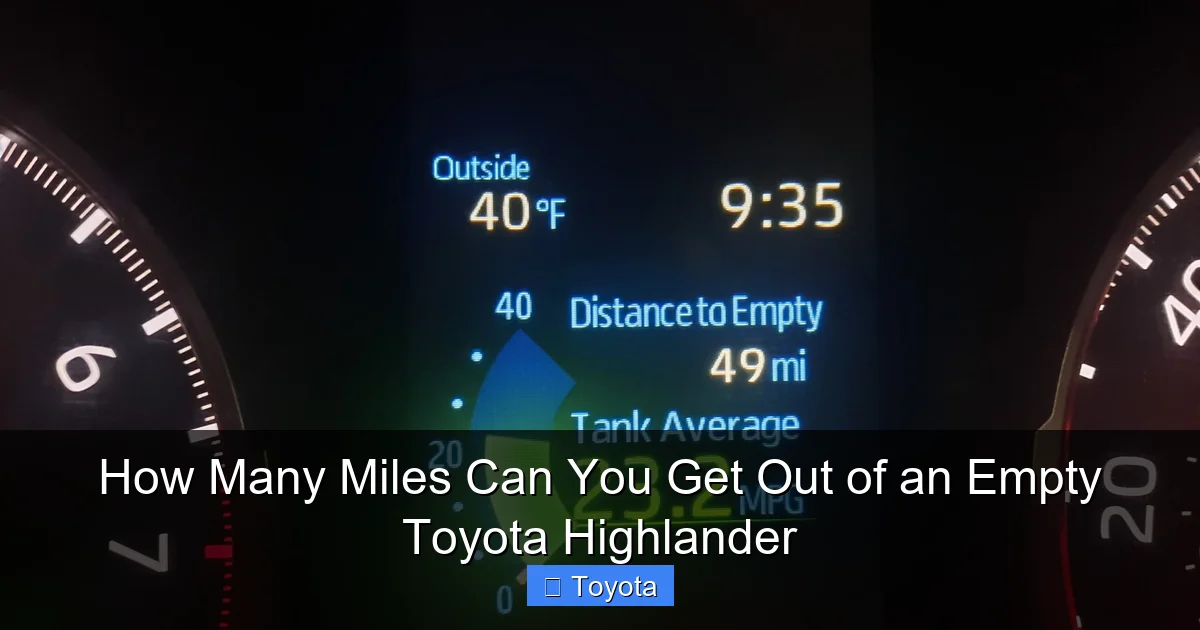
Visual guide about How Many Miles Can You Get Out of an Empty Toyota Highlander
Image source: rav4resource.com
Driving Style and Conditions
This is the biggest variable. Are you cruising on a flat highway at 65 MPH in warm weather? You’re achieving peak efficiency. Your range will be at the higher end of the estimate. Are you battling stop-and-go traffic in a major city, accelerating from 0 to 50 repeatedly? Your MPG plummets, and that 1.3-gallon reserve will vanish in half the distance. Heavy rain, snow, or strong headwinds also increase drag and energy consumption, shrinking your buffer.
Cargo and Passenger Weight
A fully loaded Highlander with eight passengers and a roof rack full of luggage is a heavy machine. More weight means the engine works harder to move mass, burning more fuel. That extra 500 pounds of gear and people can shave several miles off your post-light range. It’s a direct, linear relationship.
Tire Pressure and Health
Under-inflated tires are a silent mileage killer. They create more rolling resistance, forcing your engine to burn more fuel to maintain speed. A tire that’s 5 PSI below the recommended pressure (found on the driver’s door jamb sticker) can reduce fuel economy by 1-3%. That might not sound like much, but on a 30-mile buffer, it could mean the difference between making the station and calling for a tow.
Vehicle Maintenance
A well-tuned engine is an efficient engine. A dirty air filter, old spark plugs, or neglected oil changes can all degrade fuel economy. Similarly, a clogged fuel filter makes the pump work harder and can starve the engine of fuel, especially when the tank is low and the pickup is struggling. For insights on long-term Highlander care, understanding how often you should change transmission fluid in a Toyota Highlander is also part of holistic maintenance that affects overall drivetrain efficiency.
Terrain and Elevation
Driving uphill is essentially constant, heavy acceleration. Your engine is under high load, consuming fuel at a much higher rate. If your route to the gas station involves a long climb, you must subtract those miles from your theoretical range. Conversely, a long downhill stretch can help, but you usually can’t plan your emergency fuel stop around topography.
The Real Risks: Why “Empty” is a Dangerous Game
Knowing the potential mileage is one thing; understanding why you shouldn’t rely on it is another. Driving your Highlander consistently into the “empty” zone isn’t just risky—it’s a direct path to costly repairs and dangerous situations.
Damage to the Fuel Pump (The #1 Culprit)
The fuel pump is an electric motor housed inside the gas tank. It is cooled and lubricated by the gasoline surrounding it. When you run the tank extremely low, the pump is no longer fully submerged. It starts to run hotter and with less lubrication. Over time, this thermal stress causes the pump’s internal components to wear out and fail. Replacing an in-tank fuel pump is not a cheap job; it often requires dropping the entire tank, costing $800-$1,200 or more at a shop. Consistently driving on empty is one of the fastest ways to kill this critical component.
Clogged Fuel Filter and Injectors
Sediment and debris naturally settle at the bottom of your gas tank. The fuel pickup is designed to sit slightly above the absolute bottom to avoid sucking up this gunk. When you run the tank dry, you force the pickup to ingest this sediment. This debris can clog the fine mesh of the fuel filter, restrict flow to the fuel injectors, and cause rough running, misfires, and poor performance. Cleaning or replacing these components is another significant expense.
Loss of Power and Dangerous Situations
As the last bits of fuel are sucked from the tank, air enters the fuel lines. This causes the engine to run lean (too much air, not enough fuel), which can lead to hesitation, sputtering, and a sudden, complete loss of power. Imagine this happening as you’re merging onto a highway, navigating a busy intersection, or climbing a hill. You lose power steering and brake assist, making the vehicle extremely difficult to control. This is not a hypothetical; it’s a common cause of accidents and stranded motorists in perilous locations.
Potential for Catalytic Converter Damage
An engine running extremely lean or misfiring due to fuel starvation can dump unburned fuel into the exhaust system. This raw fuel can overheat and melt the catalytic converter’s internal substrate, a failure that costs well over $1,500 to replace.
In short, the $50-$80 you might save by skipping a fill-up is a false economy when set against a potential $1,000+ repair bill or the immeasurable cost of an accident.
What to Do the Moment That Light Comes On: An Action Plan
So, the light is on. Don’t panic. Don’t floor it to “make it.” Instead, follow this calm, strategic plan.
1. Assess Your Situation Immediately
Glance at your navigation or phone. Where is the nearest gas station? Don’t just guess. Use an app. Is it on your route, or will it require a detour? How far is it? If it’s less than 15-20 miles away and you’re on a direct route, you’re likely fine. If it’s 40 miles away on a highway with no exits, you need to start planning for a conservative driving style.
2. Drive Conservatively and Efficiently
Your goal now is to maximize every drop. This means:
- Turn off non-essential electronics: A/C, heater, seat warmers, and stereo draw power from the engine, increasing load.
- Maintain a steady, moderate speed: Use cruise control on a flat highway. Avoid accelerating hard or braking sharply. The sweet spot for most cars is 45-55 MPH, but match the flow of traffic safely.
- Draft safely: If traffic allows, increase your following distance slightly and tuck in behind a larger vehicle (like a truck) to reduce wind resistance. Never tailgate.
- Plan your route: Avoid hills, traffic circles, and congested areas. Take the most direct, flat route possible, even if it’s slightly longer in distance. Less idling and acceleration is key.
- Keep windows up: At highway speeds, open windows create significant aerodynamic drag.
3. If You Run Out, Stay Safe
If the engine sputters and dies, you’ve run out. Your power steering and brakes will become very stiff. This is dangerous. Safely:
- Steer the car to the shoulder or a safe, flat area away from traffic.
- Turn on your hazard lights immediately.
- Do not try to restart the car if you’re in a dangerous spot. If you’re in a safe location, you can try restarting after adding fuel, but it may take a few cranks to prime the fuel lines.
- Call for roadside assistance or a friend with a gas can. Do not walk along a busy highway to find a station.
For those who own multiple Toyotas, you might notice different behaviors. For instance, the range in a how many miles can a Toyota Sienna go on empty might be slightly different due to weight and engine characteristics, but the core principles of risk and response are identical across the brand.
Long-Term Care: Protecting Your Highlander’s Fuel System
Beyond the immediate panic of a low fuel light, the best strategy is proactive care to ensure your fuel system—and your range estimates—remain reliable for years.
Refueling Habits: The 1/4 Tank Rule
This is the golden rule. Get in the habit of refueling when your gauge hits the 1/4 mark. This gives you a massive buffer against miscalculation, ensures the fuel pump is always well-submerged for cooling, and helps prevent sediment from ever reaching the pickup. It adds 5-10 minutes to your routine once a week but saves immense stress and money long-term.
Quality Fuel and Additives
Buy gas from reputable, high-turnover stations. Cheap, stale fuel can have more contaminants and water content. Occasionally, especially in winter or with older vehicles, using a bottle of fuel system cleaner (like Chevron Techron or Sea Foam) can help keep injectors clean and combustion efficient, indirectly helping your MPG and range.
Listen to Your Car and Your Gauge
If you notice your fuel gauge seems to be dropping faster than usual, or the light comes on at a seemingly higher level than before, have the fuel level sending unit checked. A failing sensor can give inaccurate readings, lulling you into a false sense of security. Also, if your Highlander feels sluggish or has trouble starting after being low on fuel, it could be a sign you’ve ingested sediment—get it checked.
Don’t Ignore Related Maintenance
A healthy engine is an efficient engine. Stick to your Toyota’s recommended maintenance schedule for oil changes, air filter replacements, and spark plugs. While it might not seem directly linked, a how often should you change transmission fluid in a Toyota Highlander question highlights that all fluid systems need care. Clean fluids and filters mean less strain on the engine, which translates to better fuel economy and a more predictable range from every gallon.
Final Thoughts: Knowledge is Your Best Fuel
So, how many miles can you get out of an empty Toyota Highlander? The practical, safe answer is: as few as possible. Technically, you have a 25-50 mile emergency reserve, but treating that as usable range is a gamble with your wallet, your safety, and your vehicle’s longevity. That low fuel light is not a challenge; it’s a helpful reminder from your car’s computer. The true measure of a savvy Highlander owner isn’t how far they can push that empty tank, but how wisely they heed its warning. By understanding your vehicle, driving conservatively when the light comes on, and adopting the simple habit of refueling at a quarter tank, you ensure your Highlander remains the reliable, safe, and powerful machine it was built to be—ready for the next adventure, not the next tow truck.
Frequently Asked Questions
What is the exact mileage range for a Toyota Highlander after the fuel light comes on?
There is no single “exact” number, as it varies by model year, engine, and driving conditions. For most modern Highlanders (2020+), the realistic range is between 30 and 50 miles. Older models may have a shorter range of 20-30 miles. Always treat this as an emergency buffer, not a guaranteed distance.
Is it bad to drive a Toyota Highlander with the low fuel light on?
Yes, it is harmful. Consistently driving with the light on causes the fuel pump to overheat due to lack of submersion in gasoline, leading to premature failure. It also increases the risk of sucking sediment from the tank bottom into your fuel system, clogging filters and injectors. Occasional use of the reserve is fine, but making it a habit will lead to costly repairs.
Does a Toyota Highlander have a fuel reserve beyond the low fuel light?
Yes, absolutely. The low fuel light is designed to come on with a significant reserve—typically 1.0 to 1.5 gallons—still in the tank. This is your safety buffer. Once the engine actually runs out of fuel and stalls, you are completely “empty” and at risk of the problems mentioned above.
How does the Highlander’s empty-tank range compare to other Toyota SUVs like the RAV4 or 4Runner?
>The range is similar across many Toyota models because the fuel light is calibrated to leave a consistent reserve (about 1-1.5 gallons). A more efficient RAV4 4-cylinder might squeeze 35-45 miles from that reserve, while a less efficient 4Runner or a fully loaded Highlander might be closer to 25-35 miles. The key difference is the vehicle’s combined MPG rating. For specific comparisons, you can look up how many miles can you drive when the gas light comes on in a Toyota Camry or how many miles can you drive after the gas light comes on in a Toyota Corolla, as these sedans will generally have longer ranges due to better aerodynamics and efficiency.
What are the first warning signs that my fuel pump might be failing from running low?
Symptoms of a failing fuel pump include: engine sputtering or surging at high speeds, loss of power during acceleration, difficulty starting the vehicle (especially when hot), a high-pitched whining noise coming from the fuel tank area, and frequent stalling. If you experience these after regularly driving on low fuel, have the fuel pump and filter inspected immediately.
Should I keep a gas can in my Highlander for emergencies?
While a gas can can be a lifesaver if you truly run out, it’s not an ideal long-term solution due to safety risks (vapors, fire hazard) and potential for using old, degraded fuel. The better emergency strategy is a subscription to a roadside assistance plan (like Toyota’s or through your insurance) and the discipline to refuel at 1/4 tank. If you do keep a can, store it properly in a ventilated area, use fresh fuel, and cycle it out every 3 months.
